

S&P 500 Concentration Risk: Larry McDonald’s Warning
Key Takeaways
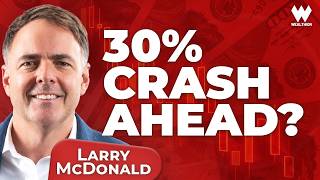
McDonald forecasts a 30% S&P 500 decline over the year following the October 16 interview. His concern centers on concentration, valuations and AI spending.
He favors selected beaten-down stocks and long-term bonds while remaining cautious about the index. Those opportunities depend on conditions such as fading selling pressure or lower yields.
His forecasts use different horizons: months for a possible AI spending reset, through mid-2027 for selected recovery trades, and roughly five years for a shift toward hard-asset businesses.
He sees potential AI beneficiaries in businesses with specialized data, including SLB, Intuitive Surgical and Baxter. These are his views, not Wealthion recommendations.
A slowdown in AI construction could also hurt commodity demand. McDonald acknowledges that these stocks can fall even while he favors their longer-term prospects.
Equal weighting can reduce dependence on the largest stocks. Stablecoin growth and gold revaluation are separate parts of his policy outlook, with speculative claims clearly distinguished from existing rules.
Key Moments
00:00:37 - Why passive investing can conceal concentration
00:06:53 - The case for selected discounted bonds
00:09:56 - McDonald's 30% S&P 500 decline forecast
00:13:34 - AI spending and businesses that own useful data
00:20:34 - A possible rotation toward hard-asset businesses
00:26:29 - Stablecoins and demand for Treasury bills
00:41:36 - What an AI slowdown would mean for commodity demand
00:46:29 - Equal weighting and portfolio construction
S&P 500 Concentration Risk: Larry McDonald's Warning
S&P 500 concentration means a small group of large companies can have an outsized influence on the index. Larry McDonald argues that today's exposure to AI creates that risk. In his October 16, 2026 Wealthion interview, he forecasts a 30% index decline over the following year while identifying opportunities elsewhere.
The founder of The Bear Traps Report joins Maggie Lake to explain why his caution about the index coexists with optimism about selected stocks and bonds. His argument connects AI spending, pressure on consumers, rising bond yields and a possible longer-term shift toward companies that control physical assets.
These are McDonald's forecasts and investment views. The conversation also includes challenges to his thesis, including the gains investors could miss by reducing technology exposure too early and the damage an AI slowdown could do to commodity demand.
Why does S&P 500 concentration matter to investors?
Owning hundreds of companies does not give each business the same influence over returns. In a market-cap-weighted index, larger companies receive larger weights. A portfolio can therefore hold many names while depending heavily on a small number of businesses and the same economic theme.
McDonald worries that investors hold overlapping AI exposure through their index funds, technology funds and individual stocks. His repeated description of the index as roughly half technology is a broad characterization of that exposure, rather than the official Information Technology sector weight. Several prominent technology-related businesses sit in other sectors.
He also questions the valuations at which large private AI businesses may reach public markets. He expects eventual index inclusion to spread that exposure to retirement savers. That is his prospective scenario; an IPO does not automatically place a company in the S&P 500.
His central concern is whether the return investors expect justifies the concentration and valuation risk they already own.
Why is McDonald predicting a 30% S&P 500 decline?
McDonald forecasts a 30% decline over the year following the interview and potentially several years of weak index performance. He connects that outlook to expensive AI-related equities, heavy capital spending and pressure from higher interest rates and energy costs.
He expects a slowdown in AI capital expenditure to challenge the Magnificent Seven. His suggested timing for that spending reset is the next two to three months. Separately, he predicts Nvidia could lose half its value over two to three years. Those are different forecasts, with different time horizons.
Lake presses him on a central weakness: if AI weakness damages the economy, could it also pull down the cheaper stocks he favors? McDonald acknowledges that nobody knows the answer. He explicitly says beaten-down companies can fall further.
He nevertheless sees a gap between index strength and the losses suffered by individual companies. His comparison with an earlier market crash describes those individual drawdowns. It does not mean the S&P 500 has already experienced the decline he predicts.
Why can he favor selected stocks while warning about the index?
McDonald looks for businesses that have already fallen sharply and may face additional selling as investors realize tax losses before year-end. Nike is one example he discusses. He believes some of those stocks could recover as that selling pressure passes.
His trading horizon for this group extends into June or July 2027. His potential return estimates are conditional opportunities he sees in selected securities, rather than promised returns for a diversified portfolio. A lower price alone does not establish that a business will recover.
He also separates AI developers from businesses that might use AI to improve an existing operation. He identifies SLB, Intuitive Surgical and Baxter as examples where he believes specialized data could provide an advantage. His optimism about those companies sits alongside his concern about the cost and competition involved in developing general-purpose AI products.
What would make long-term bonds attractive?
McDonald's bond case depends on economic weakness eventually bringing long-term yields down. Existing fixed-rate bonds generally rise in price when comparable yields fall. Bonds with greater duration have more sensitivity to those changes, which creates opportunities and potential losses.
He uses a deeply discounted Apple bond to illustrate why the debt and shares of the same company can present different investment cases. His favorable bond scenario assumes lower Treasury yields and a recovery in the bond's price. It is not a guaranteed return or evidence that all bonds are cheap.
He allows for yields to rise further before reversing. He also describes the opportunity as a possible rally within a broader bond bear market. That distinction matters for an investor deciding whether the idea is a shorter-term trade or a long-term allocation.
McDonald has explored the relationship between debt, bond yields and asset allocation in his earlier Wealthion discussion of the U.S. debt outlook.
Would an AI slowdown also hurt energy and materials?
Yes, McDonald acknowledges that slower data-center construction would weaken part of the demand story for copper, energy and construction equipment. He does not describe hard-asset businesses as insulated from an AI downturn.
His longer-term argument depends on more than construction demand. He expects investors to shift some capital from highly valued growth companies toward energy, materials and industrial businesses over roughly five years. He favors companies that generate cash today and control resources that may retain value in an inflationary environment.
Lake challenges the timing of that shift by pointing to the gains technology investors have continued to earn. McDonald argues that opportunities already exist outside the most prominent stocks. The disagreement leaves an important distinction: his conviction about a longer-term rotation does not establish when that rotation will happen or how smoothly it would unfold.
How do stablecoins and financial repression fit his outlook?
McDonald expects stablecoin growth to create more buyers for short-term U.S. government debt. His wider concern is financial repression, in which policy holds borrowing costs below inflation or directs savings toward government financing, reducing the purchasing power of returns for savers.
He speculates that policymakers could use stablecoins, debt-management measures and even gold revaluation to help manage fiscal pressure. His suggestion that investors could eventually be required to use stablecoins to buy U.S. assets is a policy forecast. It should not be read as an existing requirement.
Lake offers a counterpoint: wider use of dollar stablecoins could also support international demand for dollars. McDonald agrees they could help prolong the dollar's reserve-currency role even while he remains concerned about its purchasing power.
The interview also covers Bitcoin and quantum computing. McDonald describes a possible risk over five to seven years and says he has reduced some Bitcoin exposure. He does not establish a date at which that threat will become technically viable.
What does equal-weight investing change?
McDonald closes by discussing an equal-weight S&P 500 approach and portfolios that give greater weight to businesses owning hard assets. Equal weighting reduces dependence on the largest companies by giving each constituent approximately the same weight at scheduled rebalances. It changes the exposure rather than eliminating stock-market risk.
For an investor, the useful starting point is to understand the allocation already held: how much depends on the same AI companies, how sensitive the bond portfolio is to yields, and what would happen if the expected market rotation takes longer than McDonald anticipates.
What Investors Should Watch
- AI spending plans and evidence of a change in capital-expenditure growth, the near-term trigger McDonald identifies.
- Market breadth: whether gains and earnings strength extend beyond the largest AI-related companies.
- Long-term Treasury yields and banking stress, which influence his bond scenario and broader economic outlook.
- Cash flow, valuations and capital returns at energy, materials and industrial companies, alongside their exposure to slower construction demand.
- Actual stablecoin rules and reserve disclosures, distinguished from predictions about future government policy.
FAQ
What is S&P 500 concentration risk? It is the risk that a relatively small group of large companies or shared exposures drives a disproportionate part of index performance. A market-cap-weighted fund can hold hundreds of companies and still depend heavily on a few names.
Does Larry McDonald predict a stock market crash? He forecasts a 30% S&P 500 decline over the year following his October 16, 2026 interview. He also identifies opportunities in selected stocks and bonds, so his caution about the index does not amount to a forecast that every investment will fall.
Is half the S&P 500 officially classified as technology? No. McDonald's roughly 50% description refers broadly to technology and AI exposure. It is not the formal Information Technology sector weight. Technology-related companies also appear in Communication Services and Consumer Discretionary.
Why might bond prices rise if interest rates fall? When comparable market yields fall, an existing fixed-rate bond's payments generally become more valuable. Longer-duration bonds usually respond more strongly, but can also suffer larger losses if yields rise. McDonald's bond scenario depends on yields eventually declining.
Would hard assets avoid losses if AI spending slows? McDonald says slower data-center construction could weaken demand for commodities and equipment. His longer-term case also relies on valuations, cash generation and a shift in investor allocations. He acknowledges that these investments can still decline.
How does an equal-weight S&P 500 differ from the standard index? It gives each constituent approximately the same weight at quarterly rebalances, while the standard index weights companies by float-adjusted market value. That reduces the influence of the largest companies, but it changes sector and company-size exposure and does not remove market risk.
How much of your portfolio depends on the same AI companies or interest-rate outlook? You can request a complimentary, no-obligation portfolio review to discuss concentration, diversification and your investment goals.
Full Transcript
Maggie Lake: Joining us today is Larry McDonald, founder of The Bear Traps Report. Hi, Larry. Great to have you with us. The work you do is all about avoiding drawdowns, and it feels like we really need to be thinking about that right now. Where are the greatest risks investors need to be positioned for? What's top of your radar?
Larry McDonald: Maggie, thanks for having me. What a pleasure. The year-end setup is fascinating because of the relationship between the index, the S&P, and what I call the dark side of passive investing. It's getting pretty crazy. You've got companies like Apple trading at 10 times sales, and they've got this memory attack from Micron. Look at the memory costs that go into an iPhone. Memory inflation is probably 10%, relative to CPI above three.
That's the index itself relative to a collection of Hall of Fame brands at year-end that are decimated. McDonald's and Home Depot are down 30% to 35%, Nike and Lululemon down 80%, essentially. There are probably 60 Hall of Fame brands down 35% to 80%, and the index is at all-time highs.
During tax-loss season, in years where the S&P is up 10%, 15%, 20% and great brands are down, you want to get long the wonderful brands and maybe think about shorting the index or buying puts on the index. That's a trade I'm seeing the most sophisticated institutional investors in our Bloomberg chat put on.
Maggie Lake: It sounds like rotation within equities. Look for the beaten-down names. It sounds like a value trade, but I hear a lot of people concerned that the S&P 500 doesn't represent what's really going on in the economy. Everything is levered to AI, including the economy, and it's risky. It sounds like you're not bearish equities; you're worried about concentration. How do you see this?
Larry McDonald: It's because of AI. Essentially, the S&P is 50% tech. I'm a former Lehman trader, and our books, A Colossal Failure of Common Sense and How to Listen When Markets Speak, are at one million copies sold. I tell my wife once a month: if we sell a million books, we'll break even on our Lehman stock.
The point I try to make is that in 2000 and 2007, whenever you have one sector that big a part of the market, run. Don't walk the other way. Then you're going to take three IPOs. Think of this: SpaceX, Anthropic and OpenAI. Three years ago they were worth $360 billion. Now they're at $1 trillion from $360 billion. We're going to put them in the Nasdaq-100 and eventually the S&P.
This is the greatest cash-out from billionaires in Silicon Valley we've ever seen, and they're dumping shares into the laps of average investors in their 401(k)s. It should be stopped.
[Editor's note: The 50% figure is McDonald's broad characterization of technology exposure, not the formal Information Technology sector allocation. State Street's S&P 500 index breakdown put that sector at 38.38% on October 15, 2026. His IPO and future index-inclusion discussion is a prospective scenario; inclusion is not automatic.]
Maggie Lake: So retail is the exit liquidity for private money?
Larry McDonald: One hundred percent. It's not just exit liquidity; it's the valuation. Look at the relationship between Anthropic and Google. Google came public at about $35 billion or $40 billion. Anthropic is going to come public at whatever it is, $2 trillion. The relationships out there are crazy, and everyone's along for the ride. The index is at all-time highs and no one really cares.
Maggie Lake: Is this a stock picker's market where other names in the S&P look attractive? Or is the AI bubble bursting going to be so damaging that it takes everything down, including the economy and those names?
Larry McDonald: That's the tough thing. Nobody knows the answer to that question. I will say we've already had a 1987 crash in the stock market. Anytime you have equities down 35% and we're talking about Harley-Davidson, Lennar, Netflix. Buffett was buying Lennar about 20% above where it is now. Bill Ackman was buying Netflix 10% or 15% above where it is now. These things are down 45%, so we've already crashed. They can go down more.
Think about oil and rates over the last 60, 90, 100 days. Over the last six months or so, the 12-month Treasury is up 100 basis points. Oil, gas and diesel, what we call distillates, are up 60%, 70%, 120%. We've already had a $300 billion punch to the face of the U.S. consumer. That's why McDonald's and Home Depot are down 30% to 35%.
We've already done a lot of hiking. I'm starting to see the most sophisticated institutions we work with, hedge funds, mutual funds and pension funds, look at duration again. In other words, long-term bonds. When you have those hits to the economy, it's going to accelerate economic risk.
In the eighties and nineties, we had these supernova economies where the economy is piping hot, rates are up, oil is up and the consumer gets slammed. Then we go into a supernova, like a star burning out. That's what's about to happen.
Maggie Lake: Square that with me. You say the crash has already happened, but sophisticated investors think a rescue is coming because something is going to break. How much worse does it get? What does that break look like as the catalyst for a fall in long yields? They're buying long duration because they think policymakers will need to flip?
Larry McDonald: That's part of it, but it's more about the relationship. In our lifetimes, maybe only in the late seventies have we seen a bond market at this level of crashing. Rates were higher in the eighties, but between 2017 and 2021, $30 trillion of bonds were issued near zero to maybe 2%.
There's an Apple bond behind me trading at 47 cents on the dollar. It's double-A rated. It was issued at par, 100. It's trading at 47 cents because it's a 2.55% coupon and rates have gone up, so that bond is worth a lot less. What would you rather own: Apple equity at 10 times sales and a $5 trillion market cap, or the bond trading at 47 cents?
It's paying 2.55%, but your actual yield is much better than that. If the 30-year Treasury, for some reason in a recession, goes back to 4%, that Apple bond is going to be worth about 72 or 73. That's 18% a year if it happens in the next three years. Bonds are starting to offer equity-like returns because they've crashed like it's 1929.
[Editor's note: Face value and issue price are different. Apple's 2.55% notes due in 2060 were offered at 98.933% of face value. At a purchase price of 47 per 100 of face value, a 2.55 annual coupon gives a current yield of about 5.4%, before price changes or redemption. McDonald's future price and return are scenario estimates. Treasury yields alone do not determine a corporate bond's price.]
Maggie Lake: The smart money for you is opportunistically looking for trades that work if interest rates go down?
Larry McDonald: Right. Another one is Nike. You have the Olympics in 2028. Nike is almost 75% or 80% off. You've got free cash flow near $3 billion over the next year, a $51 billion market cap. In the last week, 360 million shares traded, and the float is 1.1 billion shares.
The capitulation score we're getting in Nike is category five. It's like Exxon Mobil in November 2021 or Intel a year and a half ago. We're talking about a category-five storm, as in a hurricane. When you can buy a world-class brand trading 30% below its 200-month moving average, you do that every day of the week and twice on Sunday.
Maggie Lake: It's funny because you're the author of The Bear Traps Report, but this is a bullish conversation about parts of the market you think are grossly mispriced.
Larry McDonald: Make no mistake. Once we get through this dumping of the IPOs, I think the S&P is going to drop 30% over the next year. It's probably going to be flat for eight years. That's what happened in 2000. From 2000 to 2010, the S&P didn't move; it was flat. There have been two periods in the last 50 years where the S&P was flat for seven years. This is what we're coming into. But within the market, there are gems on the floor that have to be picked up.
[Editor's note: The historical comparison concerns prolonged weakness in index price levels. Price return and total return, which includes reinvested dividends, are different measures. The future decline and eight-year outlook are McDonald's forecasts.]
Maggie Lake: Let's talk about bond yields. It seems all of this centers on yields going lower. That's the premise: yields have to flip at some point. Government bond yields around the world are rising, and demand for long-end U.S. Treasuries has been dismal. We've seen some terrible auctions, especially the 30-year. Are we watching a sovereign bond crisis gather steam?
Larry McDonald: There's no question. Watch the European banks. SocGen is down, I think, 20% in the last three or four weeks. They're exposed to French paper. You've got a nasty situation with the global bond market that's probably going to trigger that kind of crisis in the S&P in the next couple of months.
U.S. 30-year and 10-year yields could go a little higher, but if they do, I think it will be a nasty blow-off followed by a reversal. Any more that rates go up, bond prices come down and you start creating massive stress within the banking system.
Think of Bank of America. I'm seeing a lot of players shorting it. They're sitting on commercial real estate loans made at 2% to 3% that will refinance at 7%, 8%, 10%. They're sitting on hundreds of billions. They also have about $300 billion of deposits at zero interest because retired couples still have money in those accounts.
These Muse systems you're seeing from Meta will have people ask: what can I do about my banking deposit? Muse will say, why are you in a zero-interest-rate account when you can get 4% over here? I think $150 billion is going to leave Bank of America over the next year, or maybe five years. That's a huge part of profits. They're taking $200 billion or $300 billion, I think $600 billion total, giving clients maybe 1% and putting it in Treasuries to get 4% to 5%.
Maggie Lake: Muse just rolled out, so this is the beginning of understanding what AI-assisted search will look like and what it means. Who benefits? What companies benefit?
Larry McDonald: First, let's talk about Mr. Zuckerberg. He incinerated $300 billion on the metaverse and changed the name from Facebook to Meta. They had a world-class business, essentially a monopoly: Instagram, Facebook. They had $30 billion or $40 billion in free cash flow two or three years ago. Now they're going to go negative, minus $20 billion.
They're spending cash on a product called Muse. Google announced one today, Apple is going to have one, and there are going to be 40 of these things. It's a free product. Imagine having a monopoly or oligopoly business, taking that cash and spending it on AI for a product you're giving away, with no barriers to entry.
To get to your question: Intuitive Surgical, Baxter and Schlumberger, SLB, have the data. I think SLB could potentially double or triple over the next five or 10 years. The same thing with Intuitive Surgical. Think about robotics and surgeries. The percentage of robotic surgeries globally is probably going to go up 500% or 600%. If you have the data, that's where you can capitalize on AI. Baxter, Intuitive Surgical and SLB are our three big picks for companies that will harness AI's power.
[Editor's note: McDonald's $300 billion metaverse figure is not a reported Reality Labs operating-loss total. Meta reported a $19.193 billion Reality Labs operating loss for 2025 and $8.647 billion for the first half of 2026. Meta's company-wide free cash flow was positive $784 million in Q2 2026; the negative figure discussed here is McDonald's outlook. Reality Labs operating losses and AI capital expenditures are different measures.]
Maggie Lake: So the data is the moat for those companies. What about financials? If you're giving away AI tools and products and people are reluctant to pay for them, you're not the winner of the AI revolution. If you own the data and the moat, you are. But if you have the reallocation of savings you're talking about, that's a bank run. You say five years, but you suspect it could be quicker. Maybe older people are slower to do it. That's hugely disruptive to the financial system.
Larry McDonald: Yes. The big warning sign is capital expenditure. This is a testosterone contest in Silicon Valley. They have no idea when the payoff is. The payoff is further in the future; there's more disruption in the near term. Politicians in Europe and the United States want to slow it down.
Once these companies start slowing capex, which probably happens in the next two or three months, you can have a big reset in the Magnificent Seven. That's where you don't want to touch the Magnificent Seven or the indexes. Imagine a fiduciary taking a million dollars from a 75-year-old and essentially putting $500,000 into AI. It's madness, and it has to be outed.
Maggie Lake: Where you put things in terms of asset allocation depends on how you see this playing out. Let's talk about the macro regime. What tells you we're in a situation like the eighties, with a supernova economy, then a recession or correction and policymakers stepping in? Is that how you see it?
Larry McDonald: Never forget the rule of 72. If you can get 9% on a bond, your money doubles in eight years. At 6%, it doubles in 12 years, in a tax-deferred account. Once bonds start offering equity-like returns, like in the eighties, they start to steal market share from equities. Rates go up and bond prices come down.
The second threat is gold, silver and hard assets. Right now, there's $43 trillion in the Nasdaq-100. In March, there was $30 trillion. In the fourth quarter of 2022, there was $12 trillion. We've gone from $12 trillion to $30 trillion to $43 trillion.
When you have a shock from interest rates, oil and a multipolar world, and a sustained inflation regime, discounted cash flow models start changing. Companies controlling hard assets, oil and gas, coal, metals, tend to gain a larger share of the market.
Think about 1968 to 1981: the Vietnam War, high interest rates, the Great Society, big government spending. By 1981, 50% of the S&P 500 was industrials, materials and energy. Today we're about 14% for those groups. We're not saying we'll go back to 50%, but over the next five years, trillions will come out of growth stocks and go into companies controlling hard assets. The weight of industrials, materials and energy could go from 12% to 14% to 20% to 30%.
You want to call your financial advisor and have them reconstruct the S&P, with more assets in those groups than in technology. As a 60- or 70-year-old, you can't put a million dollars in the market and have half in a small group of stocks all exposed to AI.
[Editor's note: The rule of 72 is an approximation based on compounding. Receiving a bond coupon does not itself compound the investment; reinvestment, taxes, defaults and sale prices affect the outcome.]
Maggie Lake: Yet if you'd done that when people were calling for it, you missed a lot of gains. Buying the dip in the Nasdaq has worked.
Larry McDonald: People say that to me, and I think it's a lot of BS. Look at gold and XME, the metals ETF, over the last two, three or four years. There are parts of the market doing much better than the Nasdaq, but nobody knows because they're not on CNBC every day.
Look at the Magnificent Seven, up 15% since last October 15 or 16. Oil-service names are up 50%. Nobody talks about SLB.
Maggie Lake: We talk about it a lot on Wealthion, but people hear this and then sit with a neighbor whose portfolio is going sky-high. They regret getting out of Nvidia because they thought it was rolling over. Everyone is waiting for a crash that doesn't seem to come.
Larry McDonald: You can't buy stocks trading at 10 times sales and expect to make money over a long period. Apple traded between two and six times sales for 30 years. What's the new product? Nvidia is overcharging for chips, and eventually new generations come along and older chips get cheaper. Nvidia is going to get cut in half over the next two or three years.
Maggie Lake: That's in everyone's portfolio, probably in multiple places, which is what we worry about.
Larry McDonald: In the nineties and 2000s, the top two S&P 500 stocks were maybe 5% or 6% of the index. Nvidia is now 8%, and call Apple about 6%. About 13% of the S&P is two stocks. I give you a million dollars, and you've got $130,000 in two stocks. It's crack-smoking investing.
[Editor's note: State Street's October 15, 2026 S&P 500 index holdings show Nvidia at 7.88% and Apple at 7.48%, a combined 15.36%. These dated provider weights differ from the rounded figures in the conversation.]
Maggie Lake: China's central bank made record purchases of gold in September, and the Bundesbank president is talking publicly about central banks diversifying into gold. How much does that affect the gold price? Is it marginal support or a bigger trend that looks different from past gold cycles?
Larry McDonald: My favorite word in our first book was hubris. That was the Lehman management team, an out-of-touch group. The hubris in Washington from both parties over the last 10 years has involved hitting emerging-market countries with sanctions. They confiscated property from the Russians over the war. Russia did horrible things, but other countries think it could happen to them.
That's why China's Treasury holdings are down $600 billion or $700 billion in recent years. They're taking Treasury assets and buying gold and other things. Washington triggered an incentive for central banks to move money from Treasuries into gold. They're smoking in the dynamite shed.
Maggie Lake: Given pressure on yields and energy and the midterms approaching, do you expect policy action from the Trump administration? Their backs are against the wall.
Larry McDonald: This is an exciting story. At our ideas dinners in 10 countries a year, we sit with hedge funds, mutual funds and pension funds to triangulate information. We ask what's priced in, what's overpriced and what's not priced in. Awareness of stablecoins is not priced in.
I sat with Giancarlo, the CEO of Tether, earlier this year. It's jaw-dropping. Stablecoins have gone from $100 billion to $300 billion, maybe $350 billion. Think about it: stablecoins own T-bills, Bitcoin and gold, mostly T-bills. Look at Circle equity. We did a trade alert at 62 this year and it's up into the nineties.
If the CLARITY Act passes, they're going to start forcing money into stablecoins. I think stablecoins could go to $1 trillion or $1.5 trillion over the next five years. Think about a trucking company in Brazil or Argentina with its money in a bank and the currency moving around. You put some money into a stablecoin, and now you're in T-bills with more stability.
They're going to take trillions from the global banking system. Think about eurodollar clearing in London: they want to bring it back. If you want to own U.S. assets, Nvidia or real estate, they're going to make you own a stablecoin first. That forces money into Treasuries at the front end of the yield curve and helps finance the $40 trillion debt hole.
The only ways out are default or inflating your way out. That's what we call financial repression. Suppressing rates through mechanisms drives money into hard assets.
[Editor's note: Tether's CEO is Paolo Ardoino, not Giancarlo Devasini. The enacted GENIUS Act governs payment stablecoins and permits specified liquid reserve assets, including short-term Treasuries, cash and deposits. It does not require investors to buy U.S. stocks or property through stablecoins. McDonald's compulsory-use scenario is a prediction. The CLARITY Act is a separate legislative measure. Reserve composition also differs by issuer and product.]
Maggie Lake: The stablecoin story is important. But when you say they will force everyone into stablecoins, who are they?
Larry McDonald: This isn't Republican or Democrat. I think it's a financial crisis if they don't do it. China's got $600 billion less Treasuries. Japan and other countries are financing themselves at higher rates. Think of World War II, when the Fed and Treasury worked more closely together to finance the war.
When I say they, I mean the Fed and Treasury, Republicans and Democrats, creating mechanisms that look like financial repression. That drives money from financial assets to hard assets.
Maggie Lake: So the U.S. government at large is getting ready to pull out the mother of all bazookas?
Larry McDonald: Yes. Think about the fiscal and monetary response to Lehman Brothers: $4 trillion. The response since COVID, the regional bank crisis of 2023, elections and 6% deficits is $17 trillion, versus $4 trillion after Lehman. Their backs are against the wall, and they're going to need every trick to get out of this debt hole.
Maggie Lake: The average thought was financial repression, yield curve control and devaluing the dollar. Do stablecoins change what that response looks like?
Larry McDonald: In some ways, it's part of yield curve control, but they won't come out and call it that. They'll do white papers and move slowly. They're changing the goalposts on inflation. Using the old formula from the eighties, nineties and 2000s, we'd probably have 15% inflation. They changed the formula again this week in the PCE.
If you force an extra $2 trillion into stablecoins, they have to own T-bills. Then you sell debt on the front end of the yield curve, and there are all these new buyers. It's not yield curve control, but it's like another version.
[Editor's note: The 15% figure is McDonald's assertion, not an official inflation reading. CPI and PCE are different indexes. Stablecoin reserve requirements and additional private demand for Treasury bills are also distinct from a central bank explicitly targeting a yield.]
Maggie Lake: It's increasing demand for Treasuries, which should help, but you're also increasing demand for dollars. Some people push back on the debasement argument because a global dollar stablecoin could rein in the eurodollar market and maintain the dollar as the reserve currency.
Larry McDonald: Exactly. It's a speed bump. In How to Listen When Markets Speak, we wrote a bearish dollar chapter in 2022 and 2023, and the dollar is much lower now. But in my lifetime or my kids' lifetime, we probably won't lose reserve-currency status. They'll come up with these speed bumps along the way.
Maggie Lake: Why does that make hard assets the trade? If you're pulling rates down and creating liquidity, doesn't that normally go toward equities? People think the Fed easing will be rocket fuel for the Nasdaq.
Larry McDonald: I'm talking about equities: companies that control hard assets versus companies that control software.
Maggie Lake: You're being discerning about where the money goes. There will be different winners.
Larry McDonald: Think about discounted cash flows. Company A, say a software company, produces a billion dollars of cash flow in 10 years. In a 3% to 6% inflation regime with higher rates, that billion is worth a lot less now.
Company B controls oil and gas, gold, silver in the ground and natural gas. In that higher-inflation regime, the assets increase in value, so the company's value increases. That's why in the 1968 to 1981 regime, with higher global yields and inflation, those companies flourished. Companies owning intellectual property and technology go out of favor if that regime lasts a long time.
Maggie Lake: I want to stay with policy responses. People are watching advisers coming to Treasury, including Judy Shelton and David Zervos, and wondering if they might revalue gold. Scott Bessent spoke about recognizing assets on the balance sheet, not just debt. Does that seem imminent based on your conversations?
Larry McDonald: An empire in decline starts monetizing assets, like the U.K. did. The United States has assets: the Tennessee Valley Authority, parts of Yellowstone, gold. But government debt is much larger than government assets. There's also wealth that can be taxed.
One thing they could do is reprice the gold, perhaps put it up as collateral and use it to support the Treasury market. There are tricks they can pull. We call it Bessent's bag of tricks. We sat with an ex-Treasury official at a recent dinner, and he was confident Bessent had weapons.
Think of the debt ceiling. We could have a split Congress, with the House and Senate possibly controlled by Democrats. If we hit the debt ceiling, Treasury has about $1 trillion in the Treasury General Account, its checking account, plus perhaps $300 billion in extraordinary measures. We might have no net Treasury issuance between March, April, May, June and July next year. It's complex, but that could help bond prices over six to nine months.
If bonds are in a bear market, we're talking about a bear-market rally. Look at TLT and ZROZ. We're starting to look at and buy those again. If there is a countertrend rally between now and the middle of next year, with coupons you could potentially make 10%, 20%, 30%.
Maggie Lake: What time frame are you using for these ideas?
Larry McDonald: For Nike and bonds, think about years when the S&P is up a lot and you buy a basket of stocks facing intense tax-loss selling. Mutual funds don't want to show people they own these stocks. Then accountants tell retired couples at year-end that they need losses, so they sell the dogs and buy them back after 31 days. That's why you get a January effect with the losers.
Between now and June or July, these bonds and beaten-down stocks could offer 30%, 40%, 50% returns in some cases.
Maggie Lake: Dogs on sale. To come back to Apple, you sounded negative on the equity but interested in the bonds if yields fall. What's the distinction? Apple's memory costs are rising and you question new products, yet the bonds look attractive?
Larry McDonald: They're selling expensive phones. The first iPhone I bought was about $700. Granted, there's more memory and sophistication now.
Maggie Lake: We're doing more with them. They're the center of your life.
Larry McDonald: But it's hard to sell. When McDonald's, Home Depot, Harley-Davidson and other consumer-facing companies are down, why is Apple at $5 trillion?
I'm seeing a sophisticated trade: buy the bond at 47, take the coupons, and buy two-year puts on Apple's equity. Say you put a million dollars in and collect coupons, maybe $30,000 on a million. If the bond at 47 goes to 40 because rates rise another one or two percentage points, that would decimate the economy and hurt Apple's stock because it sells to consumers.
Bond volatility is high and prices have crashed; stock volatility is low and stock prices are high. It's like a seesaw, and it's going to flatten out. That's why people are starting to look at bonds.
[Editor's note: The supplied transcript's ambiguous current iPhone price has been omitted. The bond-and-put discussion is a hypothetical strategy, not a complete hedge: credit spreads can also affect bond prices, and option cost, expiry and position size matter. The earlier coupon calculation is based on face value, not invested dollars.]
Maggie Lake: That's a much more active view. A lot of people still use a portfolio wheel. You're bullish on hard assets, and many in our audience are interested in diversifying into real assets. But if the AI trade rolls over, what does that mean for commodity demand? How much of the energy and hard-asset story is linked to expected AI demand?
Larry McDonald: That's the mystery. The first stage of AI is inflationary. Look at Caterpillar, up 300% in about a year and a half. Data centers need construction equipment, copper and power-grid rebuilding. There's also a billion people in India without air conditioning, so energy infrastructure needs building there.
If AI construction slows, that does slow the hard-asset trade. But remember the wealth in the Nasdaq-100 relative to the metals ETF, XME. There's much more wealth over here than over there. Household wealth in commodities or commodity equities was about 4% in 1981; now it's maybe less than 1%. Even with an AI slowdown, rebalancing global wealth could support those stocks.
These stocks are cheap. You can get natural gas companies with 8%, 9%, 10% free cash flow yields. Look at Antero and Range Resources. Companies are buying back 10% to 15% of their equity with that cash flow. I'm not saying things can't go down, but the risk-reward of owning something producing free cash flow and buying back stock looks much better to me than the AI insanity.
Maggie Lake: We'll continue looking at stablecoins because this is a big change. What's the trade? Is it Circle? It seems limited.
Larry McDonald: That's the problem. Circle is one of the main ones. Tether and Circle probably have 60%, 70%, 80% of the market, and new players and IPOs could come along.
Then there's Bitcoin and gold. When I sat with Giancarlo, the gold in Switzerland was mind-blowing.
Maggie Lake: I was fascinated by the stories about them buying gold. They didn't get enough attention.
Larry McDonald: He's backing up the truck. There's a gold-backed stablecoin, and then Tether with gold, T-bills and Bitcoin. We've been buying Bitcoin; we bought on the summer lows and recently reduced it. I'm worried about quantum computing. Two years ago, saying it was a threat to Bitcoin was a joke at the dinners. Now I'd say 50% of institutional investors think it's a threat in five to seven years.
The other side is that if it's a threat to Bitcoin's cryptography, what could it do to your bank account?
Maggie Lake: Are you looking at cybersecurity or companies solving that problem?
Larry McDonald: That's an area. Cybersecurity stocks are expensive now, but on dips, absolutely, we should create a basket.
Maggie Lake: How do you stick to investing principles when this narrow Nasdaq bull market never seems to end? You see signs of change, then it rolls back, and there's massive government intervention.
Larry McDonald: Whenever something looks too good to be true, you want to start going the other way. Passive investing works because more money comes in and the indexes buy the biggest stocks, reinforcing it.
At these extremes, the financial advisors among our clients are reconstructing the S&P. They listen to in-house research but want another view. An S&P 500 equal-weight approach, such as RSP, is another way to own it. Or an advisor can reconstruct the allocation with more weight in companies controlling hard assets.
Maggie Lake: Fantastic stuff, Larry. This went by quickly. I could keep you longer, but we know you've got work to do. Thanks for your time, and come back soon.
Larry McDonald: Thanks, Maggie. All the best.
Wealthion is a dba of Greylock Peak Investments, a registered investment adviser. This newsletter is general information only. It is not investment advice or an offer or solicitation, and it is not tailored to your circumstances. Guests' views are their own and may not reflect those of Wealthion. Wealthion has not verified guest statements, including any performance figures. Investing involves risk, including loss of principal, and past performance does not guarantee future results. Wealthion refers readers to other registered investment advisers and shares in the fees they receive from referred clients, which creates a conflict of interest. Please see our Form ADV Part 2A, and consult your own financial advisor before investing.
What Serious Investors Are Watching
Dive into expert interviews, market analysis, and long-form content built to help serious investors think long-term.
S&P 500 Concentration Risk: Larry McDonald’s Warning
Larry McDonald explains S&P 500 concentration risk, his 30% decline forecast, and why he sees opportunities in selected bonds, stocks and hard-asset businesses.

Are Home Prices Dropping? Nick Gerli Explains the Divide
Are home prices dropping? Nick Gerli explains the regional divide, why lower mortgage rates may not revive demand, and where real estate risks are building.
Macro Bites – US Budget Deficit Widens as Debt Interest Costs Climb
President Trump blocked several Russian sanctions two days before they would have taken effect, as...
Enjoyed This? Get More Insights
Expert insights and curated opportunities, delivered to your inbox.
Ready to Position for What's Coming?
Whether you're still learning or ready to act, your next step starts here.
- Independent
- Macro-Informed
- Real Asset Focused


The Wealthion Network
By subscribing, you agree to receive Wealthion emails. Unsubscribe anytime.
Network Discussion
Sign in to share your thoughts and connect with other readers.
Join the Wealthion Network to Comment