

Why a 60/40 Portfolio Can Struggle With Inflation
Key Takeaways
A 60/40 mix does not guarantee offsetting returns. Stocks and bond prices can fall together when inflation pushes yields higher and constrains monetary easing.
Bond income and market-price risk are different. Higher yields can increase income available on new bonds while existing fixed-rate holdings lose market value.
Duration changes the risk within the bond allocation. Higher duration generally increases sensitivity to yield changes. Shorter duration leaves other risks intact.
Rentmeester combines hard assets with innovation. His argument includes tangible assets and developing technologies, while rejecting an all-gold or all-technology portfolio.
Asset labels hide important differences. He distinguishes property types and financing pressures, and acknowledges that useful technologies can still attract excessive investment.
Institutional concerns require precise definitions. Social Security reserve depletion is a financing shortfall, not an end to all benefits. A business premium renewal is not national inflation.
Key Moments
00:00:31 - The traditional 60/40 portfolio
00:02:26 - Long interest-rate cycles and bond risk
00:04:42 - The Fourth Turning framework
00:10:20 - Social Security and healthcare costs
00:16:35 - Hard assets, inflation and government debt
00:18:49 - Combining hard assets with growth
00:22:37 - AI, robotics and innovation
00:24:58 - Cryptocurrency and financial infrastructure
00:29:20 - Housing and commercial real estate
Why a 60/40 Portfolio Can Struggle With Inflation
From March 2 to March 31, 2026, the S&P 500 fell 5.13%. A Federal Reserve staff note estimates a 1.97% Treasury price decline, using 10-year yields and seven-year duration.[1]
The October 16 note links the episode to escalating Middle East conflict and higher energy prices. Its authors explain why inflation conditions matter for bond diversification.[1]
A 60/40 portfolio can struggle when the same inflation pressure hurts both holdings. That does not establish that the allocation has permanently stopped working. It means the bond portion's behavior depends on more than its label.
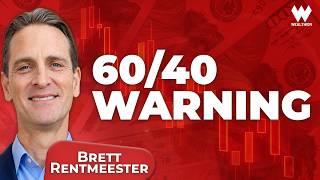
In a Wealthion interview published October 23, Brett Rentmeester makes a related argument: a portfolio built around falling interest rates may face different risks when rates rise. Speaking with Maggie Lake, he describes an approach combining hard assets with exposure to innovation.[2]
Rentmeester is founder and managing director of WindRock Wealth Management.[3] The firm is part of Wealthion's advisor network, a commercial relationship relevant to this discussion.[4]
What is a 60/40 portfolio supposed to do?
The term describes a mix of 60% stocks and 40% bonds. It is a portfolio convention, rather than a guarantee of a particular return or level of protection.
The central question is whether the two parts respond differently to economic stress. A bond can pay its promised interest while still losing market value.
The Securities and Exchange Commission (SEC) explains that prices of existing fixed-rate bonds generally fall when market interest rates rise. New bonds offering higher rates make the older payments less attractive. US government backing does not guarantee the price received in an early sale.[5]
This creates a distinction between receiving contractual payments and having a holding that offsets stock-market losses. The first does not establish the second.
Why does bond duration matter?
Duration estimates a bond's sensitivity to changes in interest rates. A higher duration generally means larger price movements for a given yield change, according to the Financial Industry Regulatory Authority (FINRA).[6]
The distinction applies to bond funds as well as individual bonds. Shorter duration reduces this particular sensitivity, while leaving other risks, including inflation and default. A broad warning about bonds therefore says little about the risk of a specific holding without its duration and credit characteristics.[6]
Rentmeester questions the assumption that a higher Treasury yield automatically makes long-term bonds attractive. His concern is the possibility of further rate increases, not the proposition that interest income has no value.[2]
Can higher yields also improve the case for bonds?
Yes. The SEC notes that newly issued bonds become more appealing when they offer higher interest rates. Those payments provide income even though an existing holding's price can decline.[7]
An individual bond held to maturity also differs from an early sale: repayment depends on the issuer meeting its obligations. Inflation can still reduce the purchasing power of those payments.[7]
This is the strongest counterargument to treating rising rates as an unqualified reason to abandon bonds. The outcome depends partly on the purchase terms and the relationship between the holding period and cash needs. Higher income and near-term price losses can coexist.
When might stocks and bonds move differently?
The Federal Reserve note distinguishes the policy response to different shocks. With inflation near target and expectations stable, policymakers may have room to ease during economic weakness. That can support bond prices.[1]
Inflationary supply shocks can constrain that response. The study covers the US, euro area and UK from 1990 through July 2026.[1]
That evidence supports a conditional answer to the 60/40 question. It does not identify the next market shock or prove that stocks and bonds will always move together.
What does Rentmeester mean by hard assets plus innovation?
Rentmeester discusses precious metals, energy, farmland and selected real estate as exposures to tangible assets. Alongside them, he sees possibilities in artificial intelligence (AI), robotics, autonomous transport and blockchain infrastructure.[2]
The combination is central to his argument. Concern about debt and currency purchasing power does not, in his view, require abandoning businesses developing new technology. He also rejects concentrating an entire portfolio in gold or technology.[2]
His real estate discussion shows why the details matter. He distinguishes single-family housing, rental property, hotels and distressed urban offices. Higher rents are a possible support for some properties in his account, while higher financing costs remain a pressure.[2]
The same selectivity applies to innovation. Rentmeester acknowledges that useful technology can attract excessive investment and that the price paid affects the outcome. For private placements, the SEC separately identifies limited disclosure, difficulty reselling and possible total loss.[8]
Does cryptocurrency provide dependable protection?
Rentmeester presents cryptocurrency as a possible response to distrust in government currencies and as infrastructure for a changing financial system. He discusses tokenization and transactions by AI agents, while acknowledging that the eventual use of these systems remains uncertain.[2]
That is an adoption thesis, rather than evidence of dependable portfolio protection. A joint regulator bulletin warns that crypto assets can be exceptionally risky and volatile, with significant loss risk and potentially limited investor protections.[9]
Blockchain use and the return from a particular crypto investment are different questions. The interview does not establish that increasing use of the technology guarantees gains for its investors.
How do debt, Social Security and healthcare fit the argument?
Rentmeester connects his portfolio concerns to government financing and the ability of institutions to meet their promises. He uses the Fourth Turning framework to interpret periods of institutional strain. That is a historical interpretation, not a validated market-timing rule.[2]
Social Security provides a concrete example, with an important distinction. The 2026 trustees project retirement and survivor trust fund reserves will be depleted in 2032. Continuing income would cover 78% of scheduled benefits then under their intermediate assumptions.[10]
The hypothetical combined retirement and disability funds have a projected 2034 depletion date, with 83% payable then. These are conditional estimates of a financing shortfall, rather than dates on which all benefits stop.[10]
Rentmeester also reports a steep increase in his business's health insurance renewal. That experience does not establish national inflation. The Bureau of Labor Statistics (BLS) measures health insurance in the Consumer Price Index (CPI) through an indirect method separating insurance services from medical benefits.[11]
His broader point concerns the gap between financial promises and household costs. Whether that pressure changes bond returns depends on policy, inflation and market pricing, rather than the cycle framework alone.
What does the interview establish about the 60/40 portfolio?
A 60/40 portfolio is exposed when its stock and bond holdings share sensitivity to the same inflation or interest-rate shock. Higher bond yields can improve available income while leaving that risk intact.
Rentmeester offers a broader mix of economic exposures as his response. The interview establishes his reasoning, not an optimal replacement allocation or a reliable forecast of which asset will perform best.
What Could Change the Picture
Inflation and the policy response: Inflation near target can allow monetary easing during weak growth. Persistent inflation can limit that flexibility.
Bond characteristics: Duration, credit quality, purchase terms and the timing of cash needs affect the outcome beyond the stock-and-bond percentages.
Property cash flows: Rent growth, financing costs, occupancy and location distinguish individual real estate investments from a broad hard-asset label.
Innovation economics: Adoption, competition, capital spending and the price paid are separate influences on an investment's result.
Fiscal assumptions: Policy changes can alter official benefit projections. The trustees' intermediate assumptions describe a conditional path, rather than a fixed deadline for all payments.
FAQ
What is a 60/40 portfolio? It is a mix of 60% stocks and 40% bonds. The label describes the allocation, rather than guaranteeing a level of protection. Bond duration and the underlying holdings influence its behavior.
Is the 60/40 portfolio dead? No permanent failure is established by this interview. Rentmeester describes a vulnerability to inflation and rising rates. Higher yields can also raise the income available on new bonds.[2][7]
Why do bonds lose value when interest rates rise? New fixed-rate bonds offering higher rates make older payments less attractive. The price of the existing bond generally falls to adjust its yield.[5]
Does a shorter-duration bond eliminate risk? No. Lower duration reduces sensitivity to interest-rate changes, but inflation, default and other risks remain.[6]
What does Rentmeester propose instead? He describes combining hard assets with innovation, rather than concentrating in a single theme. He does not supply an optimal replacement allocation, and the interview does not establish that these holdings reliably hedge one another.[2]
Who is Brett Rentmeester? He is founder and managing director of WindRock Wealth Management, a firm in Wealthion's advisor network. He joins Maggie Lake in Why the 60/40 Portfolio May Not Protect You, published October 23, 2026. Source video: https://www.youtube.com/watch?v=_A4QdIEBpN0.[2][3][4]
A complimentary, no-obligation portfolio review with an advisor in Wealthion’s network is available for a discussion of diversification and investment goals.
Abridged Interview
This exchange condenses and paraphrases the interview. Bracketed factual context is editorial text.
Higher yields and the long interest-rate cycle
Maggie Lake: Does the traditional stock-and-bond mix still make sense when interest rates are rising?
Brett Rentmeester: A higher Treasury yield can look normal compared with the years of zero or even negative rates. That does not settle whether the bond is a bargain. The question is whether rates keep rising after the purchase.
I look at the long rise in interest rates after World War II and the long decline after the early 1980s. Falling rates supported bond prices and stock valuations. If that environment changes, the assumptions behind a conventional portfolio deserve a different examination.
That is not a straight-line forecast. Even within a longer cycle, rates can fall for a period.
Maggie Lake: You connect that argument with the Fourth Turning. What does that framework add?
Brett Rentmeester: The framework developed by William Strauss and Neil Howe describes long cycles with periods of institutional crisis. The argument is that institutions eventually stop meeting society's needs and come under pressure to change.
I see parallels with earlier American crises. History does not repeat exactly, but it can provide guideposts for the kinds of changes that become possible.
[Factual context: This is Rentmeester's interpretation of a historical framework. It does not establish a predictable schedule for crises, interest rates or investment returns.[2]]
Government financing and institutional promises
Maggie Lake: How does government debt fit into that picture?
Brett Rentmeester: Large debt and higher interest costs make the fiscal choices harder. Promises outside the headline debt number add to the pressure. I think central banks may eventually become buyers when other demand is insufficient.
My concern is the effect on currency purchasing power and on institutions that people expect to support them. These pressures are not confined to the United States.
[Factual context: These are the guest's fiscal and monetary scenarios. They are not findings that central-bank purchases or a particular inflation outcome are inevitable.[2]]
Maggie Lake: What are the signs that institutions are struggling to meet people's needs?
Brett Rentmeester: Social Security's retirement reserves are projected to run out. People see public promises alongside rising living costs and become frustrated. I also see this in healthcare. Our business received a 22% health insurance renewal increase, which is far above the official inflation figures people hear.
The government does not really track health insurance the way a business experiences that premium bill.
[Factual context: The business renewal increase is Rentmeester's report, not a national statistic. BLS does measure health insurance in the CPI. Its indirect method separates insurer services, measured using retained earnings relative to benefits, from medical care reimbursements reassigned to other medical indexes.[11]]
[Factual context: The 2026 Social Security trustees project depletion of retirement and survivor reserves in 2032, with continuing income sufficient for 78% of scheduled benefits then. The hypothetical combined retirement and disability funds are projected to reach depletion in 2034, with 83% payable then. Reserve depletion does not mean all benefits end.[10]]
Maggie Lake: Could an election change the financial outlook?
Brett Rentmeester: The problems are structural and span political parties. A change in political control does not by itself resolve the underlying debt and spending pressures.
Hard assets without abandoning growth
Maggie Lake: What does your framework mean for the way you think about portfolios?
Brett Rentmeester: I am not arguing for sitting entirely in cash or expecting everything to collapse. In inflationary periods, hard assets can behave differently from conventional financial assets. My discussion includes precious metals, energy, farmland and selected real estate.
I am also cautious about promises tied to financially weak institutions, including some municipal issuers. The issue is the underlying finances and whether the rules could change.
Maggie Lake: Someone hearing that concern might leave stocks altogether and move into gold. Is that your argument?
Brett Rentmeester: No. A portfolio entirely in gold creates its own problems. So does concentrating everything in technology. There can be opportunities in the businesses building the next economy even while existing institutions are under pressure.
I see these ideas as complementary. One part responds to concerns about currency and government promises; another participates in innovation. The process can be gradual rather than an all-or-nothing change.
[Factual context: This describes Rentmeester's approach. The interview supplies neither an optimal allocation nor evidence that these assets consistently offset losses elsewhere.[2]]
Innovation and the price paid
Maggie Lake: Where do you see innovation beyond the companies already receiving attention for AI?
Brett Rentmeester: AI is moving beyond software on a computer toward physical applications. Robotics, autonomous vehicles and activity in space are among the areas I find interesting. Opportunities can exist in both public and private businesses.
That does not mean every investment will work. Parts of the technology market can become overhyped, with prices beyond what is justified.
Maggie Lake: What about the scale of investment in data centers?
Brett Rentmeester: I do not know whether the capacity being built will prove excessive. The technology could be useful while parts of the investment market still become a bubble. The price paid matters.
[Factual context: Private placements can involve highly illiquid securities, less disclosure than registered offerings and the possibility of total loss, according to the SEC.[8]]
Cryptocurrency and financial infrastructure
Maggie Lake: How does cryptocurrency fit alongside your concerns about government currencies and your interest in AI?
Brett Rentmeester: Some demand comes from people seeking an alternative to government-issued money. Another part concerns changes to financial infrastructure, including stablecoins, tokenization and blockchain transactions.
AI agents could create demand for wallets and transactions. A person using many agents might generate activity that is different from today's person-by-person model. Even people at the forefront do not know exactly how that will develop.
Maggie Lake: That seems to make an open mind and diversification more relevant.
Brett Rentmeester: Yes. Tactical positions can coexist with humility about history and the future. Concern about monetary systems and investment in growth can coexist too. Past periods of disruption still contained industries that expanded.
[Factual context: Potential blockchain adoption does not establish investment returns or dependable crisis protection. Regulators warn of substantial volatility and loss risk in crypto assets.[9]]
Different real estate markets
Maggie Lake: Real estate can also be risky when borrowing costs are high. How selective is your approach?
Brett Rentmeester: Single-family housing is regional. Some owners have low mortgage rates and high price expectations, while buyers face affordability pressures. That creates a standstill whose resolution is uncertain.
Commercial property is not one market. Higher rates hurt borrowers, but inflation can also support rents over time. I see possibilities in selected rental markets and hotels, while offices in major cities are under particular pressure.
In Chicago, I have seen transactions at a fraction of earlier values. That is my observation of particular distressed properties, not a statement about every building or real estate market.
Maggie Lake: So uncertainty can coexist with opportunity.
Brett Rentmeester: Yes. The distinction among assets, locations and prices remains important.
Sources
[1] Canlin Li and Emre Yoldas, Government Bonds' Safe-Haven Property and Inflationary Pressures, Federal Reserve FEDS Notes, October 16, 2026, including Figure 1 accessible data. Shock analysis and January 1990 to July 31, 2026 sample. https://www.federalreserve.gov/econres/notes/feds-notes/government-bonds-safe-haven-property-and-inflationary-pressures-20261016.html ; https://www.federalreserve.gov/econres/notes/feds-notes/government-bonds-safe-haven-property-and-inflationary-pressures-accessible-20261016.htm [2] Wealthion, Why the 60/40 Portfolio May Not Protect You, published October 23, 2026. Complete source transcript retrieved; chapters cross-checked with the official Wealthion podcast episode description. Publication date is not a verified recording date. https://www.youtube.com/watch?v=_A4QdIEBpN0 [3] WindRock Wealth Management, Brett K. Rentmeester, CFA, CAIA, MBA: Founder & Managing Director, accessed October 27, 2026. Official identity and role. https://windrockwealth.com/team_members/brett-k-rentmeester-cfa-caia-mba/ [4] Wealthion, WindRock Wealth Management, accessed October 27, 2026. Official advisor-network relationship and leadership. https://www.wealthion.com/partner/windrock-wealth-management/ [5] SEC Office of Investor Education and Advocacy, Interest Rate Risk: When Interest Rates Go Up, Prices of Fixed-Rate Bonds Fall, June 2013. Fixed-rate price mechanics and distinction between government payment backing and an early-sale market price. https://www.investor.gov/sites/default/files/ib_interestraterisk.pdf [6] FINRA, Duration: What an Interest Rate Hike Could Do to Your Bond Portfolio, March 6, 2017, accessed October 27, 2026. Duration sensitivity for bonds and funds; other risks remain at low duration. https://syndication.finra.org/content/duration-what-interest-rate-hike-could-do-your-bond-portfolio [7] SEC Investor.gov, Bonds: FAQs, accessed October 27, 2026. Higher rates on newly issued bonds, maturity, issuer payment risk and loss of purchasing power. https://www.investor.gov/introduction-investing/investing-basics/investment-products/bonds-or-fixed-income-products/bonds [8] SEC Investor.gov, Private Placements under Regulation D: Updated Investor Bulletin, August 17, 2022, accessed October 27, 2026. Illiquidity, limited disclosure and possible total loss. https://www.investor.gov/introduction-investing/general-resources/news-alerts/alerts-bulletins/investor-bulletins/private-placements-under-regulation-d-updated-investor-bulletin [9] SEC, Commodity Futures Trading Commission (CFTC), FINRA and other participating regulators, Technology and Digital Finance: World Investor Week 2024 Investor Bulletin, October 7, 2024, accessed October 27, 2026. Crypto-asset volatility, loss risk and potential limitations in investor protection. https://www.investor.gov/introduction-investing/general-resources/news-alerts/alerts-bulletins/investor-bulletins/technology-and-digital-finance-world-investor-week-2024-investor-bulletin [10] Social Security Administration, 2026 Trustees Report, II.A Highlights, Table II.A1. Intermediate assumptions set in February 2026; retirement and survivor and hypothetical combined-fund financing projections. https://www.ssa.gov/OACT/TR/2026/II_A_highlights.html [11] Bureau of Labor Statistics, Measuring Price Change in the CPI: Medical Care, accessed October 27, 2026. Health insurance indirect retained-earnings method, separation of benefits and allocation to other medical care indexes. https://www.bls.gov/cpi/factsheets/medical-care.htm
Wealthion is a dba of Greylock Peak Investments, a registered investment adviser. This newsletter is general information only. It is not investment advice or an offer or solicitation, and it is not tailored to your circumstances. Guests’ views are their own and may not reflect those of Wealthion. Wealthion has not verified guest statements, including any performance figures. Investing involves risk, including loss of principal, and past performance does not guarantee future results. Wealthion refers readers to other registered investment advisers and shares in the fees they receive from referred clients, which creates a conflict of interest. Please see our Form ADV Part 2A, and consult your own financial advisor before investing.
What Serious Investors Are Watching
Dive into expert interviews, market analysis, and long-form content built to help serious investors think long-term.
Why a 60/40 Portfolio Can Struggle With Inflation
Brett Rentmeester examines 60/40 portfolio risks, why stocks and bonds can fall together, and his case for combining hard assets with exposure to innovation.

Is Farmland a Good Investment? Joel Salatin on Farm Economics
Joel Salatin explains farmland investing, farm profits and food prices, including how land ownership differs from farming, processing and direct sales.

Gold Revaluation: Lyn Alden on Debt, Inflation and AI
Lyn Alden explains gold revaluation, fiscal dominance and inflation, plus why she sees a role for both stocks and gold amid the AI investment boom.
Enjoyed This? Get More Insights
Expert insights and curated opportunities, delivered to your inbox.
Ready to Position for What's Coming?
Whether you're still learning or ready to act, your next step starts here.
- Independent
- Macro-Informed
- Real Asset Focused


The Wealthion Network
By subscribing, you agree to receive Wealthion emails. Unsubscribe anytime.
Network Discussion
Sign in to share your thoughts and connect with other readers.
Join the Wealthion Network to Comment