

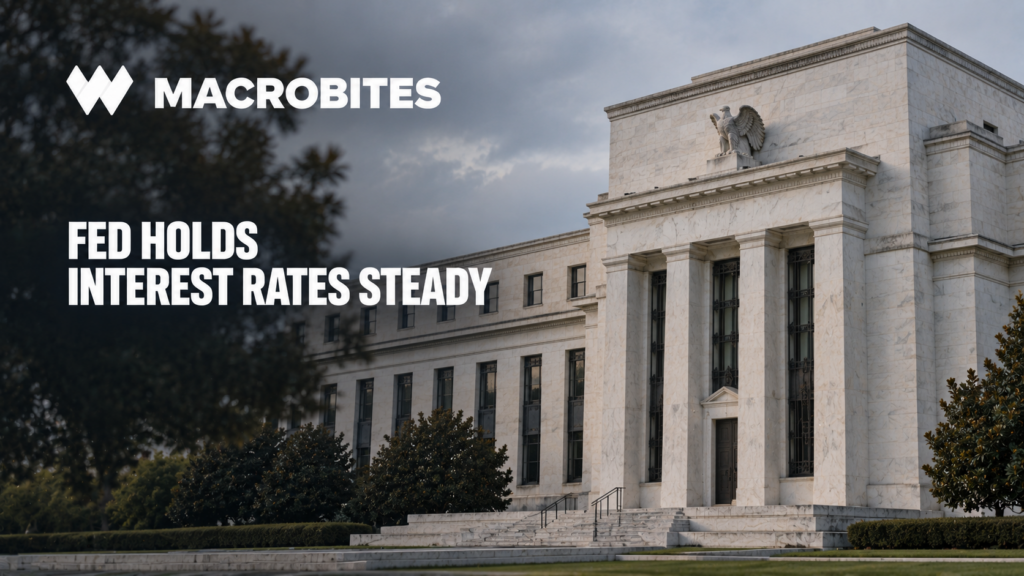
Macro Bites – Fed Leaves Interest Rates Unchanged as Warsh Limits Guidance
The FOMC voted 10-2 to maintain the target range for the fed funds rate at 3 ¾% to 4%, with Governor Cook and Cleveland Fed President Hammack dissenting in favor of a 25bps hike. The Warsh Fed continued with its stated efforts to scale back communication and guidance, with the policy statement totaling 173 words (vs. the Powell Fed’s average 350 words) and Chair Warsh refusing to answer more than one question from each reporter during his presser.
Financial media and market participants continue to express confusion and concern over the Warsh Fed’s scaled back “guidance.” We could not disagree more. We believe communications and forecasts from FOMC participants have long since reached ridiculous frequency, become highly counterproductive and caused frequent capital misallocation along the way. Chair Warsh is five months into a laudable and long overdue effort to return the Fed to its rightful, measured and muted stance, off daily front pages and letting markets do the work of setting appropriate interest rates. We say “Bravo,” and stay tuned…
ECB President Christine Lagarde announced she will leave the ECB on 2/7/27, nine months before her eight-year term was scheduled to expire on 10/31/27. Lagarde told the Governing Council on Thursday she is departing early to engage more directly in important matters like recent events in France. Lagarde was the ECB’s fourth leader and second from France when she replaced Italy’s Mario Draghi in 2019. Lagarde’s early departure sparks a major competition to replace one of the world’s most powerful monetary policymakers. Lagarde said, “I leave this institution with a sense of good work done, and an ECB that is fit for the future.”
Reuters reports the London Metal Exchange (LME) is aiming to turn metal held in its Hong Kong warehouses into digital assets that can be used for financing, a move linked to the territory's five-year plan to expand its commodities hub. The initiative and its connection to Hong Kong's development strategy have not previously been reported. LME and Hong Kong Exchanges and Clearing (HKEX) are targeting a ‘27 pilot for tokenized warehouse-receipt financing in collaboration with designated banks. The project turns stored physical metals into blockchain-based digital tokens, making it faster and easier to use physical inventory as loan collateral.
China officially reported that in a two-month Sept./Oct. blitz it had deployed the first 880B yuan ($120B) allocation of New Policy-based Financial Instruments for ‘26. This massive stimulus program (channeled through the country's three state policy banks) is designed to act as seed capital to unlock and leverage massive infrastructure and high-tech manufacturing projects. By injecting these funds directly into project capital, the initiative is designed to leverage a staggering 11.5T yuan ($1.7T) in total project investments across China’s provincial economies.
AI watch: Shares of Alphabet are 13% lower in early Thursday trading after reporting a $1.4B miss in advertising revenues and a massive acceleration in cash burn. Google Cloud revenues more than doubled, but the sustainability of that spending remains in question. Net cash flow was negative $9.1B (vs. breakeven est.). Nonetheless, Alphabet said it still plans to significantly increase ’27 capex from $195B-$205B in ’26.
The Bureau of Economic Analysis released this morning its “advanced” estimate for Q3 GDP as +3.4% (vs. +3.2% est.). The BEA will release its “revised” estimate on 11/25 and its “final” estimate on 12/23.
What Serious Investors Are Watching
Dive into expert interviews, market analysis, and long-form content built to help serious investors think long-term.
Macro Bites – Fed Leaves Interest Rates Unchanged as Warsh Limits Guidance
The FOMC voted 10-2 to maintain the target range for the fed funds rate at...

Macro Bites – DOE Offers Constellation Up to $5 Billion for Nuclear Power Upgrades
On Tuesday, Iran’s Supreme Leader Mojtaba Khamenei issued a statement reiterating Tehran's strict conditions for...
Why a 60/40 Portfolio Can Struggle With Inflation
Brett Rentmeester examines 60/40 portfolio risks, why stocks and bonds can fall together, and his case for combining hard assets with exposure to innovation.
Enjoyed This? Get More Insights
Expert insights and curated opportunities, delivered to your inbox.
Ready to Position for What's Coming?
Whether you're still learning or ready to act, your next step starts here.
- Independent
- Macro-Informed
- Real Asset Focused


The Wealthion Network
By subscribing, you agree to receive Wealthion emails. Unsubscribe anytime.
Network Discussion
Sign in to share your thoughts and connect with other readers.
Join the Wealthion Network to Comment