

Carbon ETFs Explained: What US Investors Actually Own
A US carbon ETF can hold European permits, California futures, a structured note or even Bitcoin. For investors, what sits inside the wrapper shapes the return alongside the price of carbon itself.
A carbon ETF sounds like a simple way to invest in the price of pollution. But the funds can hold very different things, from carbon allowances and futures contracts to bonds, structured notes and even Bitcoin.
That matters for anyone weighing carbon as a real asset. The largest US-listed fund is mostly a bet on European prices, not American ones. Most of its money sits in a short-duration fund. Its return depends on the euro, on the cost of rolling futures contracts and on fees, as well as on what carbon allowances do. This article looks inside the main products, at how their returns have compared with the markets they track, and at what has happened to investor money since 2021.
Key takeaways
US listing does not mean US exposure. KraneShares Global Carbon Strategy ETF (KRBN), the largest US-listed carbon ETF, had 59% exposure to European Union (EU) allowances and 28% to California on November 20, 20261.
The wrapper changes the return. KRBN lagged its index in four of five full calendar years; KraneShares California Carbon Allowance Strategy ETF (KCCA) lagged in all four of its full calendar years2,3,4,5,6,7,8,9.
Investor money has ebbed. KRBN recorded net withdrawals of $974 million over four fiscal years. Four carbon-related funds have closed since 202410,11,12,13,14,15,16.
What does a carbon ETF actually hold?
Carbon allowances are permits to emit under a regulated program. These exchange-traded funds (ETFs) get exposure through futures contracts, notes or direct allowance holdings8,17.
Futures provide exposure without requiring the fund to pay the contract’s full value upfront. It posts a smaller amount as margin and can invest the remaining money as collateral. On November 20, 2026, KRBN held 59.77% of its assets in a short-term bond fund; KCCA held 80.37%1,18. Yet KCCA’s carbon exposure was 99.8% of net assets. Holding roughly 80% in bonds did not leave only 20% exposed to carbon. The bond holdings also carry credit and interest-rate risk9.
KRBN also holds a structured note, a debt instrument that tracks EU allowances. Its market value was 17.61% of the fund’s assets, but its carbon exposure equaled 42.73%1. That exposure also carries the note issuer’s credit risk8.
In the comparison below, RGGI means the Regional Greenhouse Gas Initiative in Northeastern US states; RIC means regulated investment company.
| Product | Exposure | Disclosed fee | Net assets | Tax structure |
|---|---|---|---|---|
| KRBN | EU 59%; California 28%; United Kingdom 5%; RGGI 5%; Washington 3% | 0.91% operating expenses | $127.8mNov 20, 2026 | Intends RIC status |
| KCCA | California allowance futures, 99.8%; linked California–Québec market | 0.95% operating expenses | $120.5mNov 20, 2026 | Intends RIC status |
| COtwo Advisors Physical European Carbon Allowance Trust (CTWO) | Direct EU allowances, 99.05% | 0.79% sponsor fee | $1.9mAug 31, 2026 | Grantor trust |
| 7RCC Spot Bitcoin and Carbon Credit Futures ETF (BTCK) | Bitcoin and carbon futures; target 80/20 split | 0.68% sponsor fee | $2.0mSep 30, 2026 | Corporation |
Dated snapshots, not fixed allocations. Operating expenses and sponsor fees are different measures. BTCK’s fact sheet separately reports 0.84% gross and 0.44% net expenses. Its carbon holdings were European at September 30, but its mandate also includes California and RGGI. It is primarily a Bitcoin product1,8,9,17,18,19.
Why is a US carbon fund mostly about Europe?
KRBN’s index weights markets by trading volume, subject to caps. Europe’s large weight follows those rules rather than necessarily expressing a manager’s forecast20.
For a dollar investor, that exposure brings in two forces beyond US climate policy.
European supply and demand. Emissions from power and industrial installations covered by the EU trading system fell 16.5% in 202321. Between July 2023 and July 2026, additional auctions for the REPowerEU energy plan sold 278.5 million allowances, partly brought forward, reaching a €20 billion target22. Separately, average auction prices fell from €83.60 in 2023 to €64.74 in 2024, reaching €49.50 in February 202423. These figures illustrate demand and supply changes; they do not isolate each factor’s effect on prices.
The euro. A euro bought $1.1750 at the end of 2025 and $1.0990 on November 20, 202624,25. A weaker euro reduces the dollar value of a fixed euro-denominated holding, although a fund’s currency positions and collateral affect the final result.
How have the funds' returns compared with carbon prices?
An allowance price, a futures index and a fund’s return measure different things.
KRBN’s annual total returns were 108.83% in 2021, -10.51% in 2022, 6.58% in 2023, -13.73% in 2024 and 23.10% in 2025. These are returns based on net asset value (NAV), with distributions reinvested. Its four annual shortfalls against the published carbon index ranged from 1.55 to 2.02 percentage points; KCCA’s four ranged from 0.81 to 2.86 points2,3,4,5,6,7,8,9. Through October 31, 2026, both were ahead of the comparator published by their issuer1,18.
Futures expire, so funds replace contracts to maintain exposure. This is called rolling. When later contracts cost more, rolling can weigh on returns even without a fall in the underlying commodity’s price26. A total-return futures index also adds assumed collateral income. Fund fees reduce returns, while trading and actual collateral earnings can create further differences8,9,20.
The indexes were renamed from IHS Markit to S&P in August 2024. A separate change on November 3, 2025 shifted the funds’ objectives from total-return indexes to excess-return indexes plus actual collateral returns. An excess-return index excludes collateral income. That change limits comparisons across the two periods8,9,11.
What has happened to investor money?
Money arrived quickly in 2021 and early 2022. Each of the following four completed fiscal years brought net withdrawals.
Assets in the largest US-listed carbon ETF fell more than 90% from the end of 2021
Wealthion illustration. KRBN net assets at quarter-ends through June 2026, followed by November 20, 2026. US$ millions1,12,27.
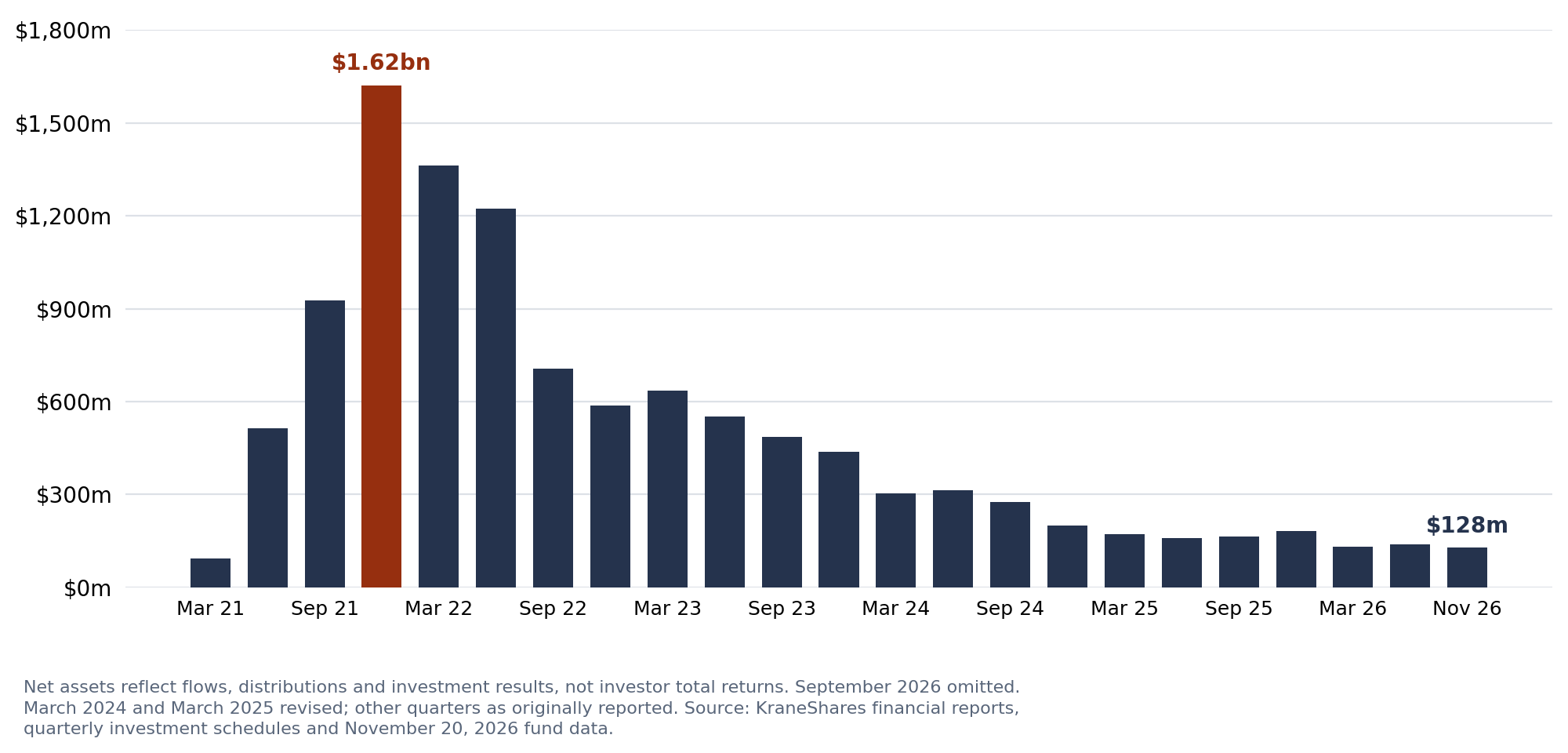
KRBN took in a net $1.04 billion in the fiscal year to March 202228. During that period, EU auction prices reached their 2022 high of €97.51 on February 829. Net withdrawals totaled $974 million over the four fiscal years through March 2026, by Wealthion’s calculation10,11,12. Assets fell from $1.62 billion at the end of 2021 to $128 million on November 20, 2026. That decline reflects flows, distributions and investment results; it is not an investor’s percentage loss1,10,11,12,27.
Four related products closed: a voluntary-offset fund in March 2024, an actively managed carbon fund in May 2024, a carbon-and-power fund in February 2025 and a Europe-only allowance fund in March 202613,14,15,16. Of those notices, only the carbon-and-power fund’s cited insufficient assets as the commercial reason. Liquidation returns cash and can trigger a taxable gain or loss13,16.
How are carbon ETFs taxed?
Tax treatment depends on the product’s structure as well as what it owns.
Directly held futures that qualify under Section 1256 receive 60% long-term and 40% short-term capital-gains treatment30. That treatment does not automatically pass to KRBN or KCCA shareholders. Both funds intend to qualify as RICs and use wholly owned Cayman Islands subsidiaries for futures exposure31. In taxable accounts, fund distributions may be ordinary income or capital gains; selling shares can create a separate capital gain or loss32.
CTWO is a grantor trust, passing income, gains and losses through to investors. BTCK elected corporate taxation: its prospectus specifies 21% federal tax on the fund’s taxable income, potentially reducing NAV before any shareholder-level tax17,19.
What does this mean for investors?
A carbon price tells only part of the story. The market a fund follows, the contracts it uses, its costs and its tax structure all help determine what reaches shareholders. Two funds carrying the same broad label can therefore produce very different investment experiences.
For investors, the lesson is simple: understanding a carbon ETF requires looking beyond its name and headline performance. What it actually owns, how it obtains exposure and what it costs to hold can matter just as much as the direction of carbon prices themselves.
Frequently asked questions
How is a carbon allowance fund different from a clean-energy stock fund? An allowance fund follows regulated emissions permits, directly or through contracts. A clean-energy stock fund owns company shares. Business earnings and share valuations therefore matter to the latter; the two are not interchangeable carbon-price investments26,33.
Can its share price differ from the value of its holdings? Yes. Shares trade on an exchange and can sit above or below NAV. The gap between quoted buying and selling prices, called the bid-ask spread, also affects trading costs32.
Can I owe tax even if my investment has fallen? Yes, in a taxable account. A fund can distribute taxable income or realized gains while its overall return is negative. A shareholder may owe tax on those distributions without having sold any shares32.
Does buying a carbon ETF offset my emissions? Not automatically. Owning fund shares provides financial exposure. Permanently removing EU allowances requires a separate cancellation process; holding or trading them is not the same as canceling them17,34.
Sources & Disclosure
1 KraneShares. KRBN fund data and holdings, November 20, 2026. 2 KraneShares. KRBN Summary Prospectus, August 1, 2022. 3 KraneShares. KRBN Summary Prospectus, August 1, 2023. 4 KraneShares. KRBN Summary Prospectus, August 1, 2024. 5 KraneShares Trust. Statutory Prospectus, August 1, 2025. 6 KraneShares. KCCA Summary Prospectus, August 1, 2023. 7 KraneShares. KCCA Summary Prospectus, August 1, 2024. 8 KraneShares. KRBN Summary Prospectus, August 1, 2026. 9 KraneShares. KCCA Summary Prospectus, August 1, 2026. 10 KraneShares Trust. Annual Report, March 31, 2023. 11 KraneShares Trust. Annual Financials and Other Information, March 31, 2025. 12 KraneShares Trust. Annual Financials and Other Information, March 31, 2026, Note 12. 13 KraneShares Trust. KEUA and KLXY liquidation supplement, February 20, 2026. 14 KraneShares Trust. KSET liquidation supplement, February 28, 2024. 15 Carbon Strategy ETF (KARB). Liquidation supplement, April 12, 2024. 16 CNIC ICE U.S. Carbon Neutral Power Futures Index ETF (AMPD). Liquidation supplement, February 7, 2025. 17 COtwo Advisors. CTWO Form 10-Q, August 31, 2026 (filed October 9, 2026); prospectus, April 21, 2026. 18 KraneShares. KCCA fund data and holdings, November 20, 2026. 19 Teucrium. BTCK prospectus, March 13, 2026; Form 10-Q, September 30, 2026; BTCK fact sheet, accessed November 23, 2026. 20 S&P Dow Jones Indices. S&P Global Carbon Credit Indices Methodology, December 2025. 21 European Commission. Report on the functioning of the European carbon market in 2023, COM(2024) 538, November 19, 2024. 22 European Commission. Report on the functioning of the European carbon market in 2025, COM(2026) 596, November 9, 2026, p. 21; REPowerEU announcement, July 13, 2026. 23 European Commission. Report on the functioning of the European carbon market in 2024, COM(2025) 735, Figure 2. 24 European Central Bank. Euro foreign exchange reference rates, December 31, 2025. 25 European Central Bank. Euro foreign exchange reference rates, November 20, 2026. 26 Commodity Futures Trading Commission. Customer Advisory: Learn About Risks Before Investing in Commodity ETPs or Funds. 27 KraneShares Trust. Financial reports and quarterly investment schedules, March 2021–June 2026, KRBN net assets. March 2024 and March 2025 use revisions in the March 2026 financials, p. 134 and Note 12; other quarters as originally reported. 28 KraneShares Trust. Annual Report, March 31, 2022. 29 European Energy Exchange. Emission Spot Primary Market Auction Reports, 2022 workbook, February 8 auction. 30 Internal Revenue Service. Publication 550 (2025), Section 1256 contracts. 31 KraneShares Trust. Statement of Additional Information, August 1, 2026, taxation sections. 32 US Securities and Exchange Commission. Mutual Funds and ETFs: A Guide for Investors. 33 US Securities and Exchange Commission. Stocks: FAQs. 34 Dutch Emissions Authority. Cancelling emission allowances voluntarily.
Wealthion is a dba of Greylock Peak Investments, a registered investment adviser. This article is general information only. It is not investment advice or an offer or solicitation, and it is not tailored to your circumstances. Guests’ views are their own and may not reflect those of Wealthion. Wealthion has not verified guest statements, including any performance figures. Investing involves risk, including loss of principal, and past performance does not guarantee future results. Wealthion refers readers to other registered investment advisers and shares in the fees they receive from referred clients, which creates a conflict of interest. Please see our Form ADV Part 2A and consult your own financial advisor before investing.
What Serious Investors Are Watching
Dive into expert interviews, market analysis, and long-form content built to help serious investors think long-term.
Carbon Investing: How the Markets Work and Where Returns Come From
Carbon allowances, project credits and carbon-linked businesses respond to different forces. Their rules, price history and investment structures explain why an emissions target and an investor’s return can diverge.
Carbon ETFs Explained: What US Investors Actually Own
Carbon funds can hold bonds, futures, physical allowances or even Bitcoin. Their holdings, market exposure, costs and tax structures help explain what investors actually own.

SPECIAL REPORT When Good Investments Go Bad | Open Position by Steven Feldman
OPEN POSITION FROM THE DESK OF STEVEN FELDMAN Why gold is falling when it is...
Enjoyed This? Get More Insights
Expert insights and curated opportunities, delivered to your inbox.
Ready to Position for What's Coming?
Whether you're still learning or ready to act, your next step starts here.
- Independent
- Macro-Informed
- Real Asset Focused

The Wealthion Network
By subscribing, you agree to receive Wealthion emails. Unsubscribe anytime.
The Wealthion Network
By subscribing, you agree to receive Wealthion emails. Unsubscribe anytime.
Network Discussion
Join the Wealthion Network to Comment