

The Refinancing Wall: Nick Gerli, Jeff Snider and Lyn Alden on Why Higher Rates Hit Years Later
Cheap debt eventually comes due. Wealthion guests explain how higher borrowing costs reach property owners, businesses and their lenders, and why some can absorb the change.
If you locked in a mortgage before 2022, you probably still pay a rate that looks unreal today. You're far from alone.
In the second quarter of 2026, 49.1% of outstanding US home mortgages had been originated at rates below 4%, according to the Federal Housing Finance Agency (FHFA). A new 30-year fixed mortgage averaged 7.21% on November 25.1,2 For homeowners with fixed-rate loans, higher market rates haven't changed their mortgage rate. A 30-year fixed loan keeps its rate for as long as they keep the loan.
Commercial property and businesses can work differently. Many loans leave a balance to be repaid or replaced when their term ends. At the end of 2025, the Mortgage Bankers Association (MBA) counted $875 billion of commercial and apartment mortgage balances on loans scheduled to mature during 2026.3 When a pile of debt like that comes due within the same period, it's called a refinancing wall, or a maturity wall.
That's why rates that rose years ago can still be doing damage today. For borrowers replacing cheap fixed-rate debt, higher costs can arrive when they refinance. But a loan coming due isn't a loan going bad. In this article, we look at how the refinancing wall works, what happens when a higher payment meets weaker income, why lenders matter as much as rates, which businesses were built on cheap debt and why many borrowers can get through.
The numbers at a glance
What is the refinancing wall?
It's a calendar, not a crisis.
Most commercial loans have a fixed term. Nick Gerli, founder and chief executive of Reventure App, told Wealthion in October that most apartment loans have terms of five to 10 years.6 If the rate is fixed, it stays the same for that term. Regular payments may be calculated over a longer repayment period, leaving a balance due when the loan matures.7 At that point, the borrower must repay the balance, refinance or agree an extension with the lender.
Bank regulators have a name for the danger in that moment. The Office of the Comptroller of the Currency (OCC) defines refinance risk as “the risk that borrowers will not be able to replace existing debt at a future date under reasonable terms and prevailing market conditions”7. Notice that it isn't only about the rate. It's also about whether anyone will lend, and on what terms.
The rate backdrop has changed a lot. The 10-year Treasury yield, a benchmark for long-term borrowing, hit 0.52% in August 2020. On November 24, 2026, it was 4.91%8. Loans written near the bottom are now meeting a very different market. Borrowers with floating-rate debt feel the change sooner, because their rate resets as market rates move. The Federal Reserve said in May that debt-servicing capacity was lower among some riskier public and private firms, “especially those that rely on floating-rate debt such as leveraged loans and private credit”9.
Commercial mortgages scheduled to mature in 2026, by lender group
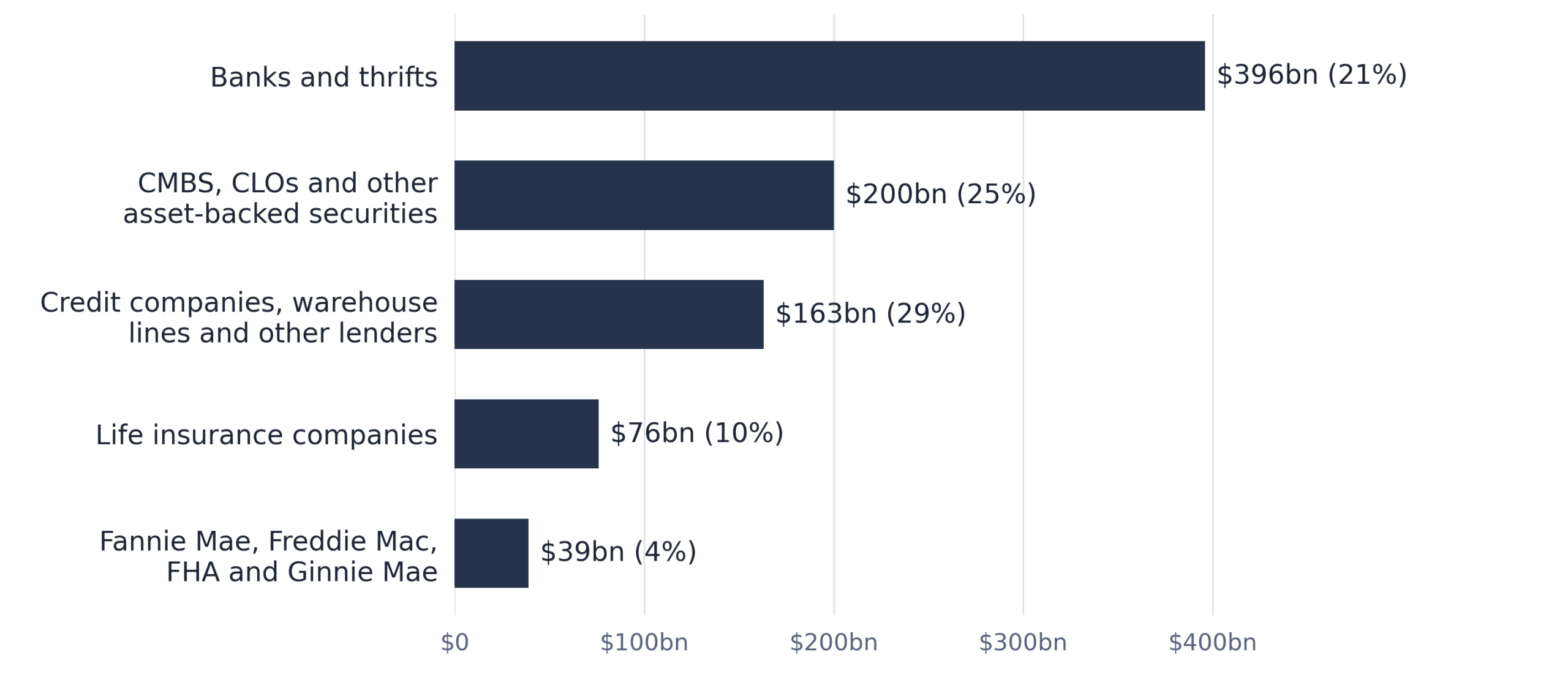
Wealthion illustration, using Mortgage Bankers Association data.3 CMBS: commercial mortgage-backed securities; CLOs: collateralized loan obligations; FHA: Federal Housing Administration.
Dollar values are loan balances. Percentages show the share of each lender category's balances scheduled to mature in 2026; the agency category includes loans held or guaranteed.
These are balances measured at December 31, 2025, on loans scheduled to mature throughout 2026, not the amount still due in late November. Balances at maturity may be lower as principal is repaid. Rounded group totals add to $874 billion against the $875 billion headline.3 What this number is: a schedule of loans due to be repaid or replaced. What it isn't: a forecast of defaults. The 2026 total is also lower than the $957 billion that was scheduled for 2025, and lenders can extend loans, which moves the date rather than necessarily forcing a sale.3,10 Banks account for the largest share in dollars, while loans packaged into CMBS and CLOs, and those held by credit companies and other lenders, have more of their category's balances coming due.
What happens when a higher payment meets weaker income?
The rate is only half the squeeze. The other half is what the property earns.
Gerli described the apartment version of the problem. Many landlords, he said, borrowed at 3% to 4% during the pandemic and in the late 2010s. “And these apartment landlords are flipping from a three and a half percent rate to a 6% rate or a six and a half percent rate,” he said. “And that's causing their interest burdens to double in some cases.”6
A landlord pays the mortgage out of rent. If rents are rising, the building may be able to absorb some of a higher interest bill. If rents fall at the same time, the numbers get tight fast. That's what Gerli sees in parts of the country: “And at the same time, rents are dropping in a lot of markets.”6
His example is telling, but it isn't the whole market. Official data paints a mixed picture. Fannie Mae's multifamily serious-delinquency rate was 0.65% in October 2026, down from 0.71% a year earlier. At Freddie Mac the multifamily delinquency rate rose to 0.62% from 0.48%. Both measure loan balances, but their definitions differ, so the figures are not directly comparable.11,12 In the MBA's survey, 4.97% of balances in loans packaged into CMBS were at least 30 days late in September 2026, down from 5.66% a year earlier, though the MBA said commercial delinquency rates rose in the third quarter.13,14
The Federal Reserve flagged where the pressure could build. In November it warned that “a substantial volume of non-agency commercial mortgage-backed securities (CMBS) debt is set to mature in late 2026,” and that difficulty refinancing could lead to forced property sales10. Stress can differ from one borrower and market to another.
Why does the lender matter as much as the rate?
A loan can only be refinanced if someone is willing to make the new one.
Jeff Snider, founder and host of Eurodollar University, told Wealthion in November that credit cycles don't turn overnight: “But these things are processes. They play out over multiple years.”15 When the economy looks less certain, lenders change how they behave. “Suddenly you start double-checking and rechecking,” he said15. In his view, stress that began in private credit, meaning loans made directly by investment funds rather than banks, has been spreading: “it wasn't contained in private credit this time around”15.
The data shows lenders getting more careful. In the Federal Reserve's October survey of bank loan officers, a net 15.5% of banks said they had tightened standards on construction and land development loans, and a net 8.8% on apartment loans.5 That's the share tightening minus the share easing, not the share refusing to lend. The extra yield investors demand on riskier corporate bonds over comparable Treasury securities, known as the high-yield credit spread, rose from 3.15 percentage points on November 24, 2025, to 3.72 points on November 24, 2026.16
Private credit needs careful reading. Fitch Ratings put its US private credit default rate at 6.2% over the 12 months to October. That broad measure counts distressed changes to loan terms, such as extensions. Counting only bankruptcies, liquidations and restructurings, the rate was 0.4%4. Both numbers are real. They answer different questions. Separately, the Fed said private credit loan defaults had risen since its May report, reaching “the upper end of its short historical distribution”10.
There's a flip side. On commercial property, the same Fed report noted that “lenders' willingness to extend or restructure maturing loans has helped mitigate this risk”10. Extensions can spread refinancing pressure over time, but they do not necessarily fix weak income or excessive debt.
Which businesses were built on cheap debt?
Some business models didn't just use cheap debt. They were designed around it.
Lyn Alden, founder of Lyn Alden Investment Strategy, told Wealthion in October that the long tailwind of falling rates has ended: “The problem is especially during this like 40-year period of declining interest rates uh that is now over.”17 She described a common private equity approach of that era: “buy a business, lever it up,” use ever cheaper debt, cut staff and sell within a few years.17
Her concern is the time frame. Private equity funds often have a set life, which she illustrated with a 10-year example, so the pressure is to improve results quickly and sell. In her view, that approach can leave a company carrying debt it struggles to support later. She was careful to say the managers aren't villains. They are responding to the incentives their funds create.17 She contrasted it with permanent owners, which she said “buy companies and they just hold them for decades”.17
This matters because many of these companies borrow at floating rates through leveraged loans, which are loans to companies that already carry a lot of debt. Fitch reported a US leveraged loan default rate of 3.9% for September 2026.18 And the corporate wall was taller further out: in an S&P Global Ratings schedule using data as of January 1, 2025, US speculative-grade nonfinancial debt covered by S&P's ratings was due in amounts of $254 billion for 2026, $360 billion for 2027 and $682 billion for 2028.19 That schedule is almost two years old, and refinancing since then will have changed it, but it shows how much of this debt was bunched into later years.
Why doesn't every maturing loan default?
Debt coming due is a test. Plenty of borrowers pass it.
Ivy Zelman, co-founder of Zelman, a Walker & Dunlop company, gave the clearest counterweight. Public homebuilders, she said, had lowered their risk “through going landlight through having the balance sheets um with much less debt and leverage”20. Lennar's filings show the shift. Its reported net homebuilding debt-to-capital ratio, which deducts cash from debt, was 2.8% at November 30, 2025, against 30.2% at November 30, 2007.21,22 Asked whether housing could spark another global financial crisis (GFC) like 2008, she said: “So we we we're not looking for a GFC right now.”20
Land-light arrangements can shift some of the exposure to landowners and financiers. Zelman explained that private equity firms now fund much of the land that builders used to hold, and she expects land sellers and land bankers “to have to capitulate” on price. Builders can still lose deposits when they walk away from land options.20 Gerli, too, drew a line between today and the mid-2000s, saying the single-family market has far fewer bad mortgages than it did then.6
Whether a borrower gets through usually comes down to a handful of questions.
| Question | More vulnerable | More resilient |
|---|---|---|
| When does the rate change? | A floating rate resetting soon, or a fixed loan close to maturity | More time before the rate changes, or cash to repay |
| Can income cover the new payment? | Falling income alongside a higher interest bill | Income with room to spare above the new payment |
| How much equity is left? | A fall in value leaves little owner capital | More equity and cash relative to the debt |
| Will lenders lend again? | Tighter standards or lenders pulling back | Access to lenders or other capital on workable terms |
Wealthion framework, drawing on the OCC's refinance-risk guidance and the Federal Reserve's Financial Stability Reports. Educational, not a test of any specific investment.
What does this mean for investors?
The wall is real. What matters is who is standing in front of it.
For investors, the refinancing wall is a slow-moving filter rather than an instant crash: higher rates hit on the specific day cheap debt expires, separating strong balance sheets from over-leveraged ones.
Rather than reacting to big maturity headlines, focus on four practical checks:
-
Separate maturities from defaults: A maturing loan only tests whether a borrower's cash flow and equity can support refinancing or an extension.
-
Check fixed vs. floating debt: Floating-rate borrowers (like leveraged loans and private credit) feel rate pain immediately, while long-dated fixed-rate borrowers have breathing room.
-
Look through fund labels: Audit your REIT, corporate bond, private credit, and small-cap funds for underlying debt levels and staggered maturities.
-
Watch for selective opportunities: Forced sales by over-leveraged owners create rare buying openings for well-capitalized investors.
If you own real estate funds, private credit funds, bond funds or small company shares, some of what you own may face this test. That alone doesn't say whether a holding is sound. Real assets with solid income and modest debt can come through a refinancing cycle in good shape. The exposure depends on which kind of borrower sits behind each holding.
Frequently asked questions
Is a maturity wall the same as a wave of defaults? No. A maturity is a date when a loan must be repaid or replaced. Many borrowers refinance, repay or agree extensions with their lenders. The Federal Reserve noted that in commercial property, extensions have helped limit the risk so far10.
What is private credit? Private credit is lending by investment funds directly to companies, outside the banking system and public bond markets. Its loans often have floating rates, which is why higher rates can reach those borrowers sooner9.
Why don't most homeowners face a refinancing wall? Most US home mortgages have fixed rates, so market-rate changes do not alter their interest rate.1 On a fully amortizing mortgage, regular payments also repay the loan by its final due date. Many commercial loans have shorter terms and leave a balance to repay at maturity.7
Sources & Disclosure
1 FHFA, NMDB Outstanding Residential Mortgage Statistics, Q2 2026; Aggregate Statistics Data Dictionary, June 26, 2026, Appendix C. 2 Freddie Mac via FRED, 30-Year Fixed Rate Mortgage Average (MORTGAGE30US), November 25, 2026. 3 Mortgage Bankers Association, 17 Percent of Commercial and Multifamily Mortgage Balances to Mature in 2026, February 9, 2026. 4 Fitch Ratings, U.S. Private Credit Default Rate Eases Modestly to 6.2% in October 2026, November 16, 2026. 5 Federal Reserve, October 2026 SLOOS Chart Data, November 2, 2026; commercial real estate lending standards. 6 Wealthion interview with Nick Gerli, October 14, 2026. 7 OCC, Commercial Lending: Refinance Risk, Bulletin 2024-29, October 3, 2024. 8 Federal Reserve via FRED, 10-Year Treasury Constant Maturity Yield (DGS10), August 4, 2020 and November 24, 2026. 9 Federal Reserve, Financial Stability Report, May 8, 2026, pp. 2, 5 and 19. 10 Federal Reserve, Financial Stability Report, November 13, 2026, pp. 2, 9, 12 and 21. 11 Fannie Mae, Monthly Summary, October 2026, Table 7 and endnotes. 12 Freddie Mac, Monthly Volume Summary, October 2026, Table 6 and additional information. 13 Mortgage Bankers Association, Delinquency Rates for Commercial Properties Increased in the Third Quarter of 2026, October 27, 2026. 14 Mortgage Bankers Association, Delinquency Rates for Commercial Properties Decreased in the Third Quarter of 2025, October 28, 2025. 15 Wealthion interview with Jeff Snider, November 4, 2026. 16 ICE Data Indices via FRED, US High Yield Index Option-Adjusted Spread (BAMLH0A0HYM2), November 24, 2025 and November 24, 2026. 17 Wealthion interview with Lyn Alden, October 19, 2026. 18 Fitch Ratings, U.S. Leveraged Loan and High-Yield Default Rates Steady; Risk Extending Into 2027, October 19, 2026. 19 S&P Global Ratings, Global Corporate Debt Maturities Through 2029, United States nonfinancial schedule; data as of January 1, 2025. 20 Wealthion interview with Ivy Zelman, October 28, 2026. 21 Lennar, 2025 Annual Report, p. 37; net homebuilding debt-to-capital reconciliation. 22 Lennar, 2007 Form 10-K, filed January 29, 2008, Item 7; net homebuilding debt-to-capital reconciliation.
Wealthion is a dba of Greylock Peak Investments, a registered investment adviser. This article is general information only. It is not investment advice or an offer or solicitation, and it is not tailored to your circumstances. Guests’ views are their own and may not reflect those of Wealthion. Wealthion has not verified guest statements, including any performance figures. Investing involves risk, including loss of principal, and past performance does not guarantee future results. Wealthion refers readers to other registered investment advisers and shares in the fees they receive from referred clients, which creates a conflict of interest. Please see our Form ADV Part 2A and consult your own financial advisor before investing.
What Serious Investors Are Watching
Dive into expert interviews, market analysis, and long-form content built to help serious investors think long-term.

How to Calculate AI Exposure Across Your Portfolio
A portfolio can hold the same AI-linked company through several funds, direct shares and bonds. Looking through those investments reveals where the overlaps sit and what each holding represents.

Is a Recession Coming? Why David Rosenberg and Chris Galipeau Disagree
The US economy is still growing. The disagreement is over how much pressure it can...

Macro Bites – China’s Stock Rally, Copper Record and Zinc Shutdown
China’s State Council pledged on Friday new policies to stabilize capital markets and strengthen defenses...
Enjoyed This? Get More Insights
Expert insights and curated opportunities, delivered to your inbox.
Ready to Position for What's Coming?
Whether you're still learning or ready to act, your next step starts here.
- Independent
- Macro-Informed
- Real Asset Focused


The Wealthion Network
By subscribing, you agree to receive Wealthion emails. Unsubscribe anytime.
The Wealthion Network
By subscribing, you agree to receive Wealthion emails. Unsubscribe anytime.
Network Discussion
Join the Wealthion Network to Comment