

Wealthion Macro Bites 11/5/25
Canadian Finance Minister Francois-Phillippe Champagne announced a C$2B Critical Minerals Sovereign Fund to accelerate investment in strategic mining projects and strengthen national security supply chains. The new fund (administered by Natural Resources Canada) will provide equity investments, loan guarantees and offtake agreements to advance critical minerals projects. Additionally, Ottawa will launch a C$372M First and Last Mile Fund to support upstream and midstream development of critical minerals supply chains.
Canada’s 2025 Budget also extends the Critical Mineral Exploration Tax Credit to 12 additional minerals: bismuth, cesium, chromium, fluorspar, germanium, indium, manganese, molybdenum, niobium, tantalum, tin and tungsten.
ICBC (China’s largest state-owned bank) plans to open a precious-metal depository at Hong Kong International Airport in conjunction with Hong Kong Chief Executive John Lee’s pledge to increase the city’s bullion storage capacity to 2,000t and establish a central clearing system over the next three years, all in support of China’s (de-dollarization) efforts to increase international RNB-denominated gold trading.
DXY dollar index -0.05%, spot gold and spot silver +0.9%. Gold /silver ratio at 83.4.
We continue to flag mounting market-liquidity stress. In our chart of the week, the spread between the Secured Overnight Financing Rate (SOFR) and the Fed’s Interest on Reserve Balances Rate (IORB) spiked to 32 basis points on Tuesday, the highest since the Covid-panic peak (3/16/20). Combined with Monday’s equity-correction warnings from Wall Street CEO’s, something is a-brewing. Stay tuned…
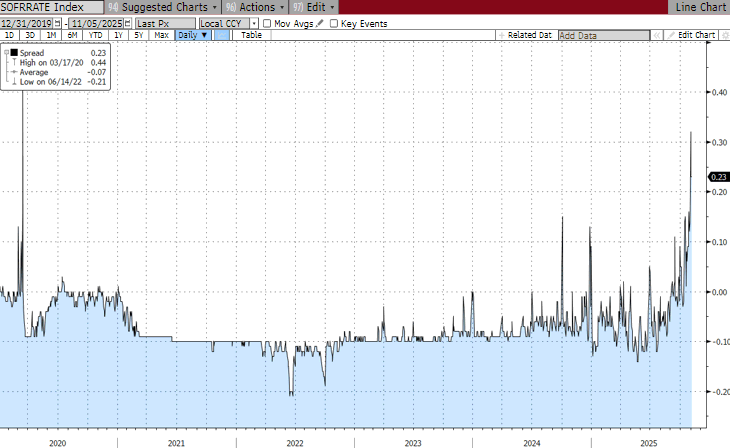
SOFR-IOBR Spread (12/31/19-11/5/25) [Bloomberg]
Sign up for our newsletter at the bottom of our homepage wealthion.com
What Serious Investors Are Watching
Dive into expert interviews, market analysis, and long-form content built to help serious investors think long-term.

Is Debt Financing the AI Build-Out a Concern? Where the Risk Sits for Investors
AI borrowing is growing. Company cash flow, interest coverage and commitments beyond reported debt show why the risks differ between borrowers and portfolios.
I Bonds Explained: How They Work and What You Earn
How I bonds earn interest, adjust for inflation and become available to withdraw, with purchase limits, tax rules and a worked example.
Negative Interest Rates Explained: Policy Rates vs Real Returns
Negative policy rates charge banks on certain central-bank deposits. Negative real returns mean an investment loses purchasing power after inflation. The difference matters for savings, bonds and gold.
Enjoyed This? Get More Insights
Expert insights and curated opportunities, delivered to your inbox.
Ready to Position for What's Coming?
Whether you're still learning or ready to act, your next step starts here.
- Independent
- Macro-Informed
- Real Asset Focused


The Wealthion Network
By subscribing, you agree to receive Wealthion emails. Unsubscribe anytime.
The Wealthion Network
By subscribing, you agree to receive Wealthion emails. Unsubscribe anytime.
Network Discussion
Join the Wealthion Network to Comment