

Is Debt Financing the AI Build-Out a Concern? Where the Risk Sits for Investors
Borrowing is financing a growing share of the artificial intelligence (AI) build-out. Current interest costs remain well covered at several of the largest spenders, while leases, guarantees and weaker borrowers complicate the wider picture.
The AI build-out is often described as a story about shares. But behind the surge in technology investment lies another story, one increasingly driven by debt. As companies race to build data centers and expand computing capacity, borrowing is becoming a more important part of the funding mix.
Strong cash flows have helped the biggest technology companies finance growth. Over the latest 12 months, two of the five biggest spenders, Amazon and Oracle, spent more on property and equipment than their operations brought in, and all five have sold large amounts of bonds. That matters to investors in two ways: it changes the risk in the companies themselves, and it brings AI risk into corporate bond portfolios.
Key takeaways
Borrowing has grown quickly. Advanced-computing-related debt issuance passed $680 billion by October 2026, against $130 billion in all of 20231.
Current interest costs remain well covered at several firms. Microsoft and Alphabet report operating income about 51 times their interest expense; Meta about 29 times and Amazon about 23 times. Oracle reports about 4.5 times2,3,4,5,6.
Obligations extend beyond reported borrowings, including more than $1 trillion of signed leases that have not started and joint ventures supported by guarantees1.
How much debt is funding the AI build-out?
Far more than in 2023, and some of it runs for 40 years or longer.
The Federal Reserve estimates that debt issuance tied to advanced computing passed $680 billion by October 2026, against $130 billion in all of 2023. Advanced-computing-related borrowing also accounted for about 31% of investment-grade debt issuance by nonfinancial companies in 2026, up from less than 6% in 20231. Investment-grade means debt rated as having relatively strong credit quality.
Most of the biggest AI spenders now carry more debt than in 2023
Wealthion illustration. Borrowings, excluding leases2,7,3,8,4,9,5,10,6,11
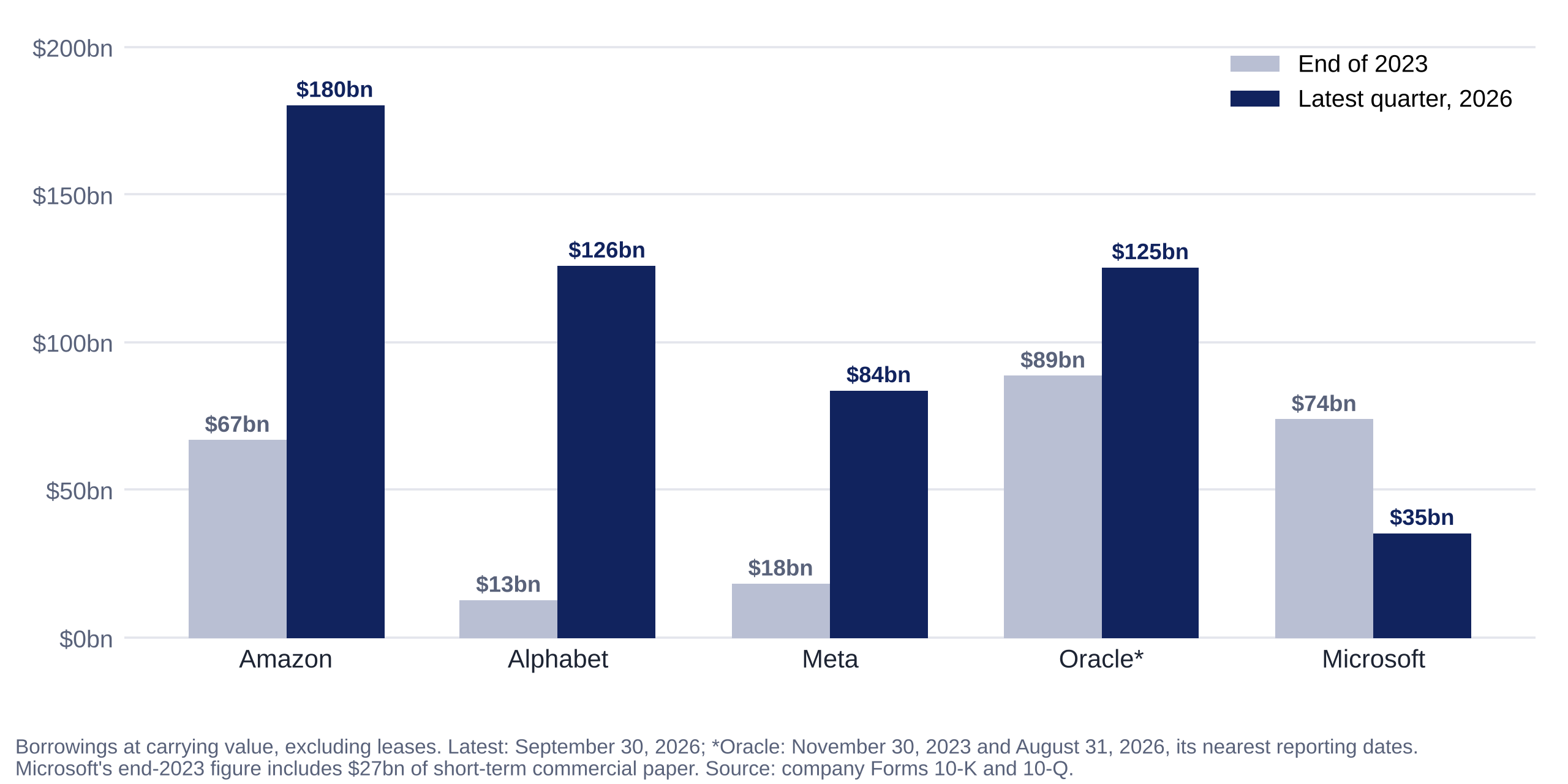
Alphabet's borrowings rose almost tenfold, from $13 billion to $126 billion. Microsoft is the exception: its borrowings fell by September 30, 2026, though its end-2023 figure included $27 billion of short-term commercial paper and its finance lease liabilities rose from $20 billion to $71 billion. It sold $25 billion of bonds in November, including $2 billion due in 20663,8,12. Some of the new debt is very long dated. Alphabet sold bonds maturing in 2126, and Amazon, Meta and Oracle have all sold bonds of 40 years or longer since 202513,14,15,16.
Why are cash-rich companies borrowing?
Because at some of them, spending now exceeds the cash their businesses produce.
Over the 12 months to September 30, 2026, Amazon spent $215 billion on property and equipment, against $168 billion of cash from operations. Oracle spent $76 billion against $47 billion in the 12 months to August 31. Both had negative free cash flow on this measure2,6. Alphabet, Meta and Microsoft still generated more operating cash than they spent on property and equipment, though Alphabet and Meta spent more than they generated in the latest quarter4,5.
Companies expect spending to rise further. Amazon expects about $220 billion of cash capital spending in 2026 and expects “cash capital expenditures to meaningfully increase in 2027.” Alphabet expects $195 billion to $205 billion this year and expects its capital spending “to increase significantly in 2027”2,17. Steve Hanke, professor of applied economics at Johns Hopkins University, summed up the shift in a November interview: “they jumped into the debt market big time”18.
Can they afford it?
The largest four have earnings well above reported interest expense. Oracle has less room.
| Company | Free cash flow, 12 months | Operating income | Interest expense | Income to interest |
|---|---|---|---|---|
| Microsoft | $60.0bn | $163.2bn | $3.2bn | 51 times |
| Alphabet | $19.7bn | $157.0bn | $3.1bn | 51 times |
| Meta | $28.6bn | $79.4bn | $2.8bn | 29 times |
| Amazon | -$46.9bn | $104.4bn | $4.5bn | 23 times |
| Oracle | -$28.7bn | $23.1bn | $5.1bn | 4.5 times |
Twelve months to September 30, 2026; Oracle to August 31, 2026. Free cash flow here is operating cash flow minus cash spent on property and equipment, calculated by Wealthion; companies' own definitions differ. These are company-wide figures, not AI-only spending. Interest expense excludes interest capitalized as part of asset costs. Coverage measures earnings against reported expense, not total repayment capacity. Source: company Forms 10-K and 10-Q2,3,4,5,6.
Reported interest expense is small relative to operating income at most of these companies. Credit rating agency S&P Global Ratings rates Microsoft AAA, Alphabet AA+ and Amazon AA. It moved Meta's outlook to negative on October 30, 2026, citing uncertainty about spending and cash flow, and cut Oracle to BBB-, the lowest investment-grade rating, in July19,20,21. Oracle's November bond sale included 20-year notes paying 8.65%22.
Steven Feldman, co-founder and chief executive of Wealthion, noted that “there's massive borrowing”, and contrasted Microsoft's capacity to repay with that of a less established borrower, CoreWeave23.
What sits outside the debt totals?
Signed leases and joint ventures add obligations. Smaller AI cloud companies present a different borrowing risk.
Leases not yet started. Microsoft has $364.6 billion of signed leases, mainly for data centers, that have not begun; Meta about $355.7 billion and Oracle $288 billion3,5,6. The Fed puts the total across the advanced-computing firms it examined at more than $1 trillion1. These are future contractual payments, not current borrowings.
Joint ventures. Meta has paired with investment firms to build data centers through ventures it does not consolidate into its accounts. BlackRock's investment in the El Paso venture was partly funded with $12.5 billion of debt financing24. Meta's maximum exposure to loss across its two ventures is $68.4 billion, including investments, commitments and conditional guarantees. A guarantee payment could be triggered if Meta ends or does not renew a lease and the property's value is below the agreed threshold, subject to other conditions5.
Weaker borrowers. CoreWeave, which rents AI computing power, had $46.9 billion of debt at September 30, 2026. Its quarterly net interest expense was $846 million on revenue of $3.7 billion, and two customers made up 54% of revenue in the quarter25.
The Fed describes how these pieces connect: strong companies' leases and “backstop guarantees” support weaker borrowers, and some deals involve “circular financing,” where money moves in a loop between investors, suppliers and customers1. Across 14 disclosed transactions, the International Monetary Fund (IMF) identifies $650 billion of additional debt financing. About $320 billion was taken on by companies receiving investment in circular-financing deals, including guaranteed and contingent financing26. Strong companies can absorb losses, the Fed notes, but their exposure can be larger than the debt on their books1.
Why does this matter for bond investors?
Because corporate bond funds can hold debt issued by the same companies in investors' stock portfolios.
Hyperscalers, the largest cloud companies, accounted for about 10% of global investment-grade corporate bond issuance as of July 2026, up from less than 1% at the end of 2024, according to the IMF, which warns that “leverage is rising in the AI ecosystem”26. New issuance adds bonds for funds to buy; a particular fund's exposure depends on its holdings. Intercontinental Exchange (ICE)'s October 2026 report put the extra yield on its US technology and electronics bond index over 10-year Treasuries at 91 basis points (0.91 percentage points), against 51 in September 202527.
The trade-off is uneven. As Steven Feldman put it, “the bond guys, they don't have the upside”23. Bondholders' contractual payments do not rise with the company's profits, although bond prices can rise or fall. Shareholders participate in the company's growth and bear its equity risk28.
What does this mean for investors?
Earnings coverage is stronger at the largest firms. The wider financing network adds other risks.
Strength is concentrated. Microsoft, Alphabet and Meta report operating income many times their interest expense. Oracle's ratio is about 4.5 times, while CoreWeave's quarterly net interest expense was close to a quarter of its revenue6,25.
Obligations go beyond debt. At Microsoft, Meta and Oracle, signed leases that have not started exceed borrowings. The figures measure different things: future contractual payments versus the carrying value of current debt3,5,6.
AI exposure can extend into corporate bond funds. A growing supply of AI-related debt creates another route for exposure to these companies, depending on what a fund holds26,1.
Spending is expected to rise again. Amazon and Alphabet expect to spend more in 2027, though neither has given a figure2,17.
Microsoft, Alphabet, Meta and Amazon currently report earnings well above their interest costs. Oracle has a smaller buffer, while CoreWeave faces a heavier burden. Beyond those comparisons sit leases, guarantees and funding relationships that can spread losses between companies. Those connections help explain why AI financing matters to both stockholders and bondholders.
Frequently asked questions
What is a hyperscaler? A very large cloud computing company that runs data centers at global scale, such as Amazon, Microsoft and Alphabet.
What is investment-grade debt? Debt rated BBB- or higher by S&P, or Baa3 or higher by Moody's. These ratings indicate stronger credit quality than speculative-grade debt; they do not mean no default risk29. Oracle is currently at the bottom of that range at S&P21.
What is off-balance-sheet financing? Financing or commitments not recorded as borrowing on a company's balance sheet, such as leases that have not started or debt in joint ventures whose accounts are not consolidated into its own. These arrangements can still create obligations, including guarantees1,5.
Sources & Disclosure
1 Financial Stability Report, November 2026. Board of Governors of the Federal Reserve System, November 13, 2026; Box 2.2, pages 23 to 25. 2 Amazon.com, Inc. Form 10-Q for the quarter ended September 30, 2026, filed October 30, 2026; balance sheet, cash flows, income statement, Notes 4 and 5 and guidance. Twelve-month figures calculated by Wealthion with the 2025 Form 10-K. 3 Microsoft Corporation Form 10-Q for the quarter ended September 30, 2026, filed October 28, 2026; balance sheet, cash flows, income statement and Note 12, Leases. Twelve-month figures calculated with the fiscal 2026 Form 10-K. 4 Alphabet Inc. Form 10-Q for the quarter ended September 30, 2026, filed October 29, 2026; balance sheet, cash flows, income statement and Note 4, Leases. Twelve-month figures calculated with the 2025 Form 10-K. 5 Meta Platforms, Inc. Form 10-Q for the quarter ended September 30, 2026, filed October 22, 2026; cash flows, income statement, Note 5, Non-Marketable Equity Investments (Data Center Ventures), and Note 10, Commitments and Contingencies (leases). Twelve-month figures calculated with the 2025 Form 10-K. 6 Oracle Corporation Form 10-Q for the quarter ended August 31, 2026, filed September 11, 2026; balance sheet, cash flows, income statement and Note 6. Twelve-month figures calculated with the fiscal 2026 Form 10-K. 7 Amazon.com, Inc. Form 10-K for 2024, filed February 7, 2025; December 31, 2023 balances. 8 Microsoft Corporation Form 10-Q for the quarter ended December 31, 2023, filed January 30, 2024; balance sheet, Notes 10 and 12. 9 Alphabet Inc. Form 10-K for 2024, filed February 5, 2025; December 31, 2023 balances. 10 Meta Platforms, Inc. Form 10-K for 2023, filed February 2, 2024; balance sheet. 11 Oracle Corporation Form 10-Q for the quarter ended November 30, 2023, filed December 12, 2023; balance sheet. 12 Microsoft Corporation Prospectus Supplement (Form 424B2), filed November 2, 2026; $25 billion notes, longest due November 3, 2066. 13 Alphabet Inc. Prospectus Supplement (Form 424B2), filed February 12, 2026; sterling notes due February 13, 2126. 14 Amazon.com, Inc. Prospectus Supplement (Form 424B5), filed March 12, 2026; notes due March 13, 2076. 15 Meta Platforms, Inc. Prospectus Supplement (Form 424B2), filed May 1, 2026; notes due 2066. 16 Oracle Corporation Form 8-K, February 4, 2026, Item 8.01 and Exhibit 4.1; 6.850% notes due February 4, 2066. 17 Alphabet 2026 Q3 Earnings Call, October 28, 2026; Anat Ashkenazi, investment outlook. 18 Wealthion, Steve Hanke Warns: A Financial Crisis Could Send Stocks Down 40%, video published November 11, 2026. 19 S&P Global Ratings, Alphabet Inc.'s Proposed Senior Unsecured Notes Rated AA+, November 11, 2026, and Amazon.com Inc.'s Senior Unsecured Notes Rated AA, March 10, 2026; original report abstracts distributed by Alacra. Microsoft 2026 Annual Report, Note 5, Credit-Risk-Related Contingent Features. 20 Sopaipilla Investor LLC Outlook Revised To Negative From Stable Following Similar Action On Meta Platforms Inc. S&P Global Ratings, November 2, 2026; summary and rationale. 21 S&P Global Ratings, Research Update: Oracle Corp. Downgraded to BBB-/A-3 from BBB/A-2 on Rising Business Risk and Weaker Cash Flow; Outlook Stable, July 9, 2026; Oracle Corp.'s Proposed Unsecured Notes Rated BBB-, November 2, 2026. Original report abstracts distributed by Alacra. 22 Oracle Corporation Prospectus Supplement (Form 424B2), filed November 4, 2026; 8.650% notes due November 4, 2046. 23 Wealthion, What to Own if the Tech Boom Falters, Steven Feldman interview, video published October 30, 2026. 24 Meta Announces New Strategic Venture with BlackRock to Develop Data Center in El Paso. Meta, July 28, 2026; project structure and financing. 25 CoreWeave, Inc. Form 10-Q for the quarter ended September 30, 2026, filed November 12, 2026; income statement, Note 3 revenue concentration and Note 10, Debt. 26 Global Financial Stability Report, October 2026, Chapter 1. International Monetary Fund; pages 2 to 4 and Figure 1.2. Hyperscaler issuance share as of July 2026; circular-financing analysis covers 14 publicly disclosed transactions since 2023. 27 ICE Fixed Income Monthly Report, October 2026. Intercontinental Exchange; Figure 1, Technology and Electronics spread over the 10-year Treasury. 28 Corporate Bonds; Bonds, Selling Before Maturity. US Securities and Exchange Commission, Investor.gov; contractual payments, shareholder rights and secondary-market price changes. 29 Understanding Credit Ratings. S&P Global Ratings; investment-grade threshold. What Is a Credit Rating? Moody's; rating categories and numerical modifiers.
Wealthion is a dba of Greylock Peak Investments, a registered investment adviser. This article is general information only. It is not investment advice or an offer or solicitation, and it is not tailored to your circumstances. Guests’ views are their own and may not reflect those of Wealthion. Wealthion has not verified guest statements, including any performance figures. Investing involves risk, including loss of principal, and past performance does not guarantee future results. Wealthion refers readers to other registered investment advisers and shares in the fees they receive from referred clients, which creates a conflict of interest. Please see our Form ADV Part 2A and consult your own financial advisor before investing.
What Serious Investors Are Watching
Dive into expert interviews, market analysis, and long-form content built to help serious investors think long-term.
Is Debt Financing the AI Build-Out a Concern? Where the Risk Sits for Investors
AI borrowing is growing. Company cash flow, interest coverage and commitments beyond reported debt show why the risks differ between borrowers and portfolios.
I Bonds Explained: How They Work and What You Earn
How I bonds earn interest, adjust for inflation and become available to withdraw, with purchase limits, tax rules and a worked example.
Negative Interest Rates Explained: Policy Rates vs Real Returns
Negative policy rates charge banks on certain central-bank deposits. Negative real returns mean an investment loses purchasing power after inflation. The difference matters for savings, bonds and gold.
Enjoyed This? Get More Insights
Expert insights and curated opportunities, delivered to your inbox.
Ready to Position for What's Coming?
Whether you're still learning or ready to act, your next step starts here.
- Independent
- Macro-Informed
- Real Asset Focused


The Wealthion Network
By subscribing, you agree to receive Wealthion emails. Unsubscribe anytime.
The Wealthion Network
By subscribing, you agree to receive Wealthion emails. Unsubscribe anytime.
Network Discussion
Join the Wealthion Network to Comment