

Accredited Investor vs Qualified Purchaser: Who Qualifies and What Changes
Two legal labels help determine who can buy certain private investments. One looks at your income, wealth or credentials; the other counts qualifying investments you own. Here is who qualifies, what each opens and what neither tells you.
Say someone offers you a slice of a private fund, a startup round or a real estate deal you can't buy through your brokerage app. Before you can invest, you may have to clear a legal bar.
There are two main bars. An accredited investor clears a test of income, wealth or credentials. A qualified purchaser clears a higher test of investments owned. These labels affect who may buy certain private investments that aren't registered with the Securities and Exchange Commission (SEC), but they measure different things and open different doors.
This guide covers who qualifies for each, why some deals use one test and some the other, and the point most often missed: qualifying tells you about you, not about the deal.
The numbers at a glance
Why does the line between these two investor labels matter now?
A label once held by a small slice of households covered almost one in five in 2022.
About 24.3 million US households, or 18.5%, met the wealth or income bar for accredited investor status in 2022, according to a December 2023 SEC staff review. In 1983 the share was 1.8% 1. The figures are survey estimates from the Federal Reserve's Survey of Consumer Finances, so they carry a margin of error 1.
The door may widen further. On September 30, 2026, the SEC published notices asking for comment on letting people qualify by passing an exam or holding certain professional credentials 3.
Who counts as an accredited investor?
For an individual, the main routes are income, net worth, credentials and insider status. One qualifying route is enough.
The routes are set out in Rule 501(a) of Regulation D 4. By income: more than $200,000 in each of the two most recent years, or $300,000 jointly with a spouse or spousal equivalent, with a reasonable expectation of the same this year. By net worth: more than $1 million, alone or jointly, not counting your primary residence, and generally not its mortgage up to the home's value, with exceptions for some recent borrowing 4.
By credentials: a Series 7, 65 or 82 license in good standing, routes the SEC added in August 2020 5. And by insider status: directors, executive officers and general partners of the issuer, plus "knowledgeable employees" of a private fund investing in that fund 4,5.
Entities have their own routes. Selected routes require more than $5 million in total assets or investments and that the entity was not formed to buy the specific securities. Other routes cover certain regulated entities or entities whose equity owners are all accredited 4,5. And the September 2026 notices would add new routes for individuals if the SEC finalizes them: an exam developed by the Financial Industry Regulatory Authority (FINRA), valid for 10 years 3, a US Certified Public Accountant (CPA) license in good standing 6, the Chartered Financial Analyst (CFA) charter in good standing 7, the US Certified Financial Planner (CFP) certification in good standing 8, and either a Series 79 license or a Research Analyst license (Series 86 and 87 together), held in good standing 9. As of November 13, 2026, these are requests for comment, not final orders, and comments are due December 4, 2026, 60 days after their Federal Register publication on October 5 3.
Accredited investor vs qualified purchaser: how do the tests differ?
Accredited asks how much you earn or are worth. Qualified purchaser asks a narrower question: how much do you have invested?
The qualified purchaser test comes from section 2(a)(51) of the Investment Company Act, added in 1996 2. An individual qualifies by owning at least $5 million in investments, as does a qualifying family-owned company. Most other entities need at least $25 million owned and invested on a discretionary basis 2. Income never counts, and there is no credential route.
What counts as an investment is defined by SEC Rule 2a51-1: securities, plus real estate, commodities and cash held for investment 10. Personal-use property and property used in your own or a related person's operating business generally don't count. Property leased to unrelated businesses may qualify, as may property held in connection with the business of someone primarily engaged in real estate investing, trading or development. Holdings are counted at market value or cost, minus any debt taken on to buy them 10.
Only investments owned count toward qualified purchaser status
Main tests for each status, simplified 4,2,10
| Accredited investor | Qualified purchaser | |
|---|---|---|
| Income | Over $200,000 ($300,000 joint) in each of the last two years, with a reasonable expectation of the same this year | Does not count |
| Net worth | Over $1 million, alone or joint, excluding the primary residence | Does not count |
| Investments owned | Individuals: no separate test. Some entities: over $5 million | At least $5 million for individuals, net of debt used to buy them |
| Credentials | Series 7, 65 or 82 in good standing; more proposed in September 2026 | No credential route |
| Entities | Selected routes: over $5 million in assets or investments; all equity owners accredited; certain regulated entities | $25 million invested at discretion; $5 million for qualifying family companies |
| Insiders | Issuer directors and executive officers; a fund's knowledgeable employees | A fund's knowledgeable employees may invest under Rule 3c-5 |
The practical gap is wide. An individual with $2 million in total qualifying investments and no debt clears the accredited net worth bar but is $3 million short of qualified purchaser status. A high earner with little saved may be accredited on income alone, yet income does nothing for the qualified purchaser test.
Why do different private offerings use different tests?
Because two different laws are asking two different questions.
Securities rules govern how a deal is sold without registering it. The Investment Company Act decides whether a pooled vehicle must register as a fund. A private fund has to answer both.
On the sales side, Rule 506(b) allows unlimited accredited investors plus up to 35 non-accredited buyers in any 90-calendar-day period, each with enough financial knowledge, alone or with a purchaser representative, to evaluate the deal, but bars public advertising 11. Rule 506(c) allows advertising, but every buyer must be accredited and the issuer must take reasonable steps to verify it 12.
On the fund side, a section 3(c)(1) fund generally has no more than 100 beneficial owners and makes no public offering. Qualifying venture capital funds may have up to 250, and knowledgeable employees are excluded from the count. A section 3(c)(7) fund generally admits qualified purchasers, with no 100-owner cap, but knowledgeable employees may invest without themselves being qualified purchasers 2.
Each exemption sets its own buyer test; 3(c)(7) generally requires qualified purchasers
Which buyer test each exemption uses 11,12,2
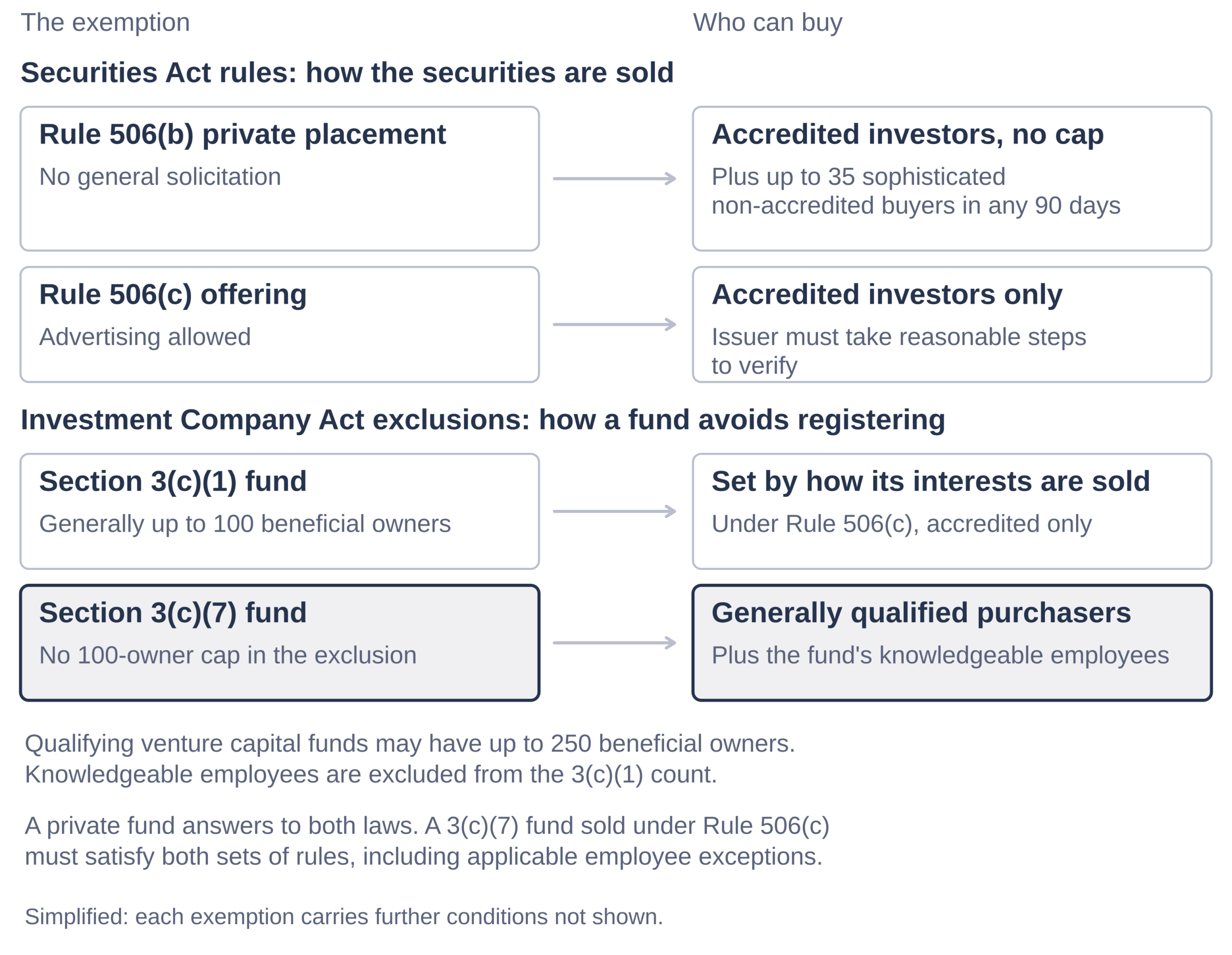
So the tests stack rather than replace each other. Qualified purchaser is not a higher grade of accredited investor. It's the gate to one type of fund.
Does qualifying make an investment suitable or safer?
No. Both tests check the buyer, not the deal.
The SEC's investor bulletin says these private offerings "involve unique risks" and that you could lose your entire investment. It also notes that issuers "do not have to make prescribed disclosures to accredited investors" 13. The SEC's private placement bulletin adds that offering documents "typically are not reviewed by any regulator," that the investments are "highly illiquid" and that a Form D filing "does not represent SEC approval or registration" 14. It warns that "fraudsters may use unregistered offerings to conduct investment scams" 14. Clearing a higher bar does not, by itself, reduce the investment's underlying risks.
Three ideas often get blurred together:
| Idea | What it means |
|---|---|
| Eligibility | A legal test of who may invest in a particular offering. This is what the two tests address. |
| Suitability | Whether a specific investment fits your goals, time horizon, need for cash and tolerance for loss. Clearing $1 million in net worth says nothing about whether your money can sit locked up for years. |
| Due diligence | Checking the issuer, its terms, fees and track record. An issuer's check of your status is not a check of the investment. |
Even the issuer's check points at you. Under Rule 506(b), an issuer needs a "reasonable belief" that you're accredited; under 506(c), it must take "reasonable steps to verify." Under either rule, a checked box alone isn't enough 15. Likewise, a fund limited to qualified purchasers has a narrower investor base, not a vetted portfolio.
Are dollar thresholds the right way to decide who gets in?
There's a fair case on both sides.
The case for financial thresholds is that they offer a practical way to identify investors who can assess risks, obtain information or withstand a loss without the protections of a registered offering. They are proxies, rather than guarantees 1.
The critique is that money is a blunt proxy. SEC Commissioner Hester Peirce said on September 30, 2026, that "wealth and income are not always great proxies for an investor's sophistication." She supported the notices, yet said an exam "still embodies a government-as-gatekeeper mentality" 16.
The thresholds have also drifted. The 2023 staff review found the jump in qualifying households "appears to be largely due" to the individual thresholds not being adjusted for inflation. Indexed to consumer prices from 1982 to 2022, the $1 million net worth bar would have been about $3.04 million 1. That cuts both ways: more households can buy private deals, while the same dollar figure signals less capacity to absorb a loss than it once did. An exam would test knowledge instead, which still says nothing about how much you can afford to lose.
Qualifying opens the door. It doesn't tell you what's behind it.
Frequently asked questions
Does a primary residence count toward either test? No. It's excluded from net worth for the accredited test, and real estate used for personal purposes doesn't count as an investment for the qualified purchaser test 4,10.
Is the accredited investor exam in effect? Not as of November 13, 2026. The SEC published it as a notice for public comment on September 30, 2026, and has not issued a final order 3.
Does a qualified purchaser automatically count as accredited? The tests are separate and calculated differently. Someone with $5 million in investments will often clear the $1 million net worth bar too, but each test is applied on its own terms 4,10.
Sources & Disclosure
1 Review of the "Accredited Investor" Definition under the Dodd-Frank Act. SEC staff, December 14, 2023; household counts and shares meeting the thresholds in 1983 and 2022 (Survey of Consumer Finances estimates), inflation-adjusted net worth threshold. 2 Privately Offered Investment Companies, Release No. IC-22597. SEC, 1997 (effective June 9, 1997); section 2(a)(51) qualified purchaser categories, sections 3(c)(1) and 3(c)(7), Rule 3c-5 knowledgeable employees. Supplemented by current 15 USC 80a-3(c)(1) and (7), including the qualifying venture capital fund exception, and current 17 CFR 270.3c-5, including employee treatment in both exclusions. 3 Potential Designation of Passage of an Accredited Investor Exam to Be Developed by FINRA as Qualifying Natural Persons for Accredited Investor Status, Release No. 33-11445. SEC, September 30, 2026; proposed FINRA exam, 10-year validity, comment period, proposal status. 4 17 CFR 230.501, Definitions and terms used in Regulation D. eCFR, current as of October 23, 2026; accredited investor categories, income and net worth tests, residence rule, spousal equivalent. 5 SEC Modernizes the Accredited Investor Definition, Press Release 2020-191. SEC, August 26, 2020; Series 7, 65 and 82 credentials, knowledgeable employees, entity and family office categories, spousal equivalents. 6 Potential Designation of U.S. Certified Public Accountant License as Qualifying Natural Persons for Accredited Investor Status, Release No. 33-11446. SEC, September 30, 2026; proposed CPA route. 7 Potential Designation of Chartered Financial Analyst Designation as Qualifying Natural Persons for Accredited Investor Status, Release No. 33-11447. SEC, September 30, 2026; proposed CFA route. 8 Potential Designation of Certified Financial Planner Certification as Qualifying Natural Persons for Accredited Investor Status, Release No. 33-11448. SEC, September 30, 2026; proposed CFP route. 9 Potential Designations of the Investment Banking Representative License (Series 79) and the Research Analyst License (Series 86 and Series 87) as Qualifying Natural Persons for Accredited Investor Status, Release No. 33-11449. SEC, September 30, 2026; proposed FINRA license routes. 10 17 CFR 270.2a51-1, Definition of investments for purposes of section 2(a)(51). Code of Federal Regulations, 2017 annual edition via GovInfo; what counts as investments, personal-use real estate exclusion, valuation, debt deduction. 11 Private Placements - Rule 506(b). SEC, last reviewed September 21, 2026; 35 non-accredited buyer limit, no general solicitation, disclosure to non-accredited buyers. 12 General solicitation - Rule 506(c). SEC, last reviewed March 17, 2026; all purchasers accredited, reasonable steps to verify. 13 Accredited Investors - Updated Investor Bulletin. SEC Office of Investor Education and Advocacy (Investor.gov), April 14, 2021; risk of loss, no prescribed disclosures to accredited investors. 14 Private Placements under Regulation D - Updated Investor Bulletin. SEC Office of Investor Education and Assistance (Investor.gov), updated September 21, 2026; no regulator review of offering documents, illiquidity, Form D is not approval, fraud warning. 15 Assessing Accredited Investors under Regulation D. SEC, March 21, 2025, last reviewed April 24, 2026; reasonable belief versus reasonable steps to verify, self-certification not enough. 16 The Other AI: Remarks at the Open Commission Meeting on Accredited Investor Notices under Rule 501(a)(10) of Regulation D. Commissioner Hester M. Peirce, SEC, September 30, 2026; quotes on wealth as a proxy and the exam.
Wealthion is a dba of Greylock Peak Investments, a registered investment adviser. This article is general information only. It is not investment advice or an offer or solicitation, and it is not tailored to your circumstances. Guests’ views are their own and may not reflect those of Wealthion. Wealthion has not verified guest statements, including any performance figures. Investing involves risk, including loss of principal, and past performance does not guarantee future results. Wealthion refers readers to other registered investment advisers and shares in the fees they receive from referred clients, which creates a conflict of interest. Please see our Form ADV Part 2A and consult your own financial advisor before investing.
What Serious Investors Are Watching
Dive into expert interviews, market analysis, and long-form content built to help serious investors think long-term.

Accredited Investor vs Qualified Purchaser: Who Qualifies and What Changes
Two legal labels help determine who can buy certain private investments. One looks at your...

How Much Cash Belongs in a Portfolio? It Depends on the Job You Give It
Money set aside for a tax bill can sit in the same account as money...

Macro Bites – Nvidia Slides 8% on CEO Turmoil as Iran Talks Stall
Iran’s Secretary of the Supreme National Security Council Mohsen Rezaei said Wednesday that Washington has...
Enjoyed This? Get More Insights
Expert insights and curated opportunities, delivered to your inbox.
Ready to Position for What's Coming?
Whether you're still learning or ready to act, your next step starts here.
- Independent
- Macro-Informed
- Real Asset Focused


The Wealthion Network
By subscribing, you agree to receive Wealthion emails. Unsubscribe anytime.
The Wealthion Network
By subscribing, you agree to receive Wealthion emails. Unsubscribe anytime.
Network Discussion
Join the Wealthion Network to Comment