

When Should You Rebalance a Portfolio? How the Main Approaches Work
When you build a portfolio, you choose investments to help you reach a goal. You might be saving for retirement, preparing for a major expense or investing money that now needs to provide an income. The balance of stocks, bonds and cash reflects when you expect to need that money and how much uncertainty you are comfortable with along the way.1
Over time, that balance may need attention. Markets can change the proportions of your investments, while changes in your life can affect the proportions that suit you. Rebalancing brings the holdings back toward a chosen mix. Some investors make that adjustment on a schedule, such as once a year; others act when the mix has changed by a preset amount. The aim is to keep the investments aligned with the reason you own them.
Why might your portfolio need rebalancing?
The mix that suited you while retirement was decades away may feel different when withdrawals are about to begin. A change in income, spending plans or your ability to tolerate losses can also change what you need from the portfolio. In those situations, the question is whether the original allocation still fits.1
Markets create a separate reason for a review. After stocks have risen faster than bonds, they account for more of the portfolio, even if you have bought nothing. A higher balance can therefore come with more exposure to the next stock-market decline. Rebalancing can reduce that stock share and add to holdings that have fallen below their intended share.1
This can feel counterintuitive: an investment that has done well is the one being reduced. But the reason for selling is that its place in the portfolio has grown. A rebalancing rule does not require a view that the rally is about to end.2
The distinction matters. Restoring an existing mix and choosing a different one solve different problems. One responds to changes in the holdings; the other responds to changes in the investor's needs.
How do the main rebalancing approaches decide when to act?
There are three common ways to connect a portfolio review with an adjustment. Their main difference is whether the trigger is a date, a change in the investment mix, or both.1,2
Calendar-based rebalancing returns the portfolio to its target on a set schedule, such as annually. It is relatively simple to organize because the dates are known in advance. Its limitation is that markets may change the mix considerably before the next date arrives. It can also produce a trade when little has changed.
Threshold-based rebalancing responds to the size of the change. For example, a hypothetical rule might trigger when a stock allocation moves from 60% to 65%, a five-percentage-point increase in its share of the portfolio. This is different from stocks gaining 5%. The threshold is an illustration, not a limit that suits every investor. This approach needs ongoing monitoring, although the checks do not always lead to trades.
A combined approach separates the review date from the decision to trade. The portfolio is checked on a schedule and adjusted only if it has crossed its agreed limit. A small change may result in no transaction. The trade-off is that a larger change between review dates can remain in place until the next check.
Is rebalancing once a year enough?
An annual schedule is one workable framework, rather than a rule for every portfolio. The Securities and Exchange Commission describes both six- and twelve-month intervals, alongside approaches based on changes in allocation.1
Research also gives little reason to assume that more frequent trading is always better. Vanguard researchers studying American stock and bond returns from 1926 through 2009 found broadly similar results relative to the risk taken with monthly, quarterly and annual rebalancing. More frequent adjustments meant more transactions and associated costs.2
Those findings concern the portfolios and historical returns studied. They do not establish an ideal interval for every combination of investments, taxes and trading charges. The practical choice also depends on how much variation from the target is acceptable and how the portfolio is monitored.
A change in your circumstances raises a question that a calendar alone cannot answer: does the target still make sense? Returning investments to an outdated allocation would not resolve that change in your needs.1
How much can the mix change if it is left alone?
The effect can be substantial over many years. The chart follows an illustrative portfolio that began at the end of 2004 with 60% in American stocks and 40% in Treasury bonds. One version was left alone; the other was reset to the starting mix at each year-end.3,4
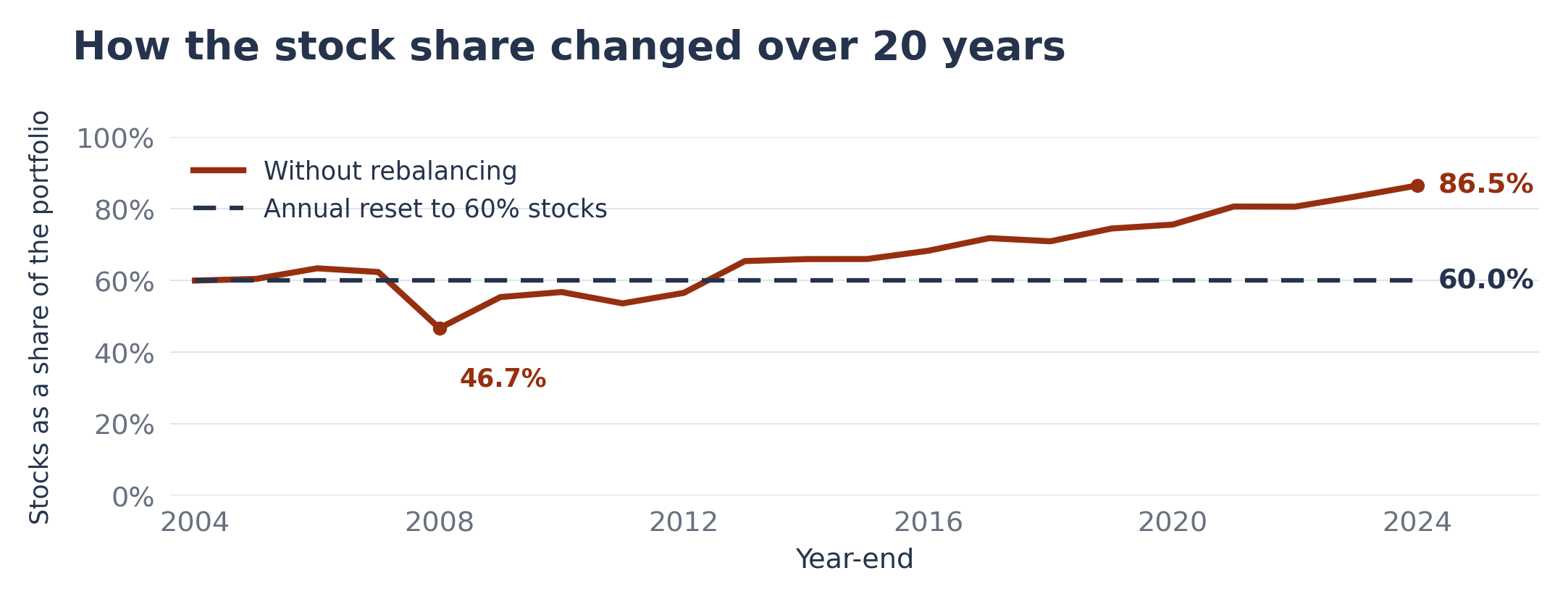
Illustration, end-2004 to end-2024; starting mix: 60% stocks/40% bonds. Stocks: Standard & Poor's 500 (S&P 500), including dividends; bonds: 10-year United States Treasury return series. Year-end observations follow annual resets; weights can change between them. Income reinvested; no deposits, withdrawals, taxes or costs. A separate 40% stock/60% bond starting mix reached 74.0% stocks without rebalancing. These are examples, not recommended allocations. Source: Wealthion calculations using published annual returns from Aswath Damodaran, New York University Stern School of Business.3,4
Without rebalancing, the stock share reached 86.5% by the end of 2024. But the movement was not always upward: it fell to 46.7% in 2008. Restoring the starting mix after that fall would have meant moving money toward stocks. Rebalancing can therefore add to a weaker asset as well as reduce a stronger one.4
The chart measures the investment mix, not which approach earned more. If stocks continue rising, selling some of them can produce smaller gains than leaving the portfolio alone. Rebalancing manages exposure relative to a target; it does not prevent losses or guarantee a higher return.2
Can contributions and withdrawals help without extra sales?
An adjustment does not always require selling an investment. New savings can buy more of a holding whose share has become too small. Dividends and interest can serve the same purpose, rather than automatically purchasing more of the investment that paid them. The Financial Industry Regulatory Authority (FINRA) describes these uses of portfolio cash flows in its rebalancing guidance.5
Withdrawals work in the opposite direction. When stocks have grown beyond their intended share, taking spending money from that part of the portfolio can also bring the mix closer to its target. This connects rebalancing with money already entering or leaving the account.
The size of those flows matters. A small contribution will make little difference to a large imbalance in a much larger portfolio. Cash flows may reduce the amount that needs to be sold without completing the adjustment.5
What trading costs can a rebalance involve?
Rebalancing can involve commissions and other transaction charges.6 A commission-free trade may still involve a bid-ask spread, the difference between the highest buying price and lowest selling price.7
Moving partway toward the target can reduce the amount traded, but it leaves some of the changed exposure in place. That is the trade-off behind partial rebalancing: fewer costs today may mean accepting a portfolio farther from its intended mix.2
How do taxes affect a portfolio rebalance?
Where the investments are held can matter as much as which investments change. In a taxable brokerage account, a sale can realize a capital gain. The gain generally depends on the sale proceeds minus the investment's adjusted tax cost, rather than on the whole amount sold.8
Shares bought at different prices can produce different gains when sold. Their holding periods matter too: gains are generally long term after more than one year, while net short-term gains are taxed at ordinary-income rates.8,9 These differences help explain why two investors making a similar adjustment may face different tax bills.
Trading inside an individual retirement account (IRA) generally does not create current capital-gains tax. Taking money out is a separate event governed by the account's distribution rules.10 Looking across accounts can reveal different ways to change the overall mix, with different tax consequences.
Using dividends to rebalance does not remove their tax treatment: taxable dividends remain reportable when reinvested. Selling at a loss raises a separate issue. A deduction can be disallowed if substantially identical securities are bought within 30 days before or after the sale. Purchases by a spouse or through the seller's IRA can also trigger wash-sale rules.9
How do required retirement withdrawals fit in?
For someone subject to required minimum distributions (RMDs), an annual withdrawal can also reduce a holding that has grown beyond its target share. Selling investments inside the account and distributing money are separate steps; the internal sale alone does not satisfy the withdrawal requirement.5,10
The amount available to reinvest elsewhere depends on spending needs and taxes. Using an RMD to rebalance does not change the withdrawal's tax treatment. Account rules also differ: original Roth IRA owners have no lifetime RMDs.10
The starting point remains what the money is meant to do. A portfolio can need rebalancing because markets have changed its holdings, or a different target because life has changed its purpose. Understanding that difference gives the timing question its context. A date or a threshold provides a way to act consistently; the goal, the costs and the money coming in or out explain what that action is meant to achieve.
We are not making any recommendations.
Sources & Disclosure
1 Beginners’ Guide to Asset Allocation, Diversification, and Rebalancing. Securities and Exchange Commission, Investor.gov. Accessed November 13, 2026; goals, time horizon, risk tolerance, Changing Your Asset Allocation, Rebalancing 101 and When to Consider Rebalancing sections. 2 Best Practices for Portfolio Rebalancing. Colleen M. Jaconetti, Yan Zilbering and Francis M. Kinniry, AAII Journal. Original Vanguard-author research article; accessed November 13, 2026. Broad American stock and bond data, 1926–2009; purpose of rebalancing, frequency comparisons, rebalancing triggers and implementation costs. 3 Historical Returns on Stocks, Bonds and Bills. Aswath Damodaran, New York University Stern School of Business. Updated January 5, 2026; published annual Standard & Poor's 500 stock returns including dividends and 10-year United States Treasury bond returns, 2005–2024. Data compiled from multiple data services. The illustration deliberately covers the 20 years after the end of 2004. 4 Wealthion historical allocation illustration. Wealthion calculations. Calculated from source 3's published annual returns. Illustrative portfolios start at the end of 2004 with 60% stocks/40% bonds and, separately, 40% stocks/60% bonds. Income is reinvested within each asset sleeve. No deposits, withdrawals, taxes or costs. Unrebalanced holdings compound independently; the annual-reset portfolio returns to its starting weights at each year-end. Chart observations follow those resets and do not show drift between them. Allocations are examples, not recommendations. 5 Report on Digital Investment Advice. Financial Industry Regulatory Authority. March 2016, printed pages 11–12; monitoring and rebalancing policies, contributions, dividends, withdrawals, insufficient cash flows and potential commissions/tax consequences. 6 How Fees and Expenses Affect Your Investment Portfolio: Investor Bulletin. Securities and Exchange Commission, Investor.gov. July 23, 2025; transaction fees, commissions, markups/markdowns and other product charges. 7 Bid Price/Ask Price. Securities and Exchange Commission, Investor.gov glossary. Accessed November 13, 2026; bid, ask and spread definitions. 8 Topic no. 409, Capital gains and losses. Internal Revenue Service. Accessed November 13, 2026; sale proceeds and adjusted basis, holding periods, and ordinary-income treatment of net short-term gains. No current income thresholds or assumed personal tax rates are used. 9 Publication 550 (2025), Investment Income and Expenses. Internal Revenue Service. Accessed November 13, 2026; dividends used to buy stock, share identification and basis, and Wash Sales sections. 10 Publication 590-B (2025), Distributions from Individual Retirement Arrangements (IRAs). Internal Revenue Service. Accessed November 13, 2026; tax advantages of an IRA, required minimum distributions, distributions not eligible for rollover and original Roth IRA owners' lifetime distribution rules.
Wealthion is a dba of Greylock Peak Investments, a registered investment adviser. This article is general information only. It is not investment advice or an offer or solicitation, and it is not tailored to your circumstances. Guests’ views are their own and may not reflect those of Wealthion. Wealthion has not verified guest statements, including any performance figures. Investing involves risk, including loss of principal, and past performance does not guarantee future results. Wealthion refers readers to other registered investment advisers and shares in the fees they receive from referred clients, which creates a conflict of interest. Please see our Form ADV Part 2A and consult your own financial advisor before investing.
What Serious Investors Are Watching
Dive into expert interviews, market analysis, and long-form content built to help serious investors think long-term.
When Should You Rebalance a Portfolio? How the Main Approaches Work
Your goals shape your investment mix. Rebalancing addresses changes in that mix, with schedules, cash flows, taxes and costs shaping the adjustment.

Why a Copper Shortage Does Not Guarantee Bigger Profits for Miners
Copper prices reached record highs in the third quarter of 2026, but copper miners' profits...

Macro Bites – US Deficit Hits $404B; Fed Officials Signal More Rate Hikes
Just hours before Iran claimed to have hit a U.S. military’s early-warning radar system in...
Enjoyed This? Get More Insights
Expert insights and curated opportunities, delivered to your inbox.
Ready to Position for What's Coming?
Whether you're still learning or ready to act, your next step starts here.
- Independent
- Macro-Informed
- Real Asset Focused


The Wealthion Network
By subscribing, you agree to receive Wealthion emails. Unsubscribe anytime.
The Wealthion Network
By subscribing, you agree to receive Wealthion emails. Unsubscribe anytime.
Network Discussion
Join the Wealthion Network to Comment