

Why a Copper Shortage Does Not Guarantee Bigger Profits for Miners
Copper prices reached record highs in the third quarter of 2026, but copper miners' profits haven't all risen at the same pace 1. Here's what decides whether a higher copper price reaches a miner's profit, and what investors can look at beyond the price itself.
A copper mining company digs copper ore out of the ground, processes it and sells the copper. For investors, these companies are one of the main ways to gain exposure to the copper price.
With copper prices having reached record highs, it's natural to expect miners' profits to rise just as fast. Sometimes they do. Profit also depends on how much the company produces, what each pound costs, how much goes to governments and how much it must reinvest to keep its mines running.
Is there really a copper shortage?
In concentrate supply, yes. In finished copper, not on current global annual forecasts.
Most mines don't sell pure copper. They sell concentrate, a copper-rich powder that smelters and refineries turn into refined copper, the finished metal manufacturers buy. The two markets can move differently.
In October 2026, the International Copper Study Group (ICSG), an intergovernmental body, forecast that world mine output would grow just 1.3% in 2026. Yet it still expected a refined copper surplus of 104,000 metric tons this year and 368,000 tons in 2027 2.
The tightness is in what mines produce, which can improve the terms miners selling concentrate receive.
How much have copper prices risen?
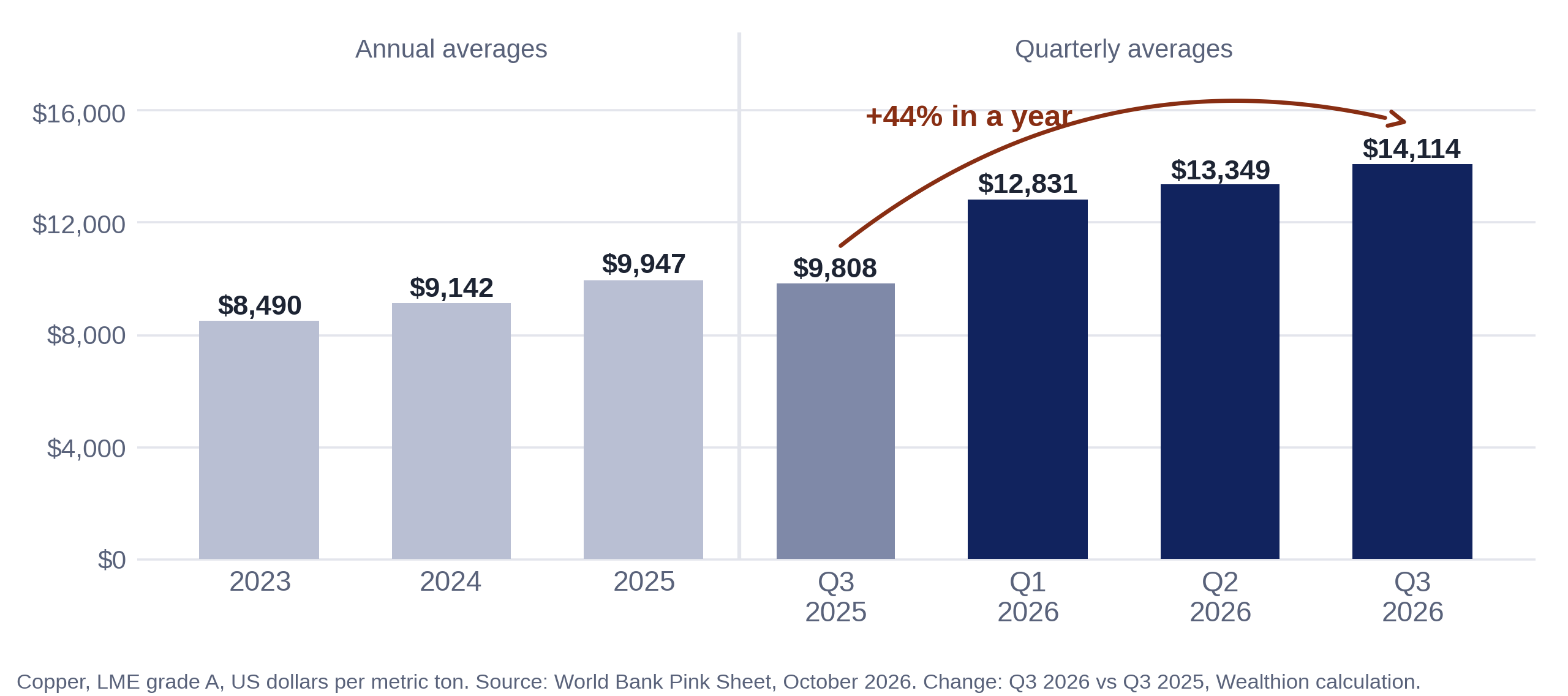
London Metal Exchange (LME) copper averaged $14,114 a metric ton in the third quarter of 2026, 44% higher than a year earlier (Wealthion calculation) 3.
Copper prices have climbed 44% in a year
Average copper price, United States dollars per metric ton; Q means quarter. World Bank 3
Have miners' profits gone up so far?
Yes, at all four miners we looked at, but by very different amounts.
In most cases, profit grew faster than the copper price itself. Many of a miner's costs don't rise with the price, so more of each extra dollar of revenue drops through to profit.
| Miner (period) | Latest | Year earlier | Change |
|---|---|---|---|
| Southern Copper (Q3 2026) | $1.80 billion | $1.11 billion | Up 63% |
| Freeport-McMoRan (Q3 2026) | About $1.2 billion | $674 million | Up 74% |
| First Quantum Minerals (Q3 2026) | $207 million | Loss of $48 million | Back to profit |
| Antofagasta (first half of 2026) | $847 million | $522 million | Up 62% |
Attributable net profit, including exceptional items; changes use unrounded figures. Periods differ. Freeport's 2025 quarter included initial Grasberg disruption costs. Company results 4, 1, 5, 6.
At Freeport, company-wide profit rose while its calculated copper cash margin remained below its pre-disruption level. That difference shows why the profit total needs explanation.
Why haven't all miners gained equally?
The price that matters to a miner is its realized price: the revenue price it recorded for the copper it sold. That can differ from the exchange price. In the third quarter of 2026, Freeport-McMoRan realized $6.54 a pound, while LME copper averaged $6.40 1.
In September 2025, a mud rush, a sudden flow of wet material into underground workings, hit Freeport's Grasberg mine in Indonesia. By the third quarter of 2026, its mill was running at 67% of capacity 1. Freeport's realized price kept climbing, but it sold fewer pounds and each pound cost more to produce. Its calculated copper cash margin, (price minus net cash cost per pound) multiplied by pounds sold, stayed below its pre-mud-rush level of about $3.5 billion, despite a 44% higher realized price 1, 7, 8, 9.
Freeport's copper price rose 44%, but its cash margin stayed below its pre-mud-rush level
Freeport-McMoRan, by quarter; cash margin is a Wealthion calculation, not reported copper profit. Net cash costs include by-product credits and exclude relevant Grasberg idle and restoration costs in 2025 and 2026. In the chart, bn means billion, m means million and lb means pounds 1, 7, 8, 9.
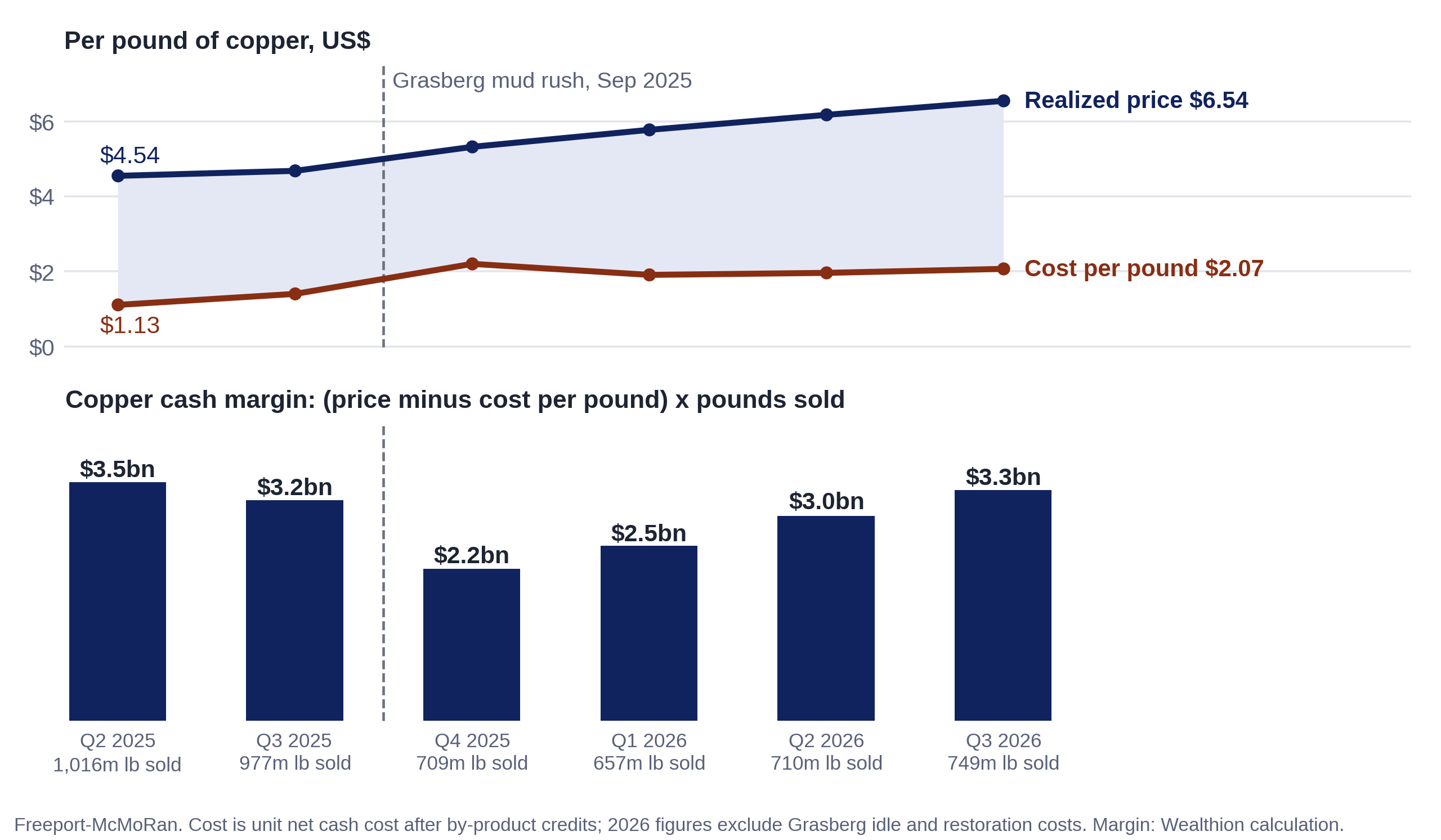
The calculation also leaves out Grasberg's idle and restoration costs, which were $244 million in the third quarter of 2026 alone 1.
What can stop a higher price from reaching profit?
Falling output. As Freeport shows, a miner that sells fewer pounds can lose more from lower volume than it gains from a higher price.
Rising costs. Ore grade, the share of copper in the rock, can fall over time. In Chile, the world's largest producer, the average processed-ore grade fell from 1.29% in 2000 to 0.58% in 2025, so more ore must be processed for each pound, all else equal 10. Energy matters too: Southern Copper said its production costs rose 12.3% in the third quarter of 2026, "pushed upward by higher fuel and energy costs" 4.
Hedging. A fixed-price hedge locks in a price in advance. It protects a miner if prices fall, but gives up gains if they rise, on the hedged volume. First Quantum Minerals realized $5.34 a pound in the second quarter of 2026, against an LME average of $6.05, after hedge losses of $158 million 11. Once its hedges ended on June 30, its realized price rose to $6.37 5.
Governments. Royalties, payments to governments for the right to mine, are often linked to sales or profit margins, so the dollar amounts can rise when prices rise. In the first nine months of 2026, Southern Copper's copper revenue rose 34%, while its Mexican mining royalty rose 82% and its Peruvian royalty and special mining tax rose 95% (Wealthion calculation) 4. These company-wide charges also depend on other metals, volumes and profits.
One more point for investors: cost figures can measure different things. Miners often subtract revenue from other metals they produce, such as gold or molybdenum, from their copper costs: Southern Copper's cash cost was $2.46 a pound before these by-products and $0.09 after in the third quarter of 2026 4. All-in sustaining cost (AISC) adds sustaining capital and other charges; First Quantum's cash cost was $2.59 a pound and its AISC $4.30 5. A low cost figure can reflect strong by-product prices, or leave out spending, as much as an efficient mine.
Which miners benefit from the shortage?
When miners sell concentrate, smelters take a fee off the price to cover turning it into refined copper. These fees are called treatment and refining charges. When concentrate is scarce, smelters compete for it and the fees fall, leaving more of the copper price with the miner.
That's what has happened. The annual treatment benchmark fell from $21.25 per dry metric ton of concentrate for 2025 to zero for 2026. The 2025 refining benchmark was 2.125 cents per pound of payable copper 12. In spot deals, treatment charges have gone below zero, so smelters are effectively paying miners to secure concentrate. Chile's state copper commission, Cochilco, concluded that the value created by higher prices has been captured mainly by mining 12. Benchmark terms do not set every contract.
The gain is uneven. Mines that make refined copper on site pay no outside smelter fees, and miners that own smelters are partly on the losing side 12.
What does this mean for investors?
Cash generated by the business isn't the same as cash paid to shareholders, even at a low-cost miner.
In the third quarter of 2026, Southern Copper's operating cash flow was $2,224.3 million and capital spending $515.8 million. That left $1,708.5 million of free cash flow, equivalent to $3.32 per pound of copper sold, against $6.72 in copper revenue per pound (Wealthion calculation) 4. This is company-wide cash flow, including other metals and working-capital changes, not a copper-only margin. Capital spending includes growth and maintenance.
Southern Copper's company-wide free cash flow equaled about half its copper revenue
Third quarter of 2026, United States dollars per pound of copper sold; company-wide cash flow divided by copper pounds sold. Wealthion calculation 4
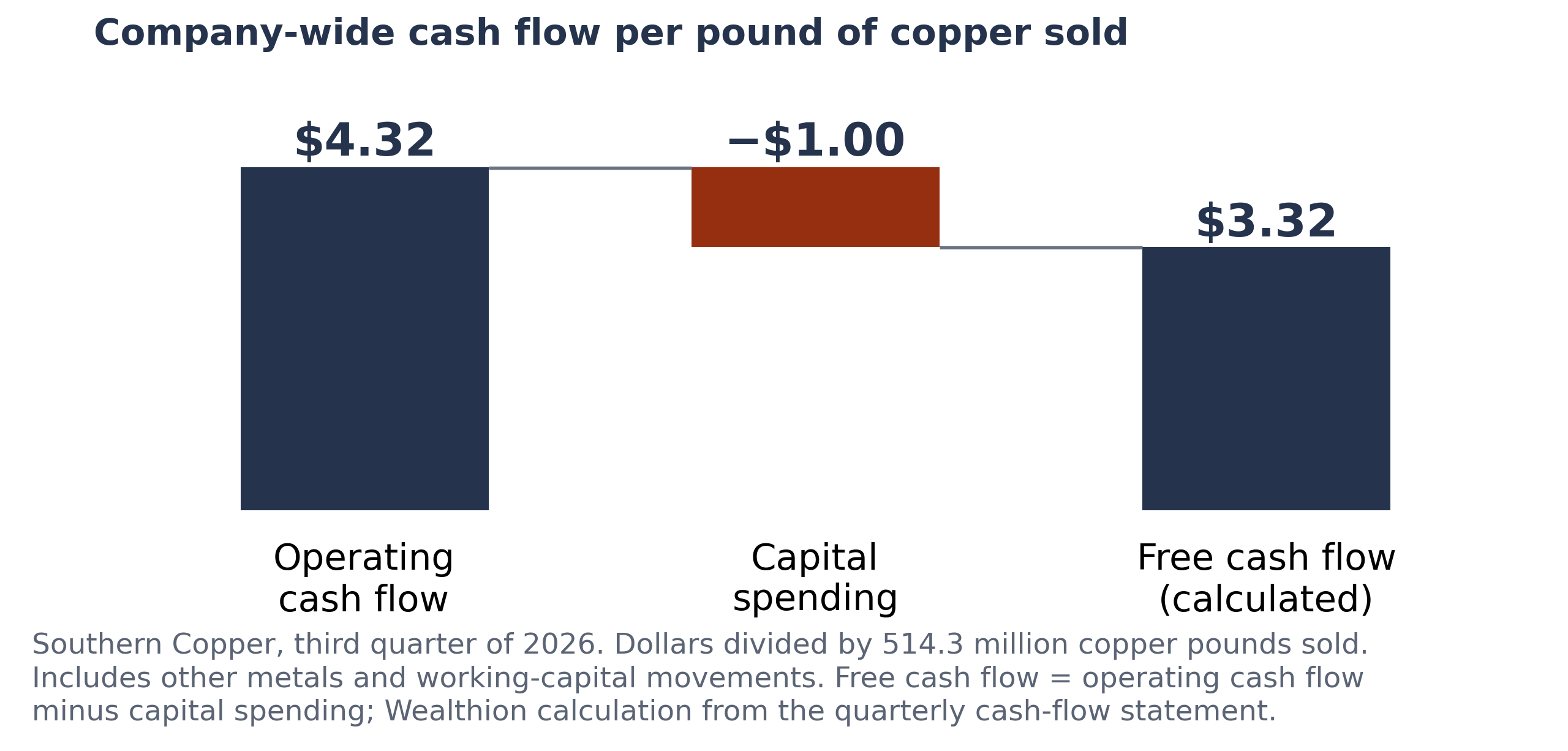
Some of that cash goes to shareholders. Southern Copper paid $917.9 million in dividends in the quarter, a little over half its calculated free cash flow 4.
Copper mining shares are priced on expectations for years of prices, output, costs and taxes, not on one quarter's copper price. Treating a higher copper price as a matching rise in every miner's earnings is a common mistake.
Frequently asked questions
Is there a copper shortage in 2026? Concentrate is tight; refined metal is forecast to be in surplus globally 2, 12.
What are treatment and refining charges? Fees smelters earn for turning concentrate into refined copper, taken off what they pay miners. The 2026 annual treatment benchmark is zero; individual contracts differ 12.
Sources & Disclosure
1 Third-quarter 2026 financial and operating results, October 27, 2026, and Form 10-Q for the quarter ended September 30, 2026. Freeport-McMoRan; dated LME settlement record, realized prices, net cash costs and exclusions, sales, Grasberg operations and attributable income. 2 ICSG Copper Market Forecast 2026-2027. International Copper Study Group press release, October 14, 2026; mine production growth and refined copper balance. 3 World Bank Commodities Price Data (The Pink Sheet), October 2026. World Bank, October 2, 2026; copper (LME grade A) annual, quarterly and monthly averages. 4 Form 10-Q for the quarter ended September 30, 2026. Southern Copper Corporation; attributable income, cash costs and by-product credits, copper revenue and pounds sold, royalties, operating cash flow, capital expenditures and cash dividends. Free cash flow is a Wealthion calculation: operating cash flow less capital expenditures. Per-pound cash-flow amounts divide company-wide figures by copper pounds sold, not copper-only profits. 5 First Quantum Minerals Reports Third Quarter 2026 Results. First Quantum Minerals, October 28, 2026; realized price, hedging expiry, reported unit cash costs and all-in sustaining costs. 6 Half Year Results for the six months ended June 30, 2026. Antofagasta plc, August 13, 2026, pages 13, 25 and 45; profit attributable to equity holders including exceptional items. 7 Freeport-McMoRan fourth-quarter and year 2025 results, Form 8-K Exhibit 99.1. Freeport-McMoRan, January 22, 2026. 8 Freeport-McMoRan first-quarter 2026 results, Form 8-K Exhibit 99.1. Freeport-McMoRan, April 23, 2026. 9 Freeport-McMoRan second-quarter 2026 results, Form 8-K Exhibit 99.1. Freeport-McMoRan, July 23, 2026. 10 Anuario de Estadísticas del Cobre y Otros Minerales 2025. Chilean Copper Commission (Cochilco), 2026, table 2.5, page 21; average grade of copper ore processed in Chile, including the 2000 and 2025 observations. 11 First Quantum Minerals Reports Second Quarter 2026 Results. First Quantum Minerals, July 2026; realized copper price, LME average and hedge losses. 12 Mercado de concentrados e industria de fundiciones, Reporte 2026. Chilean Copper Commission (Cochilco), August 2026, pages 28–34; concentrate tightness, smelter economics, negative spot charges, zero annual treatment benchmark and contract variation. Hudbay Minerals, Management’s Discussion and Analysis, February 18, 2025, Exhibit 99.2, page 37; 2025 treatment and refining benchmarks of $21.25 per dry metric ton of concentrate and 2.125 cents per payable pound of copper.
Wealthion is a dba of Greylock Peak Investments, a registered investment adviser. This article is general information only. It is not investment advice or an offer or solicitation, and it is not tailored to your circumstances. Guests’ views are their own and may not reflect those of Wealthion. Wealthion has not verified guest statements, including any performance figures. Investing involves risk, including loss of principal, and past performance does not guarantee future results. Wealthion refers readers to other registered investment advisers and shares in the fees they receive from referred clients, which creates a conflict of interest. Please see our Form ADV Part 2A and consult your own financial advisor before investing.
What Serious Investors Are Watching
Dive into expert interviews, market analysis, and long-form content built to help serious investors think long-term.

When Should You Rebalance a Portfolio? How the Main Approaches Work
Your goals shape your investment mix. Rebalancing addresses changes in that mix, with schedules, cash flows, taxes and costs shaping the adjustment.
Why a Copper Shortage Does Not Guarantee Bigger Profits for Miners
Copper prices reached record highs in the third quarter of 2026, but copper miners' profits...

Macro Bites – US Deficit Hits $404B; Fed Officials Signal More Rate Hikes
Just hours before Iran claimed to have hit a U.S. military’s early-warning radar system in...
Enjoyed This? Get More Insights
Expert insights and curated opportunities, delivered to your inbox.
Ready to Position for What's Coming?
Whether you're still learning or ready to act, your next step starts here.
- Independent
- Macro-Informed
- Real Asset Focused

The Wealthion Network
By subscribing, you agree to receive Wealthion emails. Unsubscribe anytime.
The Wealthion Network
By subscribing, you agree to receive Wealthion emails. Unsubscribe anytime.
Network Discussion
Join the Wealthion Network to Comment