

Negative Interest Rates Explained: Policy Rates vs Real Returns
Only a handful of central banks ever set negative policy rates. In the US, short-term rates below inflation have been far more common. Understanding the difference helps explain why earning interest does not always preserve purchasing power.
Most investors think of negative interest rates as something that happened elsewhere: banks in Europe and Japan being charged to hold cash.
That is only half the story. The rate that matters to a saver is the return after inflation. In the US, short-term interest rates have been below inflation at the end of most years from 2000 to 2025, even though the Federal Reserve never set a negative policy rate. Knowing the difference between a policy rate and a real return helps investors understand both the headlines and the purchasing power of their savings.1,2,3
Negative policy rates and negative real rates are not the same: A negative policy rate means a central bank sets a benchmark interest rate below zero, potentially charging commercial banks on certain deposits they hold with it. It does not necessarily mean that ordinary bank customers are charged for keeping money in their accounts. A negative real rate is different. It occurs when the interest earned on savings or an investment is lower than the rate of inflation. The nominal return may still be positive, but the money loses purchasing power. In short, a negative policy rate concerns the interest-rate setting by a central bank, while a negative real rate concerns what money actually earns after inflation.
Key takeaways
Negative policy rates were rare. The five examples below show how central banks in Europe and Japan used them between 2012 and 2024. Their main benchmark rates were all zero or above as of November 20, 2026, although some Swiss bank deposits at the central bank still faced a negative rate.4,5,6,7,8
Rates below inflation have been common. The federal funds rate was below annual inflation in December of 16 of the 26 years from 2000 to 2025. That comparison does not measure the return on a particular savings account.1,2
Real returns decide purchasing power. Interest that trails inflation leaves savers able to buy less, even when the interest earned is positive.
What is a negative interest rate policy?
A central bank charges interest on certain deposits banks hold with it, instead of paying them interest.
Banks keep reserves at their central bank and can earn interest on them. Under a negative rate policy, some of those reserves can be charged instead. When the European Central Bank (ECB) first did this in June 2014, it set its deposit rate at -0.10%, so banks paid to keep money in that account rather than earning interest on it.9
Some central banks softened the cost by charging only part of each bank's reserves. The Bank of Japan applied its -0.1% rate to just one of three tiers of reserves from the start, and the ECB exempted part of banks' excess reserves from October 2019.10,11 Charges did sometimes reach households. In Denmark, 30% of private customers' deposits, by value, carried a negative rate in May 2021, and the average rate on their ordinary deposits was -0.21%.12
Why would a central bank set rates below zero?
To ease policy further once rates were near zero and, in some smaller economies, to curb pressure on the currency.
When inflation is low and growth weak, central banks usually cut interest rates. Once rates are near zero, there is little room left. A negative rate makes holding certain deposits at the central bank costly. The aim is to encourage lending and lower borrowing costs further.13 In Switzerland, the -0.75% rate was announced on the same day the Swiss National Bank dropped its minimum exchange rate against the euro.14
Negative rates can influence how households, businesses and investors use their money. When interest earned on savings is low or negative, the incentive to keep money in bank deposits may weaken, encouraging some households to spend or seek better returns elsewhere. Negative real rates have a similar effect on purchasing power: even when savings earn positive interest, returns below inflation reduce their real value. For businesses, lower borrowing costs can make investment in expansion, equipment and new projects more attractive, provided they expect sufficient demand. By encouraging spending and investment, negative rates can support economic activity and growth when an economy is weak. The effect is not automatic, however. Uncertainty may cause households to save more as a precaution, while prolonged negative rates can squeeze bank profitability and weaken the incentive to lend. The overall impact depends on economic conditions, confidence and how effectively lower rates translate into actual borrowing and spending.
There are limits. Banks may be reluctant to charge ordinary savers, especially when customers can withdraw banknotes instead. If lending rates fall while deposit rates cannot fall much further, the gap between what banks earn and pay narrows, potentially weakening their ability to lend.13
Where have negative rates been used?
Five prominent examples are shown below. The rates listed have all since moved back to zero or above.
Dates are when each rate took effect. Denmark: certificates-of-deposit rate. Euro area: deposit facility rate. Switzerland: rate on sight deposits, later the policy rate. Sweden: repo rate. Japan: rate on part of bank reserves.
| Central bank | First went negative | Lowest rate | Back to zero or above |
|---|---|---|---|
| Denmark | July 201215 | -0.75%, February 201516 | September 202217, after a brief positive spell in 201418 |
| European Central Bank | June 20149 | -0.50%, September 201919 | July 202220 |
| Switzerland | January 201514 | -0.75%, January 201514 | September 202221 |
| Sweden | February 201522 | -0.50%, February 201623 | January 202024 |
| Japan | February 201610 | -0.1%, February 201610 | March 202425 |
As of November 20, 2026, the Swiss National Bank's policy rate was 0%, the lowest of the five. The other main benchmarks ranged from around 1.25% in Japan to 2.50% for the ECB's deposit facility.5,6,7,8,4 Switzerland still applied -0.25% to bank deposits at the central bank above a specified threshold. A zero headline rate therefore does not mean every central-bank deposit earns zero.5
The US Federal Reserve never set a negative policy rate.3 In 2019, all participants at its policy meeting judged that negative interest rates “currently did not appear to be an attractive monetary policy tool in the United States.”26
What is the difference between a policy rate and a real return?
The policy rate is what a central bank sets. A real return measures the change in an investment's purchasing power after inflation.
For a savings account, the real return is roughly the interest earned minus inflation over the same period. When the account earns positive interest below inflation, its balance grows but buys less.27
Suppose $10,000 earns 3% over a year, leaving $10,300. If prices rise 4% during that year, the balance buys what about $9,904 bought at the start. The account has more dollars, but less purchasing power. This hypothetical example excludes taxes and fees.
The US chart below measures something different. It compares the December average federal funds rate, the overnight rate banks charge each other, with the increase in consumer prices over the preceding 12 months. It shows how short-term rates compared with inflation, rather than what savers earned.1,2
In December 2021, for example, the federal funds rate averaged 0.08%, while consumer prices were 7.2% higher than a year earlier using seasonally adjusted data.1,2
US short-term rates have often been below inflation
Wealthion illustration. Federal funds rate minus inflation at each year-end, percentage points.1,2
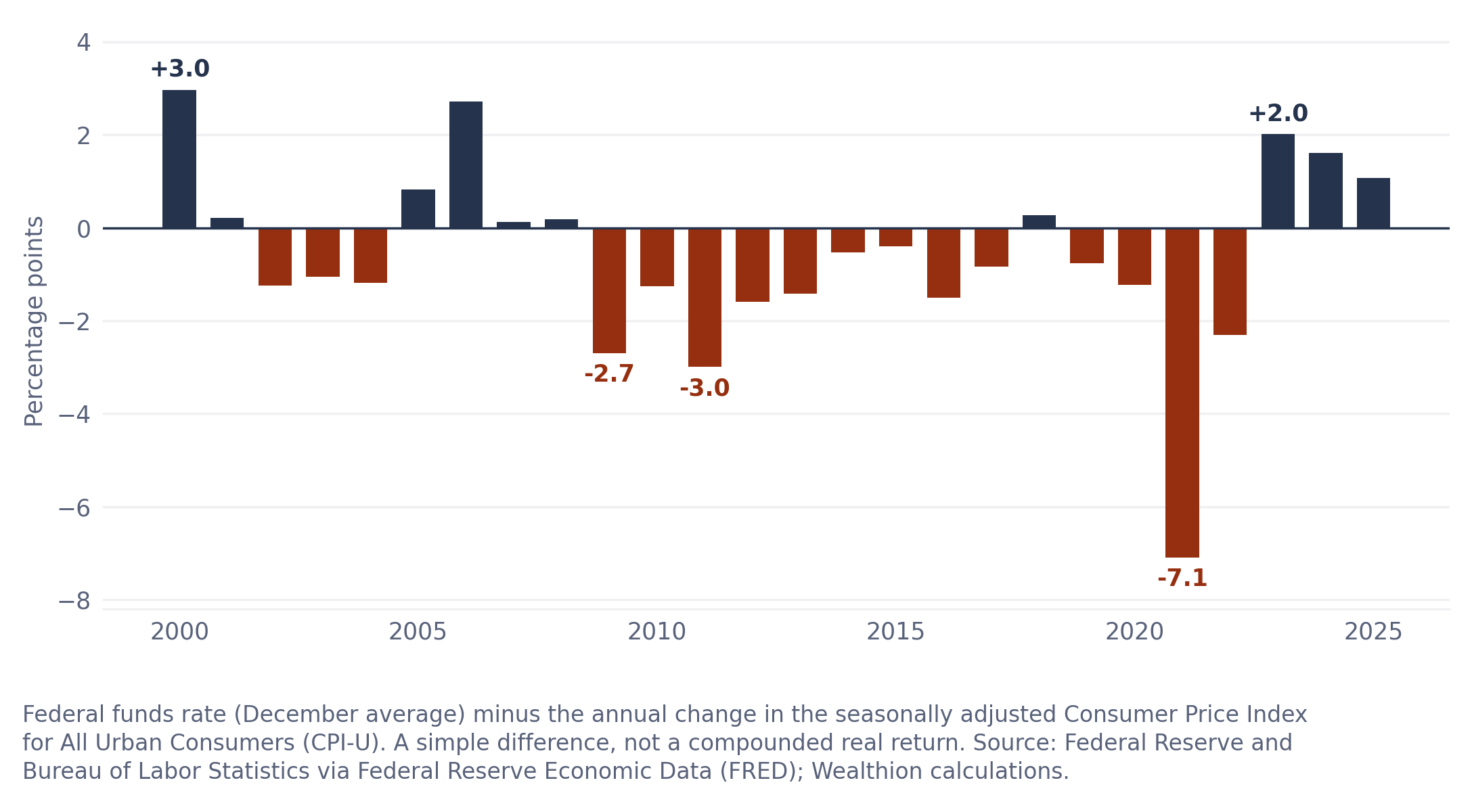
Month by month, the largest shortfall below inflation since at least 1980 came in March 2022, when the federal funds rate averaged 0.20% and inflation, on the seasonally adjusted measure, was about 8.6%, leaving the rate more than 8 percentage points behind.1,2
Longer-term real yields provide a different measure. Treasury Inflation-Protected Securities (TIPS) adjust their principal with inflation. Their quoted real yield reflects the return above that inflation adjustment implied by the purchase price and future payments. It is not a measure of what an existing holder has already earned.28
The 10-year TIPS yield was mostly below zero from late 2011 to mid-2013 and again from March 2020 to April 2022, reaching a low of -1.19% in August 2021.29 The US therefore had long stretches of negative real yields without a negative policy rate.
Some voices on Wealthion expect government debt to influence future interest-rate policy. Steven Feldman, co-founder and chief executive of Wealthion, argued in October that with government debt this high, “You're going to have to have negative real rates.”30 Rupert Mitchell, a global macro investor, expressed a broader concern: “I see a lot of financial repression under all forms of guises over the next few years.”31
Financial repression includes policies that steer savings into government bonds or hold interest rates below market levels. When combined with inflation, these policies can reduce the real burden of fixed nominal government debt at savers' expense. But negative real rates can also result from unexpectedly high inflation; they do not, by themselves, prove deliberate repression.32
What does this mean for investors?
The interest rate in a policy announcement is only part of the picture.
Positive interest can still mean lost purchasing power. What matters for a savings account is its own return compared with inflation over the same period. For a bond sold before maturity, changes in its market price also affect the outcome.27,33
Real yields can turn positive again. The 10-year TIPS yield was 2.88% on November 18, 2026, against -1.04% at the end of 2021.29 High government debt does not make a negative real yield inevitable. Feldman's and Mitchell's views describe possible future policy choices, rather than a settled outcome.
Real yields influence the appeal of gold. Higher real yields can make interest-paying investments more attractive relative to gold, which pays no interest. Lower real yields can reduce that advantage. This is one influence on gold's price, not a rule that determines its return.34
A positive interest rate tells us that money is earning interest. It does not tell us whether that money will buy more. For savings, the answer depends on the interest earned and inflation over the same period. For bonds sold before maturity, changes in their price matter too.
The central bank's rate helps explain the conditions investors face. Understanding what an investment actually earns requires looking beyond it.
Frequently asked questions
Does a negative policy rate mean every savings account is charged?
No. A charge on banks' deposits at the central bank does not automatically become a charge on every customer account. Banks may pass it on to some depositors while leaving others unaffected. European experience showed more limited pass-through to household deposits than to corporate deposits.13
Has the US ever had negative interest rates?
Not as a Federal Reserve policy rate.3 In March 2020, Fed Chair Jerome Powell said: “we do not see negative policy rates as likely to be an appropriate policy response here in the United States.”35 US Treasury real yields have nevertheless been negative, as the TIPS history shows.29
Why would someone buy a bond with a negative yield?
Some investors accept a negative yield on government bonds because they value the issuer's perceived safety.36 A buyer may also expect the bond's price to rise if market yields fall further, allowing a gain on an earlier sale.37 That gain is uncertain. A negative nominal yield to maturity still implies a loss in money terms if the bond is held to maturity and makes its promised payments.
Can TIPS have a negative real yield and still pay interest?
Yes. The coupon is the interest rate paid on the inflation-adjusted principal. The yield also takes account of the price paid for the security. A buyer can pay enough above face value that the real yield is negative even though the coupon is positive.38
Sources & Disclosure
1 Federal Funds Effective Rate (FEDFUNDS), monthly. Board of Governors of the Federal Reserve System via FRED, updated November 2, 2026. 2 Consumer Price Index for All Urban Consumers: All Items (CPIAUCSL), seasonally adjusted. Bureau of Labor Statistics via FRED, updated November 10, 2026; year-over-year changes and differences from the federal funds rate calculated by Wealthion. 3 Open Market Operations, target federal funds rate history; 2026 Macroeconomic Model Guide, page 36. Board of Governors of the Federal Reserve System, retrieved November 20, 2026 and February 2026. 4 Key ECB interest rates. European Central Bank, retrieved November 20, 2026; deposit facility rate table. 5 Monetary policy assessment of 24 September 2026; Current interest rates and exchange rates, sight-deposit thresholds. Swiss National Bank, September 24, 2026 and retrieved November 20, 2026. 6 Statement on Monetary Policy. Bank of Japan, October 30, 2026; page 1, guideline for money market operations. 7 Policy rate raised to 2 per cent. Sveriges Riksbank, November 4, 2026. 8 Interest rate increase. Danmarks Nationalbank, September 10, 2026; certificates of deposit rate. 9 ECB introduces a negative deposit facility interest rate. European Central Bank, June 5, 2014. 10 Introduction of Quantitative and Qualitative Monetary Easing with a Negative Interest Rate. Bank of Japan, January 29, 2016; page 1 and attachment, pages 5 to 6, the three-tier system. 11 ECB introduces two-tier system for remunerating excess liquidity holdings. European Central Bank, September 12, 2019. 12 The Danes' deposit rate averaging -0.21 per cent. Danmarks Nationalbank, Statistical News, July 15, 2021; May 2021 data. 13 Negative rates and the transmission of monetary policy. Miguel Boucinha and Lorenzo Burlon, European Central Bank, Economic Bulletin, Issue 3/2020; sections 1 to 3. 14 Swiss National Bank discontinues minimum exchange rate and lowers interest rate to -0.75%. Swiss National Bank, January 15, 2015; Chronicle of monetary events, January 22, 2015 effective date. 15 Interest rate reduction. Danmarks Nationalbank, July 5, 2012. 16 Interest rate reduction. Danmarks Nationalbank, February 5, 2015. 17 Interest rate increase. Danmarks Nationalbank, September 8, 2022. 18 Interest rate increase, April 24, 2014; Interest rate reduction, September 4, 2014. Danmarks Nationalbank; certificates-of-deposit rates effective April 25 and September 5, 2014. 19 Monetary policy decisions. European Central Bank, September 12, 2019; deposit facility rate. 20 Monetary policy decisions. European Central Bank, July 21, 2022. 21 Monetary policy assessment of 22 September 2022. Swiss National Bank, September 22, 2022. 22 Riksbank cuts repo rate to -0.10 per cent. Sveriges Riksbank, February 12, 2015. 23 Repo rate cut to -0.50 per cent. Sveriges Riksbank, February 11, 2016. 24 Repo rate raised to zero per cent. Sveriges Riksbank, December 19, 2019. 25 Changes in the Monetary Policy Framework. Bank of Japan, March 19, 2024. 26 Minutes of the Federal Open Market Committee, October 29 to 30, 2019. Board of Governors of the Federal Reserve System, November 20, 2019; review of monetary policy strategy, tools and communication practices. 27 Constructing ex ante real interest rates on FRED. Federal Reserve Bank of St. Louis, May 19, 2022; real-rate definitions and exact inflation adjustment. 28 Treasury Inflation-Protected Securities (TIPS). US Department of the Treasury, TreasuryDirect, retrieved November 20, 2026; principal adjustments and interest payments. 29 Market Yield on U.S. Treasury Securities at 10-Year Constant Maturity, Inflation-Indexed (DFII10), daily. Federal Reserve H.15 via FRED, retrieved November 20, 2026. 30 Wealthion, What to Own if the Tech Boom Falters, Steven Feldman interview, video published October 30, 2026. 31 Wealthion, Your Portfolio Is One Big AI Bet: The Diversification Illusion, Rupert Mitchell interview, video published October 5, 2026. 32 The Liquidation of Government Debt. Carmen M. Reinhart and M. Belen Sbrancia, IMF Working Paper 15/7, January 2015; Box 1 and discussion of negative real rates and nominal debt. 33 Bonds - FAQs. US Securities and Exchange Commission, Investor.gov, retrieved November 20, 2026; interest-rate and inflation risks. 34 What Drives Gold Prices? Robert Barsky, Craig Epstein, Adrian Lafont-Mueller and Younggeun Yoo, Federal Reserve Bank of Chicago, Chicago Fed Letter No. 464, November 2021. 35 Transcript of Chair Powell's Press Conference Call, March 15, 2020. Board of Governors of the Federal Reserve System; page 7. 36 How Low Can You Go? Negative Interest Rates and Investors' Flight to Safety. Richard G. Anderson and Yang Liu, Federal Reserve Bank of St. Louis, January 1, 2013; demand for safer government securities. 37 Dissonant markets? Bank for International Settlements, Quarterly Review, September 2016; Core fixed income yields under pressure. 38 Information on Negative Rates and TIPS. US Department of the Treasury, TreasuryDirect, retrieved November 20, 2026; positive coupons, premium prices and negative real yields.
Wealthion is a dba of Greylock Peak Investments, a registered investment adviser. This article is general information only. It is not investment advice or an offer or solicitation, and it is not tailored to your circumstances. Guests’ views are their own and may not reflect those of Wealthion. Wealthion has not verified guest statements, including any performance figures. Investing involves risk, including loss of principal, and past performance does not guarantee future results. Wealthion refers readers to other registered investment advisers and shares in the fees they receive from referred clients, which creates a conflict of interest. Please see our Form ADV Part 2A and consult your own financial advisor before investing.
What Serious Investors Are Watching
Dive into expert interviews, market analysis, and long-form content built to help serious investors think long-term.

Is Debt Financing the AI Build-Out a Concern? Where the Risk Sits for Investors
AI borrowing is growing. Company cash flow, interest coverage and commitments beyond reported debt show why the risks differ between borrowers and portfolios.
I Bonds Explained: How They Work and What You Earn
How I bonds earn interest, adjust for inflation and become available to withdraw, with purchase limits, tax rules and a worked example.
Negative Interest Rates Explained: Policy Rates vs Real Returns
Negative policy rates charge banks on certain central-bank deposits. Negative real returns mean an investment loses purchasing power after inflation. The difference matters for savings, bonds and gold.
Enjoyed This? Get More Insights
Expert insights and curated opportunities, delivered to your inbox.
Ready to Position for What's Coming?
Whether you're still learning or ready to act, your next step starts here.
- Independent
- Macro-Informed
- Real Asset Focused


The Wealthion Network
By subscribing, you agree to receive Wealthion emails. Unsubscribe anytime.
The Wealthion Network
By subscribing, you agree to receive Wealthion emails. Unsubscribe anytime.
Network Discussion
Join the Wealthion Network to Comment