

All-In Sustaining Cost: What It Actually Costs to Mine an Ounce
All-in sustaining cost, AISC, is the standardised figure the gold mining industry uses to answer one question. What does it actually cost to keep producing an ounce of gold, once every ongoing expense is counted, not just the ones that show up in a simple cash-cost line? The global average reached $1,785 per ounce in the first quarter of 2026, up 16 percent year on year, marking the 28th consecutive year-on-year increase.
That streak, not any single number, is the part worth paying attention to.
What does AISC actually include?
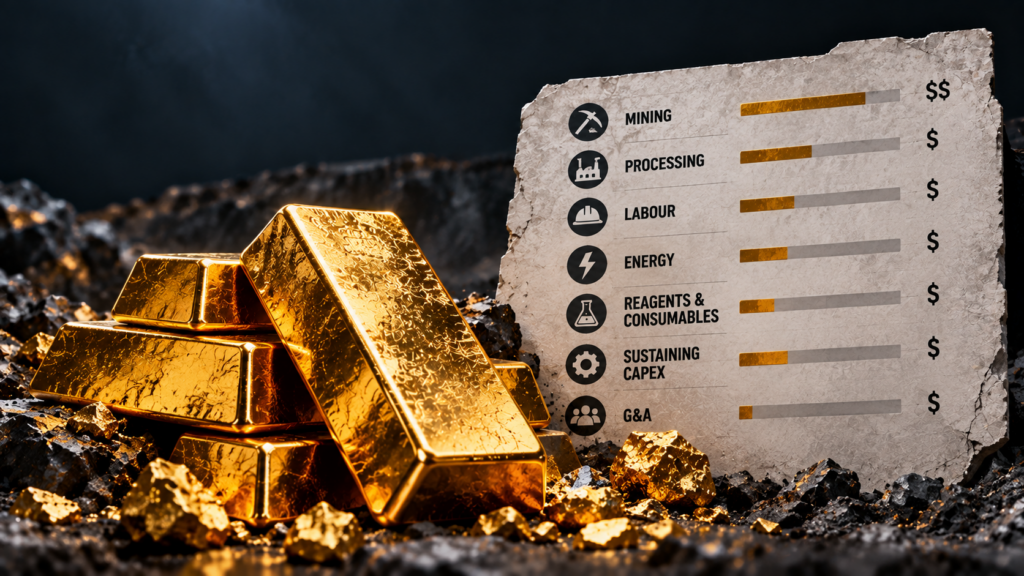
More than the obvious mining costs. It covers mine-site cash costs: labour, energy and consumables. It then adds sustaining capital expenditure, the ongoing spending required to keep current production going, rather than to grow it. It adds near-mine sustaining exploration, reclamation and closure costs, and a share of corporate overhead. What it leaves out is growth capital and exploration aimed at finding new deposits. Those are investments in future production, not the cost of sustaining what already exists.
The World Gold Council introduced the standard in 2013. The older measure, cash cost, was too narrow to give investors a reliable picture of a miner's true economics.
Why does AISC run so much higher than cash cost?
Because cash cost only captures the money spent to dig up and process ore today. AISC adds everything required to keep doing that next year, and the year after. Replacing worn equipment. Maintaining the pit or shaft. Funding the environmental obligations that come with operating a mine. Covering a share of the corporate structure that supports it. Industry estimates put AISC running thirty to sixty percent above cash cost. That gap is large enough that comparing miners on cash cost alone can be seriously misleading.
Why has it risen for 28 consecutive years?
The World Gold Council attributed the most recent increase primarily to royalties, alongside broader cost inflation across energy, labour and materials. Royalty payments scale with the gold price itself in many jurisdictions. That creates a structural link: as gold rises, a portion of that increase is mechanically returned to governments and landowners through higher royalty costs, rather than flowing entirely to the producer's margin.
Declining ore grades compound the pattern. Many mines are processing lower-grade ore than they were a decade ago. That means more rock has to be moved and processed to produce the same ounce, raising energy and labour costs per ounce, even before any external inflation is considered.
Does a rising AISC mean mining is becoming a worse business?
Not necessarily, and this is where the metric has to be read alongside the gold price, not in isolation. AISC is a cost. The margin is the gold price minus AISC. A cost of $1,785 an ounce looks alarming in isolation. Against a gold price running well above $4,000 an ounce through 2026, it still leaves a very wide margin. It is historically among the widest the industry has recorded, even as the cost figure itself sets a new record.
The risk AISC actually flags is not current profitability. It is what happens if the gold price falls faster than costs can adjust. Costs, once embedded in a mine's structure, are far stickier than the metal price.
How should an investor actually use this number?
As a comparison tool between producers, not as a standalone verdict on the sector. AISC lets you compare how efficiently different mining companies run, independent of the gold price both are exposed to. A producer with AISC well below the industry average has more cushion if prices fall and more margin expansion if prices rise. A producer near or above the average is more exposed on both sides.
It is also the number that functions as a rough floor for the gold price over time. If prices fall meaningfully below the industry's average AISC, higher-cost mines become unprofitable and begin curtailing production. That tightens supply and tends to support the price. That mechanism does not operate quickly, since closing or reopening a mine takes time, but it is a real structural relationship.
Why does this matter for reading the mining-equity discussion already on this site?
Because AISC is precisely the mechanism behind the observation that miners can underperform the metal even in a rising gold price environment. A twenty percent gold rally does not automatically translate into a twenty percent increase in a miner's margin. AISC is rising too, and rising costs eat directly into the operating leverage that is supposed to make miners outperform the metal.
What should you watch?
The trend in AISC over successive quarters, published by the World Gold Council, which shows whether cost inflation is accelerating or stabilising. The specific AISC of any producer you are evaluating, relative to the industry average, which shows its cost position within the sector. And the gap between the gold price and industry average AISC. That gap is the sector's aggregate margin, and the best single indicator of how much cushion the industry currently has.
FAQ
What does AISC stand for? All-in sustaining cost. It is the standardised measure of the total cost to produce one ounce of gold while sustaining current production levels.
What is the current AISC for gold mining? The World Gold Council reported a global average of $1,785 per ounce in the first quarter of 2026, up 16 percent year on year.
Why is AISC higher than cash cost? Cash cost only covers direct mine-site operating expenses. AISC adds sustaining capital expenditure, exploration, reclamation costs and corporate overhead, typically running 30 to 60 percent above cash cost.
Why does AISC keep rising? Royalties, which scale with the gold price in many jurisdictions, were the largest driver in the most recent increase. Declining ore grades and broader input cost inflation also contribute.
Does rising AISC mean gold mining is becoming unprofitable? Not currently. Against a gold price well above $4,000 an ounce through 2026, even a record AISC still leaves a historically wide margin for most producers.
How do investors use AISC? As a comparison tool between mining companies. It shows which operate more efficiently, independent of the gold price both are exposed to, and it functions as an approximate floor for the gold price over time.
Why do rising gold prices not always translate into proportional miner profits? Because AISC rises alongside or even ahead of the gold price in some periods, which erodes the operating leverage investors often expect from mining equities.
If you want a professional read on how mining exposure fits your own portfolio, you can request a free portfolio review from an advisor who understands real assets at https://www.wealthion.com/advisors/.
This article is educational and is not investment, tax, or legal advice. It does not recommend any security. Advisory services are provided by Greylock Peak Investments, LLC, a subsidiary of Wealthion. Wealthion is compensated for advisor introductions; see the Solicitor's Disclosure Document, ADV Part 2A and Form CRS. That arrangement does not influence editorial coverage.
What Serious Investors Are Watching
Dive into expert interviews, market analysis, and long-form content built to help serious investors think long-term.

Real Yields and Gold: Why the Old Relationship Broke
For decades, the single best predictor of gold's direction was the real, inflation-adjusted yield on...

What Is the Gold Lease Rate?
The gold lease rate is what a borrower pays to rent physical gold, typically from...
All-In Sustaining Cost: What It Actually Costs to Mine an Ounce
All-in sustaining cost, AISC, is the standardised figure the gold mining industry uses to answer...
Enjoyed This? Get More Insights
Expert insights and curated opportunities, delivered to your inbox.
Ready to Position for What's Coming?
Whether you're still learning or ready to act, your next step starts here.
- Independent
- Macro-Informed
- Real Asset Focused


The Wealthion Network
By subscribing, you agree to receive Wealthion emails. Unsubscribe anytime.
Network Discussion
Sign in to share your thoughts and connect with other readers.
Join the Wealthion Network to Comment