

Gold Recycling 2026: Why High Prices Aren’t Lifting It
Gold recycling fell to a three-year low in the third quarter of 2026 while the price stayed near records. World Gold Council data show what keeps old gold off the market, and why low recycling alone does not establish a supply shortage.
The numbers at a glance
Why is gold recycling falling while prices sit near records?
Gold averaged $4,262 per troy ounce in the third quarter of 2026 (Q3 2026), according to the World Gold Council (WGC), its third-highest quarterly average on record and 23% above a year earlier 1. Over the same quarter, gold recycling fell 8% from a year earlier to 314 metric tons, a three-year low 1.
At the quarter's average price, that recycled metal was worth roughly $43 billion (Wealthion calculation from WGC data). The WGC put the puzzle plainly: "Recycling, in contrast, remains broadly unresponsive to high prices" 1.
That cuts against a simple intuition: if old jewelry is worth far more, more of it should go to refiners. The short answer is that owners react to recent price moves, their own finances and expectations, as well as the price level. In the third quarter of 2026 the recent move was down, finances had not forced widespread selling and many holders expected higher prices.
How big is gold recycling next to mine supply?
Gold recycling is the second-largest source of supply after mining, around 30% of the total over the two decades to 2018, according to the WGC 2. Roughly 90% of it comes from jewelry; the rest is industrial scrap 2.
In Q3 2026, mines produced a third-quarter record of 1,071 metric tons, while recycling supplied 314 metric tons 1.
Recycling fell to a three-year low of 314t as mine output hit a Q3 record
Quarterly global gold supply, metric tons; recycling as a share of total supply below each quarter
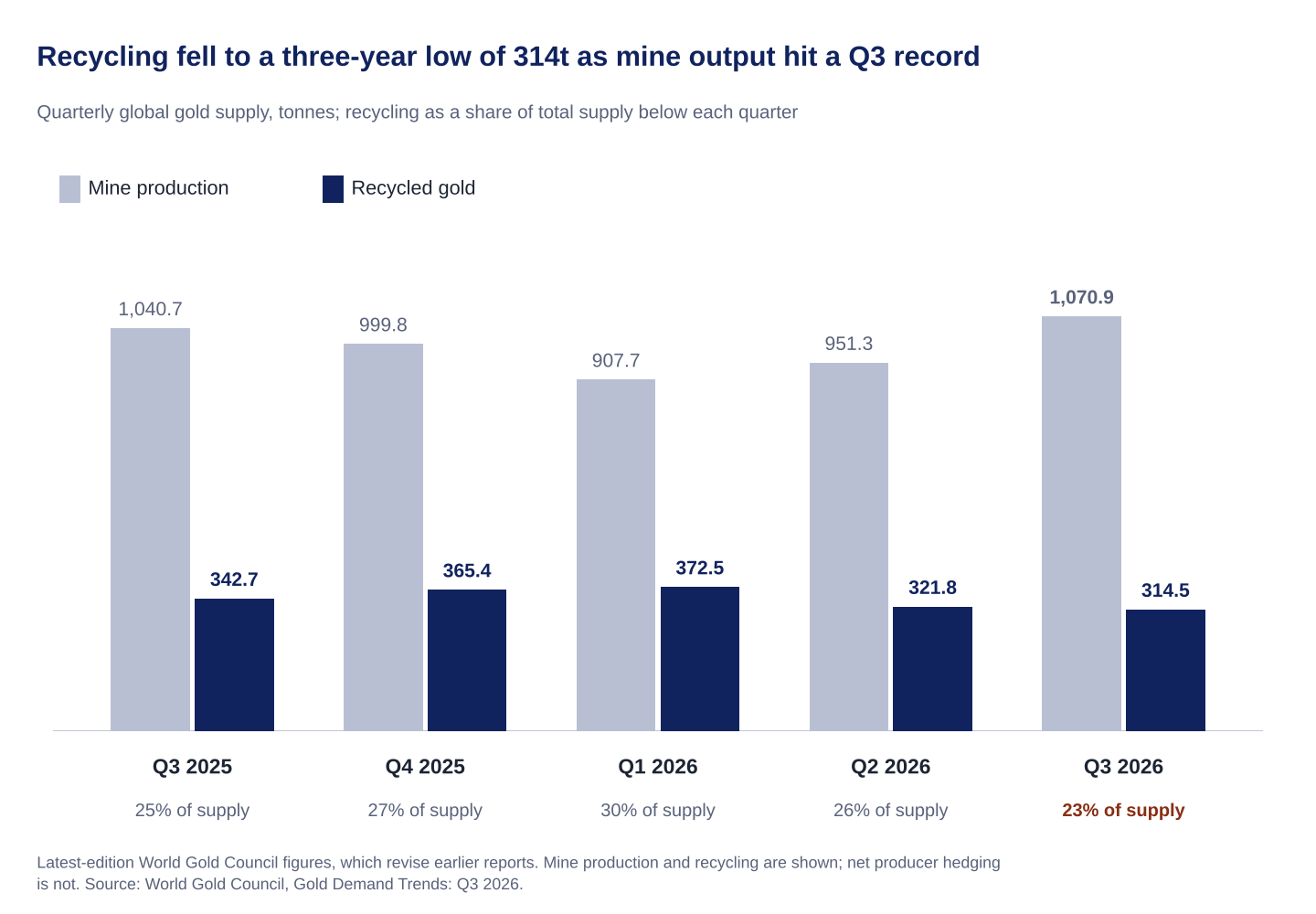
Latest-edition World Gold Council figures, which revise earlier reports. Mine production and recycling are shown; net producer hedging is not. 1
What the chart can't show is how unusual this is for the price. In 2025 the average gold price rose 44%, yet the WGC's table shows recycling rose only about 3%, to 1,404 metric tons, its highest level since 2012 3. The WGC wrote that "it was a surprise that recycling volume did not increase by more than it did" 3.
Why do dollar and local-currency gold prices tell different stories?
Headlines quote gold in dollars, but households selling old gold think in local currencies, such as rupees, yuan, lira or yen. When a currency weakens against the dollar, the local gold price rises faster, all else equal. In India, the WGC's country report put the average domestic price in Q3 2026 at 148,891 Indian rupees per 10 grams, up 45% from a year earlier, supported by rupee weakness and the higher import duty 4.
That is roughly double the 23% rise in dollars 1. The WGC names both causes without splitting the gap, so only part of it is currency.
Yet the higher price did not bring more Indian gold to market. India's recycling fell 12% from a year earlier and was flat on the quarter 5. The WGC pointed to the lower price versus the second quarter (Q2), a preference for pledging gold as loan collateral, and more trade-ins of old jewelry for new 5.
Policy matters too. Recycling in China fell 20% from a year earlier and 12% from Q2, which the WGC linked to a new 7% value-added tax on jewelry sales 5. Buyers can reduce the tax by trading in old pieces, shifting activity from recycling to exchange 5.
A weak currency can also keep gold at home. In parts of the Middle East in Q3 2026, economic turmoil and "expectations of currency devaluation in some markets, kept jewellery owners sidelined, with sales limited to distressed consumers" 5. The WGC cited anecdotal evidence that holders in "countries with weak currencies" expect gold to "help protect them from further economic turmoil" 5.
What makes households sell gold, or hold on to it?
Research by the WGC and Boston Consulting Group found that price fluctuations explained around 75% of changes in recycling from 1982 to 2012, and economic shocks could lift it by up to 20% 6. The key word is fluctuations: the WGC's latest report says activity "is more sensitive to recent movements in the gold price than to year-on-year comparisons" 5.
Q3 2026 shows why the level alone is not enough. The average price fell about 5% from Q2 while staying about 23% above a year earlier 5. Recycling followed the quarterly dip, and the WGC cited anecdotal evidence that "holders of gold expect prices to recover" 5.
Household stress is the other lever. The WGC said rising energy prices, inflation and unemployment "have not yet triggered widespread signs of consumer distress-led selling of gold" 5.
Expectations reinforce the wait. In India, the WGC said, expectations of higher prices over the medium to longer term have helped keep recycling low 5. In 2025 it cited expectations of further gains, and turmoil in countries such as Iran, as restraining sales in emerging markets 3.
Borrowing against gold is another release valve. In 2025 the WGC said Indian consumers "continue to pledge their gold jewellery as collateral for loans, capitalising on the high price" 3. A loan itself raises cash without selling the metal, so it does not count as recycling.
Several factors held gold recycling down in Q3 2026
Five drivers of gold recycling and the conditions that move it each way
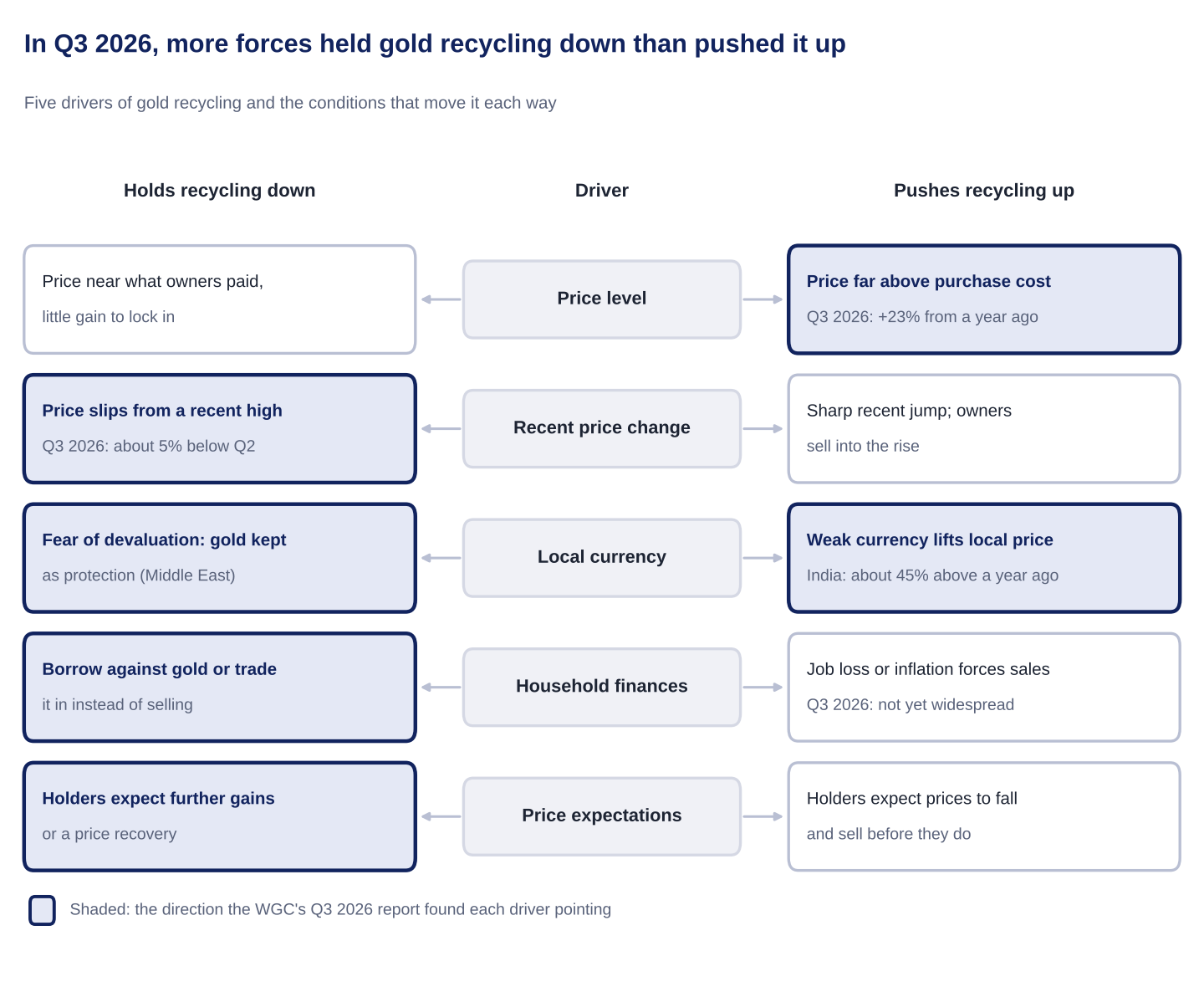
Wealthion illustration of mechanisms discussed in the WGC reports. Shading highlights factors relevant to Q3 2026; unshaded boxes show illustrative alternatives, not measured effects 1 4 5.
The drivers rarely line up. High prices can encourage selling in some markets. In Q3 2026, the recent dip, expected gains, gold-backed borrowing and trade-ins pulled the other way.
How does gold recycling differ from mine supply?
Mine output moves slowly, even when prices jump. In 2025, with the price up 44%, mine production rose about 1% to 3,672 metric tons 3, and through the first nine months of 2026 it was up 2% 5. The WGC said "gold mine production remains the only likely area of – modest – supply growth" 1.
Recycling moves fast because millions of owners can choose their moment. Between the first quarter (Q1) and Q3 2026, recycled supply fell about 16%, from 373 metric tons to 314 metric tons 1. Mines generally keep selling what they produce to cover running costs, whatever owners of old jewelry decide.
What can gold recycling data tell readers, and what can't it?
Recycling data show how much old gold went back to refiners, where it came from and how that changed. They do not measure how much gold sits in homes, and they do not forecast prices.
Four limits matter. Trade-ins are invisible: "The exchange of gold jewellery has no net impact on supply and therefore is not captured in recycling data" 5. Many explanations, such as holders expecting a recovery, are described by the WGC itself as anecdotal.
The series is also estimated and revised, and the WGC publishes about a month after each quarter ends, so conditions may already have changed.
Two misreadings are common. Low recycling alone does not establish a supply shortage. Total Q3 2026 supply fell 1% to 1,369 metric tons: higher mine production more than offset lower recycling, but a larger negative contribution from miners' hedging contracts, used to manage future selling prices, reduced the total 1 5. And low recycling describes how holders behaved last quarter, not where prices go next.
The obvious counterargument is that recycling is responding, just modestly. Full-year 2025 recycling was the highest since 2012 3. In Q3 2026 it rose 12% from a year earlier in Europe and 8% in the US 5.
Full-year 2025 recycling was high by historical standards, despite a modest response to prices. The latest quarter, however, was a three-year low. So why aren't high prices bringing more metal to market? The latest price move was down, many holders expect higher prices, and owners in India and elsewhere are borrowing against or trading in gold instead of selling.
Distress selling, which economic shocks have historically added to recycling, has not appeared at scale 5,6. That combination is what sits behind the WGC's description of recycling as "broadly unresponsive to high prices" 1.
Frequently asked questions
What is gold recycling? It is gold recovered from existing items, refined and sold back into the market. Roughly 90% comes from old jewelry and the rest from industrial scrap such as electronics, according to the WGC 2.
How much of the world's gold supply comes from recycling? In 2025, recycling supplied 1,404 metric tons of a total 5,002 metric tons, or about 28% 3. In Q3 2026 its share was about 23% 1.
Sources & Disclosure
1 Gold Demand Trends: Q3 2026, Executive summary and Table 1. World Gold Council, November 3, 2026; quarterly average gold price, supply and demand table, mine-production record, recycling low and supply outlook. The price is the London Bullion Market Association (LBMA) afternoon (PM) benchmark, quoted per troy ounce. 2 Recycling, market primer. World Gold Council, May 7, 2018; recycling's historical share of total supply over the preceding 20 years and jewelry's share of recycled gold. 3 Gold Demand Trends: Q4 and Full Year 2025, Supply. World Gold Council, January 29, 2026; annual supply and mine production, recycling volume and historical comparison, annual average price increase, gold-backed borrowing and expectations. Recycling growth is approximately 2.9% from the published table. 4 Gold Demand Trends: India Focus Q3 2026. World Gold Council, November 3, 2026; domestic-price table, 148,891 Indian rupees per 10 grams and 45% annual increase, attributed to rupee weakness and higher import duty. 5 Gold Demand Trends: Q3 2026, Supply. World Gold Council, November 3, 2026; producer hedging, regional recycling, price sensitivity, gold-backed loans, trade-ins, anecdotal expectations, distress selling and year-to-date mine production. 6 Gold recycling: new report examines the evolving industry that contributes a third of global gold supply. World Gold Council, March 5, 2015; World Gold Council and Boston Consulting Group research covering 1982–2012, price fluctuations and economic shocks.
Wealthion is a dba of Greylock Peak Investments, a registered investment adviser. This article is general information only. It is not investment advice or an offer or solicitation, and it is not tailored to your circumstances. Guests’ views are their own and may not reflect those of Wealthion. Wealthion has not verified guest statements, including any performance figures. Investing involves risk, including loss of principal, and past performance does not guarantee future results. Wealthion refers readers to other registered investment advisers and shares in the fees they receive from referred clients, which creates a conflict of interest. Please see our Form ADV Part 2A and consult your own financial advisor before investing.
What Serious Investors Are Watching
Dive into expert interviews, market analysis, and long-form content built to help serious investors think long-term.

Why Keith McCullough Is Turning to Treasury Bonds
Keith McCullough connects his concerns about the artificial intelligence investment cycle with a forecast for slowing growth and inflation. The conversation explains his bond outlook, credit risks and approach to changing market signals.

The Credit Market Warning That Could Hit Stocks | Jeff Snider
Jeff Snider explains how tighter lending could reach stocks through the financing behind the artificial intelligence buildout. Andrew Sarna discusses overbuilding risks, market anxiety and his different perspective on bonds.

Macro Bites – Global Oil Market Returns to Surplus as Supply Recovers and Demand Weakens
Reuters reports the global oil market is returning to excess supply as demand drops due...
Enjoyed This? Get More Insights
Expert insights and curated opportunities, delivered to your inbox.
Ready to Position for What's Coming?
Whether you're still learning or ready to act, your next step starts here.
- Independent
- Macro-Informed
- Real Asset Focused

The Wealthion Network
By subscribing, you agree to receive Wealthion emails. Unsubscribe anytime.
The Wealthion Network
By subscribing, you agree to receive Wealthion emails. Unsubscribe anytime.
Network Discussion
Join the Wealthion Network to Comment