

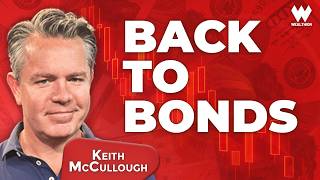
Why Keith McCullough Is Turning to Treasury Bonds
Key Takeaways
- McCullough expects growth and inflation to slow together, although he says the economic data remain in an accelerating phase at the time of the interview.
- He argues that strong recent earnings do not settle whether AI-related spending and profit growth can keep accelerating.
- He says he has added Treasury bonds and favors more defensive areas of the stock market. His positions depend on his market signals.
- Falling Treasury yields and widening corporate credit spreads can happen together, producing different outcomes for government and company debt.
- Most leveraged funds target daily returns. Their results over longer periods can differ substantially from a simple multiple of an index return.
- He says price, trading volume and volatility guide whether he keeps or changes a position.
Key Moments
00:00:21 - The reaction to the election
00:02:42 - The economic cycle behind the rally
00:05:08 - His AI bubble argument
00:09:43 - The attachment to past winners
00:16:52 - The Federal Reserve dilemma
00:23:50 - Treasuries and defensive stocks
00:26:14 - Oil and market signals
00:30:57 - Bond yields and gold
00:35:41 - Responding to headlines
00:38:02 - Leveraged funds and retail investors
Maggie Lake speaks with Keith McCullough about artificial intelligence (AI), the economic cycle, Treasury bonds, oil, gold and the risks of leveraged trading.
A technology stock can help pay for your retirement and still become the hardest holding to judge when it starts falling. The gains were real. The question is whether the growth that produced them is still ahead.
That is the tension Keith McCullough, founder and chief executive officer of Hedgeye Risk Management, explores with Maggie Lake. He argues that the artificial intelligence (AI) investment cycle is weakening and that a broader economic slowdown could follow. His response has been to favor more defensive stocks and add Treasury bonds. Those are his positions and expectations at the time of the interview, rather than a settled account of what markets will do next. 1
The slowdown he expects has not arrived in his data
McCullough organizes the economy around two questions: Is growth speeding up or slowing down? And is inflation speeding up or slowing down? Hedgeye calls the four possible combinations its quads. 2
The distinction matters because slowing growth does not necessarily mean a recession. An economy can keep expanding while expanding less quickly. Similarly, inflation can slow while prices continue rising. The direction changes before either measure necessarily turns negative.
In the interview, McCullough says the economy is still in Quad 2, where growth and inflation are accelerating together. He expects a move toward Quad 4, where both slow. His argument is that investors may start changing their holdings before the economic reports confirm that shift. 1
That also explains an apparent contradiction in the conversation. He expects inflation to keep accelerating before that shift, yet he is already discussing disinflation, a slower rate of price increases. His concern is what comes after that strength, including the possibility that the Federal Reserve raises rates as the economy begins losing momentum. 1
Strong earnings can arrive after the best part of a stock rally
The same timing problem sits beneath his AI warning. Companies report what happened during a quarter. Their share prices also reflect expectations for quarters that have not happened yet.
McCullough argues that a strong earnings report therefore cannot, by itself, settle whether an investment cycle has peaked. He is focused on whether revenue and profit growth can keep accelerating, and whether share prices hold their gains after apparently good news. 1
Capital expenditure, the money companies spend on buildings, equipment and other long-lived assets, connects the story. A large computing buildout produces orders for chips and related equipment. If customers increase spending less quickly, suppliers can still have substantial sales while facing a less favorable growth comparison.
That is a possible explanation for weakness, rather than proof that AI demand is disappearing. Spending could remain stronger than McCullough expects, and businesses could earn enough from new services to justify further investment. His bearish case depends on a slowdown developing and affecting profits, financing or valuations. The usefulness of the technology alone cannot decide between those outcomes.
Why his argument leads to Treasury bonds
The bond case follows from that expected slowdown. If growth and inflation ease and comparable market yields fall, the fixed payments on an existing Treasury become more attractive. Its market price generally rises. The reverse happens when comparable yields rise. 3
The payment itself does not increase. A bond promising a fixed coupon keeps paying that coupon; buyers adjust the price they are willing to pay for it. That is how a holder can earn interest and also experience a gain or loss in the bond's market value.
This is the opportunity McCullough sees after a period in which he says he had been positioned against Treasuries. He now believes yields have peaked. That remains his assessment, and an economic slowdown would not guarantee that every Treasury yield falls. 1
The risk is especially relevant for longer-term bonds. They generally react more strongly to changes in yields than otherwise similar shorter-term bonds. If inflation stays high and yields rise, their prices can fall. A government promise to pay interest and principal does not guarantee the price an investor receives when selling before maturity. 3
Corporate debt can tell a different story
McCullough is also monitoring whether pressure among AI borrowers spreads into broader credit markets. Here, a lower Treasury yield would not automatically solve the problem.
A company's borrowing yield includes compensation for risks that a comparable Treasury does not carry in the same way. The difference is called a credit spread. Federal Reserve material describes that spread as compensation for corporate default and liquidity risks, including the risk of difficulty trading the bond. 4
If investors become more worried about a company's ability to pay, they can demand a wider spread even while Treasury yields fall. High-yield companies, which carry greater default risk, can face particular pressure in a weakening economy. 5
For example, suppose a hypothetical company's bond yields 8%, made up of a 5% Treasury benchmark and a three-percentage-point spread. If the benchmark falls to 4% but the spread widens to five percentage points, the company's yield rises to 9%. This simplified illustration leaves other bond features unchanged. It shows why a Treasury rally and more expensive corporate borrowing can happen together.
That is the connection McCullough worries about: businesses that depend on financing could encounter less forgiving lenders as their growth slows. He does not need to establish a banking crisis for that pressure to matter. Nor does an individual borrower's difficulty establish that a market-wide crisis is underway.
Leverage makes waiting for a recovery more complicated
For a company, leverage can make a slowdown harder to absorb. The interview also examines what leverage does to an investor's exposure through semiconductor funds. An industry can eventually recover while a product used to invest in it behaves very differently along the way.
Most leveraged exchange-traded funds (ETFs) reset daily. Their stated multiple applies to daily performance; it is not a promise to multiply an index's return over months or years. The Securities and Exchange Commission (SEC) warns that the longer-term difference can be substantial, particularly in volatile markets. 6
A hypothetical index starts at 100, rises 10% to 110, then falls 10% to 99. It has lost 1%. A hypothetical fund delivering exactly three times each day's return would go from 100 to 130, then fall 30% to 91. It has lost 9%, before fees and expenses.
This is an illustration, not the performance of a particular fund. It explains why a modest net decline in an industry can produce a much larger loss in a product designed to magnify daily moves.
A forecast still needs a way to change
McCullough's outlook is forceful, but he describes his positions as conditional on his signals. Price, trading volume and volatility help determine whether he stays with a view or changes it. His preference for healthcare, consumer staples and utilities reflects the more defensive environment he expects; those sectors remain equities that can lose value. 1
The gains from the AI boom explain why letting go of its winners can feel difficult. McCullough's concern is that the next phase may reward a different economic outcome. A slowdown in AI investment is one possible route to weaker growth; his Treasury case ultimately depends on comparable yields falling. If those yields rise instead, existing fixed-rate bonds can lose value even when his concerns about technology stocks prove justified.
Frequently Asked Questions
What does Hedgeye mean by Quad 4
Growth and inflation slowing together. It does not necessarily mean an economic contraction or falling prices. 2
Why might Treasury bonds rise in a slowdown
If comparable yields fall, existing fixed-rate bonds generally become more valuable. Persistent inflation or rising yields can produce the opposite result. 3
Would lower Treasury yields help every corporate borrower
No. A wider credit spread can offset the decline, leaving a company's borrowing yield higher. 4 5
Does a three-times leveraged fund triple a long-term return
Not necessarily. Most such funds target daily returns. Compounding can produce a very different result over longer periods. 6
Full Cleaned Transcript
Maggie Lake: Is it risk-on for the remainder of the year, or danger ahead? Joining me to discuss is Keith McCullough, CEO of Hedgeye Risk Management. Hey Keith, great to see you. Thanks for being with us.
Keith McCullough: Hey, I'm a first-timer here, so take it easy on me.
Maggie Lake: Come on now. I should say that to you. First-timer, but I know a lot of people follow you and the great work you do.
We have the great fortune of chatting on a day when there's a heck of a lot of news. We are in the wake of a massive shift in power in Congress, at least on the headline, at least on the surface, with the Democrats sweeping Congress. What's been the most interesting reaction on the tape for you? What are you noticing as we, as investors, start to digest this?
Keith McCullough: People were really concerned about the event risk. You did get a bunch of hedging right into the event. We saw quite elevated S&P 500 put buying, for example, ahead of the event.
I think part of the unwind is just what it is. The greatest fear, whatever it might have been politically for people, has been alleviated, I guess.
But the downside in semiconductors today, specifically in some of the AI bubble stocks, we've been calling them this, the AI bubble, finally it's time for it to go down. I think SpaceX is probably the best story to be paying attention to.
It's not inadvertent. Elon loses political power with this shift. I would say that he was a recipient of a lot of grift and a lot of political power on the side of SpaceX, not only going public, but getting the kind of funding that it had. Seeing a stock like that react negatively and seeing these AI stocks down on a big market up day, I think that's a big take.
Maggie Lake: That's so interesting. One of the things I always appreciate is that, on a day when there's a lot of political analysis happening, you always take it back to math, rules, discipline, the framework. It's something we talk about as well.
02:42 Rotation and the economic cycle
Maggie Lake: We're looking at a rebound. We're looking at a lot of green, aside from what you mentioned, some of the laggards in AI. Should we read that as risk-on, or is this just people covering from a concern that maybe we weren't going to have the elections certified, that there was going to be unrest? Those are always at the fore now for these elections.
Are you seeing this as real sentiment and rotation, maybe out of tech, or does this look like a knee-jerk and we need to wait a bit before we see how this unfolds?
Keith McCullough: There are multiple parts to the market, obviously. To your point, the market's not trading tomorrow and for the rest of the quarter and into 2027 on what happened during the election. It's going to happen on what's happening economically and what's happening from a market-signal perspective.
Yes, we are rules-based. Yes, we think we're peak-cycle looking backwards. I think that's pretty self-evident to anybody paying attention.
The three big components: You get a short squeeze on people hedging the event. The AI bubble actually is not participating. It's going straight back down. We're short semis, so it's a good day for that. Then you've got the broadening into lower-beta sectors, which would in and of itself be a signal that the economy is essentially past its cycle peak and is about to enter what we call Quad 4.
Quad 4 is when the rate of change of both growth and inflation starts to slow at the same time. When that happens, and we've made this call multiple times in the last two decades, the market starts to rotate away from high-beta tech and into healthcare, consumer staples. We bought more utilities today, buying Treasury bonds, which we'd been short earlier in the year, and for quite some time, for that matter.
There's a big rotation going on. It's actually front-running an economic outcome that is a growth-slowing environment and an inflation-slowing environment, as opposed to anything else.
Maggie Lake: Interesting. I want to touch on those. Let's stick with AI for a second. We may not have seen a massive roll in the Nasdaq, but we've seen some pockets of real weakness.
The AI investment cycle
Maggie Lake: Do you feel like this has more downward momentum? Or is a Democratic-controlled Congress likely to slow the overbuild and maybe make it look a little bit more like a correction than some sort of real fallout in AI?
Keith McCullough: First of all, the AI bubble is crashing. I don't know what else to call it other than what happens when something goes down more than 20% in a straight line.
Essentially, the AI bubble peaked when capital expenditure peaked and the cycle peaked in the second quarter and into the third. If you look at semis, which is really the hottest part, or the tip of the spear, you could look at South Korea's stock market, which peaked in and around the same time, adding all these South Korean components to semiconductor ETFs that are levered. There was a whole discussion to be had on market structure and retail-investor behavior. That, to me, was the definition of a bubble.
First of all, we were long it. It wouldn't have been a bubble if it wasn't going up. But once a bubble stops going up, drops, rolls and crashes, that's what you have right now.
You have stocks like Intel that are absolutely rinsing people. It's a classic retail bag-holder stock where they bought it because the government bought it. It's down like 65% from where people own this thing.
These are major moves in major stocks. Nvidia broke trend on our signal, which is relatively new in the last week or so. That's really joined the carnage. It's not crashing yet.
To your point, the Nasdaq's had an 8% to 10% drawdown, depending on what day you're using, from its all-time high. I think these are early days. We should be old enough to remember that the Nasdaq hit an all-time high in the first week, or thereabouts, of October. It's early.
That's what a general drawdown from a bubble looks like. It looks quick. A lot of people try to catch falling knives. I don't do that. I think it can go down a lot more, the Nasdaq more broadly.
It's not my first rodeo calling a crash. In fractal math, we say the emergent properties start to occur, start to crack, break and crash, and then the surface area caves in at the end.
Spending and growth
Keith McCullough: The surface area is the Nasdaq and, more broadly, certainly the S&P. The S&P has a lot of components that I just rattled off, healthcare, staples, utilities, that are going to go up in that scenario.
But I think it's done. If the view is that Dems are going to cut spending, then it's done-done. You don't get your bubble back if they cut capital expenditure spending. You don't get gross domestic product back either. It was a huge contributor to gross domestic product.
If you have my view that the economic cycle peaked, gross domestic product peaked in 2026, and you have any view that there's any curtailing of capital expenditure, then you should have my view, which is growth is going to slow. You don't have to have a recession. You just have to have a slowdown.
Maggie Lake: It's really interesting you brought up Nvidia because I'm listening to you say, "Listen, this thing already crashed." Yet if you look across media, whether it's financial Twitter or traditional media, the question is, "Is the AI bubble going to burst?" By the way, guilty, because I have people come on who are asking the question and I'm having the conversation.
As I'm listening to you, and then you mentioned Nvidia, I think it's largely because a stock like Nvidia hasn't gone down 20%. We do have some headlines coming out. AMD just had earnings that looked strong because chip demand is still strong. You have those headlines that seem to counter the idea that the bubble has already burst.
Keith McCullough: First of all, AMD is a crash stock that just bounced. It bounced off an oversold signal. By the way, Maggie, if they didn't have a good quarter, why did we have the bubble to begin with? We're talking about what happened in the past. We're not talking about what's going to happen in 2027.
If AMD fails here, that's what you've really got to pay attention to. These companies that have quote-unquote good quarters, how do they act within the next three weeks, not three hours of trading?
Nvidia, by the way, is down about 17% from where it peaked. It's only 3% away from crashing. Most people, if they own it, know it's crashing.
Most people are actually long these things if they're retail investors. I call them the CNBC-type retail investor. They peaked basically at the end of May. If you look at the most widely owned basket of retail stocks across brokerage accounts, that thing peaked at the end of May.
Letting go of past winners
Keith McCullough: There have been a tremendous number of stocks that have not only collapsed but crashed that many people own and are bag-holding.
Everybody owns Nvidia, whether they like it or not, in their 401(k), because it's 8% or 9% of the S&P 500. It's in a mother of a drawdown here. If it doesn't see its all-time highs for another couple of years, this is going to turn into the story after the fact, of course.
I don't know what it takes for people to empirically know when a stock's down. They should just get some live quotes.
Maggie Lake: I'm glad you brought up the fact that this is so widely held because there is this mentality that it'll come back. We're in a revolution. All the things the bulls say.
It's really hard for people who are sitting at home, trying to decide about this winner that they rode, that was so important to building wealth: "Can I turn away from it?"
I was thinking about this because we had a comment from a viewer. Shout-out to Boulder Ghost, who said in response to a conversation under another video: "Instead of a second home, I invested in AI stocks and made four times on my investment in two years. Real estate never does that. AI stocks, my friend, AI stocks."
I get it, because that was really important. How do you think about helping people make that turn and give up the winners that they've sat on? How do they emotionally let go, even if the screen is telling them that they're down?
Keith McCullough: The first step should be they shouldn't have any emotional decision to make. Good for anybody who can make a pile.
But there's one thing that's endemic to all bubbles. There's a rate-of-change acceleration and a huge catalyst to drive that and perpetuate that. The rate of change being that revenue growth is accelerating. In this case, capital expenditure is perpetuating revenue growth and earnings growth across all these names that people made a pile in.
But now that same thing that got you paid, that's great. A lot of Americans want shortcuts. Let's be clear, too. They want quick-rich fixes, levered options, zero-days-to-expiration options. This was never going to end well, Maggie. You know that.
Measuring the risks ahead
Keith McCullough: Telling me what people made when I was making money alongside them, that's interesting, but not useful. Having a view on the future and the rate of change of growth for these things that became bubbles is the number one thing to solve for.
In our current macro themes deck, which is about 150 slides deep if people want to get into the weeds, we created an AI bubble cockpit, something to measure and map. It includes everything from the credit default swaps of names that we're short, like CoreWeave, Nebius, IREN. These are some of the best shorts of my life.
When people say, "It made my life," how do you get these people to give it up? I'm going to need a crowbar to get it out of people's hands, and I don't have it because I can't go to their house.
But on the short side, you know you're right when you're getting paid on the short side. When you look at everything that continues to manifest and develop that drove the AI bubble to the upside, it has reversed and is now going the other way. What is the catalyst to change that? This election definitely wasn't. The concern is that it's going to slow it further.
Is regulation going to perpetuate it or slow it? It's going to slow it. Then there's a whole topic of who made all the money and where it goes from here.
History does not serve people who stay with bubbles forever very kindly. There are three economic cycle peaks in my career, going back almost 30 years. I'm talking about bubble peaks. The AI bubble peak is the 2026 peak. You have the 2000 peak and, of course, the 2007 peak. They're all driven by different factors.
If you were to say that because I made all this money in 1999, 2000, and I just can't let go because of an emotional attachment to this, these aren't marriages. Those are hard enough. These are tickers.
Credit markets and the risk of contagion
Maggie Lake: I love the idea of building a cockpit to look at, and we'll talk a little bit about credit. But when you're sitting in a cockpit, you can't look backward. You're only looking forward at where you're going.
That's a really good visual for people. If you made four times, that's backward-looking, not forward-looking. It's very simple, but it's helpful when you're thinking, "Do I need to make some changes? Do I need to reallocate? What does the next year look like?"
You mentioned credit default swaps as part of what you have in the cockpit. Are you concerned about what you're seeing in credit markets? Is this AI bubble that is collapsing going to threaten to spread? Is there contagion that can spread through either the credit markets or the equity markets? Or is this a sector collapse that has a positive benefit in terms of rotation to other areas?
Keith McCullough: Initially, it's very local to the financing of the AI bubble. Don't forget that this was circular financing. This is a bubble on the order of a definition that only the future will decide. This is not going to be determined by people who are looking backwards at returns.
It was local to these companies in particular. Credits essentially stopped trading for those types. You can ask anybody who trades credit actively. They know that.
The question on contagion is different from the question on the peak of the economic cycle. What people generally get wrong is that credit spreads bottom at the peak of an economic cycle, then start to widen. Then there's a causal factor, like this AI bubble, that's triggering credit events inside credit. But as the economy slows, credit spreads just continue to widen. That's why you get a broadening of a credit problem. It's just an economic problem.
The profit cycle and the Federal Reserve
Keith McCullough: Let's not forget that the upside-down of that has really been the profit cycle. We've seen profits accelerate like we've never seen in my almost 30 years of doing this. Those are extremely difficult comparisons. Companies have an extremely difficult time dealing with revenues and earnings slowing from cycle peaks.
If you're a company depending on leverage to exist, if credit spreads continue to widen, we're at 330, 340 basis points over Treasuries right now in high yield. That's not a "Let's giddy up and start buying post-election" signal. That's a "Get out because the economic cycle has peaked" signal. To boot, the Fed's going to tighten into it, right on time, as they like to do procyclically.
Maggie Lake: Do you think they will tighten? Some people know they're talking that way and dissenting, and they've got meetings coming up, but some people still think they're not going to be able to pull the plug.
Keith McCullough: Anything can happen. If they are who I think they are, which is totally politicized and unaccountable, these are unelected officials, don't forget, who work for Wall Street. He's got that grin on his face, and he's like, "We're going to fight that six-year high in inflation."
We have the most accurate inflation nowcasts on Wall Street. In fact, we have the only one, which makes it pretty easy to be the most accurate if you don't have any competition that publishes a number weekly like we do. But it's been extremely accurate.
Last month we were looking for 3.74%. We nailed it right to a basis point. We're looking for two more months of acceleration. You're going to have a high-threes inflation growth rate.
For the Fed not to tighten with that, they're going to have to turn around and say, "We have such an economic and credit problem that we cannot fight inflation here. We have to not cut interest rates."
Maggie Lake: Admit what's wrong, the weakness they see, to have any credibility.
Keith McCullough: Which we can see. But the problem is we can also see a huge credibility problem with the Fed. These are the same people that told you inflation was a transitory problem before it went from two to six to nine, when our same inflation nowcast was indicating it was going to go to nine.
They're going to have to deal with what is the peak of the cycle of inflation.
Inflation and oil
Keith McCullough: I think not raising rates at the recent meeting was a political decision not to do it ahead of the election. No matter what anybody tells me, that's what I'm going to think about that anyway, because the data said they should have raised rates.
Now they didn't raise rates, so it almost forces them to raise rates a little later in time, which is a problem if I'm right on the cycle. They're going to be tightening right into Quad 4. We remain, so far, knock on wood, undefeated on Quad 4. Quad 4 predicts all stock market crashes. If the Fed's tightening into a crash, that's a really bad problem.
Maggie Lake: Quad 4 is slowing growth?
Keith McCullough: And inflation.
Maggie Lake: And inflation. Are we going to see a sustained drop in oil? Is that going to help pull inflation down? We've got a weak economy, presumably demand is slowing, but we've also got this war, which JD Vance is coming out today very clearly saying is why we lost.
There are a lot of questions. Is military action off the table? Was oil going to go down anyway because of demand? How are you thinking about the oil complex?
Keith McCullough: They didn't just lose because of oil. They lost because there's more grift in the US government and those tied to it, the elites and the richness of it all, than anything we've seen in American history. People are sick and tired of that. They're sick and tired of being told that being Elon Musk is the only way to become.
My partner Neil Howe, you may have met him, has written a book called The Fourth Turning. We're in it, where you get the absolute abuse of political power by a generation. In this case, it's been both parties. The people are pretty much fed up with both. There's a lot more than just the war.
Maggie Lake: I think that was a really important theme that's come out. If you're listening to this and you're not sitting in the US, this is very important. It's less popular to talk about among elected officials, but some are saying it.
I'm sure you see it, and I see it in the comments all the time. People are really, and it's across the spectrum, I would say it's apolitical, bipartisan, generational, young, old, geographically diverse, there is this feeling that there is so much corruption and that the game is rigged, and they're very unhappy with it. I totally agree with you. That's a big takeaway from this.
Falling inflation and company profits
Keith McCullough: You've got that, and then you have the question of oil. Let's not forget in 2008, oil went to almost 150 and then it collapsed and crashed. A lot of people were like, "That's the catalyst for the next bull market. Warren Buffett's buying stocks." No.
Part of a profit cycle is inflation. A lot of companies, industrial companies, oil companies, energy companies broadly, were the recipients of inflation accelerating.
We used to be long shipping. We sold that. Thank God, because it looks like it got cut in half three times. BWET is the ETF for that one.
You have a lot of things that are not good when the inflation cycle starts to go down, not the least of which are profits. What if we disinflate the pricing on chips? Is that good or bad? Terrible.
Disinflation is not good for a lot of things. It is good for who you mentioned, and thank God you did, because it's good for the people. If you look at the K-shaped economy that we started calling in 2021, it was the same dynamic back then and it hasn't changed. It's just that more people know about it because mainstream media now knows about it and talks about it five years later.
What I think is going to happen is you're going to get an alleviation of the pressure for the people who don't own stocks, on the bottom end of the K, and you're going to get an absolute bludgeoning of the rich people on the top end of the K because they're going to lose their market cap.
Elon Musk front and center with SpaceX on that one is the way I like to think about it as an analogy. I've always thought he's at the center of the mother of all bubbles. This whole post-pandemic concept by keyboard warriors who think you can get really, really rich by being like Elon, or you just hold these stocks and get yourself out of a van down by the river, that's a totally flawed way to think about investing.
People say, "Only invest what you can lose." The most absurd things we'll ever hear, we've already heard on that front.
Oil is going to alleviate some things. What it's really going to do is alleviate pressure on bond investors, which to me is the most incremental asset-allocation move you can make here.
23:50 Bonds and defensive stocks
Keith McCullough: If you think oil's going to continue to break down, it broke our medium-term trade-signal level earlier this week. We were long oil up until earlier this week, so we're out of it. The next thing would be to short it and buy more bonds.
Bonds have not performed for a lot of people for a long, long time. To me, that's the big opportunity. You don't go buy stocks when growth and inflation are slowing. You actually buy Treasury bonds.
Maggie Lake: Just to circle back, earlier you were talking about when the AI trade's rolling over, or at least in the action we are seeing and are likely to see over the next few days, you're seeing tech hurt, but rotation elsewhere, this relief rally, and healthcare and consumer staples doing well.
Does that feel like more of a trade to you if you're worried about the economy? Or is the equity portion going to rotate to those safer, more defensive areas, but it's bonds that provide maybe the most opportunity? How are you thinking about the balance between those areas?
Keith McCullough: When it comes to the big stuff, bonds are the last thing I added. We've been long healthcare for quite a while. That has some different attributes, some AI components that are really helping productivity, a lot of positives inside the healthcare sector.
I actually think financial services and healthcare are the two sectors of the US economy that have been disrupted the least. They're run by the establishment the most. To go all Ted Lasso on you, that smells like opportunity. You get an opportunity to disrupt the old wall. You're looking at it right here.
There's a reason I've been blackballed by mainstream media on Wall Street. We are disruptors. There is a better way. We're using AI every single day to really expedite that disruption. You're seeing the same thing in healthcare. You used to have human beings in the lab; now you have robots. Every decision gets faster, more accurate. That's especially applicable to financial services and healthcare.
That's a secular trend. Financials, depending on which ones we're talking about, are also a sector we'd be rotating into.
26:14 Following signals in oil
Keith McCullough: If you're investing across the full investing cycle, when growth is accelerating, you want to be on growth. When growth is decelerating, you want to rotate into lower beta, more predictable, stable growth.
Utilities aren't wild and exciting, and neither are consumer staples, but they've had excellent returns. They're not just a trade. This could last as long as it should last, until the signal tells me it's done lasting. I have no idea when that's going to be, but for now I'm good with it.
Maggie Lake: On oil, I think you said you're out of it, but you're not shorting it. I'm assuming that means equities as well, because the energy sector was one of the better performers.
Is this just a pull off the war-premium peak high and we stay elevated because of more structural issues, or could we see a substantial decline in the price of oil? Are you waiting for signals, or do you have a sense of that?
Keith McCullough: I only have one sense. It's the signal. The signal has an unbelievable way of sniffing out things that are much larger than I'll ever be. I'm not the person to predict markets in the future. I'm just a humble servant of the signal, a humble servant of God and a humble servant of the signal.
Every morning I wake up, God willing, and take those signals for what they are. I don't tell people where the world is going to be, or could or should be. I deal with what is.
Right now, oil has lost its medium-term trade momentum, but it is still bullish on a trending basis. For that to change, you'd have to break 92 on West Texas Intermediate, which is our trend-signal level. If that were to break, that's like the dam breaking, Maggie. In that case, oil could be down 10, 20, 30 bucks from there. I'm talking about West Texas Intermediate. We're very signal-specific on this.
To use the other side of the signal, before the Russian incursion into Ukraine, the signal was saying buy oil, and I had no idea. Three months later, we're dealing with a war. It's like, well, the signal knows.
The reason I use the signal, fractal math, and the rates of change of price, volume and volatility, as opposed to some single-factor moving monkey, is that it affords me the ability to be as humble as possible and observe nature for what it is.
28:31 Price signals and bond yields
Keith McCullough: Everyone always has inside information on something. There's more grift in the world, it's not just a US political problem, than there's ever been.
Do you think some Russian dudes didn't know they were going to do what they were going to do in Ukraine? Do you think they weren't buying oil futures hand over fist, and volume and price weren't going up on something? Somebody always knows something. That's why I'm so signal-centric.
Maggie Lake: That's fantastic. A lot of people are going to be nodding along like I am because it resonates. We do see these mysterious moves, and we're always scratching our heads about them.
Keith McCullough: Mysterious. But it's good, Maggie, because it's actually an answer. I don't want to go all religious on you again, but if you're so upset with insider trading and grift and cheating and lying and stealing, that's a big theme in America. People are sick and tired of it, and they should be.
Why don't you use computing power and AI to fight against it? I know when people are trading on inside information, so I just as soon ride the same trade. I don't have to wear orange-jumpsuit risk or moral risk, or have my kids figure out that the house they live in is because I was doing things illicitly.
I think it's a great gift. AI has a lot of gifts associated with it that are blessings, making our industry better. The sad thing is that the majority of our industry won't change because they don't get paid to. But for us, having real conversations like this, these are really positive things born out of AI.
Maggie Lake: I love that way of looking at it. You've got to play the game you're in to the best of your ability, which is what you're talking about.
When it comes to bond yields, are your signals telling you that we've peaked in yields?
Keith McCullough: Yes. What's interesting on yields, if you look at the world across the full investing cycle, the mother of all cycle peaks is the 2026 peak. But the 2007 cycle peak for the economy ran in conjunction with the peak in the stock market and the peak in the 10-year yield, all in and around the same time. Not the same day.
Guess what the 10-year yield peaked at in 2007? 5.31%. Not 5.36%, 5.31%.
30:57 The outlook for bonds and gold
Keith McCullough: Where did the 10-year yield just peak in 2026? 5.13, 5.31%. There's a big mean-reversion risk associated with that. That's about the only thing I learned with my Yale degree, Robert Shiller's long-term mean reversions, especially when you include big cycles.
The 10-year yield, from the 2007 cycle peak to the 2012 low, went to 1.4% from there. You can imagine the conversations you and I are going to have in six or nine months if the 10-year yield goes down 100 basis points, never mind down 300 basis points.
There's a lot to do when you find a cycle peak. The answer is definitively yes, that the cycle peak and the peak in bond yields have coincided. When I say yes quickly, that's going to happen infrequently because it's only happened three times in 30 years. Something to pay attention to.
Maggie Lake: Does this create a situation where gold finally rips? People have been saying gold's been weak because rates have been high. Is that where you see the correlation, or are you looking at the dollar more?
Keith McCullough: There are four different quads. We're still in Quad 2. The economic data is still in Quad 2. Quad 2 means growth and inflation are accelerating. The market starts to front-run the quad shift, though. This whole Quad 4 in the first half of 2027 is what we've already talked about.
Gold does not like Quad 2. Public enemy number one for something that has no yield, gold, a currency that competes with another major currency called the dollar, is Quad 2, because you get dollar up, rates up.
I've traded gold essentially my entire career. We're long sometimes, short sometimes. We've been bearish on it recently. We're short silver, palladium. Today you've got all the keyboard warriors back: "You're going to get killed." Because you got killed, right?
People got rinsed. Gold, from its cycle peak up until yesterday, was down 27%. That's a crash. Silver was down 57%. Palladium was down more than that.
For me, the answer is the signal, stupid. Me being the stupid one who has to be humble enough to recognize that at some point the signal is going to shift, and then I'm going to get long gold again. Not today. You don't buy the first bounce. That's what a rookie or an amateur does.
33:18 Headlines and political volatility
Keith McCullough: If you've been bag-holding it on the way down, you're not buying it today. You're praying. Prayer is definitely something to do, but it's not a risk-management process in markets.
Maggie Lake: I feel like it's something people still fall back on. It sounds like you feel pretty confident about where we're headed into 2027, and you're looking at your framework and signals, which is why this all matters. It's good to have one for when you position or take the position. Some you're already in; some you're waiting to take.
How do you handle all the tape bombs, that's what we used to call them, the volatility coming from either the geopolitical or political backdrop? Is President Trump now a force for less volatility or more volatility? He has traditionally been a source of volatility. How do you factor that in? Do you look at that at all? How does it fit into your framework, or do you simply ignore it?
Keith McCullough: I measure and map the rate of change of price, volatility and volume in everything I do, all the time.
What's interesting is that no matter how much you didn't like Trump, he was actually a catalyst for lower market volatility. Global chaos and volatility militarily are different from market volatility.
Now that he, I call him Pump, but Pump gets pumped in the election, volatility is breaking up because there could be a phase transition politically, and who knows what it's going to be?
On tape bombs, that's a really good way to ask the question. Do you have kids?
Maggie Lake: Yes, two.
Keith McCullough: I have four, so I have a lot of reps. Their behavior can be a tape bomb. What do we do with that? As a younger parent, I would have freaked. As an older man, with my fourth child, there's far less emotion associated with any issues she has, behaviorally or otherwise.
35:41 Reacting without becoming a macro tourist
Keith McCullough: I can wake up any day to any tape bomb, any behavioral problem with any of my kids, any employee problem. That's the world we live in. You either accept that and expect it, or you don't. I'm not living in fear of one of these things happening. I assume they're going to.
The assumptions after that, which is not an easy assumption to make, not a lot of people start there, God willing, two feet on the floor, two hands on the keyboard every day. I'll take whatever they want to give me. Then I'm going to read and react using my process.
If it's good, great. If it's bad versus my prior positioning, get rid of the positioning and change it. That's the way it's going to be. If my kid's got bad behavior, let's change it. Let's find a way to communicate to her or him how not to do that again.
To me, it's very practitioner-based, as opposed to emotionally charged.
Maggie Lake: I absolutely love that. This is why we drive home having a framework, so you're not bouncing from headline to headline. Have some sort of framework and understand the risk you're comfortable with.
Keith McCullough: That's what I call a macro tourist. By definition, if you're a tourist, you're jumping from tourist site or venue to tourist site. You're popping around. The locals are watching you like you're an idiot. They've seen it all, different permutations, sizes, kinds.
That's what a macro-market tourist is. Every day they wake up and they're triggered by the headline news of that day. But what happens to everything else going on within economic gravity? Apparently, you're going to ignore that and focus and anchor on this. Today it's the election. Tomorrow it's whatever it's going to be.
You don't want to be a macro tourist. You want to focus on where the cycle is. Reading and reacting to some things tourists react to can impact the cycle, but most of them don't.
Maggie Lake: Exactly. Especially when we have trading platforms on our phones, people think they're timing the market. That's what it looks like to them.
38:02 Leveraged funds and retail-investor losses
Keith McCullough: They're really good at that. That's a part we haven't talked about. The market structure, Maggie, is loco. This triple-levered bull for semiconductors, SOXL, is down 75% from June.
Today they tried chasing it again on the open, and the thing failed because semis failed first. People are getting absolutely rinsed. It's an embarrassing thing to watch.
Maybe they should have Charlie Munger on their Instagram once in a while and notice that investing is really hard to get right over time. A lot of keyboard warriors have made too much money in a short period. There's one way to reconcile that and give people a pretty good lesson, and that's to do the opposite.
I'm concerned that too many people have that attitude you explained earlier. They don't want to give back their gains, or this is how they get out of the van down by the river, or how their future is going to be different. The history of markets is that it punishes way more people than it pleases on that score. I'm very concerned too many people are going to get hurt this time.
Don't forget, we lost an entire generation of investors after 1999, 2000.
Maggie Lake: Absolutely. We remember that clearly. It was so painful.
I'm glad you brought up SOXL because the head of Interactive Brokers comes on all the time and says he's worried because it's the most popular fund. He's been warning about this without talking against his business. To his credit, he's been throwing up a flare: "I see signs of excess. This is our most popular fund all the time."
You're saying it's down 70%?
Keith McCullough: Seventy-five. It lost $10 billion in assets under management. It peaked at around $25 billion. It lost $10 billion in three days.
It's got a huge market impact, too, because market-on-close orders are affected by the daily drawdown or bounce. It sometimes has big bounces.
40:21 Shortcuts and a risk-management framework
Keith McCullough: People have started to think, whether it be Polymarket, Kalshi, "I want to get in on the grift," or "I want to get in on the fun."
A lot of people are getting their hands slapped for trading on inside information through Kalshi and Polymarket. Now they're under corporate control so they can't do that. If you're looking for a shortcut to get rich, you're looking for the wrong thing. Way too many people are still doing it.
Maggie Lake: I feel for folks. This is why we talk about this all the time. I get that it feels like there's no way to get ahead. Back to where we'll end, where we started, the election and people saying they're pissed off because the economy's not working for them.
I understand and have a lot of sympathy for the motivation. It's helpful to talk to folks like you who are putting stuff out all the time, saying have a framework, go slower, gain real wealth and know how to protect it, as opposed to gambling and taking the loss, because that's usually how it works out.
This has been such a fun conversation. Thank you so much for coming on. Appreciate it.
Keith McCullough: It was a fun back-and-forth. Thanks for having me.
Maggie Lake: By the way, your sweatshirt is "Nobody cares. Work harder," right? We should have included that at the end of the conversation because that's what we're saying. But it helps when you have the tools to do it. We appreciate you sharing some of yours today.
Keith McCullough: Thanks, Maggie.
Sources & Disclosure
1 Wealthion, Keith McCullough interview with Maggie Lake, November 6, 2026. 2 Hedgeye, Keith McCullough, "A Starter-Guide To FullCycleInvesting," September 4, 2019. 3 Securities and Exchange Commission, "Fixed Income Investments: When Interest Rates Go Up, Prices of Fixed-Rate Bonds Fall," June 26, 2013. 4 Federal Reserve, Financial Stability Report, November 2019, "Asset Valuation," footnote 6. 5 Securities and Exchange Commission, "What Are High-yield Corporate Bonds?" June 4, 2013. 6 Securities and Exchange Commission, "Updated Investor Bulletin: Leveraged and Inverse ETFs," August 29, 2023.
Wealthion is a dba of Greylock Peak Investments, a registered investment adviser. This article is general information only. It is not investment advice or an offer or solicitation, and it is not tailored to your circumstances. Guests' views are their own and may not reflect those of Wealthion. Wealthion has not verified guest statements, including any performance figures. Investing involves risk, including loss of principal, and past performance does not guarantee future results. Wealthion refers readers to other registered investment advisers and shares in the fees they receive from referred clients, which creates a conflict of interest. Please see our [Form ADV Part 2A] and consult your own financial advisor before investing.
What Serious Investors Are Watching
Dive into expert interviews, market analysis, and long-form content built to help serious investors think long-term.
Why Keith McCullough Is Turning to Treasury Bonds
Keith McCullough connects his concerns about the artificial intelligence investment cycle with a forecast for slowing growth and inflation. The conversation explains his bond outlook, credit risks and approach to changing market signals.
The Credit Market Warning That Could Hit Stocks | Jeff Snider
Jeff Snider explains how tighter lending could reach stocks through the financing behind the artificial intelligence buildout. Andrew Sarna discusses overbuilding risks, market anxiety and his different perspective on bonds.

Macro Bites – Global Oil Market Returns to Surplus as Supply Recovers and Demand Weakens
Reuters reports the global oil market is returning to excess supply as demand drops due...
Enjoyed This? Get More Insights
Expert insights and curated opportunities, delivered to your inbox.
Ready to Position for What's Coming?
Whether you're still learning or ready to act, your next step starts here.
- Independent
- Macro-Informed
- Real Asset Focused


The Wealthion Network
By subscribing, you agree to receive Wealthion emails. Unsubscribe anytime.
The Wealthion Network
By subscribing, you agree to receive Wealthion emails. Unsubscribe anytime.
Network Discussion
Join the Wealthion Network to Comment