

Is a Stock Market Crash Coming? Henrik Zeberg
Key Takeaways
Zeberg expects a final melt-up before the crash. He thinks the Nasdaq could surge toward 37,000 to 39,000 in a fast blow-off, then reverse hard, comparing it to 2000, when a 45% rally in seven weeks was followed by a roughly 40% drop in two to three.
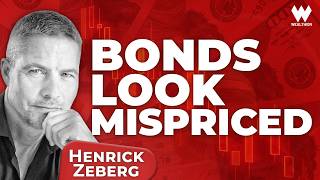
He calls bonds too cheap. Against the "bond market is blowing up" narrative, Zeberg says Treasuries look "very mispriced, but that's because they're too cheap," expecting yields to fall as the economy turns.
He sees the labor market in near free fall. He argues 12-month average job creation has fallen to around 50,000 a month, revised as low as 16,000, weaker than heading into any recession in decades, and warns the headline payroll number rests on a record-low survey response rate.
He thinks inflation lags lower, not into stagflation. With consumer savings at just 2% to 3%, Zeberg argues households cannot carry sustained inflation, so a weakening economy pulls it down; the real inflation risk, he says, comes later.
The dollar rips in a bust, and havens get sold first. Zeberg is near-term bearish the dollar but "massively bullish" into a bust, when he expects gold, crypto and good businesses to be sold for cash before the Fed backstops and hard assets shine.
Is a Stock Market Crash Coming? Henrik Zeberg on the Final Melt-Up and Why Bonds Are Too Cheap
With stocks near record highs and headlines split between "unstoppable AI boom" and "everything is about to break," the crash question is unavoidable. Henrik Zeberg, macro strategist at Swissblock and author of The Zeberg Letter, told Wealthion in September 2026 that both sides are partly right: he expects one more powerful melt-up, then a fast and severe reversal. Along the way he makes a contrarian call that bonds are too cheap and that the real economy is far weaker than the headlines suggest. This is his attributed, contrarian view, not investment advice.
Is a stock market crash coming?
Zeberg's answer is yes, but not yet, and not before a final surge. He thinks the Nasdaq "could see 37,000, 39,000" in a fast blow-off top, and that today's market closely resembles 2000: he notes the Nasdaq rallied about 45% in the seven weeks into that top, then fell roughly 40% in just two to three weeks, "the Eiffel Tower" pattern of a sharp spike followed by an even sharper collapse. He does not claim to know the catalyst, arguing the 2007 top had none either; instead he likens the market to an avalanche where "the underlying structure of the avalanche is unstable" and getting more so, so "it's just a matter of time before it starts rumbling down." A companion bear case from a different angle appears in David Rosenberg's is the stock market going to crash.
Why does Zeberg think bonds are too cheap?
Because he expects the economy, and with it yields, to turn down. Against the popular narrative that "the bond market is blowing up," Zeberg says Treasuries look "very mispriced, but that's because they're too cheap." His logic follows from his growth view: if the real economy is weaker than the headlines and inflation lags lower, then long-term yields have overshot, and bonds should rally as the cycle rolls over. It is a deliberately contrarian position at a moment when most commentary is bearish on bonds.
Why does he say the labor market is in "free fall"?
Because, beneath the headline, hiring has stalled. Zeberg argues "the labor market is in almost a free fall": the 12-month average of monthly job creation has dropped to around 50,000, and a recent revision put a stretch of it near 16,000 a month, which he calls "a standstill" and weaker than the economy created heading into any recession in the past 50 to 60 years. He is skeptical of the upbeat monthly prints, noting one recent payroll report was built on a survey response rate around 44%, the lowest on record, with the Bureau of Labor Statistics' own 90% confidence range spanning 40,000 to 280,000 jobs. The message: take the headline "with a grain of salt."
Will inflation stay high or come down?
Zeberg expects it to lag lower, not spiral. He argues that at this stage of the cycle a CPI near 3.5% is not actually high, and that inflation can only persist if someone can carry it. With consumer savings down to 2% to 3% (versus 10% to 20% in the 1970s), he says households simply cannot absorb sustained price increases the way they once could, so an oil spike squeezes the typical consumer rather than igniting durable inflation. He rejects the stagflation label for now, describing what people call stagflation as really the transition phase in which inflation lags a downturn, and argues "inflation is not something that comes down from the sky," it needs demand. The genuine inflation risk, he says, comes later, on the far side of the bust once stimulus returns.
Is the Fed making a policy error?
Zeberg thinks the risk is real. He warns central banks are hiking into weakness, drawing a parallel to the ECB raising rates into the 2008 downturn, and argues the Fed's 2% target is somewhat arbitrary, a Greenspan-era idea formalized around 2012, when for much of the past half-century inflation ran comfortably above 2% alongside strong growth. He is pointed about the "K-shaped economy" framing that dismisses the bottom 70% of consumers, calling it "arrogant and wrong," and argues inequality that hollows out the middle class is bad for growth, a dynamic he says is visible in elections beyond the US. For the opposing, more optimistic read on the economy's resilience, see Chris Galipeau on why the U.S. economy keeps defying expectations.
What happens to the dollar, gold and crypto in a bust?
Here Zeberg lays out a sequence, and it is not the simple "own gold and Bitcoin" story. He is near-term bearish the dollar (seeing the index fall toward 93 to 94 as the market realizes the Fed will ease) but "massively bullish the dollar going into whatever kind of bust," because a global scramble to cover dollar-denominated credit and margin calls creates a dollar shortage, the dollar as a "wrecking ball." In that phase, he warns, gold, crypto and even good businesses get sold for cash. Only afterward, once the Fed backstops the system and a new inflation psychology takes hold, does he expect gold, silver and commodities to do really well. On crypto specifically, he expects "another burst" of euphoria (a possible new all-time high in Ethereum, a bounce in Bitcoin), but frames it as a risk-asset rotation, not a genuine dollar alternative, and says he would not be long crypto at the dollar's bottom. These are his attributed views, and gold and crypto are volatile; nothing here is advice. Related reads include Peter Boockvar on the AI spending boom cracking and Kevin Muir on why some investors are selling AI stocks.
What Investors Should Watch
- A Nasdaq blow-off toward 37,000 to 39,000: Zeberg's marker of a final melt-up before the reversal.
- Short-term yields: a sharp drop is the signal he says would flag the turn.
- The 12-month average of job creation: his gauge of hidden labor-market weakness.
- Consumer savings near 2% to 3%: the reason he doubts inflation can persist.
- The dollar index toward 93 to 94: his near-term target before a bust-driven dollar surge.
FAQ
Is a stock market crash coming? Henrik Zeberg expects one, but only after a final melt-up. He thinks the Nasdaq could surge toward 37,000 to 39,000, then fall sharply in a dot-com-style reversal, and says the market's underlying structure is increasingly unstable, so it is "just a matter of time" before it breaks.
Why does Zeberg say bonds are too cheap? Against the view that the bond market is breaking down, he argues Treasuries are mispriced on the cheap side and should rally as a weakening economy pulls yields down.
Is the labor market really weak? Zeberg argues it is near a standstill, with 12-month average job creation around 50,000 a month, revised as low as 16,000, and warns the upbeat headline prints rest on a record-low survey response rate.
Will there be stagflation? Zeberg rejects the label for now. He argues consumers, with savings of just 2% to 3%, cannot carry sustained inflation, so a downturn pulls inflation lower; what people call stagflation, he says, is really the transition phase, with the real inflation risk coming later.
What does he expect for the dollar, gold and crypto? Near-term bearish the dollar, then "massively bullish" into a bust, when he expects gold, crypto and good businesses to be sold for cash before the Fed backstops and hard assets recover. He sees another euphoric crypto burst but not a true dollar alternative. These are his attributed views, not advice.
Full Transcript
Speakers: Maggie Lake (Wealthion host) and Henrik Zeberg (macro strategist, Swissblock; author, The Zeberg Letter). ASR errors corrected (names, terms) and filler removed; meaning preserved. Two Wealthion membership messages have been noted rather than reproduced.
Henrik Zeberg (cold open): These are completely, insanely elevated valuation levels we have right now. We saw a 45% rally in the Nasdaq in seven weeks, and then in two to three weeks it dropped almost 40%. It's just a matter of time before it starts rumbling down.
Maggie Lake: We have oil prices spiking again, adding to inflation concerns. What is your macro framework telling you about growth and inflation?
Henrik Zeberg: There's what seems to be right in front of us, and then there's the real engine down beneath. On the surface, people see inflation apparently stubbornly high, the Fed losing control, the bond market blowing up. We've seen this before: in the late phase of the cycle, inflation pushes through because the party has been going on so long, with tremendous demand for capital from the AI boom. But down beneath is the real economy, the 70% of the US that is the consumer. The housing market is frozen solid, and the labor market is in almost a free fall. That's not what the headline non-farm payrolls said on Friday, but if you look deeper, something is going on. Even though oil is spiking, somebody has to carry that inflation. Take "Mrs. Johnson": she doesn't suddenly have more money when she fills up her car, so she has to prioritize, and that is where inflation starts to bite into demand. When people say this is like the 1970s, it's completely different, for two reasons. Consumer savings now are down to 2% to 3%, so she can't dive deeper into her pocket the way people could in the '70s when savings were 10% to 20%. And the labor market is at a standstill: the 12-month moving average of job creation is around 50,000 a month, and the last revision put it near 16,000. That's lower than going into any recession in the last 50 or 60 years. So I'd be more worried about the opposite of what everyone fears: a CPI around 3.5% is not high inflation at this point in the cycle; it was much higher into 2007 and 2001.
Maggie Lake: So we're late-stage, which isn't consensus. What looks mispriced?
Henrik Zeberg: A lot. On the good end, bonds, Treasuries, look very mispriced, but that's because they're too cheap. On the other side, valuation levels in the stock market, especially big tech and AI, are insane. And the Fed's rate level looks wrong: why cool an economy with such low job creation? There are two mandates, not one. The 2% target is something Greenspan talked about in the '90s and that was formalized around 2012; go back 40 to 50 years and inflation was above 2% most of the time, around 3% to 3.5%, and growth was often best then. Nobody really asks why it must be 2%, or why we should kill the consumer to get there.
Maggie Lake: [Membership message noted.] There's a narrative that the real economy doesn't matter anymore, that it's the top 10% of asset owners, the upper K, that drives growth. You don't buy that?
Henrik Zeberg: I'll put it mildly: it's a very arrogant way of looking at things, "let them eat cake." That's not how the economy runs. The economy runs well when the middle class does well; that's when you get the highest growth. There's never been a K-shaped economy that's been persistent. The top will thrive for a while, but down beneath is the real economy nobody speaks of. The median US consumer can't handle a $2,000 surprise bill; more people are living paycheck to paycheck than ever, even more than at the top of the financial crisis. Businesses ultimately earn money on the end consumer; if that consumer doesn't have a job, they can't buy the products. So calling it "K" sounds agnostic, but "inequality that's hurting the economy" is more accurate, and it's not just the US; you see it in European elections too.
Maggie Lake: We're on the cusp of a possible policy error, with the Fed, ECB and BOJ hiking into weakness. Is that a concern?
Henrik Zeberg: One hundred percent. The ECB hiked into 2008; it was a massive mistake, and their inflation forecasts were way off, they expected inflation above 3% and got deflation. There's a sequence to how inflation works that they miss. They'll likely hike right into the moment it dawns on them that the economy isn't strong, and that they have that second mandate. That happened to the Fed into the financial crisis: they were promising hikes in August 2007, the market spiked 25%, and by January 2008 they cut 125 basis points while inflation was at 4% and rising. The moment the super-tanker turns, inflation follows down, because inflation is not something that comes down from the sky and punishes us; it's carried person to person, and if people are laid off, there's no one to carry it.
Maggie Lake: How do you feel about commodities, if slowing demand is around the corner?
Henrik Zeberg: Look at 2008: oil ripped to around $145 to $150 on the "China will buy all the oil" narrative, then plunged when the economy stalled. Copper did the same. We can see these spikes, and they matter short-term for the inflation calculation, but they don't put money in Mrs. Johnson's pocket; they make it harder for her, which helps kill what's left of growth. I think we're close to a top in copper. Oil is a bit different right now because of the Middle East, but the narrative is the same as 2008.
Maggie Lake: Do you buy stagflation as a lasting state?
Henrik Zeberg: No. Inflation that is more permanent can't persist without a consumer to carry it. Real stagflation is inflation of 6% to 7% with unemployment around 7% to 8%; that's not what we have at 3.5% inflation. What people call stagflation is really the transition, inflation lagging a downturn, as we saw for about nine months in 2022. The real inflation risk is on the other side of a decline, when the Fed and stimulus come back in and psychology shifts.
Maggie Lake: What does that mean for equities?
Henrik Zeberg: We're not at the top yet. What I want to see is short-term yields dropping sharply, and we don't see that, which means we can go higher. I think we could see 37,000 to 39,000 on the Nasdaq, and fast. This market resembles 2000, and not just on valuation; we track close to a million data points to compare cycle phases. Into the 2000 top, the Nasdaq rallied 45% in seven weeks, then dropped about 40% in two to three weeks, the Eiffel Tower. Nobody can show me a chart where it goes up like that and then drifts sideways; it comes down hard. As for the catalyst, people always ask, and I ask them what the catalyst was in October 2007, there wasn't one on the day. These tops develop and then roll over as things get too heavy. An avalanche can be set off by a big shock or by the slow accumulation of snow making the underlying structure unstable. I don't know which it will be, but the longer this persists, the more unstable it gets, the circular AI revenue recognition, the stretched consumer, and it's just a matter of time before it starts rumbling down. I don't want to be in the village beneath that avalanche.
Maggie Lake: [Membership message noted.] Talk to me about the dollar. The debasement trade seems back in vogue.
Henrik Zeberg: Near-term I'm bearish the dollar; I think the Dixie can fall toward 93 to 94. What sets that off is the market realizing the Fed will support at some point rather than stay hawkish. But I'm massively bullish the dollar going into a bust. The dollar system is powerfully constructed: when bad things unfold, the rest of the world, which is effectively short dollars, needs dollars to close credit lines and meet margin calls, so you get a dollar shortage. You don't close those with gold or Bitcoin or Apple stock, you close them with dollars. The dollar becomes a wrecking ball that can crush the rest of the world, self-propelling, until the Fed steps in to stop it. So in that phase, gold that's been hoarded, good businesses, crypto, a lot of it gets sold off for cash, sometimes below fair value. It's the phase after, when the Fed backstops again, that I'm very bullish gold, silver and commodities, especially because this time the psychology of inflation expectations has changed. For most of my life we saw low and falling inflation; if people start to expect rising inflation, that's a big change, and in that later phase commodities and metals do really well.
Maggie Lake: How are you feeling about ETH and Bitcoin shorter term?
Henrik Zeberg: I think of crypto as an asset class, and I think we're seeing a rotation of capital: it went into the most secure areas first, then into the Nasdaq and AI themes, and now a bit rotates into crypto. It doesn't take much, maybe a trillion dollars out of a 150-trillion global stock market, to move it a lot. So yes, I think we can see a new all-time high on Ethereum and on the altcoin index, and euphoria develop once more, though on Bitcoin I'm less sure of a new high, a bounce toward 115,000 is plausible. But this is a risk-asset rotation searching for the next momentum trade, not a diversification into an uncorrelated, non-dollar asset. I would not be long crypto once we see the dollar bottoming. And I don't see crypto as a real competitor to the dollar down the road; it's a technology that will help propel AI, but it's not going to replace the dollar, however much that appeals at the dinner table.
Maggie Lake: We love catching up with you, Henrik, because you push back against the narratives. Thank you so much.
Henrik Zeberg: Thank you, Maggie, for having me on.
What Serious Investors Are Watching
Dive into expert interviews, market analysis, and long-form content built to help serious investors think long-term.
Is a Stock Market Crash Coming? Henrik Zeberg
Key Takeaways Zeberg expects a final melt-up before the crash. He thinks the Nasdaq could...
What Central Bank Gold Buying Signals That the Price Does Not
What Central Bank Gold Buying Signals That the Price Does Not Central banks are the...
The Dollars That Live Outside America
The Dollars That Live Outside America Most dollars are not created by the Federal Reserve....
Enjoyed This? Get More Insights
Expert insights and curated opportunities, delivered to your inbox.
Ready to Position for What's Coming?
Whether you're still learning or ready to act, your next step starts here.
- Independent
- Macro-Informed
- Real Asset Focused

The Wealthion Network
By subscribing, you agree to receive Wealthion emails. Unsubscribe anytime.
Network Discussion
Sign in to share your thoughts and connect with other readers.
Join the Wealthion Network to Comment