

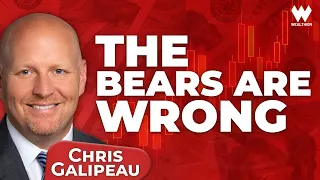
Is Now a Good Time to Invest in Stocks? Chris Galipeau
Key Takeaways
Galipeau thinks investors are too bearish. He says "people are seemingly waiting for the world to end" and argues "the world doesn't end that often," pointing to the S&P's roughly 13.5% year-to-date gain despite spiking oil and rising bond yields.
Earnings, not headlines, drive his outlook. His refrain is that "the stock market just doesn't crash on its own," usually needing the Fed to raise rates too high and hold them too long, and that earnings growth remains "phenomenal" through 2026 into 2028 on his forecast.
He does not think the AI trade is the dot-com bubble. Comparing Nvidia's roughly 20 times earnings to Cisco's roughly 100 times in 2000, he says flatly, "you can't tell me it's a bubble," calling the earlier semiconductor speculation "a casino, not investing," but the broader AI trade fundamentally different.
Volatility is opportunity, not danger, in his framework. "Volatility favors the prepared investor. We like volatility. Bring it on," he says, describing how active managers trim into speculative surges and add into pullbacks.
He does flag two real risks. The peak rate of change in earnings growth, and a Fed that hikes six or seven times rather than one or two, are the two things he says would actually worry him.
Is Now a Good Time to Invest in Stocks? Chris Galipeau Says Investors Are Too Bearish
Between spiking oil, rising bond yields and a steady drumbeat of crash warnings, many investors are asking whether now is a reasonable time to be in stocks at all. Chris Galipeau, head market strategist for the Franklin Templeton Institute, told Wealthion in September 2026 that the pervasive bearishness is largely unjustified, that earnings remain the variable that actually matters, and that the AI-driven market looks nothing like the dot-com bubble on the numbers that count. This is his attributed, deliberately bullish view, offered as a counterweight to more bearish takes elsewhere, and not personalized advice.
Is now a good time to invest in stocks?
Galipeau's answer is a qualified yes, built on earnings rather than sentiment. He notes the S&P is up roughly 13.5% for the year despite four or five pullbacks of 4% to 9%, long rates backing up about 100 basis points, and oil climbing from the mid-60s to above 100. His conclusion: "the earnings power has been great," well ahead of Street forecasts, with a good third quarter still ahead and growth he expects to continue through 2026, 2027 and into 2028. His broader complaint is about investor psychology: "people are seemingly waiting for the world to end," a pattern he says has held for his entire 35-year career, and "I've got news for you. The world doesn't end that often."
Are investors too bearish?
Galipeau thinks so, and pins the blame on headline noise. He argues "the stock market just doesn't crash on its own," typically requiring the Federal Reserve to raise rates too high and hold them too long, or a genuine black-swan shock like COVID that cannot be forecast in advance. Over 35 years, including three recessions he has managed money through, he treats a true recession as roughly a once-a-decade event, not the constant, imminent risk implied by the "constant drumbeat" of bearish headlines. His advice is simple: "ignore that. Focus on what matters. Earnings matter. Period. End of story." For a more bearish read on the same debate, see David Rosenberg's is the stock market going to crash and Henrik Zeberg's why bonds may be too cheap.
Is the AI trade a bubble like 2000?
No, in Galipeau's view, and valuation is his central argument. He recalls Cisco, the poster child of the dot-com era, trading around 100 times earnings near the March 2000 peak, when the S&P itself traded around 30 times. Today's market, by contrast, trades around 21 times this year's earnings and 19 times next year's, with Nvidia around 20 times, a sharp difference he summarizes bluntly: "you can't tell me it's a bubble." He does acknowledge one parallel: he flags "some concern around the circular nature of the financing" in AI infrastructure spending, and says a parabolic run in semiconductor stocks earlier in the year did remind him of 2000, calling that specific episode "a casino, not investing." But he distinguishes that leveraged speculation from the AI trade's underlying earnings power, which he says the dot-com era never had. For the opposing view, see Barry Knapp's is the AI bubble bursting, and for a middle-ground concern about circular financing specifically, Peter Boockvar's the AI spending boom cracking.
How does Galipeau manage volatility as an investor?
Actively, and by his account, this is where volatility becomes an ally rather than a threat. He says the "stock market usually takes out its own trash," describing how the speculative semiconductor surge corrected sharply on its own without dragging the broader market down with it. His practical test for any holding: "if I didn't own this stock today, would I buy it here?" If the answer is yes based on the fundamentals, he holds or adds; if a chart looks parabolic with no underlying case, he waits for a better entry. His conclusion is direct: "volatility favors the prepared investor. We like volatility. Bring it on." He also treats the broadening rally beyond mega-cap tech as a bullish signal in itself, not a warning sign, since more sectors participating spreads the market's dependence on any single trade.
Are small caps and other sectors still attractive?
Cautiously yes, in his framework. Galipeau notes small caps and emerging markets, particularly South Korea and Taiwan (heavily semiconductor-linked names) rather than China specifically, have led performance year to date, supported by the strongest earnings-estimate revisions in the US small-cap space in two years. His caveat is that small caps carry more floating-rate debt, so further increases in long rates would pressure them more than large caps, an effect he says is partly offset by real GDP growth running above trend. On energy and utilities as an AI-adjacent trade, he is constructive but flags a correlation risk: since those names tend to move with the AI complex, adding several of them alongside semiconductor and hyperscaler exposure often just replicates the same underlying bet rather than diversifying it.
Will AI destroy jobs, or boost productivity?
Galipeau leans toward productivity, using a real example. He describes an unnamed but well-known retailer telling investors it expects to grow revenue at the same rate over the next five years as the prior five without adding headcount, partly by using an AI shopping tool that, in his telling, nudges a shopper toward a 35% larger basket than an equivalent customer without it. He says roughly 25 companies in the S&P gave a "discernible ROI" from AI use in a recent quarter, which he calls "the first inning of a nine-inning game," expecting more disclosure ahead. He is candid that this dynamic likely explains some of the "no hire, no fire" labor market of the past year or two, since companies are more cautious about adding headcount when in-house tools might cover the same function, though he frames that as an economic policy question rather than an earnings problem.
What are the biggest risks to stocks from here?
Two, by his account. First, the peak rate of change in earnings growth, since comparisons get tougher into 2027 and a low forward multiple on names like Nvidia and Microsoft could reflect the market already pricing peak earnings rather than genuine undervaluation. Second, a Fed that hikes not once or twice but six or seven times, which he considers unlikely but not impossible, especially since he reads the Fed's current tightening partly as an attempt to rebuild credibility after inflation ran meaningfully above target. On AI regulation specifically, he does not dismiss the risk of a repricing if government rules slow deployment, but is skeptical that heavy-handed regulation is the right tool, preferring that the people building the technology figure out appropriate guardrails themselves. As always on Wealthion, this is his attributed, bullish view, not investment advice.
What Investors Should Watch
- Forward earnings growth versus its own recent pace: Galipeau's "peak rate of change" concern, distinct from a nominal earnings decline.
- Fed hikes beyond one or two: the threshold he says would actually worry him.
- Company-level AI ROI disclosures: the "25 companies" data point he expects to keep growing each quarter.
- Long-term interest rates: the variable he flags as the bigger risk to small-cap performance.
- Circular financing in AI infrastructure spending: the one parallel to 2000 he does not dismiss.
FAQ
Is now a good time to invest in stocks? Chris Galipeau argues yes, on the strength of earnings rather than sentiment, noting the S&P's roughly 13.5% year-to-date gain despite oil and rate headwinds. This is his attributed, bullish view, not personalized advice.
Are investors too bearish right now? Galipeau thinks so, arguing markets rarely crash on their own outside Fed-induced tightening or genuine shocks, and that a steady drumbeat of crash predictions has been a constant throughout his 35-year career without matching reality.
Is the AI trade a bubble like the dot-com era? No, in his view. He points to Nvidia trading around 20 times earnings versus Cisco's roughly 100 times near the 2000 peak, and the broader market at about 19 to 21 times versus roughly 30 times in 2000, though he does flag circular AI financing as a real concern worth watching.
What are the biggest risks to stocks right now? Galipeau names two: the peak rate of change in earnings growth as comparisons get tougher, and a Fed that hikes rates far more than the one or two moves he currently expects.
Are small-cap stocks still attractive? Cautiously, in his view. Small caps have led on strong earnings-estimate revisions, but carry more floating-rate debt, so further increases in long-term rates would hit them harder than large caps.
Full Transcript (cleaned)
Speakers: Maggie Lake (Wealthion host) and Chris Galipeau (head market strategist, Franklin Templeton Institute). ASR errors corrected (names, terms) and filler removed; meaning preserved. A mid-interview Wealthion membership message has been noted rather than reproduced. A named large retailer's specific AI feature has been kept factual and unembellished; Claude is mentioned once by the guest alongside other AI assistants and is left as a neutral, unremarked example.
Chris Galipeau (cold open): People are seemingly waiting for the world to end. I've got news for you. The world doesn't end that often. The semiconductor names went into complete speculation mode. That was a casino, not investing. You can't tell me it's a bubble. That's not a bubble. Volatility favors the prepared investor. We like volatility. Bring it on.
Maggie Lake: It's been quite a September, with spiking oil prices and rising bond yields creating a lot of investor anxiety, yet the Nasdaq hit a record high. What's the direction of travel, and how do you separate the noise from the signal?
Chris Galipeau: The S&P is up about 13.5% for the year as we speak, with four or five pullbacks between 4% and 9%, normal course of business, and we just had another one. If you'd told me long rates would back up 100 basis points and oil would go from 65 to north of 100, and you'd still tape up low double digits starting from a 22.5 times multiple on January 1, I'd have had my doubts. But earnings power has been great in the first six months of the year, well ahead of Street forecasts, with a good third quarter still ahead. So we have this void where headlines will whip the tape around, but what actually matters, far more than the level and direction of rates, is earnings growth, and that has been phenomenal, on track to continue through 2026 into 2027 and 2028.
Maggie Lake: Does it feel like investors are too bearish here, like everyone's waiting for the bubble to pop or the market to crash?
Chris Galipeau: That's been the case my whole 35-year career. People are seemingly waiting for the world to end, and the shoe to drop. I've got news for you: the world doesn't end that often. The stock market just doesn't crash on its own; it's usually Fed-induced, meaning they raise rates too high, hold them too long, and break something. That drumbeat has been constant for years, and for most of my career. Ignore it. Focus on what matters. Earnings matter, period, end of story, and earnings have been fabulous.
Maggie Lake: On the Fed, some believe we're at the start of an aggressive hiking cycle rather than one and done. Are you worried about that eventually hitting equities?
Chris Galipeau: It's a risk; historically the Fed rarely hikes just once and stops. I'd expect one, maybe two more. The economy and market seem strong enough to handle that, but it's something to watch. Genuine recessions are rare, maybe once a decade; I've managed money through three in 35 years. The usual trigger is the Fed raising rates until something breaks, or a black swan like COVID, which I can't forecast. My guess is one or two more hikes from here, which the stock market and economy can probably handle. We're not overheating; the inflation problem has been sticky for five years and right now is more of a supply-side shock, especially from oil, than demand overheating, and raising rates 100 basis points won't move the price of oil or diesel. So I'd expect the Fed to be measured, though it's a risk worth watching.
Maggie Lake: Is oil a bigger problem? Does it need to come down, given it's an input cost for so many companies?
Chris Galipeau: Oil would need to trade meaningfully above 100 and hold there for around six months to really matter macro, but as consumers we already feel it at the pump, especially anyone driving a diesel vehicle. Even if oil fell back toward 70 today, it takes time to feed through to pump prices. Higher oil does bleed into core inflation, a good example being truckers and rail shippers whose costs rise and get passed along, a negative feedback loop that hopefully gets addressed soon.
Maggie Lake: Companies and equities seem to be absorbing everything thrown at them. What's underappreciated on the positive side?
Chris Galipeau: The earnings picture has been broad, both in the US and globally. The strongest earnings power globally has been in emerging markets, likely continuing into next year, and in the US the strongest rate-of-change in forward earnings has been in small caps, which is why EM and US small caps are the year-to-date performance leaders, something I think is underappreciated.
Maggie Lake: Within EM, is that China-driven, or something else?
Chris Galipeau: Not really China; the two prime drivers are South Korea and Taiwan, think Taiwan Semiconductor, Samsung, SK Hynix, though the industrials, healthcare and materials complexes there are robust too. On a rate-of-change basis, though, the big driver has been the semiconductor names.
Maggie Lake: Does the concentration in that AI-adjacent trade worry you?
Chris Galipeau: You saw semiconductor names go into complete speculation mode, probably in the second quarter; that was a casino, not investing, and I told clients to watch out for it. The stock market took out its own trash: those stocks got clobbered, came back, and reset the bottom, and they've since traded higher, which is fine. There is some concern around the circular nature of AI-related financing, I'll grant that. But what most people miss is how many companies are actually implementing AI as a tool and can measure the resulting efficiency, productivity, and ultimately profitability, which is flying under the radar. In Q2, about 25 companies in the S&P gave a discernible ROI from AI use; that's the first inning of a nine-inning game, and it should keep growing across industries.
Maggie Lake: Is that something management teams volunteer, or only when asked?
Chris Galipeau: They're asked, but increasingly they bring it up proactively, especially in the last one or two quarters, walking through what deploying AI has meant for efficiency, margin accretion and ultimately net income. Every company handles it differently, but everyone is addressing it one way or another. [Membership message noted.]
Maggie Lake: There's a skeptical camp arguing everyone's using AI but few are implementing it well, with unclear ROI and rising token costs that could cause spending cutbacks. Is that what you're hearing from companies themselves?
Chris Galipeau: What we hear from companies is largely the opposite, ranging from early adopters already seeing benefits to others still figuring it out. But you can't call it a bubble when the major players, say Google, Microsoft and Nvidia, trade at multiples below the broader market. That's not a bubble. I understand the concern around circular spending, but on pure valuation, revenue, earnings and multiples, this is nothing close to the dot-com bubble. I managed money through that; it's apples and oranges.
Maggie Lake: Why do you see it as so different? What are the specific markers?
Chris Galipeau: Valuation is the most striking difference. Go back to 2000 and take Cisco as the poster child, trading around 100 times earnings, with the S&P near 30 times at its March 2000 peak. Today the tape trades around 21 times this year's earnings, 19 times next year's, and Nvidia around 20 times. That's a sharp contrast. Back then it was all eyeballs and clicks with no real earnings power; companies could put ".com" in their name and go public into a genuine mania. This is different: you can't argue with the revenue, earnings, and until recently, free cash flow conversion, though the hyperscalers have blown through typical free cash flow generation lately in a way nobody quite anticipated. Still, no real similarity to 2000. What did worry me earlier this year was the parabolic move in semiconductor stocks, which did remind me of 2000; I wrote about it and warned clients. The market took those stocks to the woodshed and reset some attitudes, reminding people what happens when you speculate on leverage without knowing what you're doing. People got hurt, which is unfortunate but sometimes happens.
Maggie Lake: So it's really the difference between fundamentals and momentum built on leverage.
Chris Galipeau: Exactly, and you have to watch for that wrecking ball moving through different sectors as people chase momentum. The stock market usually takes out its own trash: today we have double and triple leveraged ETFs, options and futures on them, so speculation is easy, and you need to understand stop-loss and good-till-canceled discipline if you're going to play that game. But the market tends to self-correct internally; remarkably, when those stocks went parabolic and then came unglued, the broader market didn't flinch, it just rotated into other areas.
Maggie Lake: As an active manager, does that require being more nimble about rebalancing rather than shorting the whole market, a more laser focus on where the excess is building?
Chris Galipeau: Yes. As an active stock picker, you're constantly weighing a stock's price and valuation against your own income-statement model, thinking one to three years out at minimum, which lets you look through short-term swings. A useful discipline: if a stock you own gets hit and you ask, "if I didn't own this today, would I buy it here?", and the answer is yes based on your analysis, you hold or add. Conversely, with the semiconductor mini-bubble, if the chart looked straight up and you asked the same question, the honest answer was often no, so you wait for a better entry even if you like the fundamentals. Every portfolio manager runs that process daily, with a watchlist of names they want to own at the right price, trimming and adding around core positions at the margin.
Maggie Lake: Is that why active managers feel they have an edge here, versus passively adding to indexes that don't capture that discipline?
Chris Galipeau: Volatility favors the prepared investor. We like volatility. Bring it on, because it creates opportunities to trim names going vertical or add to names that have pulled back to an attractive risk-reward, or simply confirms you should add to something you already own. The broadening rally over the last couple of years, more names participating rather than just a handful, is not a concern; it's bullish, not bearish.
Maggie Lake: Are you fully invested in equities at all times, or do you hedge with other asset classes?
Chris Galipeau: Speaking for the firm, we're predominantly a long-only house, so yes, generally invested, though you're always moving capital across names, sectors, industries and regions based on risk-reward. If your thesis hasn't changed, you're not making wholesale shifts. I can be a bit more nimble personally than someone managing a very large portfolio, but the principles are the same.
Maggie Lake: If AI is delivering real ROI, does that pair naturally with energy given the power demands involved, or are there reasons energy doesn't look attractive to you?
Chris Galipeau: It's a real trade; the US power grid has needed upgrading for decades, so energy and utilities can be a reasonable adjacent way to play AI demand. Just be aware that if you already own semiconductor and hyperscaler names and then add several energy or utility names for the same thesis, you're often just replicating the same underlying bet, correlated exposure rather than true diversification. Building a portfolio is like laying bricks one at a time, each one chosen for a reason, ideally with different, fundamentally driven rationales, and good risk systems to flag when several holdings are really the same trade in different clothing.
Maggie Lake: On small caps, there's concern about rates. What's the bull and bear case, and are rates the key risk?
Chris Galipeau: Rates are a bigger issue for small caps because many carry floating-rate debt, so you're right to flag that. It's partly offset by strong earnings-estimate revisions in small caps for two years running, likely continuing into 2027. If long rates move meaningfully higher from here, that adds incremental pressure, but a strong economy helps offset it, since small caps are sensitive to real GDP growth, which has run above roughly 2% the last couple of years, above its longer-term trend near 1.8%. We haven't finalized a view for next year yet, but you do need to watch rates carefully in this space.
Maggie Lake: On AI and jobs, when management teams talk about proactive AI adoption filtering into earnings, is that about cost savings, growing the market, or both?
Chris Galipeau: Both. It ranges from early adopters already seeing benefits to companies still figuring out implementation. As one example everyone will recognize, a major retailer indicated a couple of quarters ago that it expects to grow revenue at the same rate over the next five years as the prior five without adding headcount. They also described how a shopper using their AI tool in-store might spend meaningfully more, something like 35% more, than an equivalent shopper without it, since the app proactively suggests complementary items based on what's already in the cart. That's a real example of AI both holding down expense growth and driving incremental revenue and profitability.
Maggie Lake: That's a great example, though it does raise concerns for future workers if companies aren't hiring, even if they're not laying people off either.
Chris Galipeau: That's a fair point. In a recent meeting with a well-known management team, I asked directly about hiring and AI's impact, and they said they're not rushing to lay anyone off, but are more cautious about adding headcount if in-house technology can already perform that function. That struck me as a real, if partial, explanation for the "low hire, low fire" labor market of the past couple of years. It's less an earnings problem and more an economic-policy question going forward.
Maggie Lake: What do you see as the biggest risks heading into year-end?
Chris Galipeau: Two, for equities specifically. First, the peak rate of change in earnings growth, not peak earnings in dollar terms, but the pace of growth, since comparisons get tougher heading into 2027. It's genuinely hard to identify in real time, though one marker is that forward multiples on names like Nvidia and Microsoft, and the Magnificent Seven basket broadly, are well below their 10-year medians, which could reflect the market already pricing in peak earnings growth. Second, if the Fed hikes not once or twice but six or seven times, that would be a real problem, though I don't currently expect that.
Maggie Lake: On the Fed, is the hiking mainly about credibility?
Chris Galipeau: I think that's a real part of it. Core inflation has been running around 3.3%, about 50% above the Fed's 2% target, which isn't acceptable to the public, and raising rates now looks like an attempt to reestablish credibility. That doesn't mean five or six hikes are coming, which would likely cause real problems, but it's something to watch, alongside the fact that both of these risks, peak rate of change and further hikes, would raise volatility even if they don't play out fully.
Maggie Lake: There's also a lot of talk about AI safety and whether the technology itself needs to slow down or face regulation, sometimes coming from executives themselves. Setting aside their motives, if growth has to slow, do current valuations need to reprice?
Chris Galipeau: We haven't seen actual slowing yet. If meaningful regulation gets layered on top, that could be a real game-changer; I won't speak for those management teams' timing decisions on going public. A few prominent voices have raised the issue and a few have pushed back, so I see it as a real risk that will likely get sorted out one way or another. If the industry has to self-regulate to avoid running off the rails, that's probably fine with most people; I'm less convinced heavy government regulation is the right tool, given how capable the people building this technology are. I'd come back to real-world use, most individuals already use one AI assistant or another, ChatGPT, Claude, or similar tools, and companies are increasingly deploying them effectively. There will be starts and stops, and winners and losers, and figuring out which is which at the margin is exactly the job of an active manager.
Maggie Lake: It makes sense, and I like framing volatility as opportunity rather than something to fear. Chris, we love catching up with you. Thank you so much for your time today.
Chris Galipeau: You bet. Thanks for having me.
If you want a professional read on how short-term funding risk fits your own portfolio, you can request a free portfolio review from an advisor who understands real assets at https://www.wealthion.com/advisors/.
This article is educational and is not investment, tax, or legal advice. It does not recommend any security. Advisory services are provided by Greylock Peak Investments, LLC, a subsidiary of Wealthion. Wealthion is compensated for advisor introductions; see the Solicitor's Disclosure Document, ADV Part 2A and Form CRS. That arrangement does not influence editorial coverage.
What Serious Investors Are Watching
Dive into expert interviews, market analysis, and long-form content built to help serious investors think long-term.
Is Now a Good Time to Invest in Stocks? Chris Galipeau
Key Takeaways Galipeau thinks investors are too bearish. He says "people are seemingly waiting for...
Real Yields and Gold: Why the Old Relationship Broke
For decades, the single best predictor of gold's direction was the real, inflation-adjusted yield on...

What Is the Gold Lease Rate?
The gold lease rate is what a borrower pays to rent physical gold, typically from...
Enjoyed This? Get More Insights
Expert insights and curated opportunities, delivered to your inbox.
Ready to Position for What's Coming?
Whether you're still learning or ready to act, your next step starts here.
- Independent
- Macro-Informed
- Real Asset Focused


The Wealthion Network
By subscribing, you agree to receive Wealthion emails. Unsubscribe anytime.
Network Discussion
Sign in to share your thoughts and connect with other readers.
Join the Wealthion Network to Comment