

Is the 60/40 Portfolio Dead? What Six Experts Said on Wealthion in 2026
The 60/40 portfolio, 60 percent stocks and 40 percent bonds, was the default answer to portfolio protection for two generations. Whether it still works is now the live debate: six experts interviewed on Wealthion split between rebuilding the 40 with bonds that finally pay, replacing it with cash, gold, and scarce real assets, and warning that the real bubble sits in investor behavior itself. As of August 2026, with US households holding a larger equity share than at the peak of the dot-com era, the protection question has rarely mattered more. Here is the debate.
Is the 60/40 portfolio dead?
It failed when it mattered most, and that is where the argument starts. David Rosenberg, in his conversation with Steven Feldman, recalled the 2022 setup: "The 6040 mix is 40% bonds. Bonds give you no return." When rates rose, both sides of the classic mix fell together, the exact failure the structure was meant to prevent. But dead is a strong word, and the experts here disagree about what follows: Jim Bianco argues the bond side has been repriced back to relevance, while Feldman and others argue the whole framework misses what actually diversifies in this cycle. The honest answer is that the old autopilot is dead; the allocation question is very much alive.
Is owning the S&P 500 still diversification?
No, on this the experts converge. Feldman's version, from his July interview, describing the index: "It's overloaded with the winners of the moment," and the winners of the moment are AI winners, so owning it is a concentrated technology bet wearing a diversified costume. You cannot claim, he argues, to hold a diversified portfolio of America's best companies when a handful of correlated names set the outcome. Rosenberg supplied the system-wide numbers: US households now hold roughly $60 trillion of equity exposure, "72% is in equities" as a share of household financial assets, higher than at the late-1990s tech-bubble peak, while a "grand total" of "8% are in bonds." His sharpest line reframes the whole debate: "the bubble is in investor behavior," not merely in any asset's price. When everyone's protection plan is the same crowded index, the protection is imaginary.
Do bonds still protect a portfolio?
Here the catalog offers a genuine three-way spread, which is exactly what makes the question worth reading. Bianco takes the constructive side in his May commentary: with investment-grade all-in yields, "you can probably get 5%," and unlike stocks, "bonds mature and then you'll get your principal back." He also names the uncomfortable moment honestly: the traditional diversifiers have been failing simultaneously, with bonds unreliable and metals, at that commentary date, "getting clobbered now."
Michael Howell's middle path, from his June interview, is duration discipline: own short to mid-maturity bonds where the carry compensates for rate risk, and avoid the long end while "Liquidity is inflecting and slowing." Steve Hanke, in his August interview, takes the hard line: with the money supply growing too fast and bond vigilantes back, "investing in bonds is not a very good idea," because rising yields mean falling prices. Three credentialed views, three different bond allocations; the variable that separates them is each man's inflation forecast. If inflation settles, Bianco's 5 percent with principal returned looks generous; if Hanke's money-supply arithmetic proves out, duration is the risk, not the hedge. Howell's short-to-mid position is effectively a hedge on that disagreement itself, which is why it may be the most instructive of the three for investors who refuse to bet the portfolio on one forecast.
What replaces the 40 percent?
The most concrete answer comes from Feldman, and it is a structure rather than a ticker: cash and gold are "both a ballast for your business but creates some option value in the instance where some of this stuff cracks" [as spoken]. Ballast plus option value is the whole design: the ballast steadies the portfolio through drawdowns, and the option value is dry powder for buying what the crisis puts on sale. It also answers the objection that cash and gold drag on returns; in this framework their yield is the ability to act when nobody else can. Behind it sits his scarcity screen, covered in our real assets analysis: gold as the cash proxy, farmland as the income anchor, then miners, infrastructure, and agriculture.
Jonathan Wellum's framing, from his May interview, states the goal plainly: "Investors need to really be careful about how they're going to protect the purchasing power," which for him means owning producers of scarce commodities that generate cash flow at conservative prices. Howell adds the monetary hedge logic for gold in this environment. None of these replaces the 40 with a single asset; they replace it with a job description, assets that hold purchasing power and stay liquid when equities fall.
What is the biggest risk to protect against?
Not a crash on a calendar, but the complacency that 17 years without a recession has bred, a phrase that appears almost verbatim in both Feldman interviews. Rosenberg's behavioral read completes it: investors cannot be moved off allocations that have worked, advisers cannot get clients to rebalance, and money keeps pouring into the most concentrated index in modern history. Protection, in the version these six describe, is less about predicting the break than about not being positioned as if the break is impossible. That is a decision available to every investor before the data settles the recession debate covered in our 2026 outlook. And it is measurable: the gap between a household sector at 72 percent equities and any of the allocations described above is the protection trade, sitting in plain sight.
The 60/40 autopilot is broken, but the allocation question is urgent. Cash, gold, and real assets, or short-duration bonds and commodities? Which framework fits your current holdings, your time horizon, and your risk tolerance? A Wealthion-endorsed advisor can help you build a protection structure that actually works. Request your free portfolio review at https://www.wealthion.com/advisors/
FAQ: Portfolio Protection in Brief
Is the 60/40 portfolio dead? The autopilot version failed in 2022 and remains contested. Bianco argues 5 percent bond yields revive the 40; Feldman and Wellum argue real assets and cash now do the diversifying job; Rosenberg argues the bigger problem is investor concentration in equities.
What is the 60/40 portfolio? A classic allocation of 60 percent stocks and 40 percent bonds, built on the assumption that bonds rise when stocks fall. That correlation broke when inflation returned.
Is the S&P 500 diversified? The experts interviewed on Wealthion say no: the index is concentrated in a handful of AI-linked winners, and household equity exposure now exceeds its dot-com-era share of financial assets.
What are the best alternatives to bonds for diversification? Named playbooks from these interviews: short to mid-duration bonds for carry (Howell), cash and gold as ballast with option value (Feldman), and cash-flowing producers of scarce real assets (Wellum). Each is that expert's own position.
How much cash should investors hold? No expert gave a universal number. Feldman's principle is that cash and gold together should be large enough to steady the portfolio and fund purchases if markets crack; Rosenberg notes households currently hold about 20 percent in cash and very little in bonds.
What is wealth preservation? Protecting purchasing power across a full cycle rather than maximizing any single year's return, the thread running through all six interviews and our inflation-hedge analysis.
Which experts and interviews does this article reference? Six Wealthion interviews from May to August 2026: David Rosenberg and Steven Feldman on bear markets, Steven Feldman on the investment risk nobody discusses, Jim Bianco on the market AI is holding up, Michael Howell on liquidity and inflation, Steve Hanke on the bond market's warning, and Jonathan Wellum on protecting purchasing power.
Wealthion editorial content is for informational purposes only and is not investment advice. The views quoted belong to the named guests. If you want a professional read on whether your own portfolio is positioned for this environment, you can request a free portfolio review at wealthion.com/free.
What Serious Investors Are Watching
Dive into expert interviews, market analysis, and long-form content built to help serious investors think long-term.
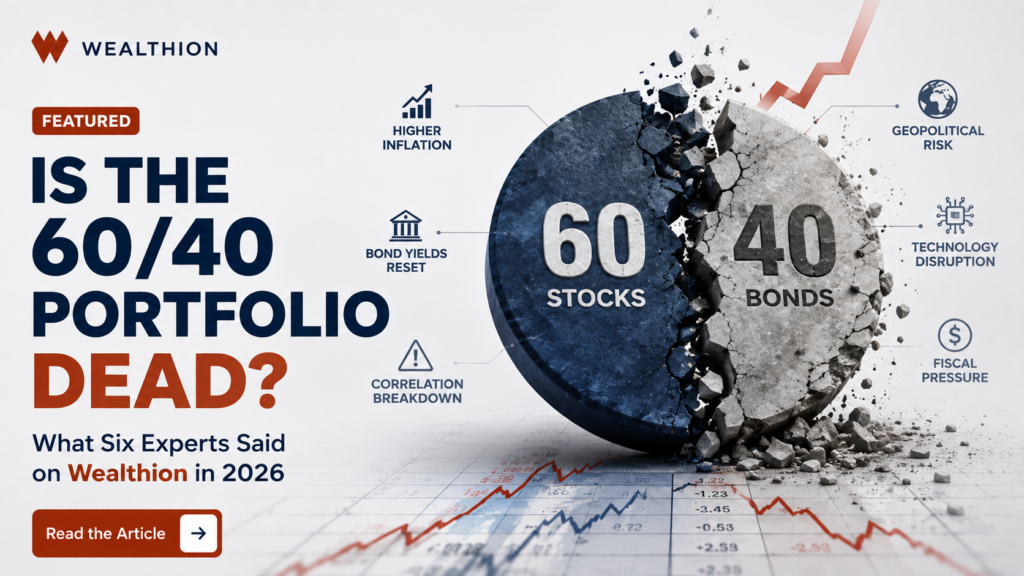
Is the 60/40 Portfolio Dead? What Six Experts Said on Wealthion in 2026
The 60/40 portfolio, 60 percent stocks and 40 percent bonds, was the default answer to...

Investing in Commodities in 2026: What Eleven Experts Said on Wealthion About the Supercycle
How to invest in commodities is a different question in 2026 than it was a...
How to Hedge Against Inflation: What Six Experts Recommended on Wealthion
Five years of above-target inflation have turned "how to hedge against inflation" from a textbook...
Enjoyed This? Get More Insights
Expert insights and curated opportunities, delivered to your inbox.
Ready to Position for What's Coming?
Whether you're still learning or ready to act, your next step starts here.
- Independent
- Macro-Informed
- Real Asset Focused


The Wealthion Network
Stay ahead of the curve. Subscribe to Wealthion’s newsletter and get timely videos, articles, and alerts featuring insights from the world’s leading experts in investing and wealth-building.
Network Discussion
Sign in to share your thoughts and connect with other readers.
Join the Wealthion Network to Comment