

Macro Bites – Oil Shipping Risks Rise
The pace of Iranian attacks on tankers in the Strait of Hormuz has reaccelerated, just as oil shipments through the world’s most important energy chokepoint were approaching prewar levels. The U.K. Maritime Trade Operations and the Joint Maritime Information Center report nine attacks in the waterway already this month, half the total number reported for all of September in the Strait and Persian Gulf combined. And the August total was boosted by four attacks in the final four days, underscoring the recent acceleration.
Separately, the crew of a merchant ship was missing on Tuesday after a drone strike in Bulgaria’s exclusive economic zone in the Black Sea. Bulgarian Prime Minister Rumen Radev described the incident as a gross violation of international law. While it was not immediately clear who carried out the attack by air and sea drones about 70 nautical miles off the coastal town of Byala, NATO concerns are mounting about Russian hybrid attacks in its war with Ukraine. Global bonds and equities are declining this morning on the news.
China’s PBOC stepped up its pace of gold purchases in September (23rd consecutive monthly increase) acquiring 740k ounces (up from 650k ounces in August) and bringing China's official gold holdings to 77.47 million ounces. Analysts observed the PBOC’s gold accumulation helps hedge against international financial and geopolitical risks while creating favorable conditions for prudently and steadily promoting the yuan's internationalization.
Trafigura Group and its partners have officially agreed to back the $300M Kalumbila–Kolwezi Interconnector Project, a landmark 200km high-voltage power transmission line connecting the electricity grids of Zambia and the DRC. The deal is a significant strategic pivot for Trafigura, coming just months after the commodities giant walked away from a separate, multi-billion-dollar proposed 2,000MW transmission line that would have funneled surplus hydropower from Angola to the DRC and Zambia.
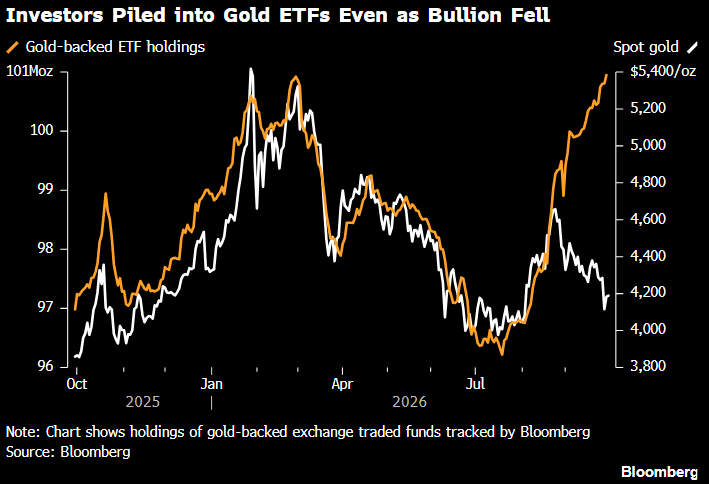
Chart of the week: While spot gold has declined 11.3% from its 8/25 intraday high ($4,696) to its 10/6 close ($4,164), total gold ounces held by bullion ETFs tracked by Bloomberg have actually increased 1.8% (from 99.2M oz to 101.1Moz). This divergence is highly unusual and suggests to us that investors focused on long-term gold fundamentals are accumulating fortuitously priced positions from shorter-term traders reacting to rising global bond yields. Amid this divergence, it is interesting to note that probabilities for an October FOMC rate hike have plummeted from 70.3% on 9/28 to 21.6% this morning. Something has to give, so stay tuned…
What Serious Investors Are Watching
Dive into expert interviews, market analysis, and long-form content built to help serious investors think long-term.
Gold After a Big Drop: How Five Past Pullbacks Compare
Gold has fallen this hard before. How deep those falls went, how long they lasted...

US Carbon Markets Explained: Why Prices Differ in California, Washington and RGGI
There is no single US carbon price. California, Washington and the Northeast power market each have their own buyers, supply limits and rules. For investors, those differences help explain why prices can move in different directions.

Will the Fed Raise Rates in December? What Steve Hanke, Kevin Muir and Keith McCullough Say
The Fed’s latest signals point toward further tightening. December’s decision turns on whether to act now, how large a hike might be and what the next reports show.
Enjoyed This? Get More Insights
Expert insights and curated opportunities, delivered to your inbox.
Ready to Position for What's Coming?
Whether you're still learning or ready to act, your next step starts here.
- Independent
- Macro-Informed
- Real Asset Focused


The Wealthion Network
By subscribing, you agree to receive Wealthion emails. Unsubscribe anytime.
The Wealthion Network
By subscribing, you agree to receive Wealthion emails. Unsubscribe anytime.
Network Discussion
Join the Wealthion Network to Comment