

REITs Explained: How Real Estate Investment Trusts Work
A REIT lets you own a share of real estate income without owning a building. But not all REITs work the same way: some own buildings and some lend money, some sell in seconds and some are hard to sell at all.
Say you'd like rental income from apartment buildings, warehouses or office towers, without buying a building yourself. A real estate investment trust (REIT) is one of the most common ways to do it.
A REIT is a company that owns or finances income-producing real estate 1. Owning its shares is a bit like owning a slice of a landlord: the REIT collects the rent, or the interest on its loans, and the rules require it to hand most of that income to its shareholders. In exchange, it is generally taxed only on the income it keeps 2.
What you actually get depends on three things, and this guide takes them in turn: what the REIT owns, how its shares are sold and what each payment is really made of. And the differences are big. On August 31, 2026, the mortgage REITs in the index of Nareit, the industry's trade body, had a dividend yield of 13.15%. The equity REITs, which own property, yielded 3.68% 3. Both are called REITs, but they are very different investments.
The numbers at a glance
How do REITs work?
For you as an investor, the idea is simple. You buy shares, the REIT earns rent or interest, and most of that income comes back to you as dividends.
That payout is built into the rules. A REIT generally isn't taxed on the income it distributes 2, and to keep that treatment it has to stay a real estate business. At least 75% of the value of its assets must be real estate, cash or government securities, at least 75% of its gross income must come from sources such as rents and mortgage interest, and it needs 100 or more owners 5. It must also distribute at least 90% of its REIT taxable income 2. That is a tax figure, not accounting profit: it is computed before the deduction for dividends paid and leaves out net capital gain 2.
What is the difference between equity REITs and mortgage REITs?
One kind is a landlord. The other is a lender.
Equity REITs "typically own and operate income-producing real estate," while mortgage REITs "provide financing to real estate owners and operators" through loans or mortgage-backed securities, as the Financial Industry Regulatory Authority (FINRA) describes them. Hybrid REITs combine both 1.
Equity REITs pay out rent cash; mortgage REITs pay out an interest spread
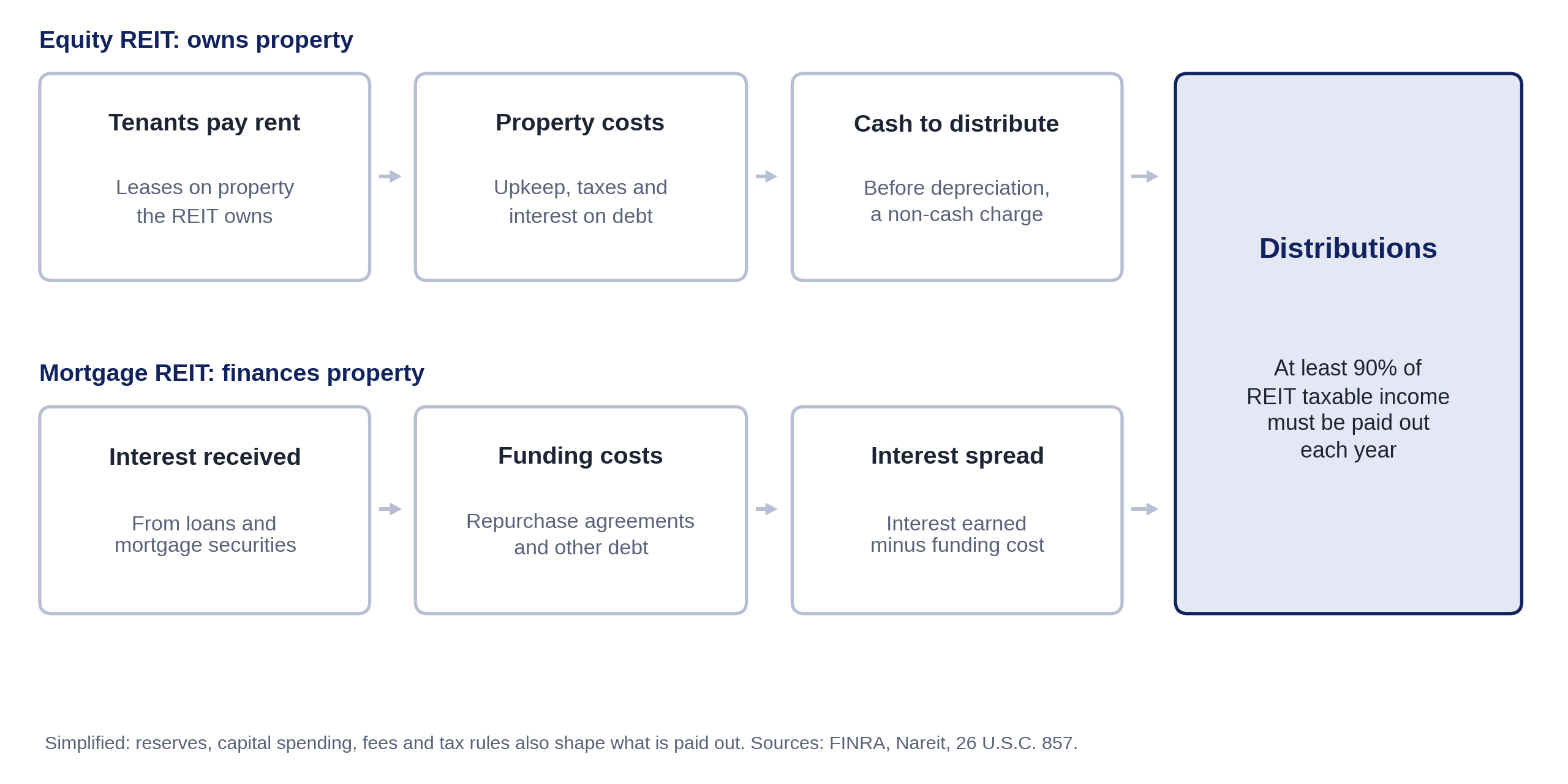
Two business models under one label
An equity REIT's cash starts as rent and shrinks as it pays operating costs, property taxes, upkeep and interest. Depreciation reduces its reported profit but uses no cash. That's why a REIT can pay out more than it earns.
A mortgage REIT earns what Nareit calls the "spread between interest income on their mortgage assets and their funding costs" 6. It funds its holdings partly with debt such as repurchase agreements, and residential mortgage REITs often fund long-term assets with short-term borrowing 6.
How do listed, public non-traded and private REITs differ?
The second question is how you'd own a REIT, and how you'd get your money back.
Listed REITs trade on stock exchanges. Public non-traded REITs are registered with the Securities and Exchange Commission (SEC) but don't trade on an exchange. Private REITs are neither, and are "primarily sold to institutional or accredited investors" 1.
Only a listed REIT can be sold at a market price on any trading day
How the three routes compare; non-traded fee and minimum figures are regulator estimates 1,7,8,9
| Listed | Public non-traded | Private | |
|---|---|---|---|
| Regulation | SEC-registered; trades on a national exchange | SEC-registered; not exchange-traded | Exempt from SEC registration; sold mainly to institutions and accredited investors |
| Getting out | Sell on any trading day at the market price | Limited redemption programs that can be ended without notice | Set by each offering's own terms |
| Share value | Market price, moving through the trading day | Net asset value (NAV) REITs: regular NAV. Fixed-price REITs: appraisals, perhaps once a year | No public market price |
| Upfront costs | Brokerage costs, as for any listed stock | About 9% to 10% (Investor.gov); 10% to 15% (SEC, 2015) | Not standardized; set in offering documents |
| Minimum | One share | Typically $1,000 to $2,500 (SEC, 2015) | Set by each offering's terms; investor eligibility restrictions also apply. |
What do liquidity, fees and valuations mean in practice?
This is where the route you choose shows up in your results.
Liquidity, meaning how easily you can turn shares into cash, is the clearest divide. A listed REIT sells like any stock, though FINRA notes listed REITs are "more prone to price swings" 1. Non-traded shares "cannot be sold readily in the market," and redemption programs "may be discontinued at the discretion of the REIT without notice," the SEC warned in a 2015 investor bulletin 7.
Upfront fees are the next difference. Estimates for non-traded REITs run from "approximately 9 to 10 percent" (Investor.gov) 8 to 10% to 15% (the 2015 bulletin) 7. On a $10,000 investment, that's roughly $900 to $1,500 in upfront costs.
And without an exchange price, someone has to estimate what your shares are worth. Non-traded values rest on "periodic or annual appraisals" that "may not be accurate or timely" 7. A steady value on your statement reflects appraisal timing, not proof of lower risk.
Why can a REIT's distribution exceed its profit, and how is it taxed?
This is the part most explanations skip, and the one that tells you what your payment is really made of.
Profit is a poor guide to what a property REIT can pay, because depreciation is large and uses no cash. Nareit created funds from operations (FFO) to deal with "the artificial nature of historical cost depreciation": roughly, net income with real estate depreciation added back and gains or losses on certain property sales excluded 10.
A hypothetical equity REIT shows the gap. The figures are illustrative.
| Hypothetical REIT, one year | $ millions |
|---|---|
| Rental revenue | 100 |
| Operating costs, property taxes and interest | 60 |
| Depreciation (non-cash) | 30 |
| Net income | 10 |
| Funds from operations (net income plus depreciation) | 40 |
| Distributions paid | 35 |
This REIT pays out 3.5 times its net income, yet less than its FFO. Depreciation isn't pure fiction, though: roofs and building systems do wear out, and FFO subtracts none of that replacement spending 10.
Now the tax side. Suppose the REIT's earnings and profits, measured under tax rules, came to $25 million. The other $10 million it paid would generally be a nondividend distribution, reported in box 3 of Form 1099-DIV 11. That's return of capital: it lowers your cost basis, and once basis reaches zero, further amounts count as capital gain 12. Non-traded REITs may also pay distributions from "offering proceeds, which includes the money you invested, and borrowings," the SEC warns 7.
Most REIT dividends "generally are treated as ordinary income" 8, but the code lets a REIT designate parts differently 2. Your 1099-DIV reports the amounts below. Boxes 1b and 5 are included in box 1a; box 2b is included in box 2a 11:
| 1099-DIV box | What it is | How it's treated |
|---|---|---|
| 1a: total ordinary dividends | The base case for most REIT income | Generally ordinary income 11 |
| 1b: qualified dividends | Only the portion a REIT designates, within limits in the code | Qualified dividend rates 2 |
| 2a and 2b: capital gain distributions | Gains the REIT passes through; 2b shows unrecaptured section 1250 gain from certain depreciable real property | Long-term gains, whatever your holding period 12,11 |
| 3: nondividend distributions | Return of capital | Reduces your cost basis; once basis hits zero, capital gain 12 |
| 5: section 199A dividends | Qualified REIT dividends | Feed a deduction component equal to 20% of those dividends, subject to overall limits 13 |
Isn't a REIT just a high-yield stock?
It's a common shorthand. It's half right.
A listed REIT does trade like a stock, so its price moves with markets and interest rates as well as rents 1. But the shorthand misses what the yield is made of: a mortgage REIT's spread that rate changes can shrink 6, or an equity REIT payout that can include return of capital. And a non-traded REIT's distribution rate is set against its own NAV or offering price, not a market price, so headline yields aren't like-for-like.
The yield tells you how much a REIT pays. The 1099-DIV tells you what it paid.
Frequently asked questions
Do REITs have to pay out 90% of their profits? Not of accounting profit. They must distribute at least 90% of REIT taxable income 2, and Investor.gov says most pay out at least 100% 8.
Are all REIT dividends taxed as ordinary income? Not all. Form 1099-DIV reports ordinary dividends, capital gain distributions and nondividend distributions. Qualified dividends and section 199A dividends are included within ordinary dividends 11.
Sources & Disclosure
1 Real Estate Investment Trusts: Alternatives to Ownership. FINRA, August 2, 2022; equity, mortgage and hybrid REITs; listed, non-traded and private structures; NAV versus fixed-price REITs; volatility. 2 26 U.S. Code section 857, Taxation of real estate investment trusts and their beneficiaries. Legal Information Institute, Cornell Law School (US Code text), viewed November 5, 2026; 90% distribution requirement, dividends-paid deduction, capital gain and qualified dividend designations. 3 REITWatch, September 2026 (data as of August 31, 2026). Nareit (industry body), September 2026; listed REIT equity market capitalization and equity versus mortgage REIT dividend yields. 4 REITs by the Numbers. Nareit (industry body), undated page viewed November 5, 2026; $4.5 trillion gross real estate owned by US REITs, $2.5 trillion in assets owned by public REITs. 5 26 U.S. Code section 856, Definition of real estate investment trust. Legal Information Institute, Cornell Law School (US Code text), viewed November 5, 2026; 75% asset and income tests, 100-person ownership rule. 6 Guide to Mortgage REIT (mREIT) Investing. Nareit (industry body), undated page viewed November 5, 2026; mortgage REIT spread income, funding sources and risks. 7 Investor Bulletin: Non-traded REITs. SEC Office of Investor Education and Advocacy, August 31, 2015; illiquidity, redemption limits, 10% to 15% upfront fees, $1,000 to $2,500 minimums, appraisal-based values, external management, performance data, distributions from offering proceeds and borrowings. 8 Real Estate Investment Trusts (REITs). SEC Investor.gov, undated page viewed November 5, 2026; 9% to 10% upfront fees, ordinary-income treatment, payout of 100% of taxable income. 9 Accredited investors. SEC, updated April 24, 2026; individual accredited investor thresholds. 10 Funds From Operation (FFO). Nareit (industry body) glossary, viewed November 5, 2026; FFO definition and rationale. 11 Instructions for Form 1099-DIV (Rev. January 2024). Internal Revenue Service, January 2024; boxes 1a, 1b, 2a, 2b, 3 and 5. 12 Publication 550 (2025), Investment Income and Expenses. Internal Revenue Service, for 2025 returns; nondividend distributions reduce basis, then capital gain; REIT capital gain distributions are long-term. 13 Qualified business income deduction. Internal Revenue Service, updated October 30, 2026; 20% component for qualified REIT dividends and overall limits.
Wealthion is a dba of Greylock Peak Investments, a registered investment adviser. This article is general information only. It is not investment advice or an offer or solicitation, and it is not tailored to your circumstances. Guests’ views are their own and may not reflect those of Wealthion. Wealthion has not verified guest statements, including any performance figures. Investing involves risk, including loss of principal, and past performance does not guarantee future results. Wealthion refers readers to other registered investment advisers and shares in the fees they receive from referred clients, which creates a conflict of interest. Please see our Form ADV Part 2A and consult your own financial advisor before investing.
What Serious Investors Are Watching
Dive into expert interviews, market analysis, and long-form content built to help serious investors think long-term.

When Should You Rebalance a Portfolio? How the Main Approaches Work
Your goals shape your investment mix. Rebalancing addresses changes in that mix, with schedules, cash flows, taxes and costs shaping the adjustment.

Why a Copper Shortage Does Not Guarantee Bigger Profits for Miners
Copper prices reached record highs in the third quarter of 2026, but copper miners' profits...

Macro Bites – US Deficit Hits $404B; Fed Officials Signal More Rate Hikes
Just hours before Iran claimed to have hit a U.S. military’s early-warning radar system in...
Enjoyed This? Get More Insights
Expert insights and curated opportunities, delivered to your inbox.
Ready to Position for What's Coming?
Whether you're still learning or ready to act, your next step starts here.
- Independent
- Macro-Informed
- Real Asset Focused


The Wealthion Network
By subscribing, you agree to receive Wealthion emails. Unsubscribe anytime.
The Wealthion Network
By subscribing, you agree to receive Wealthion emails. Unsubscribe anytime.
Network Discussion
Join the Wealthion Network to Comment