

Rethinking the 60/40 Portfolio in 2026: Wealthion Experts Weigh In
A conventional 60/40 portfolio holds 60% in stocks and 40% in bonds. The two have different jobs. Stocks are there to help money grow. Bonds supply interest, money that can be accessed and, at times, a cushion when shares fall.1
When both lose value, the whole mix comes into question. But adding another investment leaves an important decision unresolved: does its money come from stocks, bonds or both? What it replaces changes what the portfolio gains and gives up.
On Wealthion, Keith McCullough, Andrew Sarna, Brett Rentmeester and Steven Feldman approach that question from different directions. Their recent interviews, alongside institutional research, point to three responses: change the bonds, change both allocations, or add assets with different economic drivers. Each involves a trade-off.
Why has the bond portion come under pressure?
The difficulty is clearest when inflation and weak growth arrive together. Rising prices can keep interest rates high just as businesses face weaker demand. Existing fixed-rate bonds may then lose market value alongside stocks.
An October Federal Reserve staff study explains why the type of shock matters. Its historical analysis runs from 1990 through July 2026 across the United States, euro area and United Kingdom. When inflation pressures are contained, central banks have more room to ease during economic weakness, potentially supporting bond prices. Inflationary supply shocks can constrain that response.2
The study captures a recent example. From March 2 through March 31, 2026, the S&P 500 fell 5.13%. The researchers estimated a 1.97% Treasury price decline from changes in 10-year yields, using seven-year duration. Duration estimates sensitivity to yields: seven years implies roughly a 7% price move in the opposite direction for a one-percentage-point yield change. Stocks and government bonds also fell in the European comparisons. The bond figures estimate price effects, excluding coupon income.2
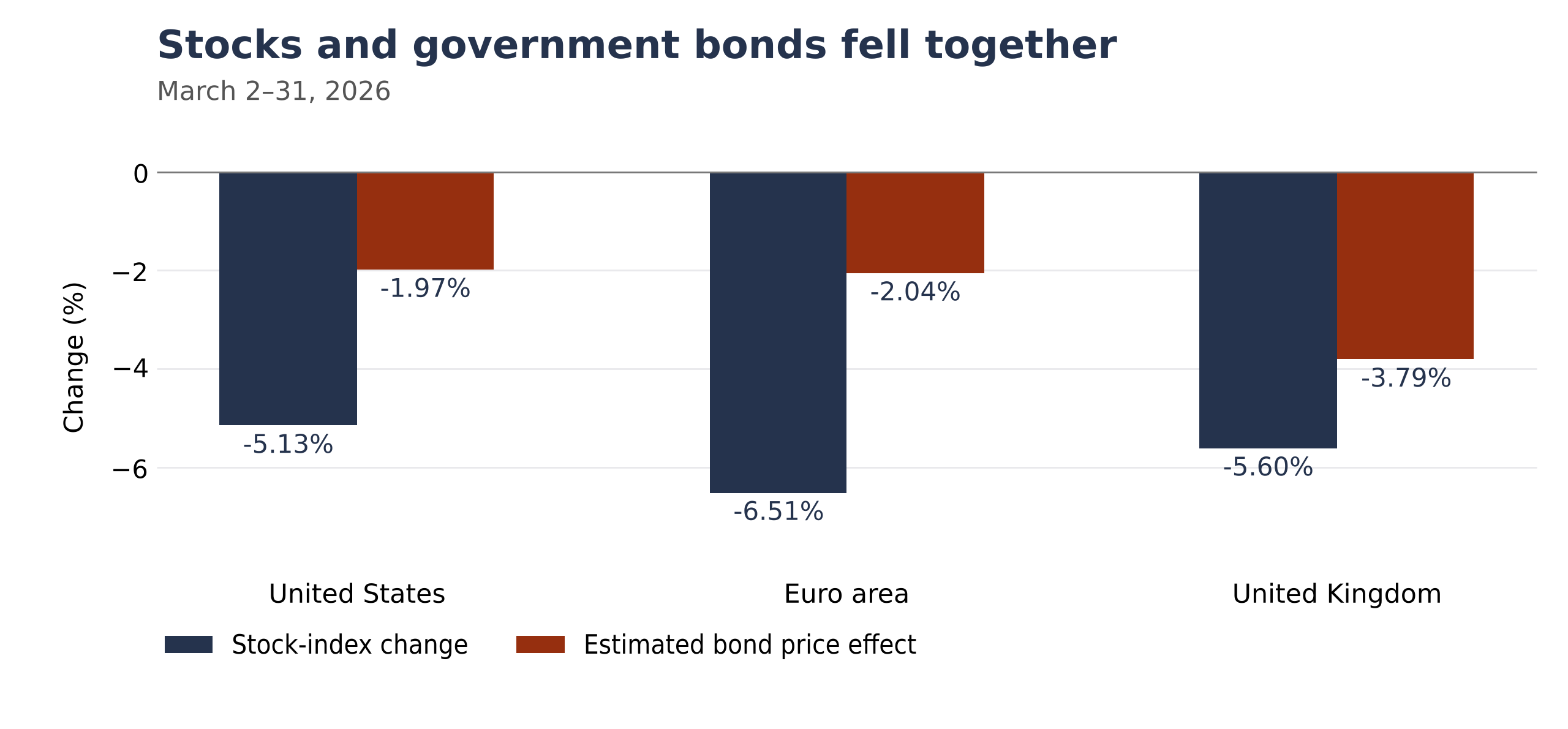
Source: Federal Reserve, Figure 1. Stock indexes: S&P 500, Euro Stoxx and FTSE 100. Bond price effects are estimated from 10-year government yield changes using seven-year duration; German yields represent the euro area. These are not investor total returns.2
An inflationary supply shock and a demand slowdown need not produce the same outcome for bonds.
Bloomberg’s October research adds another distinction: a corporate bond combines exposure to interest rates with the risk that a company struggles to repay. More company debt can mean more dependence on the same business conditions already affecting stocks. Two portfolios labeled 60/40 can therefore carry different risks.1
Why are some experts returning to bonds?
The starting income has changed. On November 20, Treasury’s indicative par yield was 4.32% at three months and 4.92% at 10 years. Those are market benchmarks, not promised total returns, but they show why the discussion differs from the near-zero-rate years.3
Hedgeye chief executive Keith McCullough’s November Wealthion interview makes the case for Treasuries through the economic cycle. He expects growth and inflation to slow and has added Treasury exposure. If comparable yields fall, existing fixed payments generally become more valuable. His case depends on that outcome; weaker stocks alone would not guarantee a bond rally.4
Wealthion’s Steven Feldman says he is beginning to return to bonds after years of skepticism. In his October discussion, he also emphasizes cash and diversification. His comments describe a changing assessment of available income and flexibility, rather than a universal replacement allocation.5
PIMCO’s 2026 secular outlook similarly argues that high-quality fixed income can again contribute income and diversification. Goldman Sachs Research’s October assessment separates near-term uncertainty from the improved longer-term case for bonds. Neither treats replacing the entire bond allocation as the only response.6,7
What are institutions proposing instead of the old mix?
BlackRock illustrates a 50/30/20 portfolio: public stocks, public bonds and alternatives. The alternative allocation reduces both stocks and bonds. Its framework distinguishes investments with more stock-like risks from those with more bond-like risks, and links that distinction to where the money comes from.8
J.P. Morgan Private Bank’s 2026 outlook examines 60/30/10, introducing liquid alternatives and hedge-fund strategies. Here, bonds fall to 30% while stocks remain at 60%. The same phrase, adding alternatives, can therefore describe reducing stock exposure or leaving it unchanged. An alternative label alone establishes neither its return source nor its protection.9
Goldman reorganizes the discussion around economic roles: roughly one-third innovation, one-third inflation protection and one-third risk mitigation. These categories can overlap. Its inflation category includes inflation-linked bonds, real assets and certain equities, each with different income and loss characteristics.10
These are proposals, not a record of universal adoption. BlackRock’s 2025 advisor poll found 73% of respondents allocated at least 5% of high-net-worth portfolios to private markets, but fewer than one-third allocated 10% or more.8
Where do gold and real assets fit?
Andrew Sarna’s October interview takes a different view of government borrowing and purchasing power. He discusses a framework combining equities, hard assets and a bearish position in bonds. His phrase “short bonds” means a position that can benefit when bond prices fall and lose when they rise. It does not mean owning short-maturity bonds. A temporary bond rally would not, in his view, settle the longer-term fiscal argument.11
WindRock managing director Brett Rentmeester also challenges a portfolio built during decades of falling rates. His response combines hard assets with innovation. He rejects moving everything into gold or technology, and distinguishes property types and their financing pressures.12
Feldman explains the attraction through replacement cost: if building a comparable property becomes more expensive, an existing one may gain value relative to a new building. Higher financing costs or weaker rental income can still outweigh that benefit. A scarce asset and a leveraged business connected to it can therefore perform differently.5
Gold serves a different role. It is a physical asset, rather than a promise to repay a fixed number of dollars. Sarna and Rentmeester look beyond those promises because they question their future purchasing power. But gold’s price does not mechanically track living costs. In their 2013 study, The Golden Dilemma, Claude Erb and Campbell Harvey found little evidence that gold had effectively hedged unexpected inflation in the historical periods they examined.11,12,13
The Commodity Futures Trading Commission warns that precious metals can be highly volatile and that premiums and fees reduce returns. Gold may provide a different exposure, but it does not promise stable spending money or protection in every selloff.14
Some inflation protection remains within bonds. Treasury Inflation-Protected Securities, or TIPS, adjust principal with inflation and deflation and pay a fixed coupon rate on that adjusted amount. The original-principal floor applies at maturity. Their market prices can still fall before then as interest rates change.15,16
What would each change add or remove?
Comparing the candidates by their possible contribution reveals what each leaves unresolved.
Different substitutes solve different problems
| Candidate | Potential contribution | What remains unresolved |
|---|---|---|
| Cash and Treasury bills | Accessible money and interest income | Inflation erodes purchasing power; future income falls if rates fall. |
| Shorter-maturity bonds | Income with less rate sensitivity | Credit losses remain possible; less benefit from falling yields. |
| TIPS | Principal linked to inflation | Prices can fall; only original principal has a maturity floor. |
| Physical gold | Asset exposure without company or government repayment risk | No coupon; prices can fall sharply. |
| Property and resource businesses | Potential rental income or business growth | Expenses, debt and weaker demand can reduce returns. |
| Trend or market-neutral strategies | Returns less dependent on rising markets | Trading and selection losses; fees; no guaranteed protection. |
| Private credit or private equity | Lending income or business growth, respectively | Defaults or equity losses; restricted cash access can remain. |
Educational comparison drawn from the research and product mechanics discussed here. Shorter duration reduces a particular rate sensitivity, not every risk.5,14,15,16,17,18
Can an alternative make the portfolio riskier?
AQR’s April analysis shows how much the label can conceal. Over five years ending February 28, 2026, its Treasury index had an equity beta of 0.19, versus 0.70 for listed lending businesses used as a private-credit proxy. Beta estimates sensitivity to stock-market moves: that proxy had more than three times the sensitivity of Treasuries. It measures neither every private loan fund nor a guaranteed relationship in future selloffs.19
A lender can suffer when its borrowers weaken. Less frequent valuation does not remove that economic loss. A smoother reported price therefore need not mean better protection when stocks fall.
AQR’s selected equity market-neutral index had little stock-market sensitivity, while its trend index tended to move in the opposite direction. That window does not establish how every fund will behave.19
Trend strategies can take positions for rising prices and positions that gain from falling prices. Sustained declines can therefore produce profits, but quick reversals can cause losses before signals adjust. Equity market-neutral strategies pair opposing stock positions to reduce broad-market exposure. They still depend on selecting and sizing those positions successfully.20,17
The Securities and Exchange Commission explains that alternative mutual funds can use derivatives, leverage and short selling, introducing costs and risks beyond conventional funds. Private equity can restrict withdrawals for years. A strategy’s economic exposure and its access terms are separate questions; a smoother reported valuation does not make the money readily available.17,18
What does rethinking 60/40 actually change?
There is no single agreed successor to 60/40. High-quality bonds still offer contractual income and possible protection when growth and inflation slow. Shorter maturities reduce rate sensitivity; TIPS address inflation-linked principal. Gold and selected alternative strategies introduce different exposures, while the source of their funding determines how much stock and bond exposure remains.
That explains the guests’ disagreement. McCullough’s Treasury case rests on slowing growth and inflation. Sarna and Rentmeester emphasize fiscal and inflation concerns. Feldman’s renewed interest in bonds shows those concerns can coexist with a changing assessment of income.
Replacing bonds with gold removes contractual interest. Adding private credit can introduce different borrower risks and restrictions on withdrawals. Funding a new holding from stocks changes the growth side instead. Rethinking 60/40 therefore means comparing income, access to cash and potential losses across the whole portfolio. Neither 60 nor 40 has to stay fixed, but a new percentage split alone cannot establish what protection the changed portfolio provides.
Sources & Disclosure
1 A Total Portfolio Approach to Fixed Income. Vikas Jain and Yingjin Gan, Bloomberg Index Research, October 27, 2026; duration, credit and portfolio-level risks. 2 Government Bonds’ Safe-Haven Property and Inflationary Pressures. Canlin Li and Emre Yoldas, Federal Reserve FEDS Notes, October 16, 2026, Figures 1–2. Historical sample ends July 31, 2026; Figure 1 estimates bond price effects from duration. 3 Daily Treasury Par Yield Curve Rates. US Treasury, November 20, 2026; indicative par yields, not realized returns. 4 Why Treasury Bonds Could Beat Stocks in 2027. Keith McCullough with Maggie Lake, Wealthion, November 6, 2026; full interview transcript, Treasury positioning and growth/inflation outlook. 5 What to Own if the Tech Boom Falters. Steven Feldman with Maggie Lake, Wealthion, October 30, 2026; full transcript, diversification, bonds and cash. 6 Rupture and Resilience. PIMCO, 2026 Secular Outlook; renewed role of high-quality fixed income. 7 Are Bonds Becoming a Better Investment for Portfolios? Goldman Sachs Research, October 8, 2026; investment horizons and bond starting yields. 8 Portfolio Construction with Alternatives. BlackRock; illustrative 50/30/20, funding sources and 2025 Advisor Center poll of high-net-worth portfolios ($5 million or more). 9 Promise and Pressure: Outlook 2026. J.P. Morgan Private Bank, pp. 55–56; 60/30/10 illustration and liquidity qualifications. Underlying historical results are not 2026 performance. 10 How the Iran War Is Impacting Investment Portfolios. Goldman Sachs Research, March 27, 2026; innovation, inflation protection and risk-mitigation framework. 11 AI Is Propping Up the Economy. The Fed Could Break It. Andrew Sarna with Maggie Lake, Wealthion; full transcript, bearish bond positioning and fiscal risks. Related Learn article, Is the 60/40 Portfolio Dead?, October 13, 2026. 12 Why the 60/40 Portfolio May Not Protect You. Brett Rentmeester with Maggie Lake, Wealthion, October 23, 2026; full transcript, hard assets, innovation and property financing. 13 The Golden Dilemma. Claude B. Erb and Campbell R. Harvey, Financial Analysts Journal 69(4), July/August 2013, pp. 10–42; inflation-hedging section and conclusion. Original published paper hosted by the author. 14 Gold Is No Safe Investment. Commodity Futures Trading Commission; volatility, premiums and fees. 15 Treasury Inflation-Protected Securities (TIPS). TreasuryDirect, US Treasury; principal adjustment, coupon and original-principal floor at maturity. 16 Duration: What an Interest Rate Hike Could Do to Your Bond Portfolio. Financial Industry Regulatory Authority, March 2017; official syndication page. 17 Investor Bulletin: Alternative Mutual Funds. US Securities and Exchange Commission, February 3, 2017; strategies, leverage, short selling and expenses. 18 Private Equity Funds. Investor.gov, US Securities and Exchange Commission; illiquidity, withdrawal restrictions and expenses. 19 A Positive Stock-Bond Correlation Is a Terrible Reason to Add More Equity Risk to Your Portfolio. AQR, April 8, 2026, pp. 2–4; index comparisons, five years ending February 28, 2026. Listed lending businesses proxy private credit. 20 A Century of Evidence on Trend-Following Investing. Brian Hurst, Yao Hua Ooi and Lasse Heje Pedersen, Journal of Portfolio Management, Fall 2017; long/short mechanism. Key Design Choices When Building a Risk-Mitigating Portfolio. AQR, Alternative Thinking 2023, Issue 2; trend implementation and choppiness.
Wealthion is a dba of Greylock Peak Investments, a registered investment adviser. This article is general information only. It is not investment advice or an offer or solicitation, and it is not tailored to your circumstances. Guests’ views are their own and may not reflect those of Wealthion. Wealthion has not verified guest statements, including any performance figures. Investing involves risk, including loss of principal, and past performance does not guarantee future results. Wealthion refers readers to other registered investment advisers and shares in the fees they receive from referred clients, which creates a conflict of interest. Please see our Form ADV Part 2A and consult your own financial advisor before investing.
What Serious Investors Are Watching
Dive into expert interviews, market analysis, and long-form content built to help serious investors think long-term.

Rethinking the 60/40 Portfolio in 2026: Wealthion Experts Weigh In
Wealthion experts weigh the case for bonds, gold, real assets and alternative strategies. Their differences reveal what changes when a new holding replaces stocks, bonds or both.

Carbon Investing: How the Markets Work and Where Returns Come From
Carbon allowances, project credits and carbon-linked businesses respond to different forces. Their rules, price history and investment structures explain why an emissions target and an investor’s return can diverge.

Carbon ETFs Explained: What US Investors Actually Own
Carbon funds can hold bonds, futures, physical allowances or even Bitcoin. Their holdings, market exposure, costs and tax structures help explain what investors actually own.
Enjoyed This? Get More Insights
Expert insights and curated opportunities, delivered to your inbox.
Ready to Position for What's Coming?
Whether you're still learning or ready to act, your next step starts here.
- Independent
- Macro-Informed
- Real Asset Focused


The Wealthion Network
By subscribing, you agree to receive Wealthion emails. Unsubscribe anytime.
The Wealthion Network
By subscribing, you agree to receive Wealthion emails. Unsubscribe anytime.
Network Discussion
Join the Wealthion Network to Comment