

WHAT BREAKS FIRST? Open Position by Steven Feldman
OPEN POSITION
FROM THE DESK OF STEVEN FELDMAN
AI's evangelists argue about existential risk a decade out. The financial risk is already here.
Oracle recently sent a force majeure notice to Blue Owl Capital, the developer building Project Jupiter, its 2.45-gigawatt data center campus in New Mexico. By the end of the day, Oracle had lost more than $20 billion in stock market value.
Here are the mundane facts. New Mexico regulators have repeatedly denied permits for the natural gas pipeline meant to power the site’s fuel cells which is now delayed six months. A separate air-quality permit is still pending. No gas, no fuel cells. No fuel cells, no 2028 opening. So Oracle used the force majeure language in its lease to justify that it does not have to pay its rent on time.
A force majeure notice, for the uninitiated, is essentially a company saying that events beyond its control may prevent it from meeting a contractual obligation without it being a breach. Think hurricanes, wars and other extraordinary disruptions. A permitting delay is a considerably more predictable problem — which is part of what makes this interesting.
The numbers underneath Oracle’s notice are not trivial. Blue Owl put in $3 billion of equity. Lenders added another $18 billion. They all are assuming that Oracle pays its rent, in full, on time. Project Jupiter is just one piece of $288 billion in lease obligations Oracle now carries — six times what it carried at the start of last year.
Joe Peiser, CEO of risk capital at the insurance broker Aon, told Semafor this week that if structures like this one come apart, the losses are “going to be dramatically higher than anyone is currently thinking about.” It harkens back to 2008, when another insurer - AIG - was unable to meet collateral demands which turned into the Great Financial Crisis. I am not saying we are about to repeat 2008, merely pointing out that in leveraged financial structures, one late payment can cause nasty reverberations.
AI can work exactly as advertised — it can transform productivity, science and the economy — while some of the financial structures built to fund it still break. The technology does not have to fail for investors to lose real money.
THE PATTERN -- What Every Transformative Technology Teaches Us, Eventually
I’ve watched this movie before and the plot doesn’t change much: the benefits of a transformative technology arrive early and get captured by the people who built it. The costs arrive later, get distributed onto people who had no vote in the matter, and get argued about only once the technology is too embedded to meaningfully restrict it.
Most recently it was social media. The platforms launched in the mid-2000s promising connection. By the mid-2010s they had built the most profitable attention businesses in history. It took until 2021 — the Facebook Files (coming to a theater near you this fall) — for the public to see documented evidence that a platform’s own data linked heavy use to teen body image and mental health harm. It took until December 2025 for a national government to impose a broad minimum-age restriction on social-media accounts: Australia’s under-16 regime, a world first.
AI is not social media. But the pattern is the same. It’s worth taking seriously before this technology finishes embedding itself, not after.
THE INVISIBLE LEDGER -- An Optimistic Economist Makes the Case
Adair Turner made a rigorous argument in the Financial Times. He does not disagree with the optimists who see AI enhancing productivity and abundance. He points out that technological transformation, GDP growth and improvements in human welfare are not the same thing.
Some AI spending will be defensive and zero-sum: better cyberattacks requiring better cyber-defense, or AI-generated legal filings requiring more resources simply to process them. Other AI breakthroughs may create enormous human value while eventually producing surprisingly little measured economic value once the technology becomes cheap and ubiquitous.
Then comes the part that lit up my investor radar. If intelligence becomes dramatically cheaper and more abundant, the things that cannot become abundant become relatively more valuable. Housing in desirable locations is the obvious example. Land, by definition, cannot be manufactured by AI.
I am happy to let someone outside the real asset space, in this case Turner, make the real-asset argument.
THE FIRST BILL -- Where the Money Actually Sits
Turner’s argument plays out over years. Oracle’s problem arrived a few weeks ago. That tells us where the first bill may show up.
The AI buildout has layered enormous amounts of debt, leases and structured capital onto projects whose economics depend on a sequence of things going right: permits, power, construction and ultimately rent payments. Break one link and the problem travels quickly through the capital stack — from tenant to landlord to lender to insurer.
That’s the distinction that matters. The long-run debate is about what AI eventually does to jobs, inequality and economic growth. The near-term question is simpler: Who financed the buildout, and what happens when a project doesn’t perform exactly as modeled?
THE COUNTERARGUMENT -- Where the Skeptics Have a Point
Fair pushback, and I’d rather state it than wave it off. Force majeure notices are not unheard of in projects this size. Oracle and Blue Owl both say this changes nothing about their long-term commitments, and Oracle insists Project Jupiter remains on schedule. One pipeline dispute is not a systemic event. And at the sovereign level, Kristalina Georgieva, the IMF’s managing director, said that AI-related investment has not yet crowded out governments’ ability to borrow. Yet I find it hard to believe that it is not contributing to the highest rate regime in 20 years.
Crowding or not, it doesn’t make the insurance warning irrelevant. When the CEO of risk capital at one of the world’s largest insurance brokers says potential losses may be substantially larger than current models assume, in the same week that a flagship project invokes force majeure, it’s worth paying attention.
WHAT YOU ACTUALLY DO -- The Call
I’m not shorting AI. The productivity gains are real.
I’m separating the technology from the financing wrapped around it.
That means being wary of data-center yield structures whose returns depend on leverage, perfect construction schedules and uninterrupted tenant payments — particularly when the underlying exposure isn’t obvious.
And it reinforces the other side of the portfolio I’ve been building since spring: assets whose scarcity AI cannot solve. Gold first. Then copper, uranium and energy infrastructure. And, following Turner’s logic, land.
My confidence is moderate-to-high on the direction and low on the timing. This is a structural view, not a trade on one force majeure notice.
The test is straightforward. If Project Jupiter resolves and no comparable projects develop similar problems over the next two quarters, New Mexico was probably an isolated permitting dispute. If several more hyperscaler-backed projects begin delaying rent, restructuring financing or invoking force majeure, we have something more important.
The goal is not to predict which data center breaks next. It is to own the things that don’t need one to.
Steven Feldman
Steven Feldman is the co-founder & CEO of GBI. This newsletter is for informational purposes only and does not constitute investment advice.
Wealthion is a dba of Greylock Peak Investments, a registered investment adviser. This newsletter is general information only. It is not investment advice or an offer or solicitation, and it is not tailored to your circumstances. Guests’ views are their own and may not reflect those of Wealthion. Wealthion has not verified guest statements, including any performance figures. Investing involves risk, including loss of principal, and past performance does not guarantee future results. Wealthion refers readers to other registered investment advisers and shares in the fees they receive from referred clients, which creates a conflict of interest. Please see our Form ADV Part 2A, and consult your own financial advisor before investing.
What Serious Investors Are Watching
Dive into expert interviews, market analysis, and long-form content built to help serious investors think long-term.
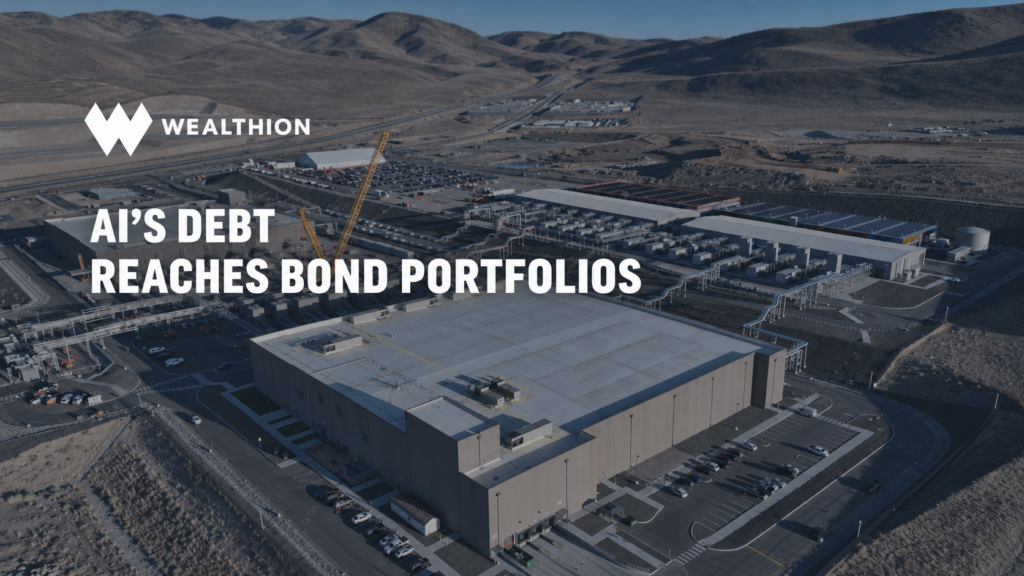
Is Debt Financing the AI Build-Out a Concern? Where the Risk Sits for Investors
AI borrowing is growing. Company cash flow, interest coverage and commitments beyond reported debt show why the risks differ between borrowers and portfolios.

I Bonds Explained: How They Work and What You Earn
How I bonds earn interest, adjust for inflation and become available to withdraw, with purchase limits, tax rules and a worked example.
Negative Interest Rates Explained: Policy Rates vs Real Returns
Negative policy rates charge banks on certain central-bank deposits. Negative real returns mean an investment loses purchasing power after inflation. The difference matters for savings, bonds and gold.
Enjoyed This? Get More Insights
Expert insights and curated opportunities, delivered to your inbox.
Ready to Position for What's Coming?
Whether you're still learning or ready to act, your next step starts here.
- Independent
- Macro-Informed
- Real Asset Focused


The Wealthion Network
By subscribing, you agree to receive Wealthion emails. Unsubscribe anytime.
The Wealthion Network
By subscribing, you agree to receive Wealthion emails. Unsubscribe anytime.
Network Discussion
Join the Wealthion Network to Comment