

What Is the Federal Reserve, and What Does It Actually Do
The Federal Reserve is the central bank of the United States. It sets short-term interest rates and manages the money supply. It supervises banks, and it acts as lender of last resort during a financial crisis. Its actions are guided by a dual mandate: maximum employment and stable prices, two goals that do not always point the same direction.
That last part is the part most explainers skip, and it is the part that actually drives the news.
What does the Federal Reserve do, in plain terms?
Four jobs, roughly in order of how often they make headlines.
It sets the federal funds rate, the rate banks charge each other overnight. That ripples out into mortgages, credit cards and corporate borrowing. It manages the size of its own balance sheet, buying or selling bonds to add or remove money from the financial system. It supervises and regulates banks. And it stands ready to lend during a crisis, the function that got its most visible workout in 2008 and again in 2020.
Claudia Sahm summarised the core tension inside that mandate in July 2026: "So in terms of the Fed's dual mandate, it's maximum employment, it's price stability, maximum employment largely looks like it's in a pretty good place, and price stability is not is going in the wrong direction."
That is the Fed's actual daily problem. It has one set of tools, interest rates, and two different targets that frequently call for opposite settings.
Who actually runs it?
A structure most people have never had explained to them. Twelve regional Reserve Banks. A Board of Governors in Washington. And a rate-setting committee, the FOMC, that meets eight times a year.
The chair is one voice among several. Sahm made that point directly: "the Fed chair is one vote just like the other voting members, but the Fed chair is the leader." The distinction matters more than it sounds. A chair sets the agenda and speaks for the institution, but cannot unilaterally set policy.
Is the Fed actually independent?
Formally, yes. In practice, the pressure runs both ways, and 2026 has been unusually public about it.
Jim Bianco, president of Bianco Research, described the politics playing out in real time in July 2026: "Trump said he supports Walsh but blames bad intentions from other Fed governors." He added, on why a nomination stalled: "they started to realize they've created an independent Fed and they're going to need somebody to run an independent Fed."
That tension is not new. What changed in 2026 is how visibly it is being argued about. That visibility is itself informative about how much room the Fed has to act without political cost.
Why can the Fed not just cut rates whenever it wants?
Because the long end of the bond market has its own opinion, and it does not always agree.
Jesse Felder, founder of the Felder Report, put it this way in August 2026: "Even if the Fed were trying to lower interest rates on the short end, you could have a revolt on the long end." The Fed sets short-term rates directly. It does not set the 10-year Treasury yield, which the market prices based on its own view of inflation and credibility.
Mike Green, chief executive of Tier 1 Alpha Asset Management, made a related point about how limited the Fed's actual reach is: "the only spending policy he controls is how much the US government pays on its interest given interest rates that are set by the market and the Federal Reserve." Even the Fed's own leverage over the government's own borrowing costs runs through a market it does not fully control.
What is forward guidance?
A tool the Fed developed to influence expectations, not just rates.
Felder explained its origin: "Forward guidance is a way to kind of was developed in the wake of the financial crisis after the Fed had already lowered interest rates to zero and needed to ease further." When the interest-rate tool hits zero, the Fed can still move markets by signalling what it plans to do next, which changes behaviour today even before any rate actually moves.
Felder also pointed to a cost of over-relying on that signal: "You had that with, you know, financial institutions like Silicon Valley Bank who said, 'Okay, Fed's going to keep interest rates low.'" A promise about future policy can encourage risk-taking that becomes dangerous if the promise later changes.
Does the Fed influence its own inflation data?
It should not, and Sahm was direct about the boundary: "I feel like the Fed should be a little bit careful telling telling the statistical agencies how to do their job."
That separation, between the people who measure the economy and the people who set policy based on the measurement, is a quieter safeguard than interest rate independence, and one that gets far less public attention.
Why does the Fed's credibility matter to your portfolio?
Because every one of the mechanisms above depends on being believed.
Forward guidance only works if markets trust the signal. Independence only functions if political pressure does not visibly change outcomes. And the long end of the yield curve sets most of your actual borrowing costs. It prices in exactly how much confidence the market has that the Fed will do what it says.
That is why so much Fed coverage focuses on personalities and politics rather than only on the rate decision itself. The mechanism runs through belief as much as through the mechanics.
What should you watch?
The FOMC statement length and tone at each of the eight annual meetings, since brevity has become a deliberate signal under the current chair. The dot plot, which shows individual committee members' rate expectations. And the spread between short and long-term yields, which tells you whether the market believes the Fed's stated plan.
FAQ
What is the Federal Reserve? The central bank of the United States. It sets interest rates, manages the money supply, supervises banks and acts as lender of last resort in a crisis.
What is the Fed's dual mandate? Maximum employment and stable prices. The two goals do not always align, which is the source of most disagreement about what the Fed should do next.
Who controls the Federal Reserve? A structure of twelve regional Reserve Banks and a Board of Governors in Washington. The Federal Open Market Committee, made up of the Board and regional bank presidents, sets interest rate policy at eight meetings a year.
Is the Federal Reserve part of the government? It occupies an unusual position. Created by Congress. Its leadership is appointed by the President and confirmed by the Senate. But it is operationally independent in its day-to-day policy decisions.
Why can't the Fed control long-term interest rates? The Fed directly sets only the short-term federal funds rate. Long-term yields, like the 10-year Treasury, are set by market participants based on their own view of inflation and Fed credibility.
What is forward guidance? A communication tool where the Fed signals its future policy intentions to influence market behaviour today. It was developed after short-term rates hit zero in the 2008 financial crisis.
Why does Fed independence matter? Because policy credibility depends on markets believing decisions are made on economic grounds rather than political ones. Visible political pressure, as seen in 2026, tests that credibility directly.
Which experts and interviews does this article reference? Wealthion interviews from July to September 2026: Claudia Sahm on the labour market; Jim Bianco on two stock markets; Jesse Felder on yields and the AI bubble.
If you want a professional read on how Fed policy fits your own portfolio, you can request a free portfolio review from an advisor who understands real assets at https://www.wealthion.com/advisors/.
This article is educational and is not investment, tax, or legal advice. It does not recommend any security. Advisory services are provided by Greylock Peak Investments, LLC, a subsidiary of Wealthion. Wealthion is compensated for advisor introductions; see the Solicitor's Disclosure Document, ADV Part 2A and Form CRS. That arrangement does not influence editorial coverage.
What Serious Investors Are Watching
Dive into expert interviews, market analysis, and long-form content built to help serious investors think long-term.
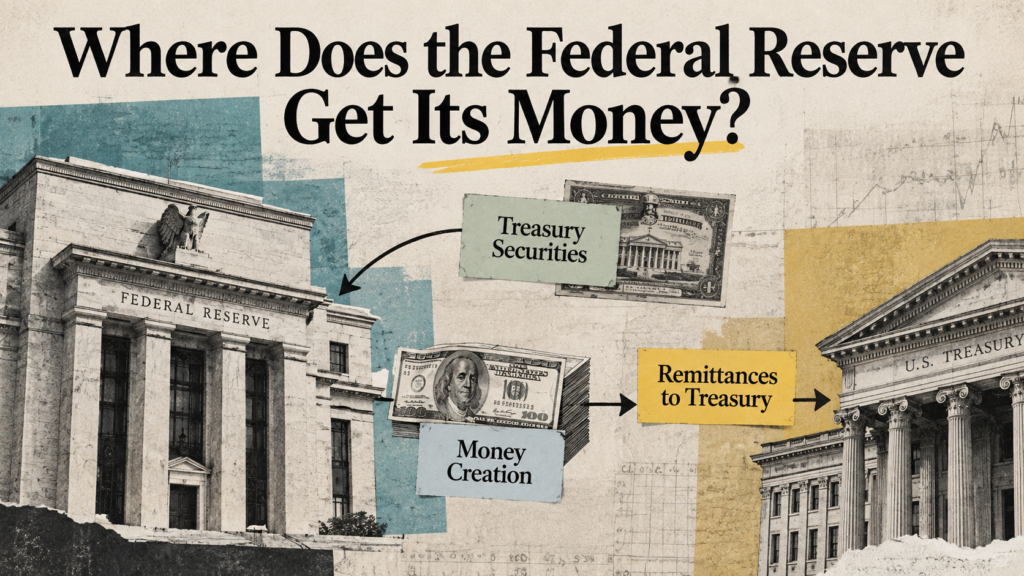
Where Does the Federal Reserve Get Its Money?
The Federal Reserve does not get its money the way a household, a company or...
What Is the Federal Reserve, and What Does It Actually Do
The Federal Reserve is the central bank of the United States. It sets short-term interest...
The Index Is Not What It Used to Be
Fifty years ago, roughly 90 percent of the S&P 500's value sat in tangible assets....
Enjoyed This? Get More Insights
Expert insights and curated opportunities, delivered to your inbox.
Ready to Position for What's Coming?
Whether you're still learning or ready to act, your next step starts here.
- Independent
- Macro-Informed
- Real Asset Focused


The Wealthion Network
By subscribing, you agree to receive Wealthion emails. Unsubscribe anytime.
Network Discussion
Sign in to share your thoughts and connect with other readers.
Join the Wealthion Network to Comment