

Bitcoin Has Gone Mainstream. Why Is It Still So Volatile?
By the autumn of 2025, investors could hold Bitcoin exposure in the same brokerage account as an index fund. A custodian looked after the coins, while investors bought and sold shares in a product listed on a stock exchange. [1] [2]
Then came October 10, 2025. Stocks fell after President Trump threatened higher tariffs on Chinese imports. After regular US stock trading ended, he announced an additional 100% tariff, and crypto selling intensified. [3] CoinGlass reported about $19 billion of crypto liquidations over 24 hours, which it described as its largest recorded event. Bitcoin briefly fell to about $101,500 on some trading venues. A familiar brokerage account offered no shelter from the selling in the market underneath it. [4]
Bitcoin remains volatile because demand can change quickly, while leverage and uneven trading liquidity can turn selling into a cascade. Mainstream access has widened the pool of potential buyers. It has not removed those forces.
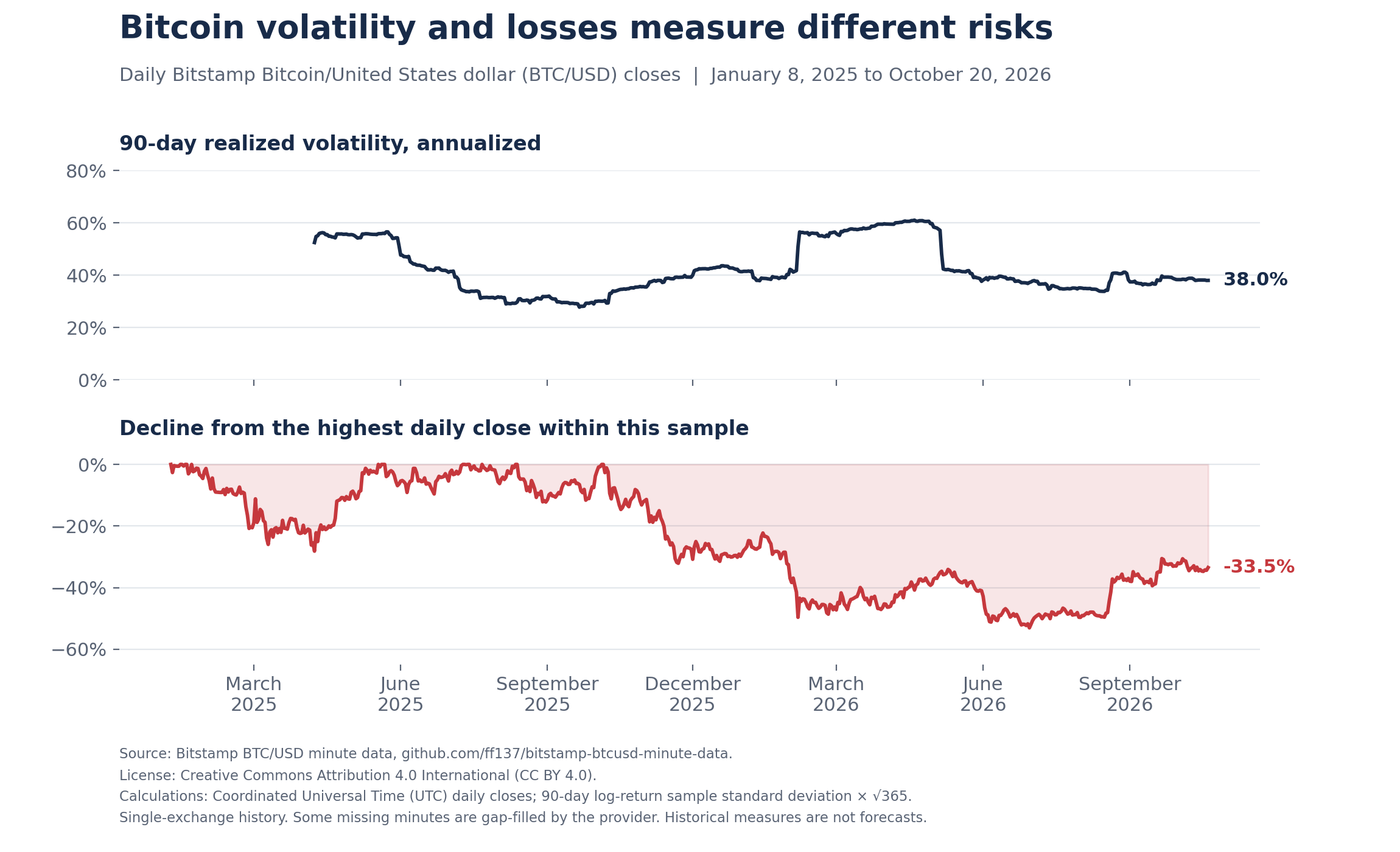
The year since illustrates the continuing risk. In the Bitstamp sample used here, Bitcoin's highest daily close came on October 6, 2025, four days before that selloff. By late June 2026 it had lost more than half that value. [5]
On June 25, Bitcoin fell below $60,000. That day, the US Bureau of Economic Analysis (BEA) reported May headline personal consumption expenditures (PCE) inflation of 4.1% year over year. [5] [6]
US spot Bitcoin funds recorded about $4.5 billion of net withdrawals in June, their largest since launch, according to Farside Investors data. By October 20, Bitcoin had recovered to about $83,000, still a third below its sample high. [7] [5]
On January 10, 2024, the Securities and Exchange Commission (SEC), the US securities regulator, approved US spot Bitcoin exchange-traded product (ETP) listings. Many are marketed as exchange-traded funds (ETFs), but they are trusts that hold Bitcoin itself rather than futures contracts. [1] [2]
In a September 22, 2026 Wealthion interview, Brett Rentmeester of WindRock Wealth Management, a Wealthion advisory partner, described how brokerage funds simplify access. He described the 50% to 80% declines seen in past cycles. [8]
What makes Bitcoin go up and down?
Bitcoin's supply rules explain part of its appeal. Under the current protocol, issuance is capped at 21 million coins, and periodic halvings reduce the rate of new supply. Neither tells us what buyers will pay tomorrow. Existing holders can sell, and demand can weaken even as new issuance slows. [9]
The bull case rests on more people and institutions wanting to hold a scarce asset. Access, confidence in custody and concerns about currencies can support that demand. Rentmeester pointed to adoption and currency-debasement concerns as possible long-term drivers of demand, while acknowledging that cryptocurrency remains an experiment. That is his view about future demand, not evidence of a floor under today's price. [8]
Rentmeester noted that historical cycles do not repeat exactly. A halving provides no dependable timetable for a recovery. [8]
The bear case is that expectations outrun demand. Bitcoin produces no cash flows of its own. A persuasive adoption story therefore does not establish that every entry price is attractive. [9]
How do the economy and the dollar affect Bitcoin?
Two forms of liquidity matter. One is the money and credit available to investors. The other is the depth of the market: how much can be bought or sold without moving the price sharply. A market can attract substantial capital over years and still lack enough buyers during a sudden rush to sell.
Henrik Zeberg's September 16 interview illustrates the first risk. He explained how debts and margin calls, demands for additional trading collateral, could create a need for dollars during funding stress. Bitcoin holdings could be sold to meet those obligations. [10]
A 2023 working paper published by the International Monetary Fund (IMF) found that American monetary tightening reduced the common component of cryptocurrency prices by curbing investors' willingness to take risk. [11]
The time frame matters. Researchers at the Federal Reserve Bank of New York found little immediate Bitcoin response to selected economic and monetary-policy announcements in their 2017–2022 sample. [12]
Diversification is conditional too. Research published by the IMF in 2022 found the correlation between Bitcoin returns and S&P 500 stock-index returns rose from 0.01 in 2017–2019 to 0.36 in 2020–2021. [13]
More recent work points the same way. The IMF's April 2025 Global Financial Stability Report examined spillovers from January 2022 through April 2025, including observations after US spot funds launched. It found that stock-market shocks appeared to spill over to Bitcoin more strongly than shocks in the opposite direction. [14]
Why can an ordinary selloff become a sharp crash?
Leverage lets a small amount of capital control a much larger position. A position with $1,000 backing $10,000 of Bitcoin exposure has ten times as much exposure as initial capital. A 5% adverse price move costs $500, half the starting capital, before fees. Liquidation rules vary, and a platform may close the position before all collateral is exhausted. The Commodity Futures Trading Commission (CFTC) warns that margin can amplify losses and require more collateral or closing positions. [15]
Forced closures of leveraged long positions can add selling after a fall has already begun. If buyers are unwilling to absorb those sales at prevailing prices, prices must fall further to find them. That is how leverage and thin trading liquidity can reinforce each other. [15]
Is Bitcoin becoming less volatile?
Volatility can ease for a period without ending the risk of large losses. The important distinction is between smaller daily price swings and recovery from an earlier fall.
Our chart uses Bitcoin prices from one exchange, Bitstamp. Its October 20, 2026 daily close of about $82,946 was 33.5% below this sample's highest daily close, reached on October 6, 2025. Its 90-day annualized realized volatility was about 38%. A quieter period can leave an investor well below a prior high. [5]
 [5]
Gareth Soloway's October 12, 2026 interview offered a technical interpretation of the rebound. He described Bitcoin's liquidity as solid and said a recent rally peak above the preceding local peak had made him more constructive. [16]
Does scarcity make Bitcoin an inflation hedge?
Scarcity supports a long-term argument about monetary debasement. Reliable protection against rising living costs is a stronger claim.
US consumer-price inflation reached 9.1% in the year to June 2022. Bitcoin ended that calendar year 64.2% below its December 31, 2021 close, using Bitstamp daily prices. That record shows why high inflation cannot be assumed to protect Bitcoin's price. [17] [18]
Does the investment vehicle change the risk?
It changes what the investor owns and adds risks of its own. Despite the ETF label, spot Bitcoin products are structured as exchange-traded commodity trusts. They are not funds registered under the Investment Company Act of 1940 and lack some of those funds' protections. Exchange-listing approval was not an endorsement of Bitcoin. [2] [1]
| Route | What you own | Additional risks |
|---|---|---|
| Direct Bitcoin | Coins held personally or by a custodian | Security of the codes controlling the coins, or reliance on a custodian |
| Spot Bitcoin ETP | Shares in a trust holding Bitcoin | Sponsor fees, custody, tracking and exchange trading hours |
| Futures-based fund | Shares in a fund using futures | Cost of replacing expiring contracts, fees and tracking differences |
| Bitcoin treasury shares | Equity in a company holding Bitcoin | Debt, dilution, operating obligations and the share premium |
Sources: Bitcoin.org; SEC investor bulletins. These routes retain exposure to Bitcoin's price. [9] [2] [19]
The last route adds a valuation question. A treasury company's stock reflects financing and business risks as well as its Bitcoin holdings. A valuation premium can shrink even if Bitcoin rises. Raising money on unfavorable terms can also dilute existing shareholders.
What does the evidence show?
Bitcoin's return depends heavily on future demand. Wider access strengthens the adoption case its supporters make, while the historical record includes large losses and periods when Bitcoin fell alongside stocks.
Position size affects the damage, but the rest of the portfolio matters too. The hypothetical examples below apply the same moves to portfolios holding 1%, 5% or 10% in Bitcoin. If Bitcoin halves and everything else is unchanged, the total portfolio falls 0.5%, 2.5% or 5%. If other assets also fall 20%, the losses are 20.3%, 21.5% or 23.0%. This is arithmetic, not an allocation recommendation.
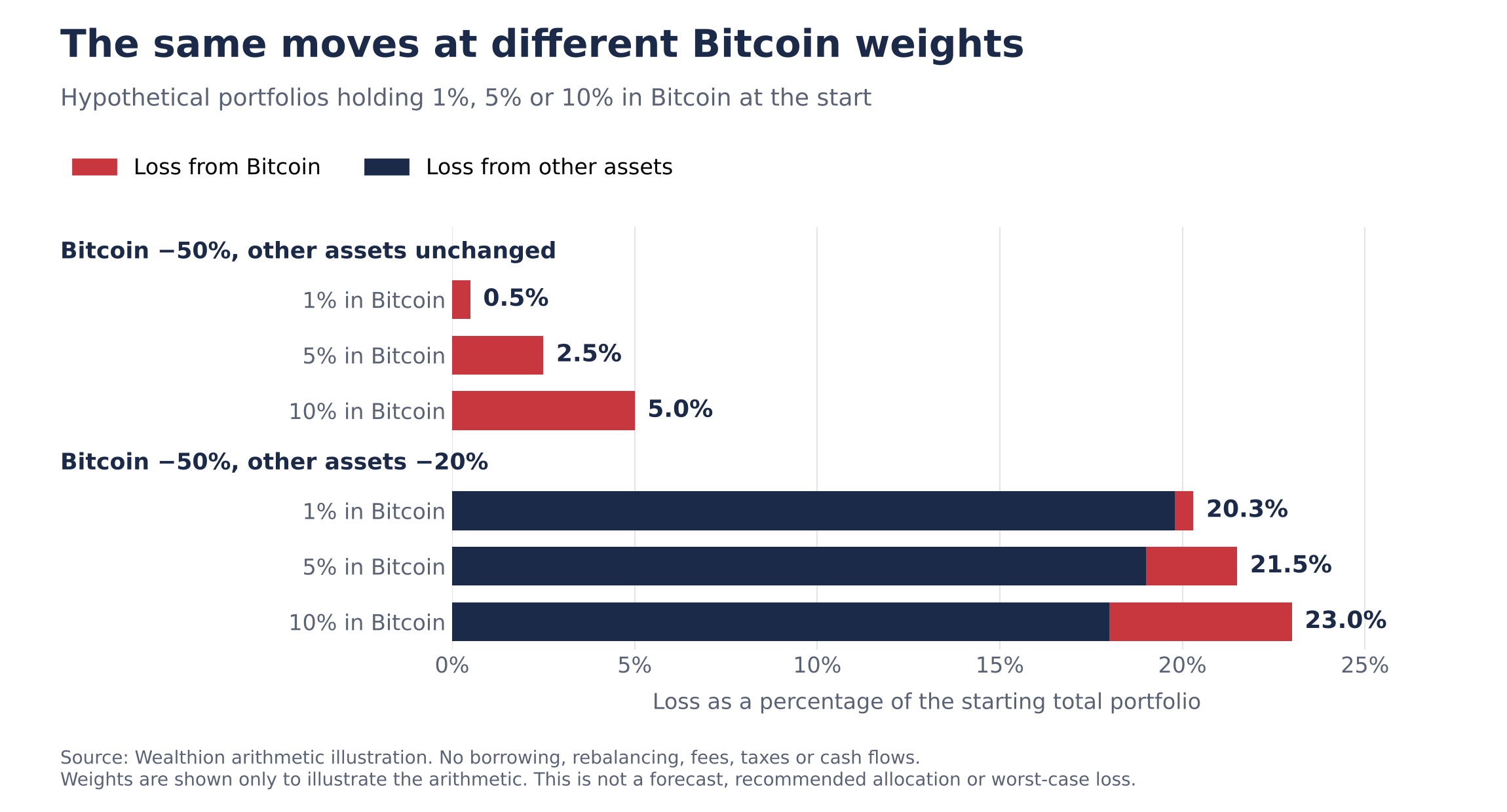
Bitcoin fell 64.2% in 2022, a year of high inflation. Its 2025–2026 decline provides another documented example of large losses despite broader access. [17] [18] [5]
Mainstream access has changed how Bitcoin is bought and held. The subsequent record shows that large price declines remain possible.
Frequently asked questions
Does a Bitcoin ETF make Bitcoin safer?
It can simplify access and remove the need to manage private keys, the secret codes controlling coins, personally. The trust still has custody and operating risks, and Bitcoin's price can fall sharply. [2]
Does a Bitcoin halving guarantee a rally?
No. It reduces new issuance under the protocol. Demand and selling by existing holders still affect price. [9]
Is Bitcoin independent of the stock market?
Its relationship with stocks varies. A different underlying technology does not guarantee that the assets will rise and fall at different times. [13]
Is Bitcoin's market value the same as available liquidity?
No. Market value generally multiplies the latest price by the circulating coin supply. Trading liquidity concerns the orders available when someone actually wants to transact.
Can Bitcoin keep trading when a stock exchange is closed?
Yes. Bitcoin trades around the clock. A listed product can be traded only during the sessions a broker and trading venue allow, so its underlying asset can move while a shareholder cannot trade.
Which Wealthion interviews informed this article?
Brett Rentmeester on access and adoption, Henrik Zeberg on the dollar and liquidity, and Gareth Soloway on liquidity and recent price patterns. Their interviews were published in September and October 2026. [8] [10] [16]
Data through October 20, 2026
Wealthion is a dba of Greylock Peak Investments, a registered investment adviser. This newsletter is general information only. It is not investment advice or an offer or solicitation, and it is not tailored to your circumstances. Guests’ views are their own and may not reflect those of Wealthion. Wealthion has not verified guest statements, including any performance figures. Investing involves risk, including loss of principal, and past performance does not guarantee future results. Wealthion refers readers to other registered investment advisers and shares in the fees they receive from referred clients, which creates a conflict of interest. Please see our Form ADV Part 2A and consult your own financial advisor before investing.
Sources
Source material and market observations are dated on or before October 20, 2026. Live datasets may update after that date.
[1] Statement on the approval of spot Bitcoin ETP listings. Securities and Exchange Commission, January 10, 2024. Approval of US listing and trading; no endorsement of Bitcoin.
[2] SEC investor bulletin on spot crypto ETPs. Securities and Exchange Commission investor bulletin, September 9, 2024. Spot ETP structure, regulation, custody, tracking and sponsor fees.
[3] October 10, 2025 tariff announcements. The American Presidency Project archive of President Trump’s posts: earlier threat, then an additional 100% tariff announced after the regular US stock-market close. ABC News reporting of the stock selloff before the later announcement.
[4] Reported October 2025 crypto liquidations. Decrypt, October 11, 2025, quoting CoinGlass: about $19.1 billion in reported 24-hour liquidations across crypto markets, described by the tracker as its largest recorded event. Secondary reporting; exchange reporting limits may understate totals. Coin360 report of the approximately $101,500 price on some venues.
[5] Bitstamp Bitcoin price data and repository terms. Bitstamp Bitcoin/US dollar minute data, github.com/ff137/bitstamp-btcusd-minute-data. Exchange-collected updates only, January 8, 2025–October 20, 2026; 651 daily closes checked against Bitstamp. Wealthion calculations: 90-day sample standard deviation of daily log returns × √365; drawdown from the highest close within this sample. Data license: Creative Commons Attribution 4.0 International (CC BY 4.0). Primary exchange prices.
[6] Personal Income and Outlays, May 2026. BEA, June 25, 2026 release. Headline PCE price index: 4.1% year over year; core: 3.4%.
[7] US spot Bitcoin fund daily flows. Farside Investors. Wealthion sum of June 2026 daily net flows: −$4,509.7 million, rounded to $4.5 billion of net withdrawals. Largest monthly net outflow in the series from the January 2024 launch through the article’s cutoff.
[8] Brett Rentmeester on crypto regulation and risk. Wealthion interview, video published September 22, 2026. Guest views are attributed in the article.
[9] Bitcoin.org technical and economic questions and answers. Bitcoin.org. Protocol issuance, the 21-million supply limit and supply-and-demand mechanics.
[10] Henrik Zeberg on markets, the dollar and crypto. Wealthion interview, video published September 16, 2026. Guest views are attributed in the article.
[11] The Crypto Cycle and US Monetary Policy. International Monetary Fund working paper, August 4, 2023. Monetary tightening and the risk-taking channel.
[12] Federal Reserve Bank of New York research on macro announcements. Federal Reserve Bank of New York, February 8, 2023. Immediate announcement responses; Bitcoin sample covers 2017–2022.
[13] IMF research on links with equities. International Monetary Fund, January 11, 2022. Historical return correlations: 0.01 in 2017–2019 and 0.36 in 2020–2021.
[14] Global Financial Stability Report, April 2025. International Monetary Fund. Chapter 1, printed page 5, Figure 1.3 panel 4: January 2022–April 2025, using a 52-week rolling window. Stock-to-Bitcoin spillovers appear stronger than the reverse.
[15] Understand the risks of virtual currency trading. Commodity Futures Trading Commission. Margin amplification and requirements for additional collateral or closing positions.
[16] Gareth Soloway on market targets and Bitcoin. Wealthion interview, video published October 12, 2026. Guest views are attributed in the article.
[17] Consumer Price Index release for June 2022. Bureau of Labor Statistics, July 13, 2022. Consumer Price Index for All Urban Consumers (CPI-U): 9.1% over the 12 months to June 2022.
[18] Bitstamp daily Bitcoin prices for calendar 2022. Bitstamp daily closes: $46,214.37 on December 31, 2021 and $16,528 on December 31, 2022. Wealthion calculation: a 64.2% calendar-year decline.
[19] SEC investor bulletin on Bitcoin futures funds. Securities and Exchange Commission investor bulletin, June 10, 2021. Futures exposure, contract replacement and tracking differences.
What Serious Investors Are Watching
Dive into expert interviews, market analysis, and long-form content built to help serious investors think long-term.

Why the US Dollar Could Weaken, and What It Means for Investors
Higher US rates can support the dollar, while borrowing needs and reserve diversification create longer-term pressures. The effects of a weaker dollar differ across assets and currencies.
Why More Efficient AI Could Still Need More Power
Efficiency reduces the energy needed for a given AI task, but wider use and more demanding applications can offset those savings. The balance matters for electricity and infrastructure planning.

Where the AI Data Center Building Boom Could Hit Its Limits
Large technology budgets do not immediately become operating data centers. Power connections, equipment, local approvals and financing shape how quickly the AI buildout can proceed.
Enjoyed This? Get More Insights
Expert insights and curated opportunities, delivered to your inbox.
Ready to Position for What's Coming?
Whether you're still learning or ready to act, your next step starts here.
- Independent
- Macro-Informed
- Real Asset Focused


The Wealthion Network
By subscribing, you agree to receive Wealthion emails. Unsubscribe anytime.
Network Discussion
Sign in to share your thoughts and connect with other readers.
Join the Wealthion Network to Comment