

Individual Bonds vs Bond Funds: Which Is Better for You?
Both pay regular interest, and both can fit a long-term plan. Where they differ is on certainty, cost, diversification and how easily you can sell.
If you want bonds in your portfolio, one question comes before any other: should you own the bonds themselves, or a fund that owns them for you?
Both can do what most investors want from bonds. Both pay regular interest, and both can be matched to your goals, your appetite for risk and how long you plan to invest.
Where they part is at the end. An individual bond has a set maturity date, subject to default and any early-repayment terms. An ongoing bond fund keeps replacing its bonds as they mature; some term funds wind up on a set date, with no guaranteed payout 1,2. That difference helps explain what you can count on, what you pay and how a loss reaches you when interest rates rise.
The short answer is that neither is better for everyone. A bond is stronger on scheduled repayment, subject to its terms and the borrower paying. A broad fund can be stronger on diversification and access, but costs vary. This guide follows $100,000 through each to show why.
What is the difference between an individual bond and a bond fund?
An individual bond is a loan with a maturity date, though default or early repayment can change the outcome. A bond fund is a pool of such loans. An ongoing fund has no scheduled end date; a term fund does, but its payout is not guaranteed 1,2.
Start with the bond. Put $100,000 into a hypothetical five-year United States Treasury note bought at face value and three things are settled by its terms. Assume it pays a fixed annual coupon of 4.64%, has no option for early repayment and makes all payments as promised. That coupon matches the five-year Treasury benchmark yield on November 6, 2026 3, a market yield rather than a particular note's coupon. The coupon is fixed for the note's life 4. Interest arrives every six months 4, which on $100,000 is $2,320 each time. And on the maturity date the government repays the face value, the amount printed on the note 5,6. The price someone else would pay for the note in the meantime remains open. It determines what you receive if you sell; holding also carries an opportunity cost when yields rise.
Now put the same $100,000 into a bond fund. Here you own shares, and the fund owns the bonds, often thousands of them. The fund collects the interest and passes it on to you. Each business day it adds up what all its assets are worth, subtracts its liabilities and divides by the number of shares. That figure, the net asset value (NAV), is what a mutual fund pays when it buys your shares back 7. An exchange-traded fund (ETF) is sold on an exchange instead, at a price that can sit above or below NAV 7.
The step that matters most is what happens when a bond inside an ongoing fund matures. The manager generally buys another one rather than returning that bond's face value to you. So an ongoing fund never reaches a scheduled day on which it owes you a set amount. Term funds can wind up on a set date, but the proceeds depend on what their assets are worth after liabilities 2,7. Its price on any day is simply what your shares are worth.
A bond promises a date and an amount, subject to default and any early-repayment terms. An ongoing bond fund promises neither; a term fund has an end date, without a guaranteed payout.
| Individual bond | Bond fund | |
|---|---|---|
| What you own | One loan to one borrower | Shares in a pool of many bonds |
| End date | A set maturity date, subject to early-repayment terms | Ongoing fund: none; term fund: planned wind-up |
| What you get back | Face value at maturity, subject to default and early repayment; not necessarily your purchase price | Share value when sold, or variable proceeds when a term fund winds up |
| Cost | Possible dealer markup/markdown, commissions and account/advisory fees 8,9 | A yearly expense ratio plus possible trading and other costs 7,10 |
What happens to a bond and a bond fund when interest rates rise?
In this fixed-rate example, both fall on the same day. Then their values and income follow different paths, and the difference is easy to misread.
Suppose that the day after you buy, market yields rise by a full percentage point and stay there. A new five-year note bought at face value now pays 5.64%. Nobody will pay full price for one that pays 4.64%, so its price drops until the two offer the same yield. Wealthion's discounted-cash-flow calculation takes $4,305 off your $100,000 and leaves $95,695 11, illustrating the price/yield relationship in the Securities and Exchange Commission's (SEC) bulletin on rate risk 5. The note and the fund fall by the same amount, because on that day they hold the same thing.
Now follow both for five years. To keep the comparison fair, the fund holds only five-year notes, charges no fees and replaces its notes every six months, buying new notes at face value.
| After | Note: value | Note: income received | Fund: value | Fund: income received |
|---|---|---|---|---|
| Day 1 | $95,695 | $0 | $95,695 | $0 |
| Year 1 | $96,463 | $4,640 | $96,074 | $5,029 |
| Year 3 | $98,133 | $13,920 | $96,074 | $15,866 |
| Year 5 | $100,000 | $23,200 | $96,074 | $26,704 |
Hypothetical; Wealthion arithmetic. Yields rise one point once and stay; interest is paid every six months and spent. Excludes taxes, fees and dealer spreads.
Look at the value columns first. Under these assumptions, the note climbs back to $100,000, because every month brings it closer to the day it repays in full. The fund reaches about $96,074 at the first six-month sale and stays there as it keeps exchanging its notes for new five-year ones bought at face value. On value alone, the note finishes $3,926 ahead.
Then look at income. The fund's new notes pay the higher rate, so its income rises to about $5,419 a year, while the note goes on paying $4,640. Add income to value and you end with $123,200 from the note and $122,778 from the fund. The gap is $422.
After five years the statements are $3,926 apart. The totals are $422 apart.
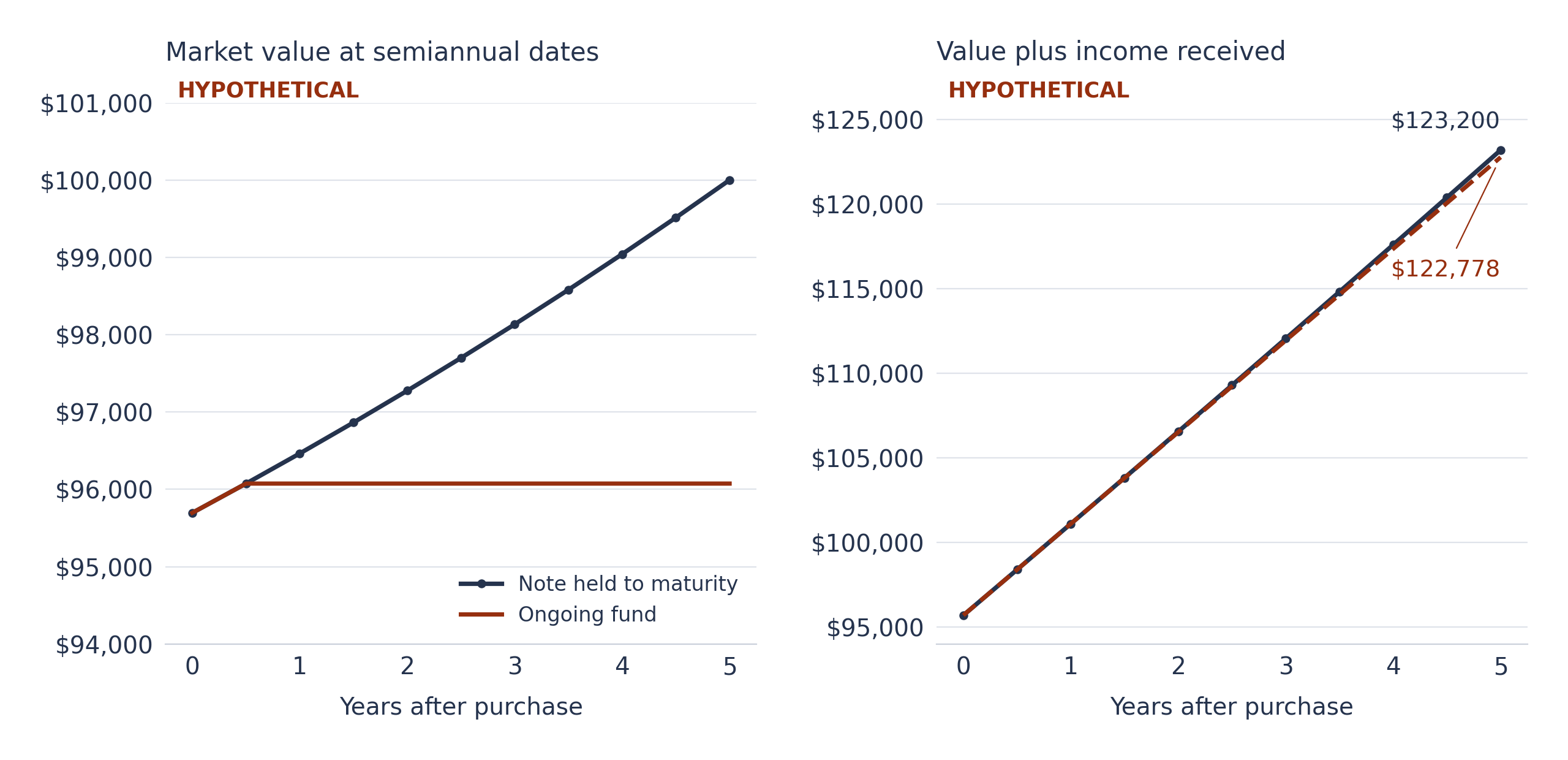
Hypothetical: $100,000, one-point rate rise, income spent. Wealthion arithmetic.
What would you conclude? Not that the note escaped every cost of the rate rise. Its coupon did not fall, but it paid about $1,000 a year less than a fresh $100,000 investment yielding 5.64%, an opportunity cost. The fund paid through a lower price, which also left less money to earn the new yield. This is an illustration, not a forecast. In this example, the end date changed the form of the cost far more than the five-year total; other rate paths, holdings and costs could change that result.
Which is better, individual bonds or a bond fund?
Neither wins outright. Each is good at something the other can't do.
The bond's strength is a scheduled repayment. If your $100,000 is meant for a house purchase in five years, the note in this example delivers its $100,000 face value that month, whatever rates did along the way, provided the government pays. For other bonds, default, early-repayment terms or a purchase price different from face value can change the result. An ongoing fund can't make that promise; a term fund has a planned end date but no guaranteed payout. You also stay in charge: you choose the borrower, the maturity and whether to sell.
The fund's strengths are spread and convenience. Consider a simple example. Own ten corporate bonds from ten different borrowers in equal amounts and each borrower holds a tenth of your money. Own one share of a broad fund and your stake can be spread across thousands of bonds. A fund can also normally be sold on any business day, and it reinvests for you.
Cost is the hardest to compare, because annual expenses and trading costs are different measures. A fund states its expense ratio, the share of its net assets taken each year to pay fees and expenses 10. Trading costs and other charges can sit outside it 7. A bond has no fund expense ratio, but account or advisory fees may apply. You may pay when you trade, through a dealer's markup or markdown or a commission 9. Certain retail corporate and agency trades require markup disclosure 8. In 2025 the average full purchase–sale spread on municipal bond trades of $100,000 or less was 0.504%, against 0.211% on trades of $1 million or more 9. On $25,000, 0.504% is $126, but that is a full-spread illustration, not a quoted fee for one purchase. Neither structure is always cheaper.
What are the risks of bonds and bond funds?
The same ones. Choosing a fund over a bond, or a bond over a fund, moves the risks around without removing them.
It is a common misconception, the SEC's investor education site says, that bonds and bond funds carry little or no risk 12. Four risks apply to both.
Interest rates. When comparable yields rise, existing fixed-rate bonds generally lose value 1, as the example showed. A fund's duration estimates how exposed it is: a duration of two years suggests a fall of about 2% if yields rise one percentage point, other factors unchanged 13.
Credit. A borrower may fail to pay interest or principal on time 1, and holding a bond to maturity is no protection against that 14. Own one bond and a default lands on your whole holding. A diversified fund carries the risk too 12, spread across its borrowers.
Inflation. Fixed nominal interest and principal buy less as prices rise 1. Neither structure alone protects you from that. Inflation-linked bonds adjust principal with a price index, and funds can hold them 15.
Liquidity. Selling a bond before maturity can mean going to a dealer, and the Financial Industry Regulatory Authority (FINRA) notes that in stressed markets this can mean reduced liquidity and losses 16. A fund can normally be sold on a business day, but only at the applicable net asset value or market price 7.
The maturity date changes what you can see. It doesn't change what the market does.
Frequently asked questions
Can a bond fund that holds only Treasuries lose money? Yes. In our hypothetical, an ongoing fund of five-year Treasury notes lost $4,305 on $100,000 when yields rose one point.
Is there a bond fund that matures? Some. Defined-maturity funds are designed to wind up on a set date, though the payout is not guaranteed and may be less than the original investment. The SEC describes bond unit investment trusts that sell remaining assets and distribute proceeds on termination 2.
Sources & Disclosure
1 Bonds: FAQs. Securities and Exchange Commission, Investor.gov; contractual payments, credit, interest-rate, inflation, liquidity and call risk. Accessed November 12, 2026. 2 Unit Investment Trusts. Securities and Exchange Commission, Investor.gov glossary; bond investment-company structures with termination dates, sale of remaining assets and distribution of proceeds. Read with the Securities and Exchange Commission guide for investment-company risks and net asset value. Accessed November 12, 2026. 3 Selected Interest Rates (Daily), H.15. Board of Governors of the Federal Reserve System; five-year Treasury constant-maturity benchmark yield of 4.64% on November 6, 2026, released November 9, 2026. Benchmark yields are interpolated, rather than the coupon of a particular note. 4 Treasury Notes. TreasuryDirect, United States Department of the Treasury; fixed auction coupon, semiannual interest and repayment mechanics. Accessed November 11, 2026. 5 Investor Bulletin: Fixed Income Investments, When Interest Rates Go Up, Prices of Fixed-Rate Bonds Fall. Securities and Exchange Commission, Investor.gov, June 26, 2013; coupon, price, yield and maturity distinctions. 6 Understanding Pricing and Interest Rates. TreasuryDirect, United States Department of the Treasury; coupon versus yield, price versus face value and semiannual payments. Accessed November 12, 2026. 7 Mutual Funds and Exchange-Traded Funds: A Guide for Investors. Securities and Exchange Commission, Investor.gov; net asset value, assets and liabilities, diversification, mutual fund redemption, exchange-traded fund prices, distributions, expenses and trading costs. Accessed November 12, 2026. 8 Regulatory Notice 17-08: Pricing Disclosure in the Fixed Income Markets. Financial Industry Regulatory Authority, February 15, 2017; specified retail corporate and agency trades require markup/markdown disclosure under qualifying conditions. 9 Transaction Costs for Municipal Securities Odd-Lot Trades. Simon Z. Wu and Nicholas J. Ostroy, Municipal Securities Rulemaking Board, April 2026; Table 2, 2025 full effective spreads of 50.4 and 21.1 basis points for the stated trade-size groups; methodology on page 5 and asset-based compensation discussion on page 11. These are not quotes for one-way purchase fees. 10 How to Read a Mutual Fund Prospectus, Part 2 of 3: Fee Table and Performance. Securities and Exchange Commission, Investor.gov; annual expense ratios as a percentage of net assets, shareholder charges and other costs. Accessed November 12, 2026. 11 Wealthion calculations, November 12, 2026. Hypothetical $100,000 face value bought at par, 4.64% fixed annual coupon paid semiannually, five years to maturity and no issuer option to repay early. Yield rises immediately to 5.64% and remains constant; all payments occur as promised. Initial price is $95,695.4497. First six-month ex-coupon sale value is $96,074.0614. The ongoing fund buys new five-year notes at par every six months; subsequent semiannual income is $2,709.2885. Five-year income is $26,703.5968 and value plus income is $122,777.6581, versus $123,200 for the held note, a $422.3419 gap. Income is spent; taxes, fees, trading spreads and accrual are excluded. Table and chart use the same semiannual observations; figures rounded for display. 12 Bond Funds and Income Funds. Securities and Exchange Commission, Investor.gov glossary; bond fund holdings, credit risk, interest-rate risk, government-bond fund losses and prepayment risk. Accessed November 12, 2026. 13 Brush Up on Bonds: Interest Rate Changes and Duration. Financial Industry Regulatory Authority, September 19, 2024; approximate sensitivity to a one-percentage-point change in yield and other risk factors. 14 Investor Bulletin: What Are Corporate Bonds? Securities and Exchange Commission, Investor.gov; coupon payments, face value, maturity, default and call provisions. Accessed November 12, 2026. 15 Treasury Inflation-Protected Securities. TreasuryDirect, United States Department of the Treasury; inflation-adjusted principal and interest. Accessed November 12, 2026. 16 Bond Liquidity: Factors to Consider and Questions to Ask. Financial Industry Regulatory Authority, September 13, 2022; early-sale and stressed-market liquidity risk.
Wealthion is a dba of Greylock Peak Investments, a registered investment adviser. This article is general information only. It is not investment advice or an offer or solicitation, and it is not tailored to your circumstances. Guests’ views are their own and may not reflect those of Wealthion. Wealthion has not verified guest statements, including any performance figures. Investing involves risk, including loss of principal, and past performance does not guarantee future results. Wealthion refers readers to other registered investment advisers and shares in the fees they receive from referred clients, which creates a conflict of interest. Please see our Form ADV Part 2A and consult your own financial advisor before investing.
What Serious Investors Are Watching
Dive into expert interviews, market analysis, and long-form content built to help serious investors think long-term.
Individual Bonds vs Bond Funds: Which Is Better for You?
Both pay regular interest, and both can fit a long-term plan. Where they differ is...
Bond Ladders Explained: How Staggered Maturities Work
A bond ladder spreads one sum across bonds that mature in different years, so cash...

Social Security COLA Explained: How the Annual Increase Is Calculated
The 2027 Social Security raise is 3.6%, produced by one price index and a rounding...
Enjoyed This? Get More Insights
Expert insights and curated opportunities, delivered to your inbox.
Ready to Position for What's Coming?
Whether you're still learning or ready to act, your next step starts here.
- Independent
- Macro-Informed
- Real Asset Focused

The Wealthion Network
By subscribing, you agree to receive Wealthion emails. Unsubscribe anytime.
The Wealthion Network
By subscribing, you agree to receive Wealthion emails. Unsubscribe anytime.
Network Discussion
Join the Wealthion Network to Comment