

Social Security COLA Explained: How the Annual Increase Is Calculated
The 2027 Social Security raise is 3.6%, produced by one price index and a rounding rule. For people whose Medicare Part B premium is deducted, what reaches their account also depends on a premium that hasn't been announced yet.
In most years, people on Social Security get a raise. It's called the cost-of-living adjustment (COLA), and its job is to keep benefits from falling behind rising prices.
Nobody negotiates that raise and nobody votes on it. Since automatic indexing began in 1975, it has come out of a formula built on one price index1. The formula compares two three-month averages of that index and rounds the result to a tenth of a percent2.
That formula is what the title promises to explain. This guide walks through it in order: what was announced for 2027, how the number is worked out, when it reaches your account, how much of it survives the Medicare deduction and whether the index behind it matches a retiree's own costs. Along the way, we'll follow one hypothetical benefit of $2,000 a month to see what a 3.6% raise really does.
It's a good year to look closely. The 2027 raise, 3.6%, is the largest since 20233,4. For people whose Medicare Part B premium is deducted, one piece of what will land in their account hadn't been announced as of November 10, 2026: the 2027 premium5,6.
The numbers at a glance
What did Social Security announce for 2027?
The headline is simple: 3.6%, with higher payments reaching most Social Security recipients in January.
The Social Security Administration (SSA) set the 2027 COLA on October 14, 2026. It reaches about 76 million people on Social Security or Supplemental Security Income (SSI)8. On the $2,000 benefit we're following, 3.6% works out to $72 a month, before anything is taken out.
For an aged couple with both receiving benefits, SSA's gross estimate rises from $3,238 to $3,355 a month7. That word "gross" matters: it means before deductions. Many retirees on Medicare have the Part B premium, the monthly charge for outpatient coverage, taken out of the same payment, so the deposit can be smaller than the raise suggests. We'll come back to that.
How is COLA calculated, and which months does it compare?
For 2027, the COLA compares two snapshots of prices taken a year apart. The raise is the percentage difference between them.
The prices come from one index, the Consumer Price Index for Urban Wage Earners and Clerical Workers (CPI-W), published by the Bureau of Labor Statistics (BLS). The law has tied COLAs to it since automatic indexing began in 19751.
Each snapshot is an average of three months, July to September2. This year's average is set beside the same average from the third quarter of the last year that produced a raise. Using three months instead of one smooths out any single month's swing. This year, the two snapshots gave:
The result is rounded to the nearest tenth of a percent. If the index hasn't risen, there's no COLA2. That has happened three times, for benefits starting in January 2010, 2011 and 20164. A zero year doesn't reset the comparison, so the next raise is still measured from the last year that produced one2.
The 3.6% COLA for 2027 is the largest since 2023
COLA (%), by the year the higher payments begin in January
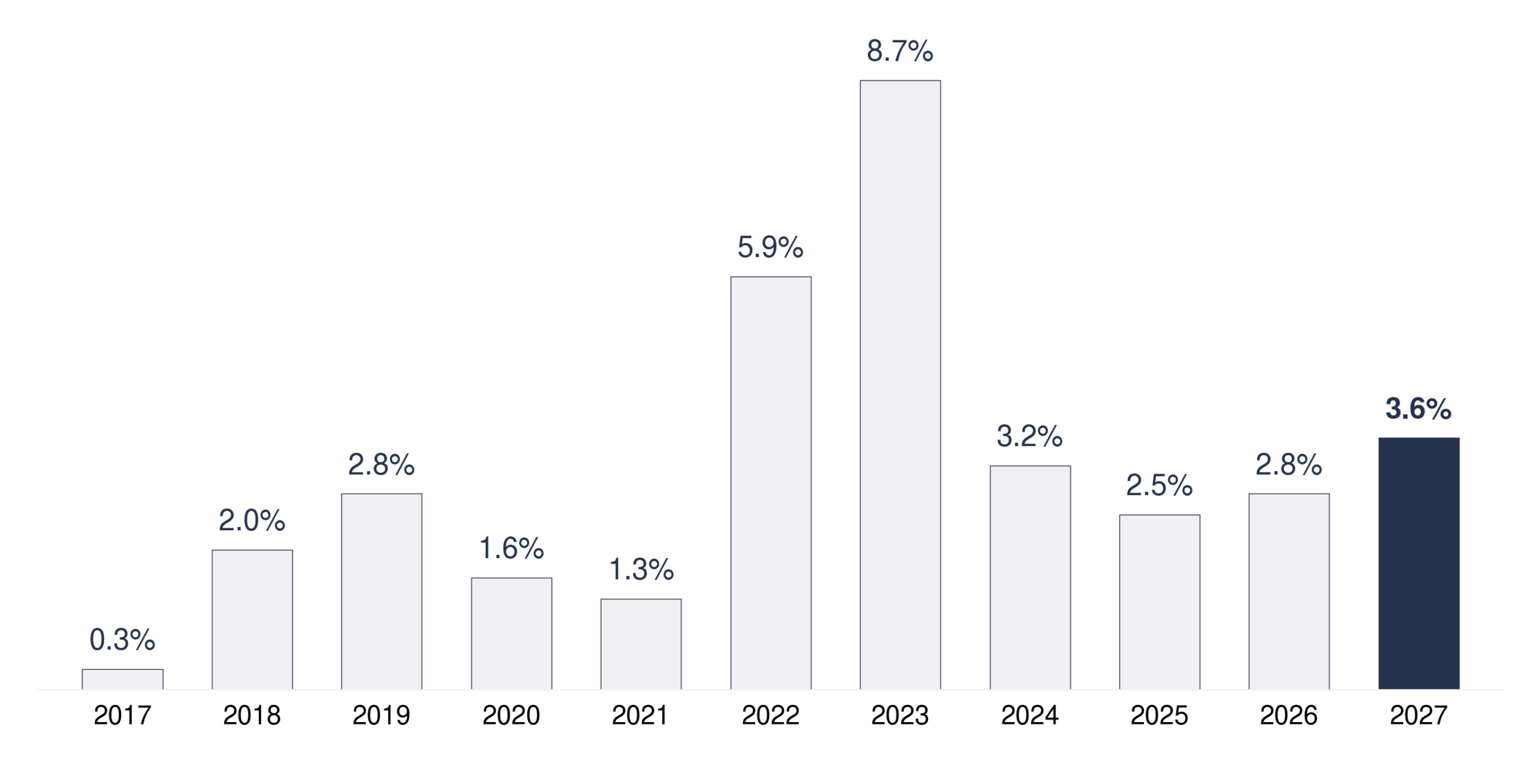
Source: Social Security Administration, Office of the Chief Actuary4. Years show January payment years; SSA's source table dates each COLA by the preceding December.
The tall bars in 2022 and 2023 followed the post-pandemic price surge. Since then, no year has fallen back to the sub-2% raises of 2017, 2020 and 2021. One labeling quirk: SSA's own table dates each COLA by the December it takes effect, so its "2026" row is this 3.6%4.
When does the increase reach beneficiaries?
The raise is set in October, but the first bigger payment arrives in January for most Social Security recipients. The gap is built into the calendar.
The 3.6% applies to December 2026 benefits, which are paid a month later, so most people see the higher amount in January 20272. The number itself has to wait for September prices, which BLS published on October 14, 20269, the same day SSA announced the COLA3. That leaves a little over three months between the last prices counted and your first higher payment.
SSI runs on its own calendar. Because January 1 is a holiday, January SSI payments always go out at the end of December2, so higher SSI amounts start with the December 31, 2026 payment10. Some Social Security recipients also receive their higher December benefit on December 31, because the usual January 3 payment date falls on a Sunday and January 1 is a holiday11.
A 3.6% raise set in October reaches most Social Security payments in January
2027 COLA calendar; Part B is deducted where applicable
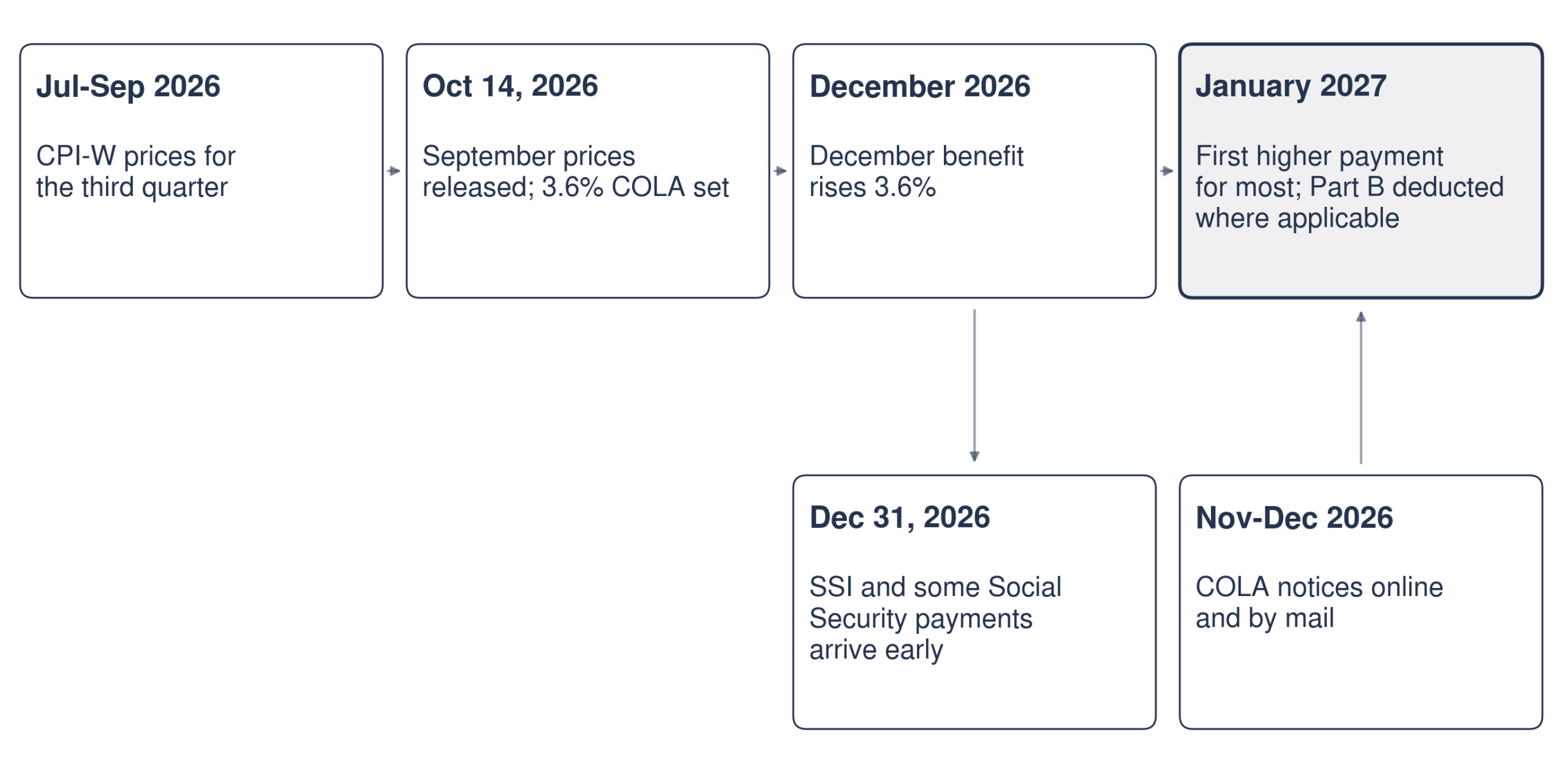
Sources: SSA COLA calculation, payment calendars and notice schedule2,3,10,11,12. The early Social Security payment on December 31 covers the December benefit; SSI's payment covers January.
Your personal notice comes later. It's online from late November if you sign up for paperless notices by November 18, or by mail in December12. Medicare enrollees see the 2027 premium online from late November12 and their new benefit amount in December13.
How much of the raise survives the Medicare deduction?
This is where the $2,000 benefit meets Medicare, and where a 3.6% raise can stop being 3.6%.
The order of operations matters. SSA first raises your primary insurance amount (PIA), the base your benefit is built from, and rounds down to the dime. It then applies any early or delayed retirement adjustment and rounds down to the dime again, before subtracting any Part B premium deducted and rounding down to the dollar14. Because the premium comes out after the raise, your payment can change by more or less than 3.6%.
The premium is a flat dollar amount, not a percentage. The standard Part B premium is $202.90 a month in 2026, up from $185.00 in 20255. The Centers for Medicare & Medicaid Services (CMS) published that figure on November 14, 2025. As of November 10, 2026, the 2027 premium hadn't been announced6.
The $2,000 benefit runs through the same steps in this illustration. It assumes no early or delayed retirement adjustment, with the standard Part B premium deducted in 2026. Because the 2027 premium is unknown, there are two cases, with 3.6% applied to the full $2,000. Neither case is a forecast.
| Monthly amount | 2026 | 2027, premium unchanged | 2027, premium up $20 |
|---|---|---|---|
| Gross benefit | $2,000.00 | $2,072.00 | $2,072.00 |
| Part B premium deducted | $202.90 | $202.90 | $222.90 |
| Payment (rounded down) | $1,797 | $1,869 | $1,849 |
| Change in payment | None | +$72 (+4.0%) | +$52 (+2.9%) |
The gross raise is 3.6% in both columns, yet the payment rises 4.0% in one and 2.9% in the other. Only the premium changed. And because the premium is a fixed dollar amount, the smaller your benefit, the bigger the share of its raise a premium increase can take.
There is a safety net. Under the "hold harmless" rule, an increase in the standard Part B premium alone can't push your January payment below December's if you were entitled to and received cash benefits for November and December, with December and January Part B premiums deducted from those benefits16. It doesn't cover people who pay the income-related monthly adjustment amount (IRMAA), a surcharge for higher incomes generally based on tax information from two years earlier17, or those whose premiums a state Medicaid agency pays. Other deductions and late-enrollment surcharges can still reduce a payment16.
Why might the COLA not match a retiree's own costs?
A price index is a shopping basket. The question is whose basket it is.
The CPI-W's basket follows urban wage-earner and clerical-worker households, and a retiree's may look quite different. BLS's December 2025 weights show how it compares with the broader Consumer Price Index for All Urban Consumers (CPI-U). Energy takes 8.1% of the CPI-W basket against 6.4% of the CPI-U's, gasoline 4.0% against 2.9%, and medical care 7.6% against 8.4%18.
BLS also publishes the Consumer Price Index for Americans 62 years of age and older (R-CPI-E), formerly known as the Consumer Price Index for the Elderly (CPI-E). These are names for one research series. BLS changed the name in August 2020 without changing the data19.
| Index | Whose spending it follows | Role |
|---|---|---|
| CPI-W | Urban wage-earner and clerical-worker households | Sets the COLA by law |
| CPI-U | All urban households | Broader benchmark |
| R-CPI-E (formerly CPI-E) | Households whose reference person or spouse is 62 or older | Research only |
| Chained Consumer Price Index for All Urban Consumers | All urban households; accounts for shifts in purchases as relative prices change | Study comparison; does not set the Social Security COLA |
Different weights can produce different readings when fuel prices rise. In the year to September 2026, gasoline rose 34.2% and energy 20.4%, while shelter rose 3.2% and medical care services 2.5%9. The CPI-W, which gives fuel a larger weight, rose 3.9% against 3.7% for the CPI-U9,18. These are 12-month readings, rather than the quarterly-average comparison used to set the COLA2.
The R-CPI-E reweights the CPI-U's items using spending by households whose reference person or spouse is 62 or older. Its household sample for estimating spending weights is about one-fifth of the urban Consumer Expenditure Survey sample. BLS also says its retail-outlet sample may miss where older people shop, so conclusions should be tentative20. An older SSA study used the series under its former name, CPI-E, which weighs medical care and shelter more. COLAs built on it would have averaged 3.35% a year from 1984 to 2006, against 3.02% for the CPI-W1.
Even so, no index describes one household. For owner-occupied homes, the same study notes that the shelter measure uses equivalent rent, meaning what the homes would rent for, which may not match what retirees who own their homes outright pay1. The further your spending sits from a working household's, the further your own inflation may sit from 3.6%.
Is the COLA too small, or about right?
Whether the COLA is too small depends on the yardstick.
One reading says retirees are shortchanged. Over 1984 to 2006, the CPI-E would have paid more on average, though in 2005 the CPI-W actually ran ahead of it1. The CPI-W also beat the CPI-U in the year to September 2026, but that compares two general indexes, not retirees' costs9.
Another reading points the other way. A chained index, which tracks how shoppers switch goods as prices change, would have paid less: 2.32% a year on average from 2001 to 2006, against 2.70% under the CPI-W1.
For now, none of these sets the COLA. BLS says other agencies have considered using the R-CPI-E, but none has, because of its limits20. Which index is "right" depends on whose spending you want it to track.
So the answer to the title is short. SSA compares the July to September CPI-W average with the last COLA year's and rounds to a tenth of a percent, which gave 3.6% for 2027. That percentage raises your gross benefit. If your Part B premium is deducted, it helps determine your deposit. What the deposit buys depends on how closely your own prices follow the CPI-W's.
The formula sets your raise. Any Medicare deduction and your own prices help determine what it's worth.
Frequently asked questions
How is COLA calculated? SSA takes the July to September CPI-W average, compares it with the last COLA year's and rounds to a tenth of a percent2.
When will you see the 2027 increase? Most Social Security recipients see it in January 2027, covering December 2026 benefits. Those normally paid on the third receive that December benefit early, on December 31, 2026. SSI's January payment also arrives that day10,11.
Can a Part B premium increase reduce your Social Security payment? Hold-harmless protection prevents a qualifying standard Part B premium increase alone from reducing January's payment below December's. Other deductions can still change the deposit. IRMAA payers and people whose state Medicaid agency pays the premium are excluded16.
Is the 2027 Part B premium known? Not as of November 10, 20266. CMS announced the 2026 premium on November 14, 20255.
Why isn't the COLA based on an index for older Americans? By law it follows the CPI-W1. BLS's index for people 62 and older remains a research series20.
Sources & Disclosure
1 Social Security Cost-of-Living Adjustments and the Consumer Price Index. Clark Burdick and Lynn Fisher, Social Security Bulletin Vol. 67 No. 3, 2007, released April 2008; statutory CPI-W link, CPI-E and chained-index comparisons, shelter weighting. 2 Latest Cost-of-Living Adjustment. Social Security Administration, Office of the Chief Actuary, accessed November 5, 2026; third-quarter CPI-W averages, formula, rounding, December and January timing, SSI holiday rule. 3 Cost-Of-Living Adjustment (COLA). Social Security Administration, Office of the Chief Actuary, accessed November 5, 2026; 3.6% COLA determined October 14, 2026. 4 Cost-Of-Living Adjustments (COLA history). Social Security Administration, Office of the Chief Actuary, accessed November 5, 2026; COLA by year and SSA's December dating convention. 5 2026 Medicare Parts A & B Premiums and Deductibles. Centers for Medicare & Medicaid Services, November 14, 2025; 2026 and 2025 standard Part B premiums. Medicare.gov, Costs, current 2026 Part B cost information, accessed November 10, 2026. 6 Medicare Part B Monthly Actuarial Rates, Premium Rates, and Annual Deductible Beginning January 1, 2027 (CMS-8094), RIN 0938-AV86. Office of Information and Regulatory Affairs, Reginfo.gov; notice received November 4, 2026 and still pending review as observed November 10, 2026. Read alongside Medicare.gov current cost information for the unannounced 2027 premium. 7 2027 Cost-of-Living Adjustment (COLA) Fact Sheet. Social Security Administration, October 14, 2026; estimated average benefits before and after the COLA. 8 Just Announced! Cost-of-Living Adjustment (COLA) for 2027. Social Security Administration, October 14, 2026; 3.6% increase for 76 million Social Security and SSI recipients. 9 Consumer Price Index - September 2026. Bureau of Labor Statistics, October 14, 2026; release date, CPI-W and CPI-U 12-month changes, component price changes. 10 How much will the COLA amount be for 2027 and when will I receive it? Social Security Administration, accessed November 5, 2026; January 2027 and December 31, 2026 payment timing. 11 Schedule of Social Security Benefit Payments 2026 and 2027, Publication No. 05-10031. Social Security Administration, January 2026; December 31, 2026 early payments for SSI and recipients normally paid Social Security on the third of the month. 12 Social Security Announces 3.6 Percent Benefit Increase for 2027. Social Security Administration, October 14, 2026; online and mailed notice timing. 13 Cost-of-Living Adjustment (COLA) Information. Social Security Administration, News, accessed November 6, 2026; Medicare enrollees' new benefit amount available in December. 14 Application of COLA to a Retirement Benefit. Social Security Administration, Office of the Chief Actuary, accessed November 5, 2026; primary insurance amount increase, early/delayed retirement factor, Part B offset and truncation. 15 2026 Cost-of-Living Adjustment (COLA) Fact Sheet. Social Security Administration, October 24, 2025; 2026 average retired-worker benefit before and after the COLA. 16 Program Operations Manual System (POMS), HI 01001.004: The Variable Supplementary Medical Insurance (VSMI) Premium. Social Security Administration, effective February 2, 2023; hold-harmless cash-benefit and sole-cause conditions, exclusions and late-enrollment surcharges. 17 POMS HI 01101.010: Modified Adjusted Gross Income (MAGI). Social Security Administration, accessed November 6, 2026; general two-year and permitted three-year tax-return basis for the income-related premium adjustment. 18 Relative Importance and Weight Information, December 2025. Bureau of Labor Statistics, accessed November 5, 2026; CPI-W and CPI-U expenditure weights. 19 Renaming of select data series. Bureau of Labor Statistics; CPI-E renamed R-CPI-E starting August 2020 without changing the data. Accessed November 10, 2026. 20 R-CPI-E Homepage. Bureau of Labor Statistics, last modified October 14, 2026; reference-person/spouse population definition, spending-weight sample and other limitations of the index for Americans 62 and older.
Wealthion is a dba of Greylock Peak Investments, a registered investment adviser. This article is general information only. It is not investment advice or an offer or solicitation, and it is not tailored to your circumstances. Guests’ views are their own and may not reflect those of Wealthion. Wealthion has not verified guest statements, including any performance figures. Investing involves risk, including loss of principal, and past performance does not guarantee future results. Wealthion refers readers to other registered investment advisers and shares in the fees they receive from referred clients, which creates a conflict of interest. Please see our Form ADV Part 2A and consult your own financial advisor before investing.
What Serious Investors Are Watching
Dive into expert interviews, market analysis, and long-form content built to help serious investors think long-term.

Social Security COLA Explained: How the Annual Increase Is Calculated
The 2027 Social Security raise is 3.6%, produced by one price index and a rounding...

Interval Funds Explained: How Withdrawals Work When the Assets Are Hard to Sell
Interval funds buy back your shares only at set times and in set amounts. That...

Buy the Dip Explained: What to Check Beyond a Falling Share Price
A stock drops after a disappointing quarter. Buying it now costs less. But the company...
Enjoyed This? Get More Insights
Expert insights and curated opportunities, delivered to your inbox.
Ready to Position for What's Coming?
Whether you're still learning or ready to act, your next step starts here.
- Independent
- Macro-Informed
- Real Asset Focused


The Wealthion Network
By subscribing, you agree to receive Wealthion emails. Unsubscribe anytime.
The Wealthion Network
By subscribing, you agree to receive Wealthion emails. Unsubscribe anytime.
Network Discussion
Join the Wealthion Network to Comment