

Interval Funds Explained: How Withdrawals Work When the Assets Are Hard to Sell
Interval funds buy back your shares only at set times and in set amounts. That limit is what lets them own loans and property that can't be sold in a day. Here is how the schedule works, what it costs and what happens when too many people want out at once.
An interval fund is an investment fund that buys back your shares only at set times, most often once a quarter, and only up to a set amount each time.
Its shares usually don't trade on an exchange, so those scheduled buybacks, called repurchase offers, are the main way to get your money out1. That sounds like a drawback, and in one sense it is. It's also the whole design. By limiting when and how much money can leave, the fund can put most of its portfolio into assets that take months to sell, such as private loans and real estate.
That's the question in the title: how do withdrawals work when the assets are hard to sell? This guide answers it step by step. We cover what an interval fund is, how its buyback schedule runs, what it costs and what happens when more investors want out than the fund will buy back. It's a timely question. Interval funds have grown to about $190 billion, roughly triple their size at the end of 2021, and the Securities and Exchange Commission (SEC) proposed changes to their rules on September 30, 20262,3.
The numbers at a glance
Why are interval funds drawing attention in 2026?
The growth shows investors are accepting the trade. The timing shows its terms may soon change.
The Federal Reserve puts interval funds' total financial assets at $189.9 billion at the end of June 2026, roughly three times the $60.8 billion it first recorded at the end of 20212. And on September 30, 2026, the SEC proposed changes to the rule that governs them, Rule 23c-3 of the Investment Company Act, including more frequent and more flexible buyback offers3,4.
Why would anyone accept limits on getting their own money back? Picture a fund that lends to mid-sized private companies, or owns office buildings. Those assets can't be sold by Friday. If a fund like that promised daily cash and a wave of requests arrived, it might have to sell whatever it could, at whatever price it could get, and leave the cost with the investors who stayed.
An interval fund reduces that pressure by promising less: to buy back a set slice of its shares at set times. Everything that follows, from the calendar to the fees to what happens in a rush for the exit, flows from that one trade. And with the structure growing just as its rules come up for revision, it's worth understanding how the trade actually works.
What is an interval fund, and how is it different from a mutual fund?
The simplest way to understand an interval fund is to set the promise it makes beside the one a mutual fund makes.
A mutual fund promises daily access: you can sell your shares back on any business day, and it generally has to pay you within seven days5. To keep that promise, it needs assets it can turn into cash quickly. That's why most mutual funds generally limit illiquid investments to 15% of net assets6,7. The rule defines these as investments the fund reasonably expects it cannot sell within seven calendar days without significantly changing their market value7.
An interval fund promises scheduled access. Legally it's a closed-end fund that, at regular intervals, offers to buy back a fixed slice of its own shares, rather than buying them back whenever asked1. Its shares usually don't trade on an exchange either, so those offers are your main way out. You don't have to accept any of them1.
Giving up daily access buys freedom on the other side. Interval funds aren't bound by the 15% cap, so they can hold commercial property, stakes in private funds and other assets that take months to sell6.
The Financial Industry Regulatory Authority (FINRA), which oversees brokers, sums up the result as "guaranteed (but limited) liquidity"6. Liquidity simply means how easily you can turn an investment into cash, and both halves of the phrase matter. The schedule is a fundamental policy that only a shareholder vote can change, although the rule allows offers to be suspended in limited circumstances4. Every offer also has a ceiling.
That fixed schedule is also what separates an interval fund from its close cousin, the tender offer fund. A tender offer fund's board decides whether and when to buy back shares3. Outside the narrow grounds the rule lists, an interval fund's board doesn't get that choice.
The price used for a buyback is net asset value (NAV) per share: the fund's assets minus its liabilities, divided by the number of shares outstanding8.
Mutual funds offer daily access; interval funds offer capped windows
Most mutual funds: daily redemption and a 15% net-asset limit on illiquid holdings. Interval funds: periodic offers, no 15% cap
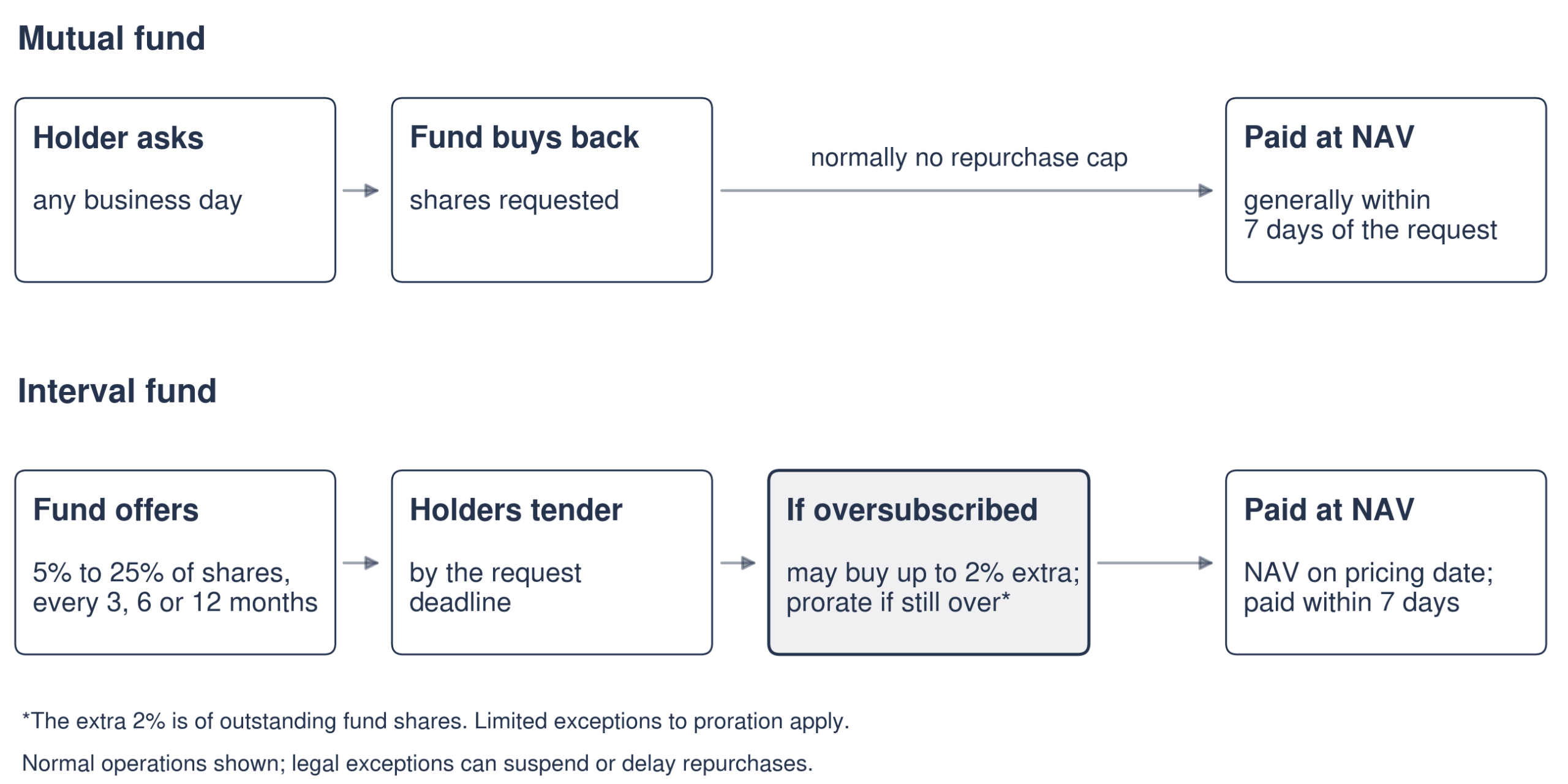
Sources: Investor.gov1,5,8; FINRA6; Rules 23c-3 and 22e-44,7. The interval-fund row shows the standard rule; some funds have exemptive permission for monthly offers.
How do interval funds set repurchase schedules, limits and pricing dates?
If the assets can't move quickly, the exits have to be planned. The schedule is that plan, and it answers three things: how often the window opens, how wide it opens and how long the cash takes to arrive.
How often is the fund's choice: every three, six or twelve months4. Most choose quarterly. At the end of 2025, 89% of interval funds made quarterly offers. Three offered every six months, and three offered monthly under exemptive orders, which are special permissions from the SEC3.
How wide is the board's choice, made before each window: at least 5% and at most 25% of the fund's shares4. Funds tend to stay near the floor, and the SEC's review of filings put the median offer at 5%3. From the day the notice goes out until the shares are priced, the fund must hold eligible liquid assets worth at least the full amount it has offered to buy4. That requirement covers the stated offer, not every request that might arrive.
How long is where the calendar comes in. Say you hold shares worth $50,000 in a quarterly interval fund, and you want all of it back for a house purchase. A notice arrives on February 1, 2027. The rule says it must come 21 to 42 days before the request deadline4, and yours names March 1, 28 days away. Until that day you can submit, change or withdraw your request4.
The fund sets the per-share NAV on the pricing date. That date must fall no later than 14 days after the request deadline, or the next business day if day 14 is not a business day. Payment is due by seven days after pricing, and may arrive earlier4. If your fund prices on March 1, your money is due by March 8. If it prices on March 15, payment is due by March 22, seven weeks after the notice arrived.
Payment is due within seven days of pricing
The repurchase calendar, in days from the request deadline (day 0); the business-day extension is explained below
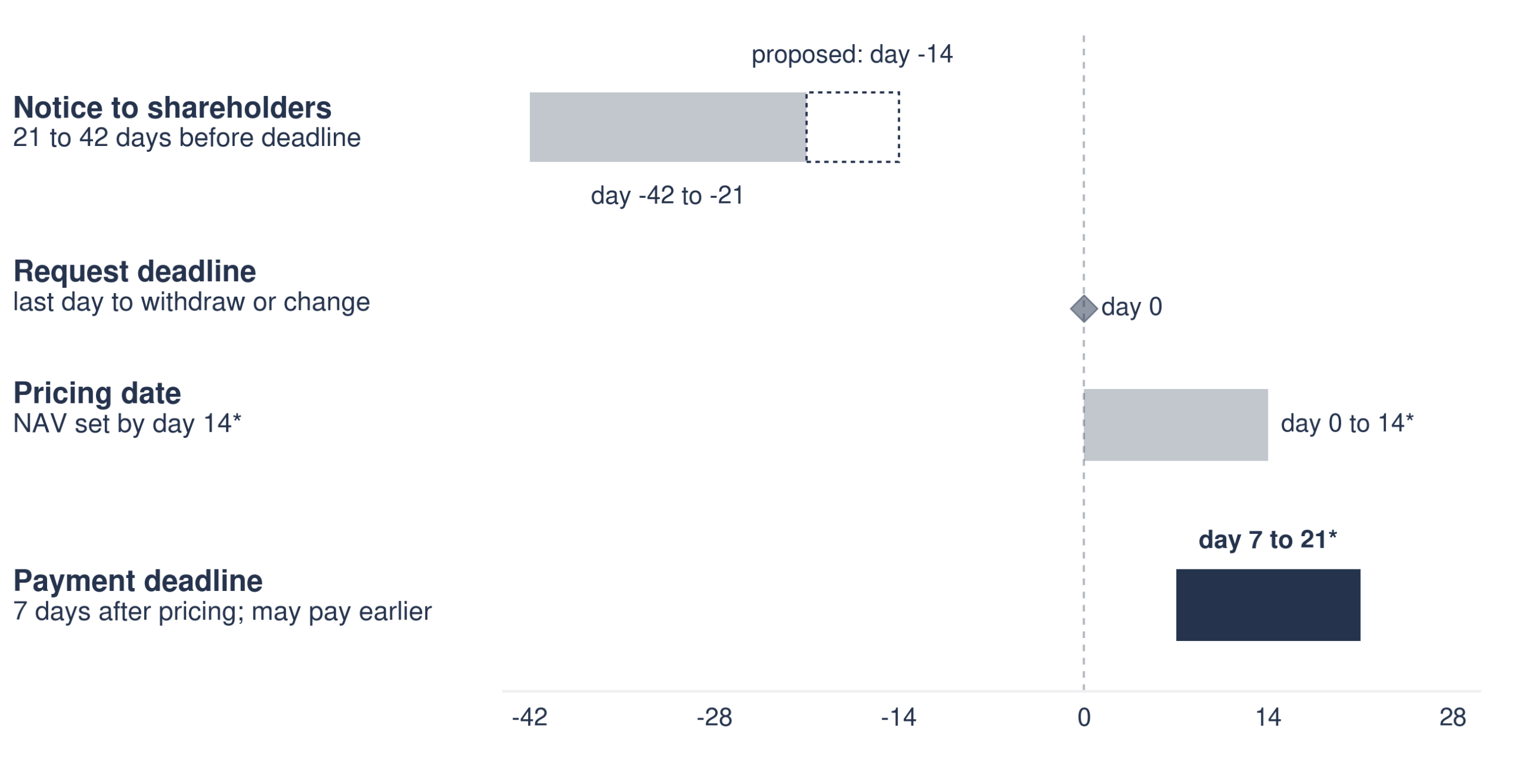
* If day 14 is not a business day, the pricing deadline moves to the next business day. The payment deadline can therefore fall after day 21. The dark bar shows payment deadlines, not a required waiting period. Source: Rule 23c-34. The dotted notice extension to day -14 is proposed, not in force3.
The calendar hides one risk. You commit at the deadline, but you learn your price only on the pricing date. If the fund's value slips 2% in between, your $50,000 becomes $49,000 before any fee, and you can no longer change your mind. The notice must warn you of exactly this4. So you aren't deciding blind, funds must calculate NAV at least weekly, and daily in the five business days before a deadline4.
The SEC's September proposal would move several of these settings. Funds could offer monthly windows without special permission, give as little as 14 days' notice, and replace the full liquid-asset cover with a broader duty to manage liquidity3,9. A new fund could also wait up to two years before its first offer. The current limit is two intervals, which already amounts to two years for an annual fund3,4. More frequent windows and shorter notice could shorten the wait; a broader liquidity standard would put more weight on each manager's judgment. None of it is in force. It is a proposal, open for comment.
What fees do interval funds charge?
Hard-to-sell assets don't only change how you get out. They change what it costs to be in.
One fee comes with the structure itself. When a fund buys back your shares, it may keep up to 2% of the proceeds as a repurchase fee, meant to cover the cost of running the buyback4. On your $50,000 sale, that's up to $1,000. The rule sets a ceiling, not a price, but FINRA notes that interval funds typically charge one6.
Then there's what you pay while you're invested. FINRA says interval fund fees and expenses "tend to be higher" than those of other closed-end funds and mutual funds, possibly because hard-to-trade assets cost more to own and need specialist managers. These can include management fees, service fees and, in some cases, a sales charge when you buy6.
A few layers can sit on top. Some funds charge performance fees, though advisory rules generally limit those to fees based on income, or to fulcrum fees that rise and fall symmetrically with results against a benchmark. A qualified-client exception can permit other arrangements when investors charged the fee meet the rule's eligibility requirements10. Some offer several share classes of one portfolio with different charges, which today requires an SEC exemptive order. The proposal would allow that by rule3, and would let funds take deferred sales charges, fees paid on the way out, from your repurchase proceeds9.
Two numbers are easy to misread. A high distribution rate isn't a high return, because payouts can include some of your own money handed back, known as a return of capital6. The SEC's proposing release doesn't provide a sector-wide expense ratio, so it doesn't supply that benchmark for comparing costs. Each fund's prospectus fee table sets out its own charges.
What happens when withdrawal requests exceed the amount offered?
This is where the problem in the title stops being theoretical.
Go back to your $50,000 request. Suppose the fund offered to buy 5% of its shares, but so many holders tendered, or asked to sell, that requests reached 10%. The fund may stretch its offer by up to another 2% of its shares. Past that, it must buy pro rata, meaning every holder who asked gets the same fraction filled4. The count is fixed at the deadline, since requests can't change after it4.
With the extra 2%, the fund buys 7% against 10% requested, so you sell 70% of what you asked for: about $35,000. Without it, you sell half, about $25,000. These amounts assume an unchanged NAV and exclude fees. The rest of your shares stay in the fund, rising or falling with it, until the next window opens. If requests again exceed the next offer, proration can apply again.
The fund's commitment is the amount it offered to buy, not every request that arrives. In filings covering 2020 to 2026, the SEC found that quarterly interval funds' median cash and short-term investment holdings ranged from 5.20% to 5.93% of NAV across three monthly snapshots around repurchases3. That measure is narrower than the rule's eligible liquid assets. A larger payout could require other liquidity sources or asset sales, but these figures alone do not show that a fund would have to sell its private loans or property.
The rule allows two small exceptions. A fund may first fill in full holders of fewer than 100 shares who tender everything, and it may choose by lot among holders who tender all their shares on an all-or-nothing basis4. A board can suspend or postpone an offer only with approval from a majority of directors, including a majority of independent directors, and only for reasons the rule lists, such as a market closure or an emergency that makes valuing the fund impracticable4.
This isn't a textbook case anymore. In early 2026, the SEC reported, several closed-end funds and non-traded business development companies (funds that lend to smaller private companies), including some interval funds, received more requests to sell than they had offered to fill3. For scale, quarterly-offer interval funds bought back $15.2 billion of shares in 20253. The SEC's proposal would clear up an ambiguity in how the extra 2% works, while keeping proration3. Wealthion's article on private credit redemptions follows the same queues across private credit.
Is the withdrawal limit a flaw or the point of the design?
There are two honest ways to read what just happened to your $50,000.
The critical reading is easy to make. You asked for your money and got half of it, or 70% at best. If others keep heading for the exit, a holder in a quarterly fund offering 5% could wait many quarters to get fully out. FINRA puts it plainly: you "might not be able to sell as many shares" as you intended6.
The defender's reading is that the limit did its job. Pro rata treatment, the SEC says, is meant to prevent preferential treatment of any one shareholder3. Within the same offer, submitting a request first does not normally give a holder a larger fraction of the available capacity. The cap can reduce pressure on a manager to sell loans or buildings into a weak market, although it does not eliminate that risk.
Both readings contain truth. The mutual fund comparison cuts both ways: daily redemptions depend on a liquid portfolio, which is why most mutual funds face the 15% limit6,7. An interval fund gives up daily redemption and can hold a larger share of illiquid assets. The difference in access is part of how the structure works.
Two misreadings are common. The 5% to 25% range is the band the board chooses within, not a promise of 25%, and the typical offer sits at the bottom of it3. FINRA's phrase describes planned, limited access, not a promise that every investor can exit in full6. Even scheduled offers can be suspended on the limited grounds the rule allows4.
The withdrawal limit is part of the structure, but it remains a real constraint even for investors who understand it. Scheduled, capped repurchases can support hard-to-sell holdings while leaving individual investors uncertain about when and how much they can withdraw4,6.
Frequently asked questions
Can interval fund shares be sold on an exchange? Usually not. They typically don't trade on a secondary market, so the fund's repurchase offer is the main way out1.
Will you know your sale price when you put in a request? No. You receive the per-share NAV determined on the pricing date. Pricing must occur by day 14 after the request deadline, or the next business day if day 14 is not a business day4.
How is an interval fund different from a tender offer fund? An interval fund must make offers on a fixed schedule, subject to limited suspension grounds4. A tender offer fund's board decides whether and when3.
Can a fund skip a scheduled offer? Only with approval from a majority of directors, including a majority of independent directors, and only on grounds the rule lists4.
Has the SEC's proposal changed anything yet? No. Comments are due December 4, 2026, 60 days after Federal Register publication on October 511. Until a final rule is adopted, today's Rule 23c-3 applies3.
Sources & Disclosure
1 Interval fund. Investor.gov, SEC Office of Investor Education and Advocacy, undated glossary entry; definition, optional participation, no secondary market trading. 2 Interval Funds; Total Financial Assets (Balance Sheet), Level (BOGZ1FL464090073Q). Federal Reserve Board, Z.1 Financial Accounts of the United States, via FRED (Federal Reserve Bank of St. Louis), updated September 16, 2026; $189.9 billion at the end of Q2 2026, $182.3 billion at the end of 2025 and $60.8 billion at the end of 2021, the first quarter with a nonzero value. 3 Interval Fund Modernization; Expansion of Multiple Share Class to Registered Closed-End Management Investment Companies and Business Development Companies, Release No. 33-11444. U.S. Securities and Exchange Commission, September 30, 2026; 139 funds and $101 billion in net assets (Form N-CEN, December 2025), 55% in credit strategies, quarterly schedules, fund counts by frequency, $15.2 billion repurchased in 2025, median 5% offer, Table 7 cash and short-term investment holdings, early-2026 oversubscription, the tender-offer comparison and the proposed amendments. 4 17 CFR 270.23c-3, Repurchase offers by closed-end companies. Electronic Code of Federal Regulations, accessed November 9, 2026; intervals, 5% to 25% offer range, notice period, pricing and payment deadlines including the next-business-day extension, liquidity requirement, proration and exceptions, 2% repurchase fee cap, suspension grounds and board voting requirements, NAV frequency. 5 Mutual fund redemptions. Investor.gov, SEC Office of Investor Education and Advocacy, undated glossary entry; redemption on any business day and payment generally within seven days. 6 Interval Funds: 6 Things to Know Before You Invest. FINRA, January 29, 2025; 15% illiquid-asset limit for most mutual funds, "guaranteed (but limited) liquidity", proration risk, fee layers, distribution rates versus total return. 7 17 CFR 270.22e-4, Liquidity risk management programs. Electronic Code of Federal Regulations, accessed November 9, 2026; illiquid-investment definition and the 15% of net assets acquisition limit for covered open-end funds. 8 Net Asset Value. Investor.gov, SEC Office of Investor Education and Advocacy, undated glossary entry, accessed November 9, 2026; total assets less liabilities and the calculation of per-share net asset value. 9 Expanding Retail Investor Choice and Promoting Innovation in Regulated Fund Structures (fact sheet). U.S. Securities and Exchange Commission, September 30, 2026; proposed monthly intervals, principles-based liquidity approach and deduction of deferred sales loads. 10 Investment Advisers Act of 1940, section 205, 15 USC 80b-5, including subsections (a)(1) and (b)(2), Office of the Law Revision Counsel; and 17 CFR 275.205-3, Electronic Code of Federal Regulations, accessed November 9, 2026; capital-gains compensation restrictions, symmetric benchmark-linked fees and the qualified-client exception, including the look-through rule for fund investors. 11 Interval Fund Modernization; Expansion of Multiple Share Class to Registered Closed-End Management Investment Companies and Business Development Companies, 91 FR 63388. Federal Register, October 5, 2026; publication date and 60-day comment period.
Wealthion is a dba of Greylock Peak Investments, a registered investment adviser. This article is general information only. It is not investment advice or an offer or solicitation, and it is not tailored to your circumstances. Guests’ views are their own and may not reflect those of Wealthion. Wealthion has not verified guest statements, including any performance figures. Investing involves risk, including loss of principal, and past performance does not guarantee future results. Wealthion refers readers to other registered investment advisers and shares in the fees they receive from referred clients, which creates a conflict of interest. Please see our Form ADV Part 2A and consult your own financial advisor before investing.
What Serious Investors Are Watching
Dive into expert interviews, market analysis, and long-form content built to help serious investors think long-term.
Interval Funds Explained: How Withdrawals Work When the Assets Are Hard to Sell
Interval funds buy back your shares only at set times and in set amounts. That...
Buy the Dip Explained: What to Check Beyond a Falling Share Price
A stock drops after a disappointing quarter. Buying it now costs less. But the company...
Treasury Inflation-Protected Securities (TIPS) Explained: How the Bonds Work
Inflation can push up the amount a bond will eventually repay while its market price...
Enjoyed This? Get More Insights
Expert insights and curated opportunities, delivered to your inbox.
Ready to Position for What's Coming?
Whether you're still learning or ready to act, your next step starts here.
- Independent
- Macro-Informed
- Real Asset Focused


The Wealthion Network
By subscribing, you agree to receive Wealthion emails. Unsubscribe anytime.
The Wealthion Network
By subscribing, you agree to receive Wealthion emails. Unsubscribe anytime.
Network Discussion
Join the Wealthion Network to Comment