

Treasury Inflation-Protected Securities (TIPS) Explained: How the Bonds Work
Inflation can push up the amount a bond will eventually repay while its market price falls. That can happen with Treasury Inflation-Protected Securities (TIPS), because the repayment and the resale price follow different rules.1
The numbers at a glance
On October 22, 2026, Treasury sold a five-year TIPS with a 2.25% fixed interest rate and a 2.367% real yield.6 A real yield expresses a return above the bond’s inflation measure, before taxes. The coupon determines cash interest payments; the yield also reflects the price paid for those payments and the eventual repayment.4
Consumer prices rose 3.7% over the year to September.7 The question is how the protection reaches the holder, and where it stops.
How does inflation change the payments?
An ordinary Treasury note promises fixed dollar payments. TIPS adjust the principal, the amount owed, using the Consumer Price Index for All Urban Consumers (CPI-U), without seasonal adjustment. Their interest rate, called the coupon rate, stays fixed. Every six months, Treasury pays half that annual rate on the adjusted principal, so the payment changes.1,4
For a hypothetical $10,000 bond paying 2.25%, an unchanged principal would produce $112.50 every six months. If the principal has risen to $10,300 by a payment date, the same calculation produces about $115.88: $10,300 multiplied by 2.25%, divided by two.4
Treasury makes the adjustment through an index ratio, which measures the change in the reference price index since the security’s original dated date. The reference index uses inflation data from three months earlier, with daily interpolation between monthly figures.4
In the illustration below, inflation runs at 3% in each of the first two years, 4% in year three and 2% in each of the last two. Principal reaches about $11,479 after five years. Most of the inflation compensation is in that larger repayment: roughly $1,479. The ten interest payments add about $97 more than they would have on an unchanged $10,000 principal.
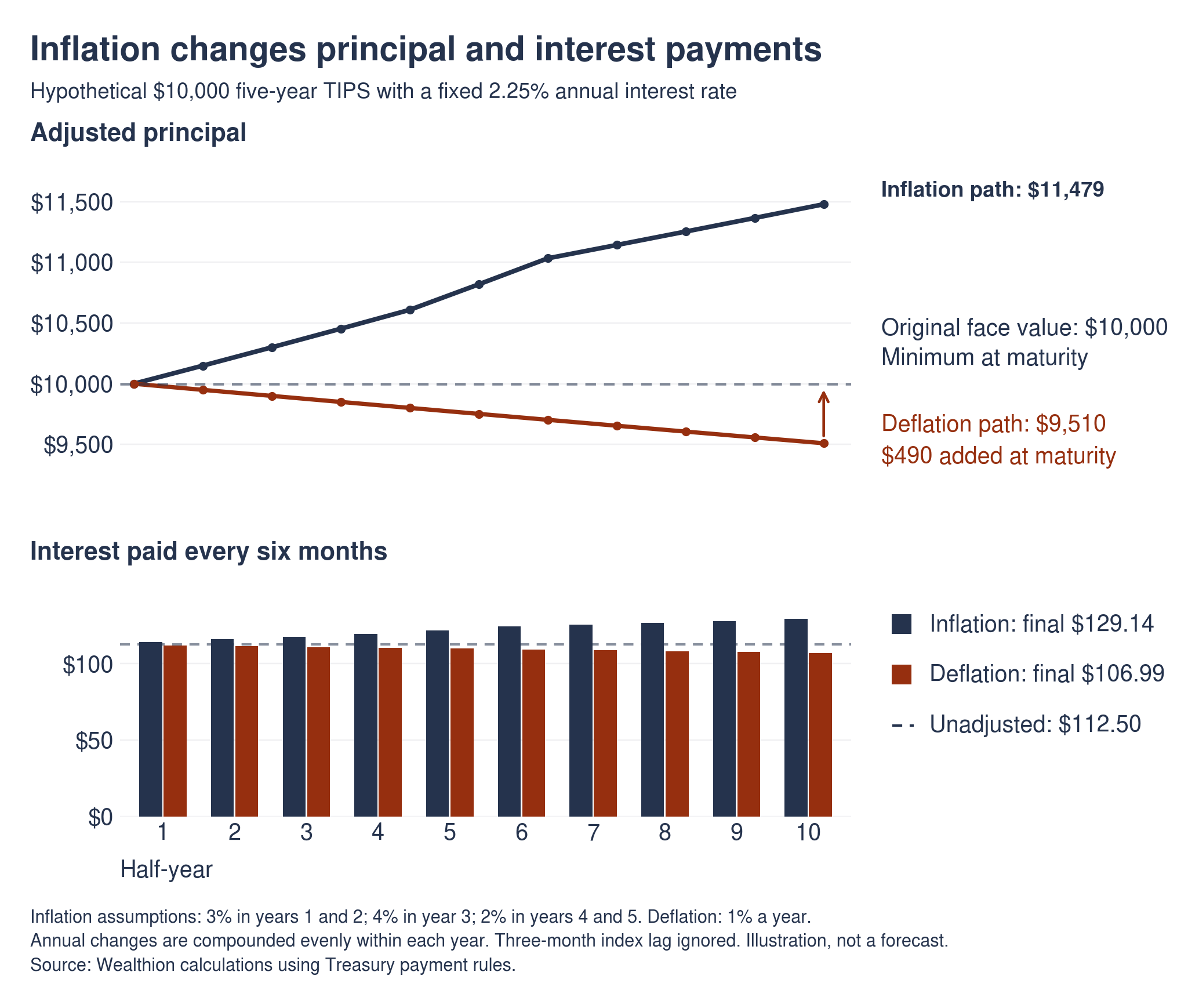
Hypothetical calculations using a 2.25% fixed rate. Annual inflation is compounded evenly within each year; the illustration ignores the three-month index lag. The maturity floor applies to principal, not interest payments.4,3
What happens if prices fall or the bond is sold?
Falling consumer prices reduce adjusted principal. In the illustration’s second path, five years of 1% annual deflation take it to about $9,510. At maturity, Treasury repays the greater of adjusted principal or original face value, also called par. Here, it adds about $490 to restore the $10,000 principal.3
The interest payments receive no matching top-up. Even the final payment uses the reduced principal, leaving it at about $106.99.3
Nor does the floor guarantee the purchase price. Someone who pays more than original par, including accumulated inflation adjustments, can receive less than they paid. The guarantee is tied to the security’s original face value.3
A sale before maturity introduces another moving part: real yields. When buyers can earn higher real yields elsewhere, an existing bond’s price generally falls. For a hypothetical five-year bond with a 2.25% coupon, a rise in real yield from 2.367% to 3.367% reduces its calculated price from about 99.45 to 94.90 per $100 of adjusted principal, roughly 4.6%. This assumes ten remaining semiannual payments and excludes accrued interest and transaction costs.4
Inflation can therefore increase the principal while a rise in real yields reduces the resale price. The maturity floor does not protect an early sale.
Why can tax arrive before the cash?
In a taxable account, the Internal Revenue Service (IRS) generally treats the annual increase in inflation-adjusted principal as original issue discount (OID). It is taxable income even though Treasury has not paid that increase in cash.5
In the first year, an investor buying at par receives about $230 of interest while principal grows by $300. That produces approximately $530 of federal taxable income. At an assumed 24% tax rate, tax is about $127. This simplified example excludes other taxes and purchase-price adjustments.
Inflation adjustments included in income increase the bond’s tax basis, the amount used to calculate a later taxable gain or loss. Deflation adjustments generally offset interest from the same bond, subject to detailed limits; amounts used also affect basis.8
Treasury interest and inflation adjustments are exempt from state and local income taxes.5 Retirement accounts follow different rules: a traditional individual retirement account (IRA) generally defers tax until distributions, while qualified Roth IRA distributions are tax-free.9
How do TIPS compare with other Treasury choices?
A conventional Treasury note fixes its payments in dollars. TIPS link payments to the price index. The yield gap provides an approximate inflation breakeven, the inflation rate at which comparable bonds would deliver similar returns before tax.
On November 5, the five-year nominal Treasury benchmark yielded 4.59%, against 2.33% for TIPS, a gap of 2.26 percentage points.2,10 Inflation above that approximate hurdle generally favors TIPS; lower inflation favors the conventional note, assuming comparable maturities and holding to maturity. The gap also includes inflation-risk and liquidity premiums, so it is not a pure forecast.11
Series I savings bonds handle inflation differently. Their rate combines a fixed component with an inflation component that resets every six months. The combined rate cannot fall below zero. Bonds issued from November 2026 through April 2027 have a 1.40% fixed rate and an annualized 5.51% combined rate for their first six months.12
I bonds have no resale market. Interest accrues monthly, compounds every six months and is paid when the bond is redeemed. They generally cannot be cashed for 12 months; redemption before five years forfeits three months of interest. They earn interest for up to 30 years, and electronic purchases are generally limited to $10,000 per owner per calendar year.13 Federal income tax can generally be deferred until redemption or final maturity.5
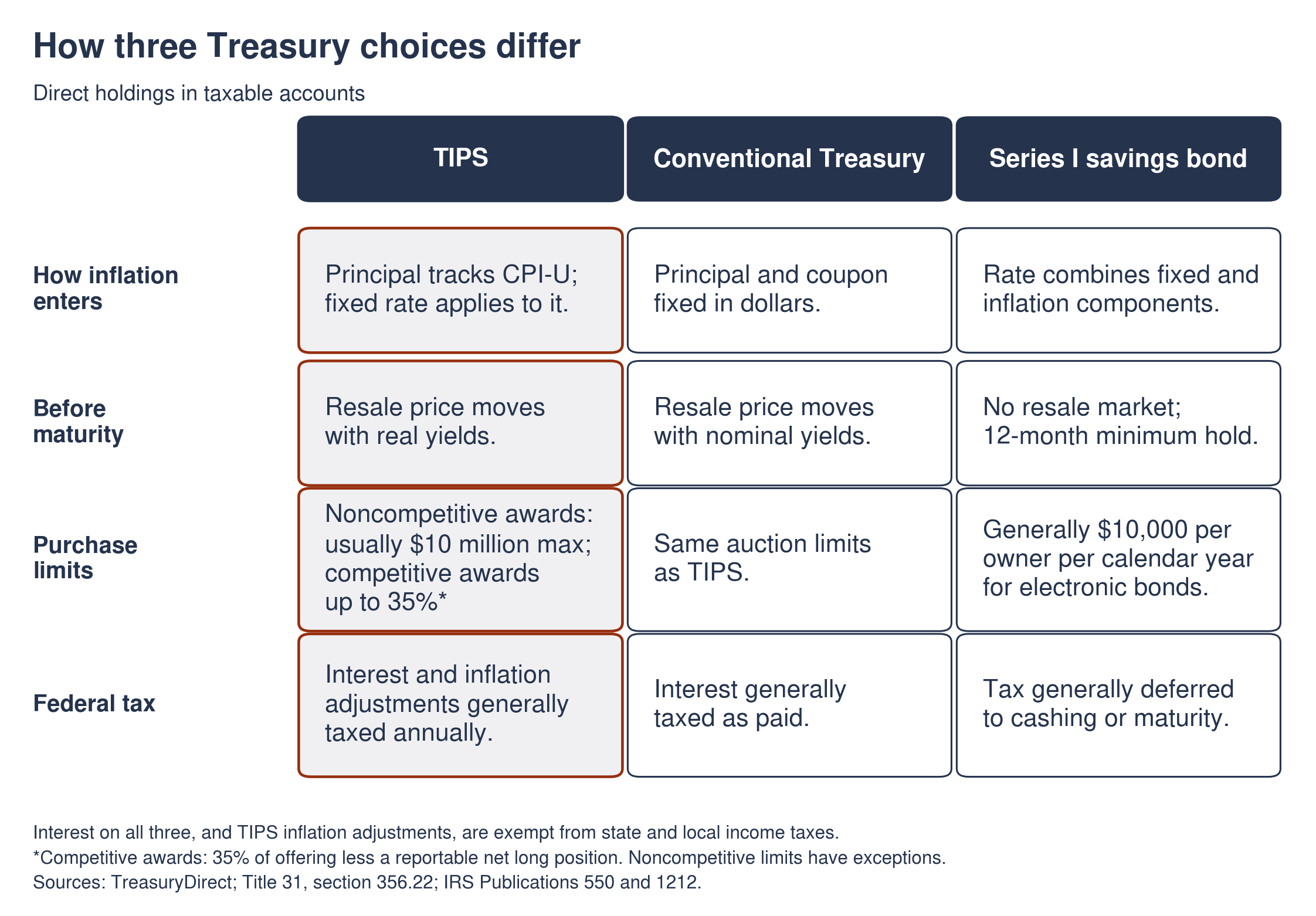
Noncompetitive bidders accept the auction yield; competitive bidders specify a yield. Limits apply per bidder per auction. Competitive awards are reduced by a reportable net long position, an existing position counted toward the limit.1,5,12,13,14,15
What does inflation protection actually cover?
TIPS follow a national price index. A household whose rent, insurance or other costs rise faster receives no extra adjustment for that difference. Taxes can also reduce the purchasing power left after inflation compensation is received.
The protection is specific: Treasury adjusts original principal for CPI-U inflation and repays at least original par at maturity. It does not promise a stable resale price, reimbursement of every purchase premium or protection against every household’s cost increases. That is why an inflation-linked bond and a bond that cannot lose money are different things.
Frequently asked questions
Can TIPS lose money? Yes. An early sale can realize a loss, and the maturity floor protects original par rather than every purchase price.3
Does the interest rate rise with inflation? The rate stays fixed; the principal used to calculate each payment changes.4
What is the index ratio? It compares the reference price index for a given day with its level on the security’s original dated date.4
Are TIPS interest and inflation adjustments taxed by states? They are exempt from state and local income taxes.5
Does an I bond’s initial rate last forever? Its fixed component lasts for the bond’s life; its inflation component changes every six months.12
Sources & Disclosure
1 TreasuryDirect, Treasury Inflation-Protected Securities (TIPS), product terms and inflation adjustment; accessed November 6, 2026. https://www.treasurydirect.gov/marketable-securities/tips/ 2 United States Department of the Treasury, Daily Treasury Par Real Yield Curve Rates, November 5, 2026, five-year benchmark. https://home.treasury.gov/resource-center/data-chart-center/interest-rates/TextView?field_tdr_date_value=2026&type=daily_treasury_real_yield_curve 3 Electronic Code of Federal Regulations, Title 31, section 356.30(b); principal redemption and final interest payment. https://www.ecfr.gov/current/title-31/subtitle-B/chapter-II/subchapter-A/part-356/subpart-D/section-356.30 4 Electronic Code of Federal Regulations, Title 31, Appendix B to Part 356, sections I.B and III; index ratios, payment and pricing formulas. Hypothetical calculations by Wealthion. https://www.ecfr.gov/current/title-31/subtitle-B/chapter-II/subchapter-A/part-356/appendix-Appendix%20B%20to%20Part%20356 5 Internal Revenue Service, Publication 550 (2025), United States Treasury securities, inflation-indexed debt and savings-bond reporting. https://www.irs.gov/publications/p550 6 United States Department of the Treasury, five-year TIPS auction results, October 22, 2026, security 91282CRR4; coupon and real yield. https://www.treasurydirect.gov/instit/annceresult/press/preanre/2026/R_20261022_4.pdf 7 Bureau of Labor Statistics, Consumer Price Index, September 2026, released October 14, 2026; 12-month all-items change. https://www.bls.gov/news.release/archives/cpi_10142026.htm 8 Internal Revenue Service, Publication 1212 (December 2025), Inflation-Indexed Debt Instruments; original issue discount, basis and deflation adjustments. https://www.irs.gov/publications/p1212 9 Internal Revenue Service, Publication 590-B (2025), traditional and Roth individual retirement arrangement distributions. https://www.irs.gov/publications/p590b 10 United States Department of the Treasury, Daily Treasury Par Yield Curve Rates, November 5, 2026, five-year benchmark. https://home.treasury.gov/resource-center/data-chart-center/interest-rates/TextView?field_tdr_date_value=2026&type=daily_treasury_yield_curve 11 Federal Reserve Board, Tips from TIPS: Update and Discussions, May 21, 2019; inflation compensation, inflation-risk premiums and liquidity. https://www.federalreserve.gov/econres/notes/feds-notes/tips-from-tips-update-and-discussions-20190521.html 12 TreasuryDirect, I bonds interest rates; November 2026 to April 2027 rates and rate-setting formula; accessed November 6, 2026. https://www.treasurydirect.gov/savings-bonds/i-bonds/i-bonds-interest-rates/ 13 TreasuryDirect, I bonds and Comparison of TIPS and Series I Savings Bonds; rates, holding terms, taxation and marketability; accessed November 6, 2026. https://www.treasurydirect.gov/savings-bonds/i-bonds/ ; https://www.treasurydirect.gov/research-center/history-of-savings-bond/comparing-tips-to-i/ 14 Electronic Code of Federal Regulations, Title 31, section 356.22; auction award limits. https://www.ecfr.gov/current/title-31/subtitle-B/chapter-II/subchapter-A/part-356/subpart-C/section-356.22 15 TreasuryDirect, Buying a Treasury Marketable Security, noncompetitive and competitive bidding; accessed November 6, 2026. https://www.treasurydirect.gov/marketable-securities/buying-a-marketable-security/
Wealthion is a dba of Greylock Peak Investments, a registered investment adviser. This article is general information only. It is not investment advice or an offer or solicitation, and it is not tailored to your circumstances. Guests’ views are their own and may not reflect those of Wealthion. Wealthion has not verified guest statements, including any performance figures. Investing involves risk, including loss of principal, and past performance does not guarantee future results. Wealthion refers readers to other registered investment advisers and shares in the fees they receive from referred clients, which creates a conflict of interest. Please see our Form ADV Part 2A and consult your own financial advisor before investing.
What Serious Investors Are Watching
Dive into expert interviews, market analysis, and long-form content built to help serious investors think long-term.
Treasury Inflation-Protected Securities (TIPS) Explained: How the Bonds Work
Inflation can push up the amount a bond will eventually repay while its market price...
Why Keith McCullough Is Turning to Treasury Bonds
Keith McCullough connects his concerns about the artificial intelligence investment cycle with a forecast for slowing growth and inflation. The conversation explains his bond outlook, credit risks and approach to changing market signals.
The Credit Market Warning That Could Hit Stocks | Jeff Snider
Jeff Snider explains how tighter lending could reach stocks through the financing behind the artificial intelligence buildout. Andrew Sarna discusses overbuilding risks, market anxiety and his different perspective on bonds.
Enjoyed This? Get More Insights
Expert insights and curated opportunities, delivered to your inbox.
Ready to Position for What's Coming?
Whether you're still learning or ready to act, your next step starts here.
- Independent
- Macro-Informed
- Real Asset Focused


The Wealthion Network
By subscribing, you agree to receive Wealthion emails. Unsubscribe anytime.
The Wealthion Network
By subscribing, you agree to receive Wealthion emails. Unsubscribe anytime.
Network Discussion
Join the Wealthion Network to Comment