

Data-Center Stocks Aren’t One Investment: Operators, Builders and Suppliers Explained
The same data-center project can generate rent for an operator, work for a builder and sales for a supplier. How each earns that revenue helps explain the cost of growth, the risks to profit and the differences behind the share prices.
A company can be called a data-center stock without owning a single data center.
Some own the buildings and rent them out. Some are hired to build them. Others make the equipment that goes inside. One project can bring business to all three, which helps explain why they are so often grouped together.
But follow the money and the differences become clear. The operator earns rent over the life of a lease. The builder earns revenue as construction progresses. The equipment maker earns much of its revenue from products, then needs another sale. Each has a different bill to pay before it can keep a profit.
Who are the operators, builders and suppliers?
The first distinction is what the customer is paying for: a place to put computers, a construction job or the equipment itself.
An operator owns or leases a building and equips it with power, cooling and network connections. Customers rent capacity and connections, generally installing their own computers. At the end of 2025, Equinix's portfolio included 280 data centers and Digital Realty's 310, including facilities held through joint ventures 1, 2. Builders construct or fit out these facilities; suppliers provide the equipment.
| What they do | How they earn revenue | Examples (ticker) | |
|---|---|---|---|
| Operators | Run facilities with space, power and connections | Rent and recurring service fees | Equinix (EQIX), Digital Realty (DLR) |
| Builders | Prepare sites and construct or fit out facilities | Construction revenue as work progresses | EMCOR (EME), Comfort Systems USA (FIX), Quanta Services (PWR), Sterling Infrastructure (STRL) |
| Suppliers | Provide power, cooling and computing equipment | Product sales and services; payment terms vary | Vertiv (VRT), Eaton (ETN), Nvidia (NVDA) |
Examples illustrate business models, not recommendations. Several builders and suppliers also serve other markets.
Who are their customers?
Large technology companies connect the three groups, but customer dependence varies widely.
Amazon, Alphabet, Microsoft and Meta operate large online and artificial intelligence (AI) services that need computing capacity. They develop their own data centers and lease additional capacity. Construction and equipment orders flow through that expansion, although the buying arrangements differ from project to project.
Together, their announced 2026 capital-spending plans total roughly $720 billion to $740 billion 3. That is company-wide spending, not a measure of AI or data-center investment alone, and the companies treat leases differently. Nor does every operator depend heavily on these four buyers: Equinix's largest customer provided about 3% of its 2025 recurring revenue 1. The technology companies also own data centers, but their broader businesses make them different from the specialist operators compared here.
How does an operator earn money?
Rent can continue for years. Creating the capacity to earn it can require substantial money upfront.
Think of an operator as a landlord for computers. Once a customer moves in, a lease can produce revenue month after month. Recurring services generated about 95% of Equinix's 2025 revenue, calculated from its reported dollars 1. At September 30, 2026, Digital Realty's leases had a weighted-average 4.4 years remaining, and 91.1% of its operating computing capacity was occupied, measured by power capacity rather than floor space 4. Contracts give revenue continuity; they do not guarantee profit or renewal.
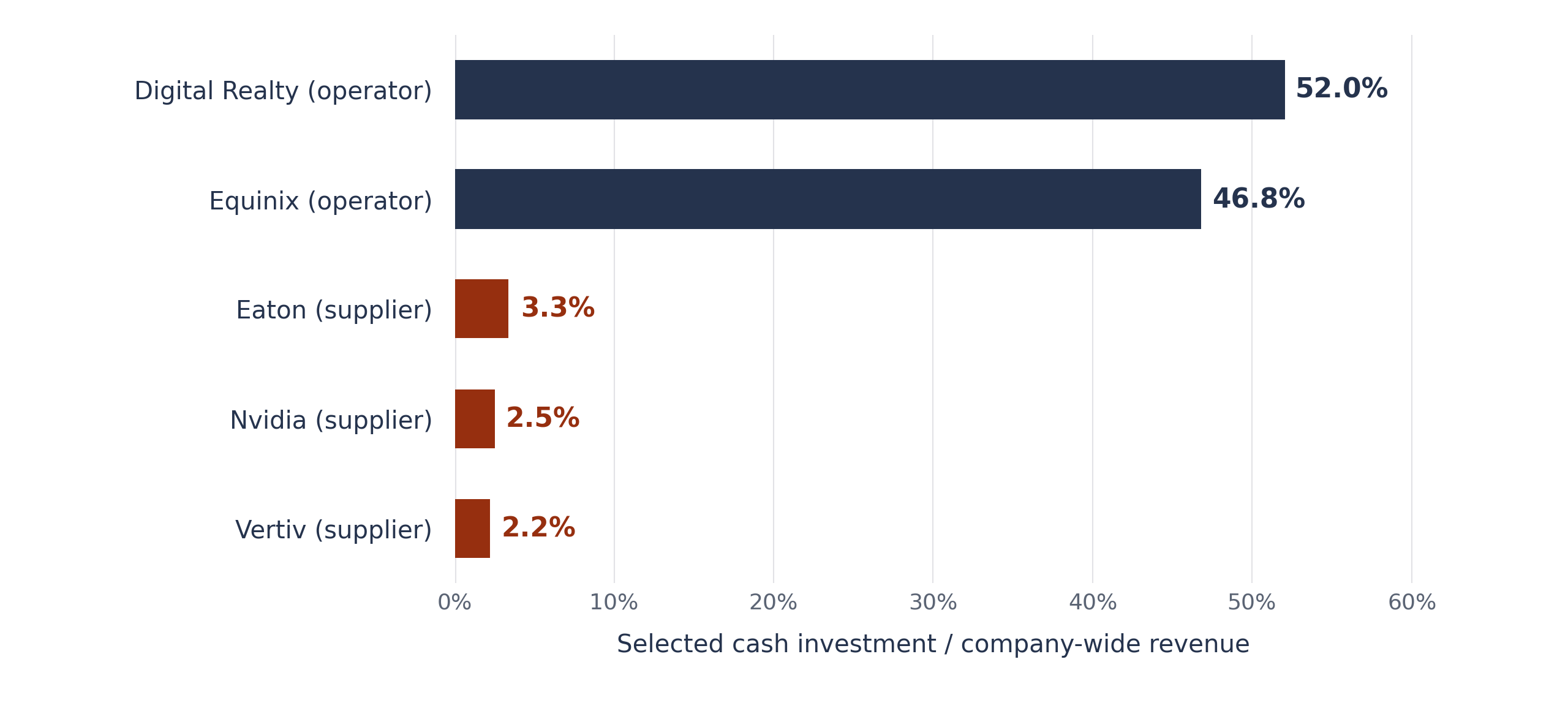
Expansion creates a timing gap. New capacity may need to be built and equipped long before rent starts. In 2025, cash spending on real estate improvements equaled 52% of Digital Realty's revenue. Equinix's purchases of other property, plant and equipment equaled 47%, its highest share in 2020–2025; that measure excludes real estate acquisitions 2, 1, 5. Each reported more than $18 billion of debt at year-end 2, 1. Digital Realty's new leases signed in the third quarter of 2026 had a weighted-average 17-month wait until contractual commencement 4. Operating cash, new equity and borrowing can all help fund that gap.
The financial measures answer different questions. Occupancy shows how much operating capacity is in use; signed leases indicate future contracted rent. Operators also report adjusted funds from operations (AFFO) per share, which adjusts accounting profit for items such as depreciation and deducts recurring maintenance spending. Companies define it differently. It is neither a dividend nor cash left after all expansion spending. Digital Realty's diluted AFFO per share rose from $5.82 in 2020 to $6.55 in 2025; Equinix's rose from $24.76 to $38.33 6, 5.
How does a builder earn money?
For a builder, the gap is between the contract price and the cost of completing the work.
People matter enormously to that calculation. Quanta had about 69,500 employees at the end of 2025, compared with 4,282 at Digital Realty 7, 2. Contractors also need equipment and money to cover payroll and materials while awaiting payment. A contract adds work to the schedule; revenue is generally recorded as construction advances. Sterling says projects in its E-Infrastructure segment, which includes data centers and factories, typically span 6 to 24 months 8.
Margins show how little room some builders have for surprises. EMCOR's reported operating margin was 10.1% in 2025, including a $144.9 million gain on selling its United Kingdom operations. Quanta's was 5.7%. Both are company-wide figures, not data-center project margins 9, 7. Fixed-price contracts generated 60.6% of Quanta's 2025 revenue 7. On those jobs, unrecovered overruns reduce the builder's profit.
A hypothetical job makes the risk clearer. Suppose a fixed-price contract pays $100 million and the estimated costs charged to that job are $95 million. That leaves $5 million before other company costs, interest and tax. If unrecovered costs rise by $3 million while the price stays fixed, that amount falls to $2 million, a 60% drop. The revenue is unchanged; the cushion has shrunk.
Backlog describes work still ahead, although definitions differ. EMCOR reported $18.57 billion of remaining performance obligations, or contracted revenue not yet recognized, at September 30, 2026 10. That is potential future revenue, not profit already earned. Margin shows how much revenue survives operating costs; cash collection shows whether recorded revenue has turned into money received.
How does a supplier earn money?
The supplier earns revenue from equipment sales, often with services alongside them.
A power system or cooling unit can be a large sale, but selling one does not create a lease on the customer's building. Products accounted for 82% of Vertiv's 2025 revenue, with services making up the rest 11. Nvidia's Data Center business accounted for 88% of its revenue in the fiscal year ended January 26, 2025 12. New product sales matter, while maintenance and other service agreements can add ongoing revenue.
The economics also depend on what is being supplied. Vertiv and Eaton make power and cooling equipment. Nvidia designs chips and relies on outside manufacturers. The selected cash-investment measures in the chart ranged from 2.2% to 3.3% of their revenue, excluding acquisitions 11, 13, 12. That does not make the remaining revenue profit: components, staff and research still cost money, and outsourced factories require investment elsewhere. Vertiv's reported operating margin rose from 4.9% in 2020 to 17.9% in 2025; Nvidia's was 62.4% in its fiscal year ended January 2025 14, 11, 12. Nvidia's margin is a company-specific result, not a norm for equipment suppliers.
The selected operators spent more relative to revenue
Selected cash investment as a share of company-wide revenue, fiscal 2025. Nvidia's year ended January 26, 2025. Measures differ and exclude acquisitions; research expense is not included. Wealthion calculations from company filings 2, 1, 13, 12, 11.
Orders show the next wave of demand, but not every order is equally firm. Eaton reported about $26.2 billion of firm backlog at September 30, 2026, with approximately 72% targeted for delivery within 12 months 15. Vertiv's organic orders more than doubled in the third quarter from a year earlier 16. Its filing also warns that orders can be canceled or rescheduled 11. A larger order book is evidence of demand, not a guarantee of future sales.
Is there a fourth type?
AI cloud providers add another model: renting computing power rather than space.
CoreWeave and Nebius acquire chips and servers and put them in data centers, including leased facilities; Nebius is also expanding sites it owns 17, 18. They sell access to computing capacity, making them customers of other parts of the chain. CoreWeave's committed contracts had a weighted-average duration of about five years at the end of 2025. Their take-or-pay terms require payment for committed capacity whether or not it is used 17. Contracted revenue, however, is only one side of the business.
The other side is funding the equipment. CoreWeave's November 2026 guidance called for full-year revenue of $13.0 billion to $13.3 billion and capital spending of $37 billion to $39 billion. At September 30 it reported about $46.9 billion of recourse and non-recourse debt, excluding lease liabilities; its third-quarter net loss was $709 million 19. Microsoft supplied about 67% of its 2025 revenue 17. Nebius expected 2026 revenue at the low end of its $3.0 billion to $3.4 billion range and approximately $27 billion of capital spending 18. These are company forecasts. Customer prepayments can help fund expansion 18. But equipment can lose economic value as technology advances, and contracted sales do not remove funding or customer-concentration risk.
How do the three compare?
For the three core groups, the useful comparison is how revenue is earned and what must be funded before it arrives.
| Operators | Builders | Suppliers | |
|---|---|---|---|
| Paid for | Space, power and services | Construction and related work | Equipment and services |
| Revenue continuity | Rent across the lease term; Digital Realty averaged 4.4 years remaining at September 2026 4 | Projects end, though customers can award more work; Sterling's E-Infrastructure projects typically span 6–24 months 8 | Product orders end; maintenance and other services can continue 11 |
| Capital required | Selected cash investment equaled 47%–52% of 2025 revenue 1, 2 | Workforce, equipment and cash to fund work before collection | Selected cash investment equaled 2.2%–3.3% of revenue; research and outsourced production add other costs 11, 13, 12 |
| Important costs | Buildings, power and financing | Labor, materials and equipment | Components, manufacturing and research |
| Pressure points | Power, occupancy and funding 1, 2 | Execution, pricing and payment delays | Orders and customer dependence. Two of Nvidia's direct customers provided 22% and 14% of revenue in fiscal 2026, ended January 25, 2026 20 |
| What the measures explain | Occupancy: capacity in use. AFFO per share: adjusted recurring performance | Backlog: future work. Margin: profitability. Collections: cash received | Orders: demand. Backlog: unfilled business. Margin: profitability |
Capital-spending figures cover the selected companies' whole businesses, not data-center divisions alone. Product sales, service contracts and project terms vary by company.
How has each behaved when spending slowed?
A historical slowdown helps show how these differences can matter. The dot-com and telecom buildout around 2000 tested operators, contractors and equipment makers alike.
| Company | What happened | |
|---|---|---|
| Operator | Equinix | Lost $188 million on $63 million of revenue in 2001. In 2002 it exchanged about $170 million of debt for shares and cash and completed a one-for-32 reverse stock split. Another operator, Exodus, filed for bankruptcy in September 2001 21, 22, 23 |
| Builder | Quanta Services | Revenue fell 13% from 2001 to 2002. Operating profit of $222 million in 2000 became a $159 million operating loss in 2002, including a $166.6 million goodwill impairment, a write-down of acquired-business value 24 |
| Supplier | Cisco Systems | Quarterly revenue fell 36%, from $6.75 billion in January 2001 to $4.30 billion in July. Cisco recorded a $2.25 billion excess-inventory charge in its third fiscal quarter of 2001 25 |
In these examples, financial strain appeared in operator debt, contractor earnings and supplier inventory. Those pressures can overlap. The comparison also has limits: Equinix was then a young company with only $63 million in annual revenue. Today's companies, customers and funding arrangements differ. This history illustrates mechanisms, not a forecast for the current buildout.
Have their shares moved together?
A shared source of demand has produced very different shareholder returns.
Over the five years from December 31, 2020 to December 31, 2025, $100 invested in the S&P 500 index grew to about $196, with dividends reinvested. The same starting amount grew to $591 in Quanta and $1,646 in Sterling, both builders. It reached $872 in Vertiv, a supplier, and $132 in Digital Realty, an operator 7, 8, 11, 2.
These are selected companies, not averages for their groups, and one five-year period cannot establish a lasting advantage. The difference between the two builders is itself a reminder that a business label cannot explain everything. Past performance does not guarantee future results.
What does this mean for investors?
The data-center label tells us where demand comes from. It tells us much less about how that demand becomes profit.
An occupied building, an unfinished contract and an equipment order represent different claims on future revenue. The operator must fund capacity before collecting rent. The contractor must deliver the job within its cost estimate and collect payment. The supplier must turn orders into profitable sales. AI cloud providers add another combination: contracted computing revenue alongside heavy equipment investment.
That is why the same spending boom can produce such different financial results. The story starts with another data center. What happens to the money depends on the business behind the stock. We are not making any recommendations.
Frequently asked questions
Is Nvidia a data-center stock? Its Data Center business provided 88% of revenue in the fiscal year ended January 26, 2025. It supplies computing and networking technology rather than renting space, so it fits the supplier category here 12.
Are data-center companies in the S&P 500? Several are. Equinix joined in 2015, Digital Realty in 2016, EMCOR and Comfort Systems USA in 2025, and Vertiv in March 2026 26. Index-tracking funds can therefore provide exposure to these businesses, although holdings depend on the fund and date.
Sources & Disclosure
1 Equinix, Form 10-K for 2025, filed February 11, 2026; portfolio including joint ventures, recurring and total revenue, customer concentration, cash purchases of property, plant and equipment, debt, funding and risks. Recurring share calculated by Wealthion: $8.739 billion / $9.217 billion = 94.8%. 2 Digital Realty Trust, Form 10-K for 2025, filed February 13, 2026; portfolio including unconsolidated entities, employees, funding, debt and total-return table. Cash investment uses $3.181179 billion of improvements to real estate / $6.112692 billion of revenue, including indirect costs; its separate capital-expenditure table excludes indirect costs. 3 Amazon, Third Quarter 2026 Results, October 29, 2026 ($220 billion cash capital spending); Alphabet, 2026 Q3 Earnings Call ($195 billion–$205 billion); Microsoft, Fiscal 2027 First Quarter Earnings Conference Call (approximately $170 billion for calendar 2026, including finance leases recognized at commencement); Meta, Third Quarter 2026 Results, October 21, 2026 ($135 billion–$145 billion, including principal payments on finance leases). Wealthion sum: $720 billion–$740 billion. Definitions and lease treatments differ; all figures are company-wide forecasts. 4 Digital Realty, Third Quarter 2026 Financial Supplement, October 29, 2026, pp. 5–7; 4.4-year remaining lease term weighted by annualized recurring revenue; 91.1% occupancy measured by IT-load power capacity, excluding development; 17-month weighted-average contractual commencement lag for new leases signed that quarter. 5 Equinix, Fourth Quarter/Full Year 2020 and 2025 Results; diluted AFFO per share of $24.76 and $38.33 and non-GAAP reconciliation. Forms 10-K for 2022 and 2025 provide 2020–2025 revenue and cash purchases of other property, plant and equipment, excluding real estate acquisitions; Wealthion ratio comparison. 6 Digital Realty, Fourth Quarter 2021 Results (2020 comparative) and Fourth Quarter 2025 Financial Supplement; diluted AFFO per share/unit of $5.82 and $6.55, and non-GAAP reconciliation. 7 Quanta Services, Form 10-K for 2025, filed February 19, 2026; workforce, fleet, fixed-price revenue share, operating income and revenue, construction accounting, collection risks and stock-performance table. 8 Sterling Infrastructure, Form 10-K for 2025, filed February 26, 2026; E-Infrastructure project duration and December 31, 2020–December 31, 2025 total-return table. 9 EMCOR Group, Form 10-K for 2025, filed February 26, 2026; reported 10.1% operating margin includes a $144.876 million gain on sale of UK operations. Figures are company-wide. 10 EMCOR Group, Form 10-Q for the quarter ended September 30, 2026; $18.572631 billion of remaining performance obligations, definition and revenue-recognition terms. 11 Vertiv Holdings, Form 10-K for 2025, filed February 13, 2026; product/service revenue, operating profit, backlog conditions and total-return table. Wealthion calculations: products $8,390.6 million / revenue $10,229.9 million = 82.0%; operating profit $1,829.7 million / revenue = 17.9%; capital expenditures including capitalized software $226.4 million / revenue = 2.2%. 12 Nvidia, Form 10-K for the fiscal year ended January 26, 2025, filed February 26, 2025; Data Center revenue $115.186 billion, total revenue $130.497 billion, operating income $81.453 billion and cash purchases related to property, equipment and intangible assets $3.236 billion. Wealthion calculations: 88.3%, 62.4% and 2.5%, respectively; fabless manufacturing model. 13 Eaton, Form 10-K for 2025, filed February 26, 2026; company-wide revenue $27.448 billion and cash capital expenditures for property, plant and equipment $919 million. Wealthion calculation: 3.3%, excluding acquisitions. 14 Vertiv, Form 10-K for 2022, consolidated statements of earnings (loss), 2020 comparative; operating profit $213.5 million / net sales $4,370.6 million = 4.9% (Wealthion calculation). 15 Eaton, Form 10-Q for the quarter ended September 30, 2026, filed November 3, 2026; approximately $26.2 billion of firm backlog, approximately 72% targeted for delivery within 12 months. 16 Vertiv, Third Quarter 2026 Results, October 28, 2026; organic orders growth over 100% year over year. 17 CoreWeave, Form 10-K for 2025, filed March 2, 2026; leased facilities, committed take-or-pay contracts, approximately five-year weighted-average contract duration and Microsoft's approximately 67% revenue share. 18 Nebius Group, Q3 2026 Letter to Shareholders, November 12, 2026; owned-site expansion, colocation, customer prepayments, updated 2026 revenue guidance at the low end of $3.0 billion–$3.4 billion and approximately $27 billion of capital expenditures. Company forecasts, not realized results. 19 CoreWeave, Third Quarter 2026 Results, November 10, 2026; full-year revenue and capital-spending guidance, $709 million third-quarter net loss and September 30 balance sheet. Wealthion debt sum: current and non-current recourse and non-recourse debt of $9.183 billion + $1.389 billion + $32.417 billion + $3.884 billion = $46.873 billion, excluding lease liabilities. 20 Nvidia, Form 10-K for the fiscal year ended January 25, 2026, filed February 25, 2026; two direct customers represented 22% and 14% of revenue. Direct customers may distribute products to end users; these shares are not disclosed end-user concentration. 21 Equinix, Form 10-K405 for 2001, filed March 25, 2002; revenue $63.414 million and net loss $188.415 million. 22 Equinix, Form 10-K for 2003, filed March 5, 2004, note 6; 2002 principal exchanged of $52.751 million plus $116.774 million, and one-for-32 reverse split effective December 31, 2002. 23 Exodus Communications, Financial Restructuring announcement, Form 8-K Exhibit 99.01, September 27, 2001; Chapter 11 petitions filed September 26, 2001. 24 Quanta Services, Form 10-K for 2004, filed March 16, 2005, selected financial data; 2001–2002 revenue decline of 13.1% (Wealthion calculation), 2000 operating profit, 2002 operating loss and $166.580 million goodwill impairment. 25 Cisco Systems, 2001 Form 10-K Exhibit 13 annual report, quarterly data and inventory discussion; quarterly sales $6.748 billion (January 27) to $4.298 billion (July 28), down 36.3% (Wealthion calculation); $2.25 billion third-quarter inventory charge, partly offset by a $187 million fourth-quarter benefit. 26 S&P Dow Jones Indices, S&P 500 constituent-change announcements dated March 13, 2015 (Equinix); May 13, 2016 (Digital Realty); September 5, 2025 (EMCOR); December 5, 2025 (Comfort Systems USA); and March 6, 2026 (Vertiv). Entry months reflect the announcements' effective dates.
Wealthion is a dba of Greylock Peak Investments, a registered investment adviser. This article is general information only. It is not investment advice or an offer or solicitation, and it is not tailored to your circumstances. Guests’ views are their own and may not reflect those of Wealthion. Wealthion has not verified guest statements, including any performance figures. Investing involves risk, including loss of principal, and past performance does not guarantee future results. Wealthion refers readers to other registered investment advisers and shares in the fees they receive from referred clients, which creates a conflict of interest. Please see our Form ADV Part 2A and consult your own financial advisor before investing.
What Serious Investors Are Watching
Dive into expert interviews, market analysis, and long-form content built to help serious investors think long-term.
Data-Center Stocks Aren’t One Investment: Operators, Builders and Suppliers Explained
The same data-center project can generate rent for an operator, work for a builder and...
Data-Center Construction Companies: Backlogs, Margins and Execution Risk
The contractors that build data centers report in a language of their own: backlog, margin,...

Growth vs Value Investing: Which Works Better, and When?
Growth looks for expanding businesses. Value looks for lower prices relative to earnings or assets....
Enjoyed This? Get More Insights
Expert insights and curated opportunities, delivered to your inbox.
Ready to Position for What's Coming?
Whether you're still learning or ready to act, your next step starts here.
- Independent
- Macro-Informed
- Real Asset Focused


The Wealthion Network
By subscribing, you agree to receive Wealthion emails. Unsubscribe anytime.
The Wealthion Network
By subscribing, you agree to receive Wealthion emails. Unsubscribe anytime.
Network Discussion
Join the Wealthion Network to Comment