

Data-Center Construction Companies: Backlogs, Margins and Execution Risk
The contractors that build data centers report in a language of their own: backlog, margin, billings and estimates. Here's how the business works and what each of those numbers measures.
A new data-center contract can sound like money already made. For the contractor, it's work still to do. Crews must be paid, systems installed and the customer billed. How much the company earns depends on what delivering the job costs. When it gets paid is another question.
That difference matters for investors in construction businesses. A large order book can point to future activity, while changing cost estimates alter reported profit and payment terms change the cash coming in. The work, the earnings and the cash can move on different schedules.
What do these contractors actually build?
We selected these four publicly traded contractors to show different parts of data-center construction, from preparing a site and connecting power to installing electrical and mechanical systems. They are examples, not an exhaustive industry list or a ranking of the best stocks. They also serve other industries. Their company-wide order books are not measures of artificial intelligence (AI) demand alone.
| Company (ticker) | Work connected with data centers | Future-work figure |
|---|---|---|
| EMCOR Group (EME) | Electrical and mechanical construction; facilities services | $18.57 billion in remaining performance obligations 1 |
| Comfort Systems USA (FIX) | Mechanical and electrical systems; off-site modular construction | $17.81 billion in backlog 2,3 |
| Quanta Services (PWR) | Power, grid and facility infrastructure | $63.7 billion in total backlog 4 |
| Sterling Infrastructure (STRL) | Large-scale site development and mission-critical electrical work | $4.14 billion in backlog 5 |
Company-wide figures at September 30, 2026, using each company's published precision and definitions. These are different measures of future work, not cash received or data-center-only revenue 1,2,4,5. Sterling's combined backlog, used in the chart below, also includes unsigned awards.
How do they make money?
By doing each job for less than the customer pays for it.
A job follows a set sequence. The builder wins a contract, the work joins its backlog, crews do the work and the builder bills the customer as it goes. Sterling says its data center and factory projects typically take 6 to 24 months 6.
The type of contract determines who carries the risk. A fixed-price contract sets what the customer pays for the agreed work. If wages, materials or the hours needed run over budget, the contractor can lose profit unless it recovers those costs through an agreed change in price or scope. Cost-plus arrangements reimburse agreed costs and add a fee or margin. They can reduce unrecovered overrun risk, although caps and contract terms matter. At Quanta, 60.6% of 2025 revenue came from fixed-price contracts, 23.8% from contracts that set a price per unit of work and 15.6% from cost-plus 7.
The profit left over is small. Across its whole business, EMCOR kept about 10 cents of operating profit from each dollar of revenue in 2025, and Quanta under 6 cents 8,7. With a margin that thin, a modest cost overrun on a fixed-price job can remove much of its profit.
What do orders and backlog show?
Backlog describes future work under each company's definition. It can include awarded contracts and estimates of future orders. It shows demand, not profit.
Contractor backlogs grew 47% to 90% in a year
Wealthion chart. Growth in reported backlog and remaining performance obligations, September 30, 2025 to September 30, 2026 9,5,4,10.
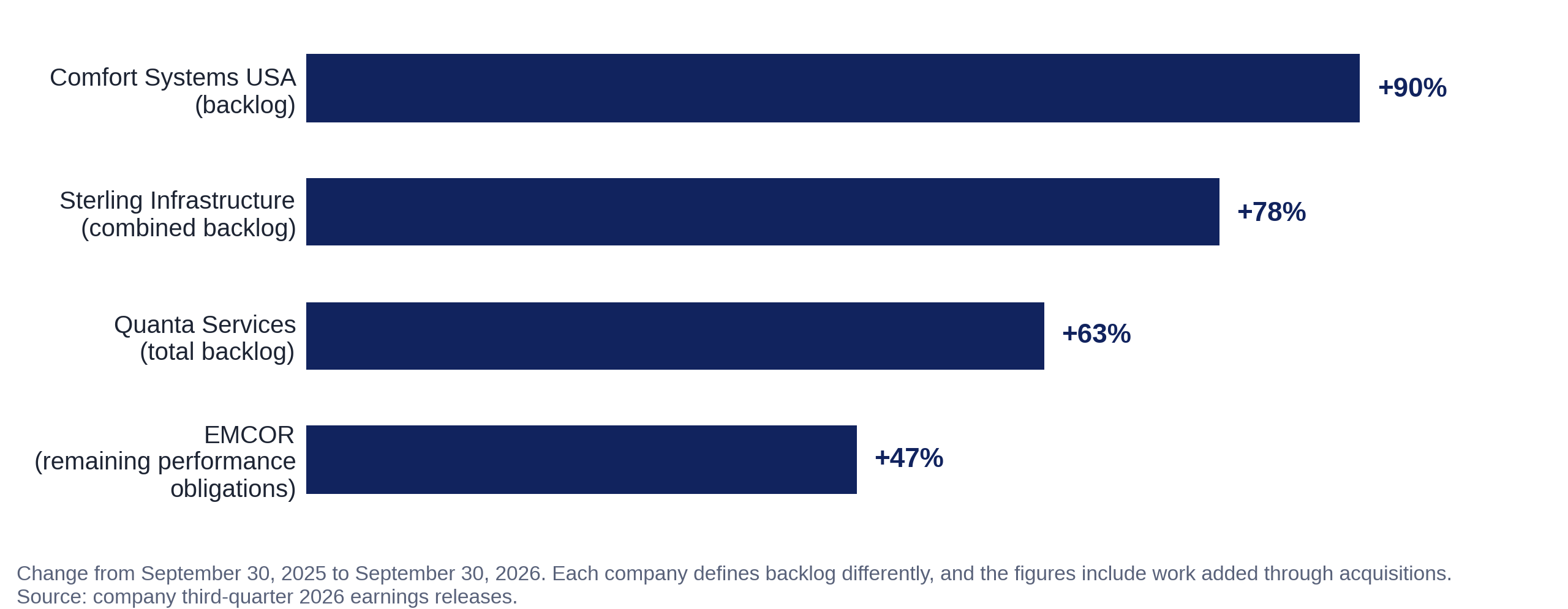
Each percentage is growth over 12 months. Comfort Systems, for example, had $9.38 billion of work won but not yet done in September 2025 and $17.81 billion a year later, an increase of 90% 9.
Three cautions apply. First, companies count backlog differently. EMCOR counts awarded work that it believes is firm 1. Sterling's $6.14 billion combined backlog includes $2.00 billion of awards it hasn't yet signed. About a third of Quanta's $63.7 billion consists of estimated orders under service agreements and certain short-term, non-fixed-price contracts 5,4.
Second, part of the growth comes from buying other companies, not from winning more work. When a builder acquires another contractor, that contractor's sales and orders are added to its own. Sterling's revenue rose 127% in the third quarter of 2026, with 70% organic growth, according to the company 5.
Third, orders aren't guaranteed. A contract can be delayed or canceled before the work is done. EMCOR says cancellations haven't had a material effect on it 1.
When does a job become revenue?
Gradually, as the work is done, and based on the builder's own estimate of the total cost.
All four companies use the cost-to-cost method for relevant construction contracts 8,3,7,6. Costs incurred so far are divided by the estimated total job cost. That percentage determines how much contract revenue is recorded. A job that has used half its expected costs is treated as half done.
That makes reported revenue depend on estimates. Changes in those estimates are recorded in the current quarter, including their cumulative effect on work already performed. Comfort Systems said such revisions added 6.6% to its revenue in the first nine months of 2026, against 4.6% a year earlier 2. Upward revisions can reflect better performance or reduced expected costs. Downward revisions can reveal problems with costs or execution.
Are margins rising, and is that because of data centers?
Comfort Systems, Sterling and EMCOR have reported large margin increases as their data-center-related businesses have grown. The filings don't prove one caused the other.
Operating margin is operating profit as a share of revenue. For much of 2015 to 2022, EMCOR, Comfort Systems and Quanta kept between about 3 and 7 cents of each dollar 11. Since 2022, three of the four have kept much more.
| Company | Operating margin, 2022 to 2025 | Link to data centers |
|---|---|---|
| Comfort Systems USA | 6.1% to 14.4% | Technology customers, where it says data center demand is especially strong, were 60.8% of third-quarter 2026 revenue, up from 45.8% a year earlier 2 |
| Sterling Infrastructure | 9.0% to 16.3% | Its segment serving data centers and factories was 83% of third-quarter 2026 revenue and earned a 22.6% margin, against 19.6% for the whole company 5 |
| EMCOR Group | 5.1% to 10.1% | Network and communications work, driven mainly by data centers, was 56% of electrical and 38% of mechanical construction revenue in the third quarter of 2026 1 |
| Quanta Services | 5.1% to 5.7% | Doesn't report data-center-only revenue. Most of its work is for utilities and power companies 12 |
Margins are calculated from each company's annual filings 11. EMCOR's 2025 margin includes a gain on selling its United Kingdom business that added 0.85 percentage point 8. These are reported margins, not comparisons of an unchanged set of businesses.
None of the four reports a margin for data center work alone, so the link is a pattern and not a proven cause. The filings also cannot tell us whether today's margins are a new normal or a high point.
Do profits turn into cash?
For Comfort Systems, more than fully. For EMCOR, nearly fully.
Cash conversion compares net cash generated by operations with reported profit. In the first nine months of 2026, Comfort Systems reported net income of $1.30 billion and generated $2.54 billion of operating cash flow. EMCOR reported $1.11 billion and generated $1.09 billion 9,10. Customer advances helped Comfort's cash flow. Its contract liabilities, which include customer advances and billings ahead of recognized revenue, rose from $2.12 billion to $3.87 billion in nine months. That balance is not a measure of cash collected 2,9.
Advance cash supports construction, but comes with work still to deliver. If new orders slowed, the builder could be completing work it had already been paid for, and cash flow could fall behind profit. Other receipts and operating payments also affect the result.
What limits growth?
Skilled labor is one of the main limits. A builder can only take on the work it has crews to do.
A builder's main asset is its people. Quanta had about 69,500 employees at the end of 2025, up from 52,500 two years earlier 7,13. In a 2026 survey of 401 industry leaders by Turner & Townsend, a construction consultancy, 81% said skilled labor in their region was constrained 14. Buying another contractor is one way to add crews: Quanta completed eight acquisitions in 2025 and EMCOR 11 in the first ten months of 2026 7,1.
Is there a tailwind?
Yes. Customer spending plans are at record levels, and much of that spending comes from a small number of buyers.
Amazon, Alphabet, Microsoft and Meta have guided to roughly $720 billion to $740 billion of capital spending in 2026 between them, using each company's definition. Their treatment of leases differs 15. Only part of that is construction, since much of it buys chips and servers. The Census Bureau's preliminary estimate put private data center construction in the United States at a seasonally adjusted annual rate of $96.5 billion in September 2026, up 90% in a year 16.
That demand is also a dependence. Comfort Systems' largest customer was 12.8% of its 2025 revenue 3. EMCOR tells investors that a fall in data center spending could reduce demand for its services 8. Amazon's latest filing, for example, shows higher borrowing alongside increased technology-infrastructure spending 17.
Is this a cyclical business?
Yes. Builders' results follow their customers' spending, in both directions.
The clearest example is the telecommunications boom around 2000. Telecommunications and cable customers made up about 44% of Quanta's revenue in 2001, on the company's own combined figures 18. When those customers cut spending, Quanta's revenue fell 13% from its 2001 peak of $2.01 billion. Its profit and its share price fell much further.
| Quanta Services | 2000 | 2002 |
|---|---|---|
| Revenue | $1.79 billion | $1.75 billion |
| Operating result | Profit of $222 million | Loss of $159 million |
| Share price range during the year | $18.00 to $63.13 | $1.75 to $18.90 |
From Quanta's Form 10-K filings for fiscal 2001, 2002 and 2004 18,19,20. The 2002 operating loss includes a $167 million write-down of acquired businesses; without it, the company roughly broke even at the operating level.
Today's buildout has different customers and funding, so this isn't a forecast. It shows how the business behaves: revenue can hold up while profit falls, and share prices can move much further than either.
Do strong results mean strong returns?
Not necessarily. A share price reflects what investors expect, not only what a company has earned.
From 2020 to 2025, Quanta's operating profit grew to 2.6 times its starting level. Over the same five years, $100 invested in its shares grew to $591, with dividends reinvested. Sterling's operating profit grew to 4.3 times its starting level, and $100 in its shares grew to $1,646. The same $100 in the S&P 500 index grew to $196 21,7,6.
At two contractors, shareholder returns outpaced profit growth
Wealthion chart. Growth in operating profit and in the value of shares with dividends reinvested, 2020 to 2025, as multiples of the 2020 level 21,7,6. Operating profit uses the figures originally reported for 2020 and 2025. Acquisitions, disposals and accounting changes affect comparisons over time.
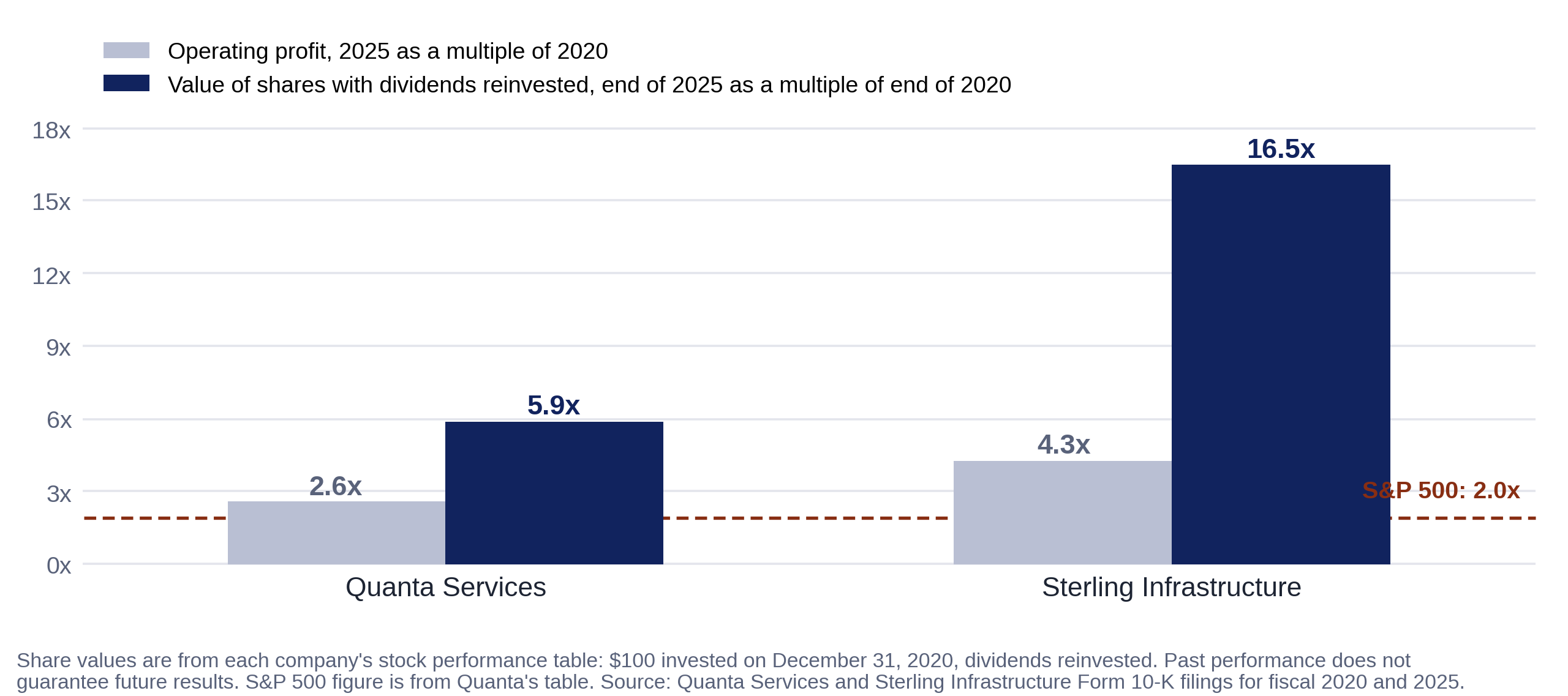
The chart shows that shareholder returns outpaced growth in total operating profit. It does not measure how much investors paid per dollar of earnings, because it uses total operating profit rather than earnings per share. Future returns depend on how results compare with what is already expected, which is why a record quarter and a falling share price can arrive together.
What does this mean for investors?
These companies are worth understanding, because their results are one of the first places AI spending shows up.
Many investors already own them: EMCOR and Comfort Systems both joined the S&P 500 in late 2025, so funds that track the index hold both 22. Four things in their results say the most. What a backlog figure includes, and how much of its growth was acquired. Whether margins are rising across the business or only in parts of it. Whether cash is running ahead of profit because of customer advances. And how much of the work depends on a few large customers continuing to spend. A fifth sits outside the results: how much of all this the share price already expects.
Backlog shows expected work. Margins show how profitably it is being done, while cash flow also reflects payment timing. The share price shows how much of that investors already expect.
Frequently asked questions
Is backlog the same as revenue? No. It describes future work under the company's definition. Revenue enters the accounts as the relevant work is performed. Estimated service-agreement orders may also sit in backlog before they become firm project orders 1,4.
What is a fixed-price contract? One where the builder agrees a price in advance and keeps what is left after its costs. If costs rise, the builder's profit falls 7.
Sources & Disclosure
1 EMCOR Group, Inc., Form 10-Q, quarter ended September 30, 2026, filed October 29, 2026. Note 3 and Management's Discussion and Analysis: construction/services, revenue by market sector, remaining performance obligations, cancellations and acquisitions. 2 Comfort Systems USA, Inc., Form 10-Q, quarter ended September 30, 2026, filed October 22, 2026. Revenue Recognition, Contract Assets and Liabilities, Backlog and Cash Flows from Operating Activities: customer sectors, estimate revisions, backlog, advances and contract-liability balances. 3 Comfort Systems USA, Inc., Form 10-K for fiscal 2025, filed February 19, 2026. Business, Customers, Risk Factors and Revenue Recognition: mechanical/electrical and off-site modular construction, contract terms, accounting and largest-customer concentration. 4 Quanta Services, Inc., Quanta Services Reports Third Quarter 2026 Results, October 29, 2026. Business description and Total Backlog table and definitions: remaining performance obligations, estimated service-agreement orders and certain short-term non-fixed-price contracts. 5 Sterling Infrastructure, Inc., Sterling Reports Record Third Quarter Results and Raises Full Year 2026 Guidance, October 28, 2026. Segment results, backlog and combined backlog, unsigned awards and reported organic growth. 6 Sterling Infrastructure, Inc., Form 10-K for fiscal 2025, filed February 26, 2026. Business, Revenue Recognition and Stock Performance: project duration, accounting, operating results and reinvested-dividend returns. 7 Quanta Services, Inc., Form 10-K for fiscal 2025, filed February 19, 2026. Revenue by Category, Revenue Recognition, Human Capital, Acquisitions, Consolidated Statements of Operations and Stock Performance: contract mix, employees, acquisitions, operating income and reinvested-dividend returns. 8 EMCOR Group, Inc., Form 10-K for fiscal 2025, filed February 26, 2026. Revenue Recognition, income statement, United Kingdom business disposal and risk factors: the disposal gain added 0.85 percentage point to reported operating margin. 9 Comfort Systems USA, Inc., Reports Third Quarter 2026 Results, October 22, 2026, Form 8-K Exhibit 99.1. Backlog, income statement, balance sheet and statement of cash flows. 10 EMCOR Group, Inc., Reports Third Quarter 2026 Results, October 29, 2026. Remaining performance obligations, net income, operating cash flow and acquisitions. 11 Historical operating-margin calculations: operating income divided by revenue, rounded to one decimal place. EMCOR Group and Comfort Systems USA Forms 10-K for fiscal 2019 (five-year selected financial data), 2022 and 2025 (income statements); Quanta Services Forms 10-K for fiscal 2016, 2019, 2022 and 2025 (income statements and segment totals); Sterling Infrastructure Forms 10-K for fiscal 2022 and 2025 (income statements). Comparative figures follow the presentation in those filings; Sterling's 2022 figure is on a continuing-operations basis. Acquisitions, disposals and accounting changes affect comparability. 12 Quanta Services, Inc., November 2026 Investor Presentation, November 10, 2026, p. 16. The Utility & Power customer category includes electric utilities, gas utilities and power developers. 13 Quanta Services, Inc., Form 10-K for fiscal 2023, Human Capital: approximately 52,500 employees at year-end 2023. 14 Turner & Townsend, Data Centre Construction Cost Index 2026–27, October 22, 2026. Survey of 401 industry leaders; 81% reported constrained skilled labor in their region. 15 Calendar-2026 capital-spending guidance: Amazon.com Announces Third Quarter Results, October 29, 2026 ($220 billion); Alphabet 2026 Q3 Earnings Call, October 2026 ($195–205 billion); Microsoft Fiscal Year 2027 First Quarter Earnings Conference Call, October 2026 (approximately $170 billion for calendar 2026); Meta Reports Third Quarter 2026 Results, October 21, 2026 ($135–145 billion). Sum: $720–740 billion. Company definitions and finance-lease treatment differ; this is not a construction-only total. 16 United States Census Bureau, Value of Private Construction Put in Place, Seasonally Adjusted Annual Rate, November 2, 2026 release, September 2026 preliminary data-center estimate: $96,462 million versus $50,700 million in September 2025. Rounded to $96.5 billion and 90% growth. 17 Amazon.com, Inc., Form 10-Q, quarter ended September 30, 2026. Liquidity and Capital Resources: increased borrowings and capital expenditure, including technology infrastructure. 18 Quanta Services, Inc., Form 10-K for fiscal 2001. Business, Management's Discussion and Analysis and Market for Common Stock: combined telecommunications/cable revenue share, 2001 revenue and quarterly share-price ranges for 2000. 19 Quanta Services, Inc., 2004 Annual Report and Form 10-K, filed March 16, 2005. Selected Financial Data: revenue, operating income and goodwill impairment for 2000–2004. The $166.58 million 2002 operating impairment is separate from the transitional accounting charge below operating income. 20 Quanta Services, Inc., Form 10-K for fiscal 2002, filed March 31, 2003, and Form 10-K/A. Market for Common Stock and Management's Discussion and Analysis: 2002 quarterly share-price ranges and the telecommunications/cable downturn. 21 Operating-profit comparison: Quanta Services and Sterling Construction Company Forms 10-K for fiscal 2020, Consolidated Statements of Operations, and each company's fiscal-2025 Form 10-K. Originally reported operating income, in millions: Quanta $611.371 to $1,611.509 (2.6 times); Sterling $94.892 to $405.916 (4.3 times). Sterling's later recast 2020 continuing-operations figure is not used. Investment values use the fiscal-2025 stock-performance tables, December 31, 2020 to December 31, 2025, with dividends reinvested. 22 S&P Dow Jones Indices, S&P 500 addition announcements dated September 5 and December 5, 2025. EMCOR Group entered September 22, 2025; Comfort Systems USA entered December 22, 2025.
Wealthion is a dba of Greylock Peak Investments, a registered investment adviser. This article is general information only. It is not investment advice or an offer or solicitation, and it is not tailored to your circumstances. Guests’ views are their own and may not reflect those of Wealthion. Wealthion has not verified guest statements, including any performance figures. Investing involves risk, including loss of principal, and past performance does not guarantee future results. Wealthion refers readers to other registered investment advisers and shares in the fees they receive from referred clients, which creates a conflict of interest. Please see our Form ADV Part 2A and consult your own financial advisor before investing.
What Serious Investors Are Watching
Dive into expert interviews, market analysis, and long-form content built to help serious investors think long-term.
Data-Center Stocks Aren’t One Investment: Operators, Builders and Suppliers Explained
The same data-center project can generate rent for an operator, work for a builder and...
Data-Center Construction Companies: Backlogs, Margins and Execution Risk
The contractors that build data centers report in a language of their own: backlog, margin,...
Growth vs Value Investing: Which Works Better, and When?
Growth looks for expanding businesses. Value looks for lower prices relative to earnings or assets....
Enjoyed This? Get More Insights
Expert insights and curated opportunities, delivered to your inbox.
Ready to Position for What's Coming?
Whether you're still learning or ready to act, your next step starts here.
- Independent
- Macro-Informed
- Real Asset Focused


The Wealthion Network
By subscribing, you agree to receive Wealthion emails. Unsubscribe anytime.
The Wealthion Network
By subscribing, you agree to receive Wealthion emails. Unsubscribe anytime.
Network Discussion
Join the Wealthion Network to Comment