

401(k) Match Explained: What You’re Offered and What You Keep
An employer match can add thousands of dollars a year to retirement savings. For savers, what it is worth depends on three things the plan decides: how the match is calculated, when it becomes yours and how it is paid.
An employer’s 401(k) match can put thousands of dollars a year toward your retirement. But the percentage in your benefits package tells only part of the story.
A match advertised as “up to 6% of pay” might add only 3%. Some matching money becomes yours immediately; some takes years. And in certain plans, contributing the same annual amount at different times can produce a different match.
Those differences determine how much your employer adds to your savings, and how much you keep if you leave.
What is a 401(k) match?
Money your employer adds to your account because you contributed.
If the plan provides for it, the employer can make matching contributions 1. Typically it adds a set amount for each dollar you put in, up to a cap. Usually, receiving a match requires contributing to the plan. Some employers also match qualifying student loan payments, explained below. The Financial Industry Regulatory Authority (FINRA), the brokerage industry’s self-regulator, describes the stakes this way: contributing less than an employer will match means “you might be passing up free money” 2.
Not every worker has a plan to begin with. In March 2026, 70% of private-industry workers had access to a defined contribution plan, the type that includes 401(k)s, and 49% took part 3. Those figures measure access and participation. They don't say whether the plan offers a match.
How is a match calculated?
By a formula with two parts: a rate and a ceiling.
The rate is what the employer adds for each dollar you contribute. The ceiling is the share of your pay beyond which the match stops. The chart compares two formulas. Formula A is the basic “safe harbor” match described by the Internal Revenue Service (IRS): 100% of the first 3% of pay you contribute, then 50% of the next 2% 4. Formula B, shown for contrast, pays 50 cents for each dollar up to 6% of pay.
The same contribution can earn a different match
Wealthion illustration. Employer match at each level of employee contribution, both as a share of pay 4
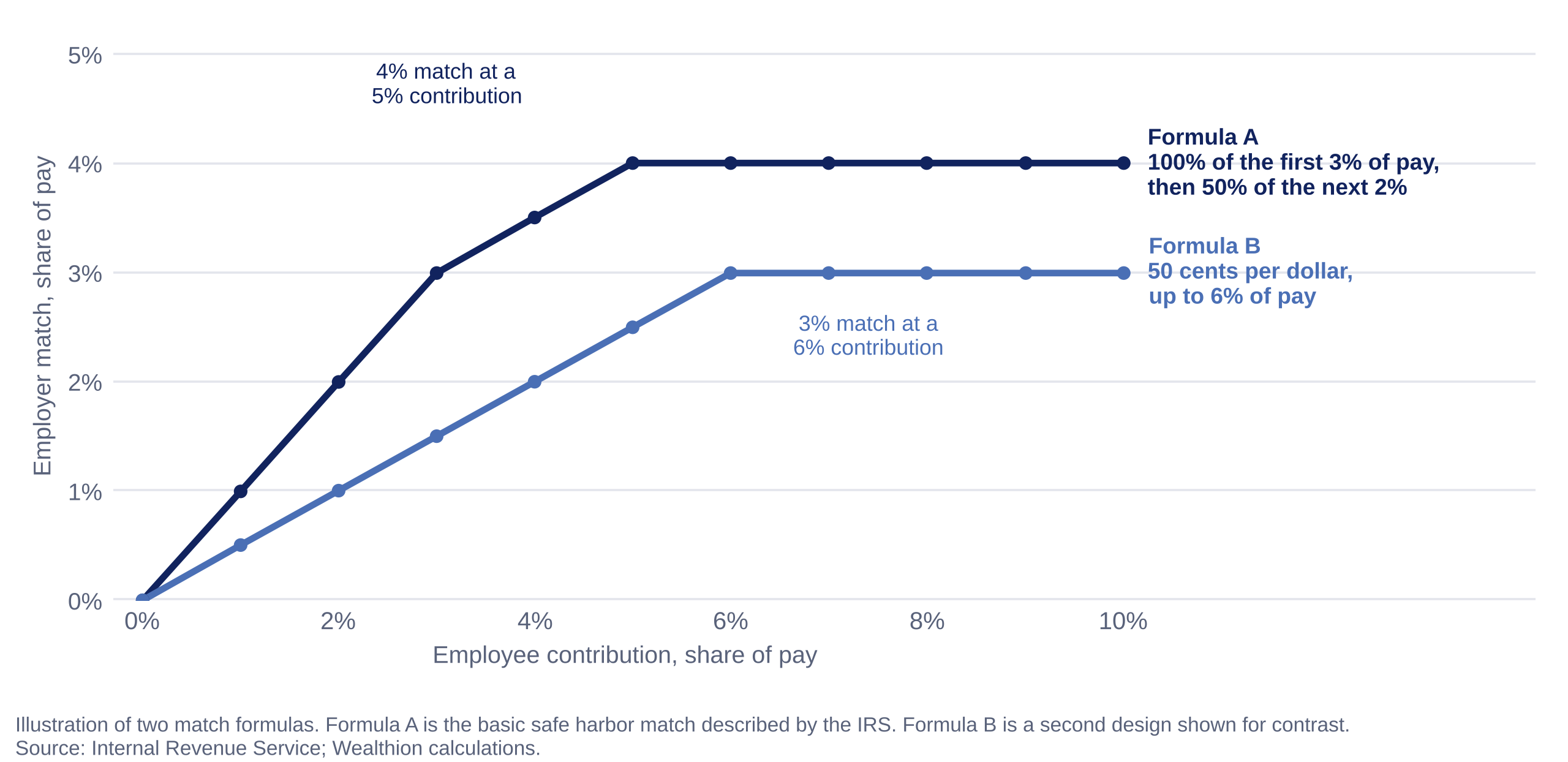
Take an example worker earning $80,000. Under Formula A, contributing 5% of pay, or $4,000, earns a 4% match, or $3,200. Under Formula B, contributing 6%, or $4,800, earns a 3% match, or $2,400. At a contribution of 3% of pay, Formula A adds $2,400 and Formula B adds $1,200.
Two details follow from this. Above the ceiling, extra contributions still add to your own savings but earn no more match. And the label can mislead. A “6% match” can mean 50 cents per dollar up to 6% of pay, which is an employer contribution of 3%.
For very high earners, there is one more ceiling. A plan can apply its formula only to pay up to a set limit, which is $360,000 for 2026 5,6.
When does matched money become yours?
Your own contributions are yours at once. The match can take years.
The process is called vesting. Vested money is yours to keep if you leave the employer. Money you contribute is always 100% vested, the Department of Labor says 7. Matching money can vest over time, and the law sets the two slowest schedules a plan may use 4. Under a cliff schedule, none of the match is yours until you have three years of service, and then all of it is. Under a graded schedule, 20% is yours after two years, rising by 20 points a year to 100% after six.
A match can take up to six years to become fully yours
Wealthion illustration. Share of employer matching money that is vested, by full years of service 4
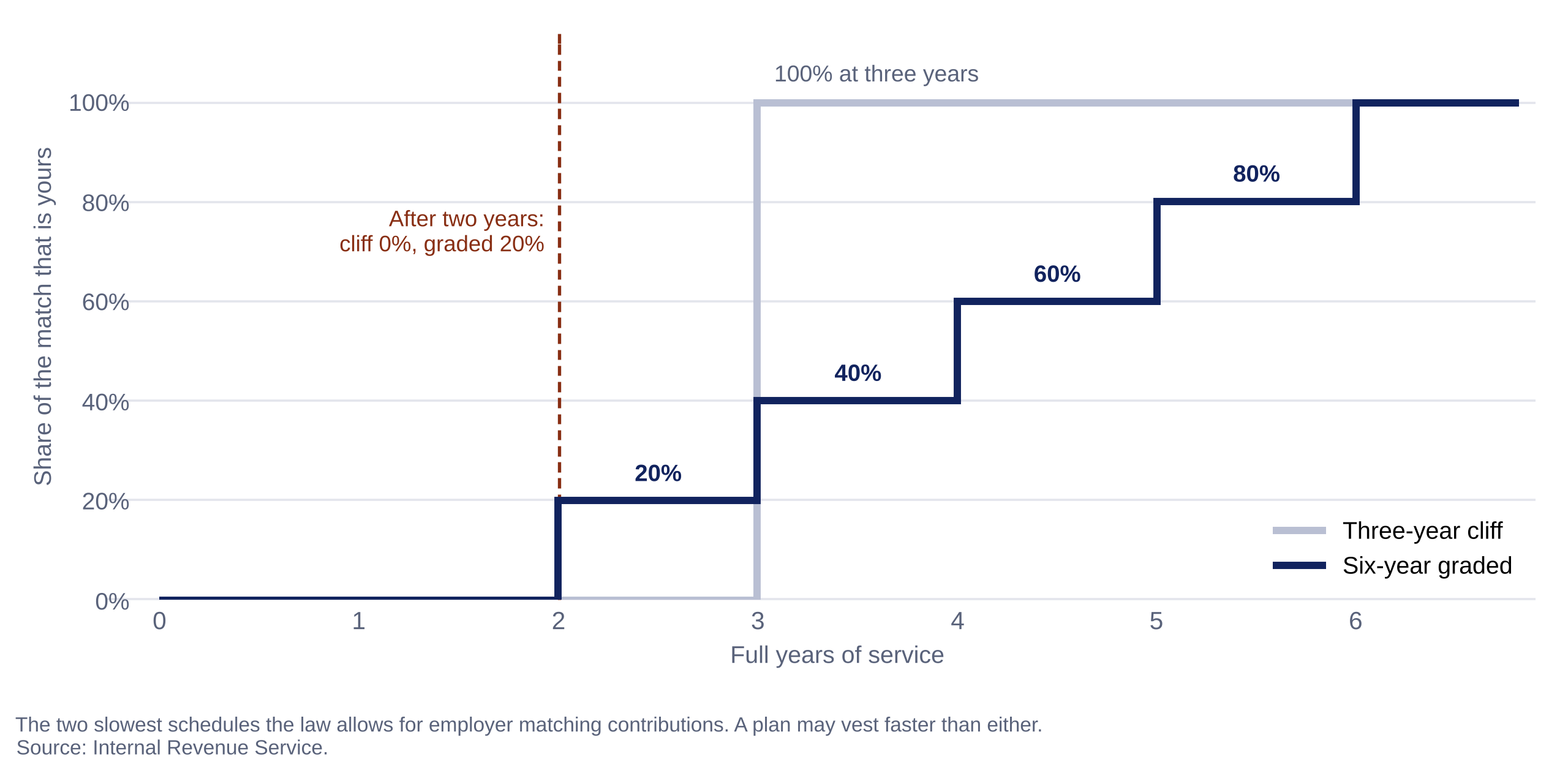
The difference shows at the two-year mark. Suppose the example worker has earned a $2,400 match under Formula B in each of two years, $4,800 in all before any investment gains or losses. Under the cliff schedule, none of it is vested. Under the graded schedule, $960 is.
Matching money that hasn't vested may be lost if you leave 7. Plans can be more generous than these minimums, and some must be. In a traditional safe harbor plan, the required safe-harbor match is 100% vested at all times 4. How a plan counts a year of service is set out in its plan document.
Can the timing of your contributions reduce the match?
In some plans, yes, if you reach the annual limit early in the year.
A plan may pay the match with each paycheck. But its formula may be written for the whole year. The IRS has said a plan “must comply with its match formula even if a participant stops making or decreases their salary deferrals during the year,” and that this can require the employer to “true-up” the match 8.
This matters most to a saver who reaches the annual limit early and so stops contributing for the rest of the year. Take a second example worker, under 50 and earning $240,000, paid monthly at $20,000, who contributes 20% of pay under Formula B. Assume the worker remains eligible all year and all salary counts toward the match. The 2026 limit of $24,500 is reached in July. Matched paycheck by paycheck, that worker receives $600 a month for six months and $250 in July: $3,850. Calculated on the full year, the formula pays 3% of $240,000, or $7,200.
A plan with a true-up pays the $3,350 difference. A plan whose formula runs paycheck by paycheck doesn't owe it. The same worker spreading contributions evenly over the year would receive the full $7,200 either way. The plan document says which method applies.
Does the match count toward your contribution limit?
No. It counts toward a separate, higher limit.
| Limit | 2026 | 2027 |
|---|---|---|
| Your pre-tax and Roth salary deferrals | $24,500 | $25,500 |
| Extra allowed at age 50 and over | $8,000 | $8,500 |
| Extra allowed at ages 60 to 63, in place of the age-50 amount | $11,250 | $11,750 |
| Your contributions and your employer’s together, excluding catch-ups | $72,000 | $75,000 |
From the IRS’s annual notices 6,9. These limits apply to traditional and safe harbor 401(k) plans. Catch-up contributions are available if the plan permits them. They sit outside the combined limit, and the combined total otherwise cannot exceed 100% of eligible compensation 10.
The match doesn’t use up any of your own $24,500 salary-deferral limit. A saver under 50 who contributes that full amount in 2026 still has up to $47,500 of room under the combined limit for the match and other contributions, subject to the plan’s rules and the limit of 100% of eligible compensation 10.
What newer options affect the match?
Two, and both depend on whether your employer has adopted them.
A match paid as Roth. A plan may let employees designate matching contributions as Roth if they are fully vested in those contributions when allocated. The match then counts as income for the year it is allocated to the account. Federal income tax is not withheld from the contribution, so the employee may need to increase other withholding or make estimated tax payments 11.
A match on student loan payments. A plan may treat qualifying student loan payments like contributions, matching them at the same rate and on the same vesting schedule. Payment information must be certified under the plan’s procedures at least annually 12. Under Formula B, the example worker on $80,000 who contributes nothing but repays $3,000 of student loans would receive a $1,500 match.
How much does a match add to your savings rate?
Often several percentage points of pay, and the amount depends on the formula as much as on you.
Your total savings rate is what you contribute plus what your employer adds, as a share of pay. The example worker on $80,000 reaches a 9% total, or $7,200 a year, by contributing 5% under Formula A or 6% under Formula B.
So the same total can ask more or less of the saver. It is also why published averages need care: some count only employees' own money and others include the employer's.
What does this mean for savers?
The headline match is the offer. The plan's rules decide what you keep.
Four things in a plan's documents settle it.
The formula. The rate and the ceiling, which together set how much you must contribute to receive the full match.
The vesting schedule. How long you must stay before the matching money is yours.
How the match is paid. Paycheck by paycheck or over the full year, and whether there is a true-up.
The options adopted. Whether the plan offers a Roth match or a match on student loan payments.
In the $80,000 salary example, both plans put $7,200 a year into retirement savings. But one requires the employee to contribute $4,000; the other requires $4,800. The same savings total can mean a different burden on your paycheck.
That is what makes the details of a match worth understanding. The headline percentage describes the offer. The amount your employer contributes, and the portion you are entitled to keep, show what that offer means for your retirement.
Frequently asked questions
Is a 401(k) match taxed when it goes in? A traditional match goes in before tax. If a plan offers a Roth match, it must be fully vested when allocated and counts as income for the year it is allocated 11.
What happens to an unvested match when you leave a job? The unvested portion may be forfeited under the plan’s rules. Your own contributions are always fully vested 7.
Sources & Disclosure
1 401(k) resource guide: plan participants, 401(k) plan overview. Internal Revenue Service, page last reviewed August 3, 2026; how employer matching works. 2 The Beginner's Guide to 401(k)s. FINRA, updated February 27, 2025; free money quote. 3 Retirement benefits were available to 72 percent of private industry workers in March 2026. Bureau of Labor Statistics, The Economics Daily, October 15, 2026; defined contribution access (70%) and participation (49%). 4 Issue Snapshot: Vesting schedules for matching contributions. Internal Revenue Service, page last reviewed June 28, 2026; basic safe harbor match formula, minimum cliff and graded schedules, safe harbor vesting. 5 401(k) plans: deferrals and matching when compensation exceeds the annual limit. Internal Revenue Service, page last reviewed February 26, 2026; match formula applies only to pay up to the compensation limit. 6 Notice 2025-67: 2026 amounts relating to retirement plans and IRAs. Internal Revenue Service, November 2025; 2026 limits. 7 FAQs about retirement plans and ERISA. Department of Labor, Employee Benefits Security Administration, undated; employee contributions always vested, loss of unvested employer money on leaving. 8 Employee Plans News, Issue 2012-3: Plan's Matching Formula May Require Additional Employer Contributions. Internal Revenue Service, November 14, 2012; true-up of matching contributions. 9 Notice 2026-66: 2027 amounts relating to retirement plans and IRAs. Internal Revenue Service, released November 12, 2026; 2027 limits. 10 Retirement topics: 401(k) and profit-sharing plan contribution limits. Internal Revenue Service, page last reviewed April 8, 2026; what counts toward the combined limit, catch-up contributions. 11 Notice 2024-2: Miscellaneous changes under the SECURE 2.0 Act of 2022. Internal Revenue Service, Internal Revenue Bulletin 2024-2, January 8, 2024; Roth employer matching contributions. 12 Notice 2024-63: Guidance under section 110 of the SECURE 2.0 Act on matching qualified student loan payments. Internal Revenue Service, Internal Revenue Bulletin 2024-36, September 3, 2024; student loan payment matching.
Wealthion is a dba of Greylock Peak Investments, a registered investment adviser. This article is general information only. It is not investment advice or an offer or solicitation, and it is not tailored to your circumstances. Guests’ views are their own and may not reflect those of Wealthion. Wealthion has not verified guest statements, including any performance figures. Investing involves risk, including loss of principal, and past performance does not guarantee future results. Wealthion refers readers to other registered investment advisers and shares in the fees they receive from referred clients, which creates a conflict of interest. Please see our Form ADV Part 2A and consult your own financial advisor before investing.
We are not making any recommendations.
What Serious Investors Are Watching
Dive into expert interviews, market analysis, and long-form content built to help serious investors think long-term.

An AI Portfolio Stress Test: What If the Spending Boom Slows?
An artificial intelligence (AI) spending slowdown could reach well beyond technology shares. Suppliers, data-center landlords...

Rising Bond Yields: What They Mean for Your Bonds, Your Stocks and the AI Trade
Higher bond yields affect existing bonds, new income, stock valuations and the cost of financing AI infrastructure. The impact depends on what investors own and how companies fund their spending.

Macro Bites – Fed Rate Debate Intensifies as Metals Markets Tighten
CNN reports U.S. intelligence indicates Iran may be developing plans to target senior Trump administration...
Enjoyed This? Get More Insights
Expert insights and curated opportunities, delivered to your inbox.
Ready to Position for What's Coming?
Whether you're still learning or ready to act, your next step starts here.
- Independent
- Macro-Informed
- Real Asset Focused


The Wealthion Network
By subscribing, you agree to receive Wealthion emails. Unsubscribe anytime.
The Wealthion Network
By subscribing, you agree to receive Wealthion emails. Unsubscribe anytime.
Network Discussion
Join the Wealthion Network to Comment