

Rising Bond Yields: What They Mean for Your Bonds, Your Stocks and the AI Trade
Higher bond yields reach well beyond the bond market. For investors, they change what existing bonds are worth, what new ones pay, how shares are valued and what it costs to fund the artificial intelligence (AI) buildout.
When market yields rise, the fixed-rate bonds you already own usually fall in price. Seeing that loss in your portfolio can make higher yields look like bad news.
But the same rise creates an opportunity to earn more as interest payments and money from maturing bonds are reinvested. Over time, that additional income can help offset the initial loss. How much it helps depends on how long the money stays invested and where yields go next.
For investors, the question is how those effects balance out, and what happens to the rest of the portfolio along the way. Higher yields also influence stock valuations and the cost of borrowing to build AI infrastructure.
What is a bond yield, and why do prices fall when it rises?
Yield expresses a bond’s return relative to its price. Yield to maturity includes its interest payments and any difference between the purchase price and the amount repaid at maturity.
Think of a fixed-rate bond as a stream of promised payments. If comparable new bonds offer higher yields, an older bond’s price generally falls to compete. The price decline does not change its promised interest or repayment at maturity, assuming the issuer pays as agreed.1
How far the price falls depends on duration, a measure of sensitivity to changes in yields. Longer-duration bonds generally have larger price moves.2 The Bloomberg US Aggregate Bond Index, which measures the broad United States (US) investment-grade bond market, had a duration of about six years at the end of 2025. As a rough guide, a one-percentage-point rise in yields would mean a price decline of about 6%, before interest income.3
How far have yields risen?
A long way since 2021, and further this year.
The 10-year Treasury yield was 1.52% at the end of 2021. On November 17, 2026, it was 5.10%, below its October 5 peak of 5.31%. Yields on 2-year and 30-year Treasuries stood at 4.80% and 5.46%.4
Yields after inflation went from below zero to almost 3%
Wealthion illustration. 10-year Treasury nominal and real par yields; last business day of each year, plus November 17, 2026. Source: US Treasury.4
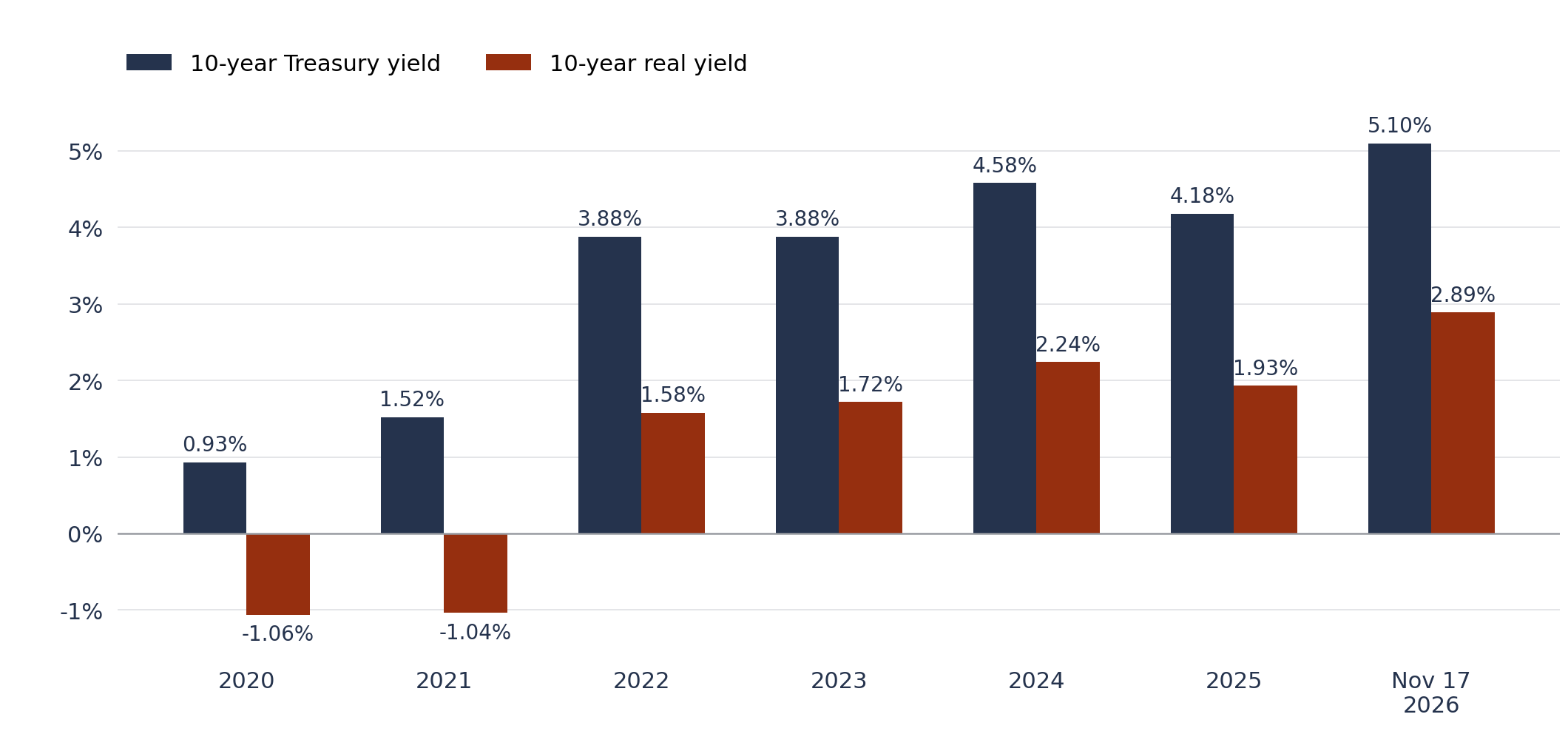
The second bar in each pair is the real yield on Treasury Inflation-Protected Securities (TIPS). Their principal adjusts with inflation; their market price can still fall. The real yield indicates the annualized return relative to inflation for a buyer holding to maturity, before taxes and costs. It was negative at the end of 2021; by November 17, 2026, it was 2.89%. That is not a promise that the bond’s market value will rise by that amount each year.4,5
Why have yields risen?
Long-term yields reflect expectations for future interest rates and the compensation investors require for holding debt over time. Inflation, policy and borrowing can influence both.6
Inflation has picked up again. Consumer prices rose 3.7% in the year to September 2026, up from 2.7% in December 2025. September remains the latest available annual comparison: the October release could not report one because October 2025 data were unavailable.7
The Federal Reserve has raised its policy rate. Its target range was 3.50% to 3.75% at the end of 2025. It raised the range to 3.75% to 4.00% in September 2026 and held it there on October 28.8
The government’s debt burden has grown. Federal debt held by the public reached 100% of the economy’s annual output in fiscal 2026.9 Net interest outlays were $970 billion in fiscal 2025; the Congressional Budget Office’s February 2026 baseline projected $2.14 trillion by 2036.10 Lyn Alden described the pressure in her October interview: “higher rates makes the deficits higher now.”11
Corporate borrowing can also play a part. Federal Reserve Bank of Dallas staff have argued that debt raised to build data centers adds to the supply of long-term borrowing, which can affect long-term interest rates.12 These are channels through which yields can change, not a precise breakdown of what caused this year’s rise.
What do rising yields do to the bonds you own?
The initial price loss can be followed by higher reinvestment income.
The Bloomberg US Aggregate Bond Index lost 13.01% in 2022, when yields rose sharply. It then returned 5.53% in 2023, 1.25% in 2024 and 7.30% in 2025.3,13 Income helped, but so did price gains: falling Treasury yields and narrower credit spreads, the extra yield corporate borrowers pay above Treasuries, supported 2025 returns.3
A hypothetical $100 following the Bloomberg US Aggregate Bond Index’s total returns from the start of 2022 would have been worth about $99.73 at the end of 2025, with income reinvested. That is a cumulative loss of about 0.3%, before fees and taxes and without adjusting for inflation.14
Higher reinvestment income can help repair a loss, but duration is not a recovery countdown. Further yield changes, defaults, fees and withdrawals can affect the result. An investor who needs to sell during a decline may not have time to benefit from that higher income.
What do rising yields mean for stocks?
They raise the bar that shares have to clear.
Higher bond yields give investors a more competitive alternative to shares. They also reduce the present value of future profits, if expected profits and the extra return investors demand for stock-market risk stay unchanged. Companies with profits expected far into the future are especially sensitive. But stronger expected earnings can offset that pressure, so higher yields do not automatically mean lower share prices.15
The S&P 500 traded at 18.3 times expected earnings for the next 12 months in FactSet’s November 13, 2026 report, against 21.3 times at the end of 2021.16,17 That is an index-wide valuation measure. It does not tell us whether any individual company is priced high or low.
Rising yields can also change how stocks and bonds move together. In 2022, the S&P 500 fell 18.11% including dividends while the Bloomberg US Aggregate Bond Index fell 13.01%.18,3 Bonds lost less, but both fell. Federal Reserve research helps explain why: inflationary pressure can weaken government bonds’ ability to cushion stock-market losses.19
What do rising yields mean for the AI buildout?
Recent bond offerings show how much financing conditions have changed for several large technology companies.
Coupons on selected bond offerings from five large technology companies
| Company | 2020 or 2021 offering | 2026 offering |
|---|---|---|
| Alphabet | 1.57% (August 2020) | 5.61% (August) |
| Amazon | 1.76% (June 2020) | 5.00% (March); 5.39% (July) |
| Microsoft | 2.95% (March 2021; exchange of existing debt) | 5.58% (priced October) |
| Oracle | 3.05% (March 2021) | 7.77% (November) |
| Meta | No comparable sale found | 5.73% (May); 6.60% (November) |
Average coupon, the fixed annual interest rate, weighted by the amount of fixed-rate bonds in each offering. Maturities differ, so comparisons reflect company risk and bond length as well as Treasury yields. These are selected offerings, not each company’s average borrowing cost, and the financing is not exclusively for AI.20
For fixed-rate borrowing, higher rates reach a company when it issues new debt or refinances maturing debt. They do not immediately change the coupon on its existing fixed-rate bonds. The pressure therefore depends on how much funding it needs, when debt matures and how much spending its own cash flow can cover.
Federal Reserve Governor Michael Barr said on November 16, 2026, that “lower-credit-quality firms most dependent on external funding have seen their cost of capital rise significantly.”21 He did not name these companies. His distinction matters: the same rise in market yields can have very different effects on borrowers.
What does this mean for investors?
Higher yields change what investors can earn and what companies must pay to borrow. How those changes play out depends on the investments themselves. A bond’s sensitivity to interest rates matters alongside its yield. A company’s cash generation and debt obligations matter alongside its growth plans.
For the AI buildout, that distinction is especially important. A business funding expansion from its own cash flow faces different pressures from one that must repeatedly raise money. Higher financing costs may squeeze returns or delay projects without bringing the whole buildout to a halt.
For investors, the useful question is how much of their portfolio depends on borrowing staying affordable, earnings meeting expectations or interest rates falling. That reveals more than the headline yield alone.
Frequently asked questions
Why do bond prices fall when yields rise? Because new bonds pay more. An existing bond's price falls until its yield matches what new bonds offer. The bigger the bond's duration, the bigger the fall: as a rough guide, the broad US bond market, with a duration of about six years, would lose about 6% if yields rose by one percentage point, before counting interest [1][12].
Do rising yields always hurt bond investors? Not over time. The Bloomberg US Aggregate Index lost 13.01% in 2022, then returned 5.53%, 1.25% and 7.30% over the next three years as higher yields fed through into income [10][1]. Vanguard's rule of thumb is that holding a bond portfolio for longer than its duration can offset the early loss, though it isn't guaranteed [12].
Why are bond yields rising in 2026? Inflation has picked up, reaching 3.7% in the year to September. The Federal Reserve raised its target range to 3.75% to 4.00% in September. And federal debt held by the public reached 100% of the economy's annual output in fiscal 2026 [4][5][6].
What is a real yield? It is the yield on Treasury inflation-protected securities, and it shows what a lender is offered above inflation. The 10-year real yield rose from -1.04% at the end of 2021 to 2.92% on November 16, 2026 [2][3].
How do rising bond yields affect stocks? They raise the return shares have to compete with and reduce what future profits are worth today, which weighs most on companies whose profits are expected far in the future. When inflation is the cause, bonds may not cushion a fall: in 2022, the S&P 500 lost 18.11% and the broad US bond market 13.01% [15][1].
Sources & Disclosure
1 US Securities and Exchange Commission, Investor Bulletin: Fixed Income Investments, When Interest Rates Go Up, Prices of Fixed-Rate Bonds Fall, June 26, 2013; fixed-rate bond prices, yields and promised payments. 2 Financial Industry Regulatory Authority, Duration: What an Interest Rate Hike Could Do to Your Bond Portfolio, March 3, 2017; duration and interest-rate sensitivity. 3 Bloomberg, Looking back at 2025: Fixed income, January 15, 2026; US Aggregate Index 2022 and 2025 total returns, year-end 2025 duration and return drivers. Bloomberg US Aggregate Index methodology, November 5, 2026; index coverage. 4 US Department of the Treasury, Daily Treasury Par Yield Curve Rates and Daily Treasury Par Real Yield Curve Rates; year-end observations for 2020–2025 and observations through November 17, 2026; retrieved November 18, 2026. 5 US Department of the Treasury, TreasuryDirect, Treasury Inflation-Protected Securities (TIPS); principal adjustment and interest payments; accessed November 18, 2026. 6 Federal Reserve Bank of New York, Treasury Term Premia; decomposition of yields into expected short-term rates and term premia; accessed November 18, 2026. 7 Bureau of Labor Statistics, Consumer Price Index releases for December 2025, September 2026 and October 2026, published January 13, October 14 and November 10, 2026; Table A and October release note on unavailable annual comparisons. 8 Federal Reserve, Federal Open Market Committee statements, December 10, 2025, September 16, 2026 and October 28, 2026; federal funds target range. 9 Congressional Budget Office, Monthly Budget Review: Summary for Fiscal Year 2026, November 9, 2026; debt held by the public relative to gross domestic product. 10 Congressional Budget Office, The Budget and Economic Outlook: 2026 to 2036, February 11, 2026; Table 1-1, fiscal 2025 net interest outlays and 2036 baseline projection. 11 Wealthion, The Treasury’s Gold Revaluation Play, Lyn Alden interview, published October 19, 2026; quotation checked against the interview transcript. 12 Hugo De Vere, Srini Ramaswamy and Seth Searls, How AI debt financing impacts duration supply and interest rates, Federal Reserve Bank of Dallas, February 10, 2026; staff analysis. 13 Bloomberg, Looking back at 2024: Fixed income, January 16, 2025; US Aggregate Index 2023 and 2024 total returns. 14 Wealthion calculation from Bloomberg’s calendar-year total returns: $100 × 0.8699 × 1.0553 × 1.0125 × 1.073 = $99.73, rounded. Hypothetical index illustration with income reinvested; before fees, taxes and inflation; not a forecast. 15 Federal Reserve, Financial Stability Report, May 2021, Asset Valuations, Factors Affecting Asset Prices; expected cash flows, interest rates and risk premia. 16 FactSet, Earnings Insight, November 13, 2026, page 1; S&P 500 forward 12-month price-to-earnings ratio. 17 FactSet, S&P 500 Earnings Season Update: February 11, 2022; forward 12-month price-to-earnings ratio at December 31, 2021. 18 S&P Dow Jones Indices, US Equities Market Attributes, June 2024, published July 2, 2024; S&P 500 total return in 2022. 19 Canlin Li and Emre Yoldas, Government Bonds’ Safe-Haven Property and Inflationary Pressures, Federal Reserve FEDS Notes, October 16, 2026; staff research on inflation and bond diversification. 20 Bond offering documents filed with the Securities and Exchange Commission: Alphabet prospectus supplements of August 3, 2020 and August 6, 2026; Amazon prospectus supplement of June 1, 2020 and final term sheets of March 10 and July 7, 2026; Microsoft Form 8-K of March 17, 2021 (exchange offer) and pricing term sheet of October 29, 2026; Oracle Form 8-K filings of March 24, 2021 and November 4, 2026; Meta Form 8-K of May 4, 2026 and pricing term sheet of November 3, 2026. Weighted coupons calculated by Wealthion from fixed-rate tranches. 21 Michael S. Barr, Some Potential Financial Stability Implications of Artificial Intelligence, Federal Reserve, November 16, 2026; Leverage in the Data Center Buildout section.
Wealthion is a dba of Greylock Peak Investments, a registered investment adviser. This article is general information only. It is not investment advice or an offer or solicitation, and it is not tailored to your circumstances. Guests’ views are their own and may not reflect those of Wealthion. Wealthion has not verified guest statements, including any performance figures. Investing involves risk, including loss of principal, and past performance does not guarantee future results. Wealthion refers readers to other registered investment advisers and shares in the fees they receive from referred clients, which creates a conflict of interest. Please see our Form ADV Part 2A and consult your own financial advisor before investing.
What Serious Investors Are Watching
Dive into expert interviews, market analysis, and long-form content built to help serious investors think long-term.

An AI Portfolio Stress Test: What If the Spending Boom Slows?
An artificial intelligence (AI) spending slowdown could reach well beyond technology shares. Suppliers, data-center landlords...
Rising Bond Yields: What They Mean for Your Bonds, Your Stocks and the AI Trade
Higher bond yields affect existing bonds, new income, stock valuations and the cost of financing AI infrastructure. The impact depends on what investors own and how companies fund their spending.

Macro Bites – Fed Rate Debate Intensifies as Metals Markets Tighten
CNN reports U.S. intelligence indicates Iran may be developing plans to target senior Trump administration...
Enjoyed This? Get More Insights
Expert insights and curated opportunities, delivered to your inbox.
Ready to Position for What's Coming?
Whether you're still learning or ready to act, your next step starts here.
- Independent
- Macro-Informed
- Real Asset Focused


The Wealthion Network
By subscribing, you agree to receive Wealthion emails. Unsubscribe anytime.
The Wealthion Network
By subscribing, you agree to receive Wealthion emails. Unsubscribe anytime.
Network Discussion
Join the Wealthion Network to Comment