

An AI Portfolio Stress Test: What If the Spending Boom Slows?
An artificial intelligence (AI) spending slowdown could reach well beyond technology shares. Suppliers, data-center landlords and lenders may depend on the same spending plans, with different consequences for each.
An investor may own a chipmaker, a data-center landlord and a bond fund for very different reasons. Yet all three could depend, in part, on the same technology companies.
If those companies pause their expansion, a supplier could lose new orders while a landlord continues collecting contracted rent. Share and bond prices could react before those business effects appear.
This stress test follows those connections through three scenarios: capital spending holds steady, falls by a quarter, or becomes more expensive to finance.
Where does AI spending sit in a portfolio?
In more places than the technology shares that get the attention.
In an index fund. The information technology sector was 37.4% of the S&P 500 index at the end of October 2026 1. That leaves out Amazon, Alphabet and Meta, which are classified in other sectors. Larry McDonald's looser description in an October interview was “Essentially the S&P is 50% tech” 2.
In suppliers and builders. These are the companies that make equipment for data centers and construct them. Technology customers provided 60.8% of revenue at Comfort Systems USA, a contractor, in the third quarter of 2026 3.
In property and infrastructure. Data-center owners earn rent from the same buyers. So do AI cloud providers, which rent out computing power: Microsoft provided about 67% of CoreWeave's 2025 revenue 4.
In bonds. The Federal Reserve estimates that advanced computing-related borrowing rose from less than 6% of nonfinancial investment-grade corporate debt issuance in 2023 to about 31% in 2026 through October. Investment grade means rated as carrying less credit risk than high-yield debt 5.
Each figure describes one company or one estimate, not a whole group. These are the four places this test follows: direct AI stocks, suppliers, infrastructure and credit.
What is being tested?
The spending plans of a few very large companies.
Amazon, Alphabet, Microsoft and Meta have each given guidance for capital spending in 2026. Added together, it comes to between $720 billion and $740 billion. These are company-wide plans, not an AI-only total, and their treatment of leases differs 6. Capital spending is money put into long-lived assets, here mostly data centers and the equipment inside.
That spending is taking a growing share of the cash these companies generate. In fiscal 2023, Amazon's cash capital spending was equal to 62% of its operating cash flow, the cash its business brought in. In 2025 it was 94%. Oracle's rose from 51% to 102% 7.
Capital spending is taking a growing share of the cash these companies generate
Wealthion chart. Cash capital spending as a share of operating cash flow, fiscal 2023 and fiscal 2025 7
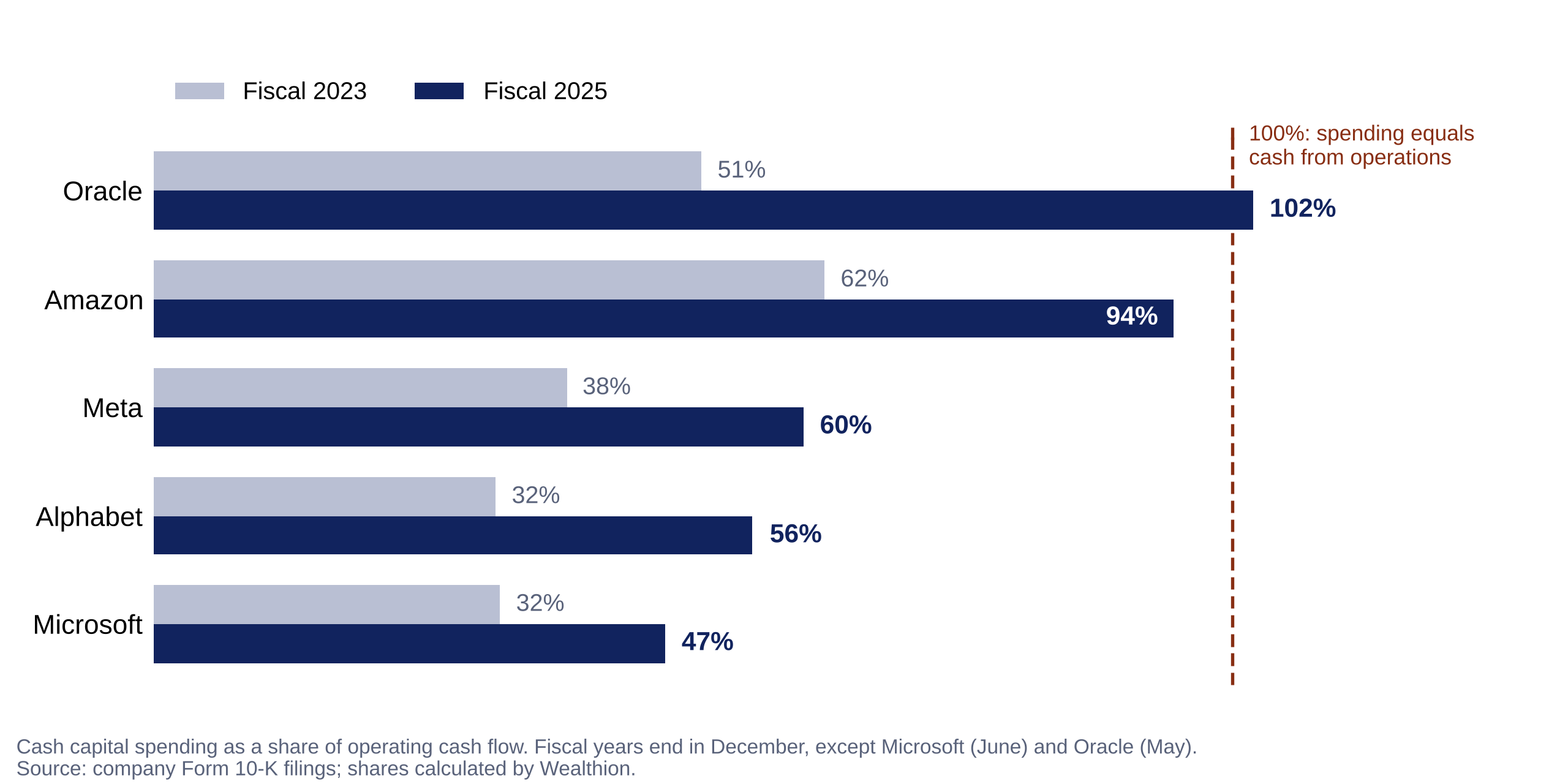
Each bar compares cash spent on long-lived assets with the cash the company's operations produced that year. Above 100%, cash capital spending exceeds operating cash flow. Microsoft's and Oracle's fiscal years end in June and May, so their figures are older. In the latest reported quarter, cash capital spending exceeded operating cash flow at Amazon, Alphabet, Meta and Oracle, though a single quarter can be uneven 8.
This matters to an investor because higher spending can leave less operating cash for other uses. A company may draw on cash reserves, raise equity or borrow to fill a funding gap. Changes to its spending plans could affect suppliers and landlords too. The test asks what could follow if spending stopped rising.
What could each scenario do?
Three assumptions, chosen to illustrate possible effects. No probability is attached to any of them. We are not making any recommendations.
A pause. The large buyers hold capital spending at this year's level.
A cut. They reduce it by a quarter.
A funding squeeze. Plans stay the same, but lenders charge more to finance them.
An AI stress-test worksheet: where each scenario could be felt
| Holding | A pause | A cut | A funding squeeze |
|---|---|---|---|
| Direct AI stocks | Chip-sales growth could slow, depending on the spending mix. Depreciation on past purchases continues. | Fewer chip orders are possible. Buyers may save cash, while depreciation and lease obligations continue. | Pressure could rise where new borrowing or refinancing is needed. |
| Suppliers and builders | New-order growth could slow. Existing contracts may support current work. | Fewer new orders and awards could put pressure on pricing. | Customers may delay projects that need financing. |
| Infrastructure | New leasing could slow. Existing lease payments remain due. | Less new leasing could make spare capacity harder to fill. | More expensive borrowing could strain projects before tenants begin paying. |
| Credit | Borrowing needs may change; refinancing can continue. | Weaker cash flow could strain some borrowers. | New borrowing costs rise. Existing fixed-rate bond prices could fall. |
Wealthion's reasoning from how each group earns its money. Illustrative only: not a forecast, a ranking or an estimate of losses.
The effects on new orders, contracted rent and borrowing could emerge at different times. Share and bond prices may react before those changes appear in company results. The sections below explain the business effects.
Why could costs persist after a spending cut?
Some costs reflect equipment already bought or contracts already signed.
Cutting new purchases can save cash. It doesn't undo past decisions. Equipment already bought is charged against profit over its expected life. That depreciation is an accounting expense, not another payment for the equipment.
That expected life is an estimate, and it moves. Meta lengthened it to 5.5 years for most servers and network assets in 2025, which lowered that year's depreciation expense by $2.92 billion. Amazon shortened it for some equipment, citing faster development in AI, which raised its depreciation and amortization expense by $1.4 billion 9, 10.
Buyers have also signed leases for space they haven't yet moved into.
| Company | Total future payments on leases signed but not yet started | As of |
|---|---|---|
| Microsoft | $364.6 billion | September 30, 2026 |
| Meta | About $355.7 billion | September 30, 2026 |
| Oracle | $288 billion | August 31, 2026 |
| Amazon | $164.9 billion | September 30, 2026 |
| Alphabet | $130.5 billion | September 30, 2026 |
Each company's own figure and definition, mainly data centers. The amounts are totals over the life of the leases, not yearly payments, and some depend on conditions being met. Amazon's also covers warehouses and other operations 11, 12, 13, 14, 15.
For investors in these companies, a cut can conserve cash while depreciation on equipment already owned continues to reduce profit.
Why might different holdings fall together?
Because the same customers appear in several companies' future sales.
Nvidia is one example. Three direct customers provided 16%, 15% and 13% of its revenue in the six months ended July 26, 2026 16.
OpenAI, a private company, is another. In 2025 announcements, it agreed to buy an additional $250 billion of computing services from Microsoft, valued its Oracle partnership at more than $300 billion over five years, and expanded its CoreWeave agreements to a total of up to approximately $22.4 billion. In February 2026, OpenAI also announced a $30 billion investment from Nvidia 17, 18, 19, 20.
The announced totals are not measures of revenue already earned. But one customer's plans can sit inside several companies' order books. In an October interview, Lyn Alden described how supplier financing can tie chipmakers, data centers and their customers together in a circle 21.
This is what a stress test is for. Holdings in different sectors can share one source of demand, and the sector labels don't show it.
Which businesses might feel a slowdown sooner?
Businesses relying on new work could feel the effects sooner than those with long contracts. Contract terms and customer finances matter.
Builders and equipment makers depend on new project awards and orders. A slowdown could reduce future work, although existing contracts may provide some protection. EMCOR, a contractor, says the economic penalty its customers would face makes the risk of cancellation very low 22. Larry McDonald drew the link to physical businesses, saying a slowdown in AI construction “does slow down the hard asset trade” 2.
Data-center owners collect rent under leases that run for years. At the end of 2025, Digital Realty's leases had about five years left on average 23. Their exposure includes new leasing and their largest tenants. AI cloud providers can depend on lenders as well as customers: CoreWeave had about $47 billion of debt at the end of September 2026 24.
Where does credit come in?
More of the buildout is now paid for with borrowed money, so bondholders are exposed too.
The Federal Reserve estimates that more than $680 billion of debt related to advanced computing was issued in 2026 through October. In all of 2023, the figure was $130 billion 5.
Company accounts show the same shift. Alphabet's debt rose from $48.5 billion at the end of 2025 to $126.1 billion nine months later. Amazon's rose from $68.9 billion to $180.3 billion 25. Some commitments also sit in ventures whose assets and liabilities are not consolidated into the company's balance sheet. Meta reports a maximum exposure of $68.4 billion to two such data-center ventures, most of it guarantees and lease commitments and not debt 12.
Rating agencies watch this closely. At the end of October 2026, S&P Global Ratings changed its outlook on Meta from stable to negative, citing uncertainty over capital spending and cash flow, while keeping the rating itself 26. In her October interview, Lyn Alden described a potential longer-term financing risk but did not put it in the same category as the subprime crisis at that stage 21.
What happened when technology spending fell after 2000?
Spending fell. Share prices fell far more.
In current-dollar terms, United States (US) business investment in information processing equipment and software fell about 14% between 2000 and 2002, from $450.6 billion to $389.3 billion 27. Over a similar period, the technology-heavy Nasdaq Composite index fell about 78% from its closing peak on March 10, 2000, to its trough on October 9, 2002 28.
Prices reflect expectations, and expectations can change faster than spending does. That is why a pause can matter to investors even if spending stays high.
The comparison has limits. In 2025, the same category of investment was 4.55% of US output, against 4.40% in 2000 27. But the measure covers all such equipment and software, not AI alone, and the companies, customers and funding involved are different now.
What can't a stress test tell you?
Whether any of this will happen, or when.
The scenarios are assumptions. They leave out how prices, costs and other customers would respond, and they treat the companies in a group as if they were alike. Wealthion's guests were candid about the limits. Discussing whether data centers had been overbuilt, Brett Rentmeester said: “I don't know the answer to that.” He also separated a possible bubble in parts of AI from the demand behind it 29. On whether a fall in technology shares would spread to others, Larry McDonald said “nobody knows the answer to that question” 2.
What does this mean for investors?
A spending cut could help a technology company conserve cash while reducing new business for its suppliers. A landlord’s lease may cushion the effect on rental income, even as investors reassess the value of its shares.
Those differences matter. Contracts, cash reserves and debt maturities help explain why some businesses could have more room to adjust than others. They also show why a shared exposure need not produce the same outcome.
The underlying connection, however, can remain: several investments may rely on the same customers continuing to expand. That is what this stress test helps uncover, along with the protections and pressures that could shape each holding’s response.
Our free AI guide covers overlapping holdings and the physical buildout behind AI in more detail.
Frequently asked questions
What is a portfolio stress test? A way of checking how a set of investments could respond if one assumption changed. It helps identify shared risks. It doesn't predict that the change will happen.
Is AI spending slowing? The four companies' October 2026 capital spending guidance adds up to more than $700 billion. That total alone does not establish whether spending growth is slowing. Timing matters too: Microsoft's October outlook reflected capacity delays 6.
Sources & Disclosure
1 S&P 500 index page, Sector Breakdown. S&P Dow Jones Indices, as of October 30, 2026; Information Technology sector weight. 2 Wealthion, Larry McDonald: S&P 500 Could Crash 30% Over the Next Year, video published October 16, 2026. 3 Comfort Systems USA Form 10-Q for the quarter ended September 30, 2026. Comfort Systems USA, October 22, 2026; revenue by customer sector. 4 CoreWeave, Inc. Form 10-K for fiscal 2025. CoreWeave, March 2, 2026; customer concentration. 5 Financial Stability Report, November 2026. Board of Governors of the Federal Reserve System, November 13, 2026; Box 2.2, Leverage in the Data Center Buildout; estimates of debt related to advanced computing. Bonds. Securities and Exchange Commission, Investor.gov; investment-grade credit risk and bond-price risks. 6 Capital spending guidance for 2026: Amazon.com Announces Third Quarter Results, October 29, 2026; Alphabet 2026 Third-Quarter Earnings Call, October 2026; Microsoft Fiscal Year 2027 First Quarter Earnings Conference Call, October 2026; Meta Reports Third Quarter 2026 Results, October 21, 2026. 7 Form 10-K filings for fiscal 2023 and fiscal 2025: Amazon.com, Alphabet, Meta Platforms, Microsoft and Oracle; operating cash flow and cash capital expenditure, with shares calculated from them. 8 Form 10-Q filings for the quarter ended September 30, 2026 (Amazon.com, Alphabet, Meta Platforms) and August 31, 2026 (Oracle); operating cash flow and cash capital expenditure for the quarter. 9 Meta Platforms, Inc. Form 10-K for fiscal 2025. Meta Platforms, January 29, 2026; change in useful lives of servers and network assets. 10 Amazon.com, Inc. Form 10-K for fiscal 2025. Amazon.com, February 6, 2026; change in useful lives of a subset of servers and networking equipment. 11 Microsoft Corporation Form 10-Q for the quarter ended September 30, 2026. Microsoft, October 28, 2026; leases not yet commenced. 12 Meta Platforms, Inc. Form 10-Q for the quarter ended September 30, 2026. Meta Platforms, October 22, 2026; leases not yet commenced, unconsolidated data center ventures. 13 Oracle Corporation Form 10-Q for the quarter ended August 31, 2026. Oracle, September 11, 2026; additional lease commitments. 14 Amazon.com, Inc. Form 10-Q for the quarter ended September 30, 2026. Amazon.com, October 30, 2026; leases not yet commenced. 15 Alphabet Inc. Form 10-Q for the quarter ended September 30, 2026. Alphabet, October 29, 2026; leases not yet commenced. 16 NVIDIA Corporation Form 10-Q for the quarter ended July 26, 2026. NVIDIA, August 26, 2026; Note 13, direct customer revenue concentration. 17 Microsoft Corporation Form 10-Q for the quarter ended September 30, 2025. Microsoft, October 29, 2025; Note 17, OpenAI purchase commitment. 18 OpenAI, Oracle, and SoftBank expand Stargate with five new AI data center sites. OpenAI, September 23, 2025; Oracle partnership value. 19 CoreWeave Expands Agreement with OpenAI by up to $6.5B. CoreWeave, September 25, 2025; cumulative contract value of up to approximately $22.4 billion. 20 Scaling AI for everyone. OpenAI, February 27, 2026; NVIDIA investment. 21 Wealthion, The Treasury’s Gold Revaluation Play, Lyn Alden interview, video published October 19, 2026. 22 EMCOR Group Form 10-Q for the quarter ended September 30, 2026. EMCOR Group, October 29, 2026; contract cancellation terms. 23 Digital Realty Trust, Inc. Form 10-K for fiscal 2025. Digital Realty, February 13, 2026; remaining lease term. 24 CoreWeave Reports Strong Third Quarter 2026 Results. CoreWeave, November 10, 2026; debt at September 30, 2026. 25 Alphabet Inc. and Amazon.com, Inc. Form 10-K filings for fiscal 2025 and Form 10-Q filings for the quarter ended September 30, 2026; total debt carrying amounts, excluding leases. 26 Sopaipilla Investor LLC Outlook Revised To Negative From Stable Following Similar Action On Meta Platforms Inc. S&P Global Ratings, November 2, 2026; refers to the October 30, 2026 outlook revision on Meta. 27 Private fixed investment in information processing equipment and software, and Gross Domestic Product, annual, current-dollar series. United States Bureau of Economic Analysis via Federal Reserve Bank of St. Louis, updated September 30, 2026; 2000, 2002 and 2025, with shares calculated from them. 28 NASDAQ Composite Index, daily close. Nasdaq via Federal Reserve Bank of St. Louis; closes of March 10, 2000 and October 9, 2002. 29 Wealthion, Why the 60/40 Portfolio May Not Protect You, Brett Rentmeester interview, video published October 23, 2026.
Wealthion is a dba of Greylock Peak Investments, a registered investment adviser. This article is general information only. It is not investment advice or an offer or solicitation, and it is not tailored to your circumstances. Guests’ views are their own and may not reflect those of Wealthion. Wealthion has not verified guest statements, including any performance figures. Investing involves risk, including loss of principal, and past performance does not guarantee future results. Wealthion refers readers to other registered investment advisers and shares in the fees they receive from referred clients, which creates a conflict of interest. Please see our Form ADV Part 2A and consult your own financial advisor before investing.
What Serious Investors Are Watching
Dive into expert interviews, market analysis, and long-form content built to help serious investors think long-term.
An AI Portfolio Stress Test: What If the Spending Boom Slows?
An artificial intelligence (AI) spending slowdown could reach well beyond technology shares. Suppliers, data-center landlords...

Rising Bond Yields: What They Mean for Your Bonds, Your Stocks and the AI Trade
Higher bond yields affect existing bonds, new income, stock valuations and the cost of financing AI infrastructure. The impact depends on what investors own and how companies fund their spending.

Macro Bites – Fed Rate Debate Intensifies as Metals Markets Tighten
CNN reports U.S. intelligence indicates Iran may be developing plans to target senior Trump administration...
Enjoyed This? Get More Insights
Expert insights and curated opportunities, delivered to your inbox.
Ready to Position for What's Coming?
Whether you're still learning or ready to act, your next step starts here.
- Independent
- Macro-Informed
- Real Asset Focused


The Wealthion Network
By subscribing, you agree to receive Wealthion emails. Unsubscribe anytime.
The Wealthion Network
By subscribing, you agree to receive Wealthion emails. Unsubscribe anytime.
Network Discussion
Join the Wealthion Network to Comment