

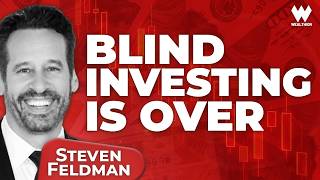
How to Diversify Your Portfolio: Steven Feldman
Key Takeaways
Feldman draws a line between intentional and blind indexing. His message is that "intentional indexing is fine, blind indexing is not fine," and that mechanically buying an index you believe is overvalued, especially at a 90% weight, is no longer wise.
He says diversification should follow the "regime." Feldman argues today's regime, wars, debts and deficits, intense global competition, and weakening international institutions, calls for a portfolio built around that backdrop, and that "you want to be prepared for the crisis first."
He expects long-term inflation and a weaker dollar. In his view, inflation and dollar depreciation are the likeliest way heavy deficits get paid down, absent politically difficult tax increases.
He favors measured AI exposure and a cash buffer. Feldman would not own zero AI, but is wary of paying 50 times earnings, and says high valuations argue for a larger cash position while it earns around 4%.
Real assets are his most overlooked opportunity. He says "we believe in real assets very deeply," pointing to rare earths, pipelines, railroads, agriculture and water scarcity.
Key Moments
00:00 - Blind indexing vs. intentional investing Why Feldman says how much of your portfolio the index represents is what matters.
00:48 - How to diversify for today's market risks Diversifying with a view of the world.
00:57 - Debt, deficits, inflation and the dollar Why he expects long-term depreciation of the dollar.
01:36 - Preparing your portfolio for a new regime Diversification as a function of the macro regime.
02:58 - How to invest in AI without taking too much risk Measured exposure and the valuation problem.
03:42 - Gold as an inflation and dollar hedge His attributed case for gold in this environment.
04:22 - Why cash matters when valuations are high Using cash to wait for a better entry point.
04:42 - Real assets: the most overlooked opportunity Rare earths, pipelines, agriculture and water.
How to Diversify Your Portfolio for a Riskier Market: Steven Feldman on Ending "Blind" Indexing
For years, the simplest advice was to buy a low-cost S&P 500 index fund and stop thinking about it. Investor Steven Feldman told Wealthion in August 2026 that this "blind" approach has become riskier as valuations and AI concentration have climbed, and that investors should shift toward intentional, diversified portfolios built for the current environment. The views below are his, framed around portfolio construction rather than any single asset, and are not personalized advice.
Is blind index investing still a good idea?
Feldman's answer is a careful distinction: "Intentional indexing is fine, blind indexing is not fine." He is not against index funds; his concern is mechanically buying an index you believe is overvalued, quarter after quarter, without regard to how large it has become within your whole portfolio. Being 90% in such an index, he says, "was a bad idea, no longer a good idea." The key question, in his framing, is how much that single position represents in the entirety of your holdings. A related critique appears in Brett Rentmeester's view that a diversified portfolio can be an expensive index fund, and Michael Green has written extensively on the hidden risks in passive market structure.
How should you diversify for today's risks?
By understanding the backdrop, which Feldman calls the regime. "Diversification is a function of regime," he says, and today's regime is defined by elevated risk: wars, debts and deficits, intensifying global competition, and a general weakening of the institutions that manage international relations, he cites the debate over whether the UN still has value as an example. The practical implication is to prepare before trouble hits: "you want to be prepared for the crisis first," rather than waiting for a crisis to force the change.
Why does he expect inflation and a weaker dollar?
Because of the math of the deficit. Feldman argues that heavy debts and deficits point to "a long-term depreciation of the dollar, long-term inflation," which he calls the most likely way governments pay down what they owe, since he doubts politicians have the will to raise taxes and still get elected. That expectation, in his view, is a core input into how a portfolio should be built.
How can you invest in AI without taking too much risk?
Feldman's answer is measured participation. He would not own zero AI, calling it the hottest technology, one that is changing the world, but is wary of how much to pay for it. Buying at 50 times earnings, with companies whose growth all depends on the same interconnection, sounds scary to him, though he notes not all trade that richly, with some at 20 to 30 times. His approach is to put a little money in that way and look for other ways to play the theme, emphasizing deliberate portfolio construction, "a word people don't do." His broader take on positioning for AI-driven demand appears in the AI resource rush.
What role do gold and cash play?
Feldman treats both as tools for this regime, and these are his attributed views. On gold, he argues it typically does well when the dollar depreciates, offering the framing that "gold is priced in dollars but dollars are priced in gold," and noting that where roughly 2,000 dollars once bought an ounce, closer to 4,000 does now, so a dollar buys about half the gold it did a couple of years ago. On cash, he says high valuations argue for a higher cash position, and that "this is where interest rates work for you," since cash now earns around 4% and lets an investor wait for a better entry point, even if the interest is taxable. Neither is presented as a recommendation, and gold in particular is a volatile asset whose role depends on individual circumstances.
Why does Feldman favor real assets?
This is where he is most emphatic: "we believe in real assets very deeply," calling them "the most overlooked part of the market," partly because they are hard to build a simple narrative around. He points to rare earths, where he notes China's dominance and growing policy support for Western supply, alongside pipeline and railroad businesses, fertilizer and agriculture, and water-scarcity themes. A more aggressive real-assets and commodity view runs through Jeff Currie's gold and silver supercycle. As always on Wealthion, this is Feldman's attributed framework, not investment advice.
What Investors Should Watch
- Index concentration in your own portfolio: how much a single index position represents, Feldman's central question.
- The macro regime: deficits, geopolitics and institutional strain, the backdrop he says should shape diversification.
- AI valuations: the gap between richly priced names near 50 times earnings and cheaper ways to play the theme.
- Cash yields: the roughly 4% that lets investors wait for better entry points.
- Real-asset themes: rare earths, pipelines, railroads, agriculture and water.
FAQ
Is blind index investing still a good idea? Steven Feldman says intentional indexing is fine but blind indexing is not, at least at today's valuations and index concentration. His concern is mechanically buying an overvalued index without regard to how large it has become in your overall portfolio.
How should I diversify my portfolio now? Feldman argues diversification should follow the macro regime, wars, debts and deficits, global competition and weakening institutions, and that investors should prepare before a crisis rather than react to one.
Why does Feldman expect inflation and a weaker dollar? He views inflation and dollar depreciation as the likeliest way heavy deficits get paid down, absent tax increases he doubts are politically feasible.
What role do gold and cash play in his approach? Feldman sees gold as a typical beneficiary of a depreciating dollar and holds cash, earning around 4%, as a way to stay patient when valuations are high. These are his attributed views, not advice, and gold is volatile.
Which expert and interview does this article reference? This article draws on Wealthion's interview with investor Steven Feldman: "Blind Investing Is Over: The Portfolio Shift to Make Before the Next Crisis."
Full Transcript (cleaned)
Speakers: Maggie Lake (Wealthion host) and Steven Feldman (investor). ASR errors corrected and filler removed; meaning preserved.
Steven Feldman (cold open): Intentional indexing is fine. Blind indexing is not fine. It probably means a long-term depreciation of the dollar and long-term inflation. You want to be prepared for the crisis first. We believe in real assets very deeply. We think it's the most overlooked part of the market.
Steven Feldman: Intentional indexing is fine; blind indexing is not fine. If you want to invest quarterly in an index you think is overvalued, and you're 90% in it, I'd say that was a bad idea, and no longer a good idea. So it's really about how much that index is within the entirety of your portfolio.
Maggie Lake: So what does diversification look like? How does one prepare for the risks we're facing?
Steven Feldman: You want to diversify with an idea of what's going on in the world. We started with what the debts and deficits mean: probably a long-term depreciation of the dollar and long-term inflation, because inflation and dollar depreciation are the best way to pay off a deficit, until someone convinces me politicians have the will to raise taxes and still get elected, which I don't think will happen. Maybe if there's a crisis, but usually you have the crisis first, whereas you want to be prepared for the crisis first. I like to think that diversification is a function of regime. The regime isn't what happens tomorrow; it's the political, geopolitical and macro backdrop, which has a lot of risk in it. We have wars, debts and deficits, global competition in a way we didn't have before, and a general weakening of the institutions that navigate international relations. I read an article over the weekend asking what we'll do with the UN, whether it has any value; maybe it was dysfunctional, but at least it was a place for people to talk, and we may not even have that. So the institutional protection within and among countries is a lot lower. That's the regime.
Maggie Lake: If someone said you're investing your first dollar into that regime, would you be 100% in risk assets?
Steven Feldman: No, you wouldn't. But if someone said, "You've been away on a lunar mission for two years and just landed; there's this thing called AI, we even landed your ship using it, how do I invest in it?" no one would say zero. It's the hottest technology, changing the world, maybe a technology that could end the world, which I've written about, but that's for another show. You'd want to participate. Then the question is how. If you're told you can, but you have to do it at 50 times earnings, with companies all increasing their earnings from this interconnection, that sounds scary. Are there other ways to play it? I'll still put a little money in that way, because who knows, maybe 50 times in two years looks like 20, and not all of them trade at 50; some trade at 20 to 30. Then you start to construct the portfolio. There's a word, construction, that people don't really do. You want to construct it. I think you should have some gold; it's typically pretty good in inflationary environments. When the dollar depreciates, remember gold is priced in dollars, but dollars are priced in gold. It used to be that 2,000 of them bought an ounce of gold, and now 4,000 do, so your dollar is worth about half what it was in gold a couple of years ago. It would have been good to be in front of that, and we were. When valuations are high, you probably want a higher cash position. This is where interest rates work for you.
Maggie Lake: So if I'd like a better entry point, I can wait in cash.
Steven Feldman: Cash isn't so hard to hold now: you get about 4%, and if rates rise, a bit more. It's taxable, which is unfortunate, but you can hold cash and wait for a better entry point. And we believe in real assets very deeply; we think it's the most overlooked part of the market, partly because it's hard to build a narrative around. Maybe rare earths have a narrative today, where people say we need them, we don't quite know what anything is worth, but China had them all and there's a lot of government and policy support, so we'll do that. But there are other businesses too: pipelines, railroads, fertilizer and agriculture, and the water-scarcity themes.
What Serious Investors Are Watching
Dive into expert interviews, market analysis, and long-form content built to help serious investors think long-term.
How to Diversify Your Portfolio: Steven Feldman
Key Takeaways Feldman draws a line between intentional and blind indexing. His message is that...
Wealthion Macro Bites – Zinc’s Surprise Deficit: How a Forecast Glut Became a 4-Year Price High
In retaliation for Iranian attempts to launch sea mines in the Strait of Hormuz, the...
Is the Stock Market Going to Crash? David Rosenberg
Key Takeaways Rosenberg is willing to call it a bubble. "I don't mind calling it...
Enjoyed This? Get More Insights
Expert insights and curated opportunities, delivered to your inbox.
Ready to Position for What's Coming?
Whether you're still learning or ready to act, your next step starts here.
- Independent
- Macro-Informed
- Real Asset Focused


The Wealthion Network
Stay ahead of the curve. Subscribe to Wealthion’s newsletter and get timely videos, articles, and alerts featuring insights from the world’s leading experts in investing and wealth-building.
Network Discussion
Sign in to share your thoughts and connect with other readers.
Join the Wealthion Network to Comment