

Is Gold Still a Safe Haven in 2026? What It Protects Against and Its Role in a Portfolio
Gold’s appeal is easy to understand: it is a tangible asset that does not depend on a company’s profits or a government’s promise to repay. Understanding when that helps protect your wealth takes a closer look.
Gold is often bought to protect wealth. For one investor, that may mean helping savings keep up with rising prices over many years. For another, it may mean owning something that holds up when stocks fall.
Those are different jobs. Gold can help with one while disappointing on another. And an investor who has owned it for years can have a very different experience from someone who buys just before a sharp decline.
Its fall in 2026 makes those differences worth understanding. Looking at when gold has helped investors, when it has disappointed them and why gives us a clearer answer to what protection it can offer.
What does gold protect against?
Gold differs from most investments in two ways. It isn’t tied to a company’s earnings or issued by a government, so the metal has no issuer that could default. And because it pays no income, its return comes from changes in its price, less ownership costs.1,2
Those features help explain three potential roles:
A diversifier: something whose returns do not closely follow the rest of a portfolio. This weak relationship is called low correlation. It can help when stocks and bonds fall together, although gold can also fall alongside them.3
A store of value: something that preserves what wealth can buy over time. From the end of 1972 to the end of 2025, gold rose about 8.3% a year and United States (US) consumer prices about 3.9%, by Wealthion’s calculation. That long-period result does not mean gold kept pace with inflation every year.4,5
A safe haven during financial stress: something investors seek when they fear losses elsewhere. Gold may attract buyers worried that the dollar will lose value or that governments will struggle to repay debt. It offers ownership of a physical asset without depending on those borrowers.6
These roles overlap, but the evidence for one does not prove the others. Low correlation with stocks, for example, does not establish that gold will rise during a crash.
How has gold behaved when stocks fell?
In 2022, global stocks lost 17.7% and US Treasuries 12.5%, while gold rose 0.4%. It preserved its dollar value during that particular stock-and-bond selloff. But consumer prices rose 6.5%, so gold still lost purchasing power.3,4,5
Gold has sometimes helped in sharper selloffs too. In a study covering 2020–2025, it gained an average of 2% in months when the S&P 500 stock index fell more than 5%. Across all 25 months when that index fell, however, gold rose only 40% of the time. The first result describes the average during larger declines; the second shows how often gold rose during any decline.6
That is useful protection in some circumstances, not a dependable response to every stock-market loss.
Why did gold fall in 2026?
Gold’s London afternoon benchmark reached a record $5,405 per troy ounce on January 29, after a 67.4% gain in 2025. By October 30, it was $3,913, about 28% below that high.7,4
Higher returns from bonds. The conflict in the Middle East pushed up energy prices and increased expectations that interest rates would stay high.8 The 10-year inflation-protected Treasury yield rose from 1.93% at the end of 2025 to 2.92% on November 16, 2026. This real yield measures the quoted return above inflation. When bonds offer more after inflation, gold faces stronger competition because it pays no interest.9
A stronger dollar. The late-January pullback followed Kevin Warsh’s nomination as Federal Reserve Chair and a dollar rally. A stronger dollar can make gold more expensive for buyers using other currencies.6,10
Investors selling to raise cash. Global gold exchange-traded funds (ETFs) shed 84 tonnes in March. The World Gold Council attributed much of that month’s decline to selling and the unwinding of positions financed with borrowing.11
In an October Wealthion interview, global macro investor Rupert Mitchell argued that gold’s weakness reflected investors needing cash to pay bills. Gold can be sold because it is readily tradable, even when sellers still see a longer-term role for it.12
Why the purchase price matters
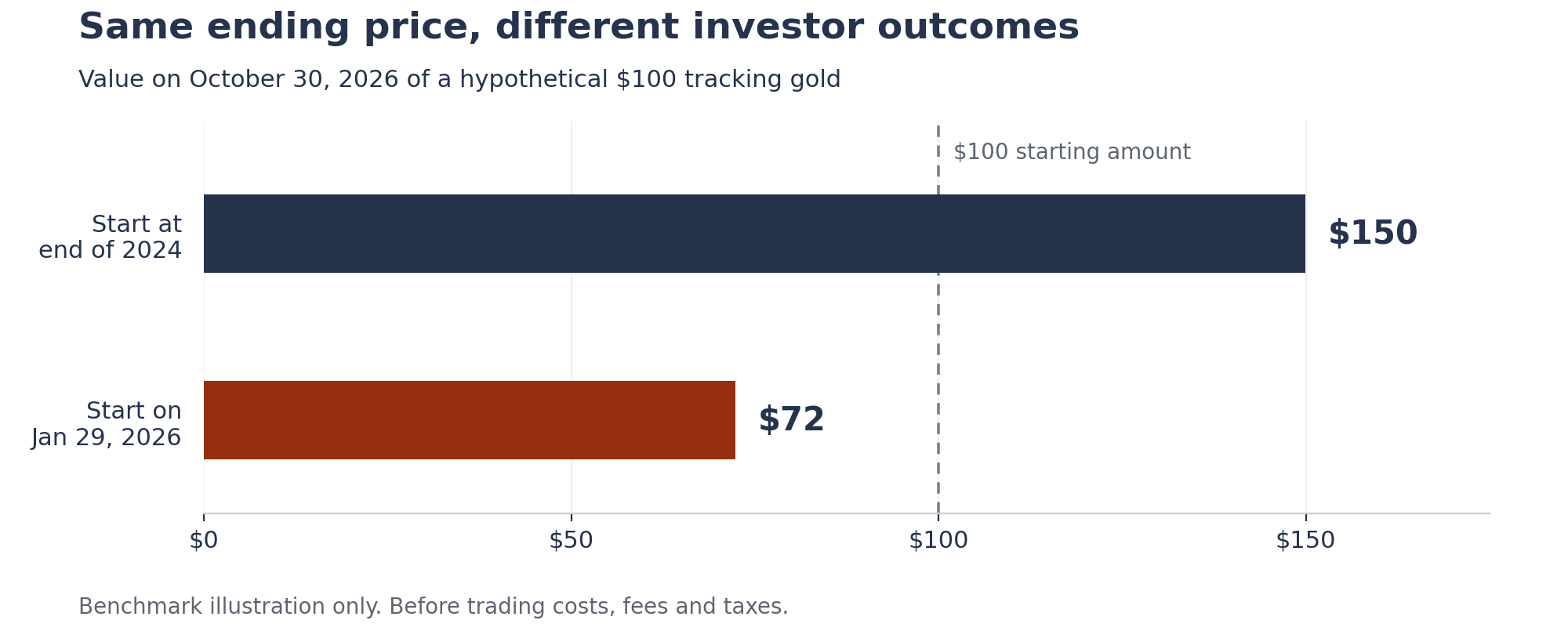
The same gold price can represent a substantial gain for one investor and a painful loss for another.
At October 30, gold remained about 50% above its end-2024 level, despite falling about 28% from January’s record. A hypothetical $100 investment tracking the benchmark from those two starting points would therefore have been worth approximately $150 or $72. This excludes trading costs, fees and taxes.4,7
Wealthion illustration using the London Bullion Market Association (LBMA) Gold Price PM in US dollars: end-2024 price $2,609.10, January 29, 2026 price $5,405 and October 30, 2026 price $3,913. Values rounded to whole dollars.4,7
The distinction also matters over decades. The chart below adjusts gold’s annual price observations for inflation, showing what each would be worth in December 2025 .4,5
Wealthion calculations using annual gold observations and the US Consumer Price Index, December values, 1972–2025. Inflation adjustment uses December 2025 dollars. Annual observations do not show every price movement within a year.4,5
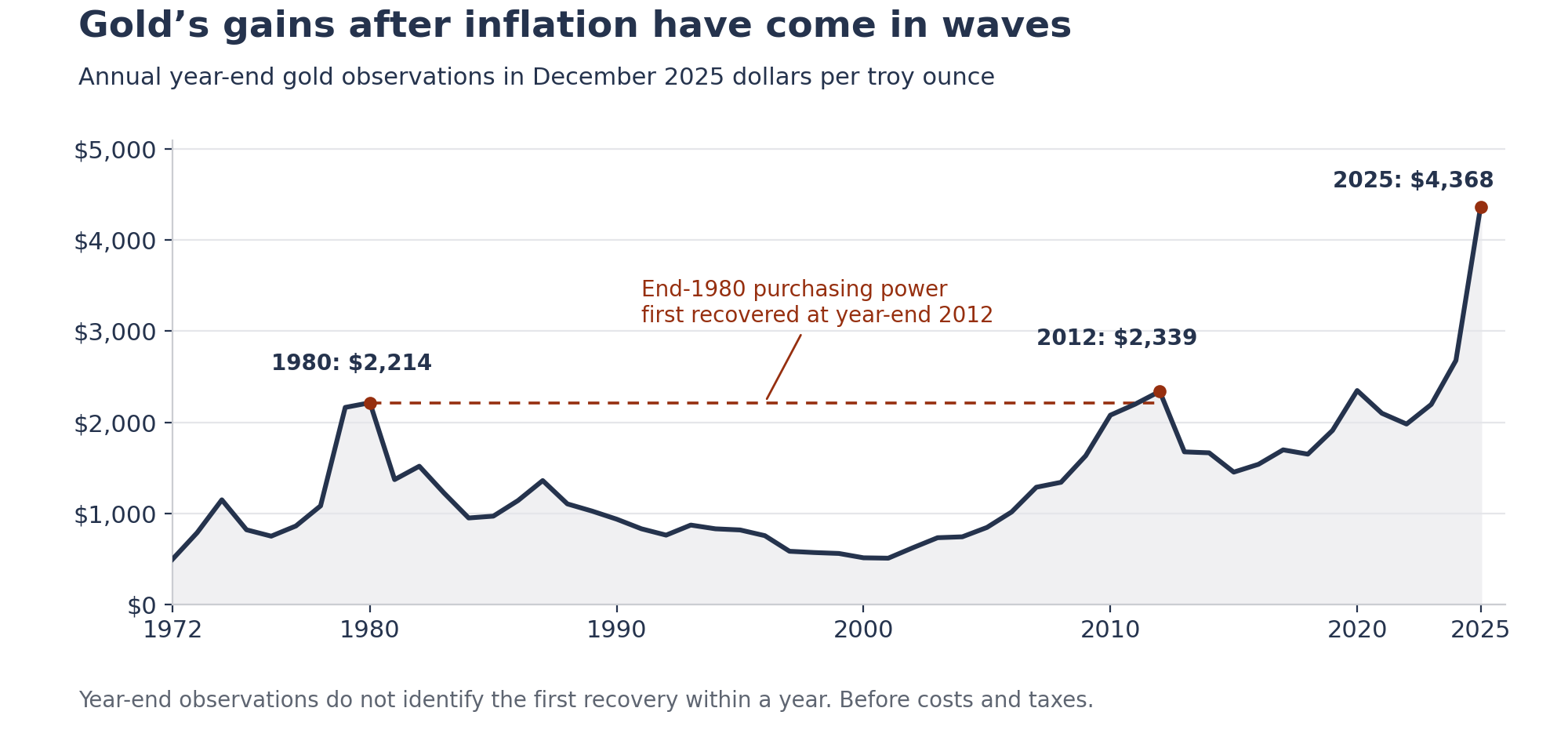
Using these year-end observations, gold first exceeded its end-1980 purchase price in 2006. After inflation, the first year-end recovery was 2012. Gold bought at the end of 2012 first recovered both its original dollar price and purchasing power at the end of 2020.4,5
Those are specific starting points, not average waiting periods. They show why a long-term store of value can still leave an individual investor waiting years. A lower price after a fall does not, by itself, establish how quickly a recovery might come.
Who is buying gold now?
Central banks remain a substantial source of demand. Their net purchases exceeded 1,000 tonnes annually in 2022, 2023 and 2024, followed by 863.3 tonnes in 2025. The World Gold Council estimates net purchases of 321.2 tonnes in the third quarter of 2026, compared with 226.3 tonnes a year earlier.13,14,15
In its 2026 survey, 89% of respondents expected global central-bank gold reserves to rise over the following year, while 45% expected their own holdings to rise. Another 74% expected the dollar’s share of global reserves to fall over five years. These are expectations, not committed purchases or a prediction that the absolute amount of dollar holdings will fall.16
Investment demand also changes. Gold ETFs added 19 tonnes in October even as the price fell.7 Buying by one group can be outweighed by selling elsewhere. Neither central-bank demand nor fund inflows establish a floor beneath the price.
What could strengthen or weaken gold’s role?
The explanation for a price move matters more than the safe-haven label. These conditions can pull gold in different directions, and several may occur together.6,8,11
| If this happens | What it could mean for gold |
|---|---|
| Bond yields rise after allowing for inflation | Gold faces stronger competition from assets that pay income. |
| Bond yields fall after allowing for inflation | The income given up by holding gold becomes smaller, which can support demand. |
| Investors expect the dollar to weaken or worry about government debt | Some may seek gold as a store of wealth outside those borrowers’ promises. |
| Investors need cash to cover losses or repay borrowing | They may sell gold along with other readily tradable assets. |
These are possible relationships, not forecasts. Gold’s 2026 decline does not erase its other roles, but it shows why a crisis alone is not enough to predict a gain.
How ownership changes the outcome
The metal’s lack of issuer risk does not make every gold investment equivalent. Physical bullion involves buying and selling spreads and may involve storage and insurance costs. Exchange-traded products have their own structures and expenses. A mining share represents a business, with operating costs and risks beyond the gold price.17,18,19
Even gold accounts differ. Allocated gold identifies specific bars owned by the customer. An unallocated account gives the customer a claim against the provider, creating credit risk.20
Gold’s value in a portfolio comes from the different risks it can address. The metal does not depend on a company meeting its earnings forecast or an issuer repaying a debt. That can matter when confidence in financial assets or currencies weakens.
The price paid still matters, as does the time available to hold it. Gold can lose value, take years to recover and produce no income along the way. For investors, understanding its role means being clear about the protection they want, the risks that remain and how their chosen form of ownership affects the outcome.
Frequently asked questions
Does a gold price recovery also restore purchasing power?
Not necessarily. If prices elsewhere have risen, recovering the original dollar amount may still leave it buying less. Inflation-adjusted returns account for that difference.5
Does gold pay any income?
The metal itself pays no dividends or interest. A gold-mining company is a separate business and may pay dividends; that does not make bullion an income-producing asset.2,19
Does central-bank buying mean gold cannot fall?
No. Central banks are one source of demand, and their buying can coincide with a falling market, as the 2026 figures show.15,7
How is gold taxed in the US?
For US individuals in taxable accounts, net long-term gains on physical gold generally face a maximum federal collectibles rate of 28%, compared with 20% for most stock gains. Certain gold-trust interests can also receive collectibles treatment. A 3.8% net investment income tax may apply; state taxes are separate.21,22
Sources & Disclosure
1 Gold as a strategic asset: 2026 edition, Introduction. World Gold Council, February 4, 2026; Gold as an asset that is no one’s liability. https://www.gold.org/goldhub/research/relevance-of-gold-as-a-strategic-asset. 2 Alternatives in a portfolio: Think role, risk, and realism. Aliaga-Díaz and Ameriks, Vanguard, May 20, 2026; Non-income-generating assets; role and risk. https://corporate.vanguard.com/content/corporatesite/us/en/corp/vemo/alternatives-in-portfolio-role-risk-realism.html. 3 Gold as a strategic asset: 2026 edition, Diversification. World Gold Council, February 4, 2026; Chart 6, weekly correlations, January 1994–December 2025; Chart 7, calendar-year 2022 comparison: FTSE All World, Bloomberg US Treasury Index and LBMA Gold Price PM, in US dollars. https://www.gold.org/goldhub/research/relevance-of-gold-as-a-strategic-asset/key-attributes-diversification. 4 Gold as a strategic asset: 2026 edition, Return. World Gold Council, February 4, 2026; Chart 5, annual LBMA Gold Price PM observations, 1972–2025. Wealthion calculations: annualized growth, annual returns, recovery observations and the $100 illustration. Price returns exclude ownership costs and taxes. https://www.gold.org/goldhub/research/gold-strategic-asset-2026-edition/20447. 5 Consumer Price Index for All Urban Consumers: All Items in US City Average (CPIAUCNS). Bureau of Labor Statistics via Federal Reserve Bank of St. Louis, accessed November 19, 2026; December observations, 1972–2025, not seasonally adjusted. Wealthion inflation adjustment: annual gold price multiplied by December 2025 CPI and divided by that year’s December CPI. https://fred.stlouisfed.org/series/CPIAUCNS. 6 Gold and silver: Price, market volatility, and what’s next. Kristy Akullian, BlackRock, iShares research, March 4, 2026; Drivers and Figure 1: S&P 500 and S&P GSCI Gold Spot Index, monthly returns 2020–2025, as of December 31, 2025. 25 negative stock months; gold positive in 40%. Gold averaged +2% in months with stock declines greater than 5%. https://www.ishares.com/us/insights/inside-the-market/gold-and-silver-investing-in-precious-metals. 7 Gold Market Commentary: Where floor art thou?. World Gold Council, November 5, 2026; Table 1 and footnote, LBMA Gold Price PM as of October 30, 2026 and January 29 record; October ETF inflows. https://www.gold.org/goldhub/research/gold-market-commentary-october-2026. 8 Is Gold Still a Safe Haven?. Morgan Stanley Research, May 5, 2026; Energy, inflation and expected interest-rate effects; real yields and gold. https://www.morganstanley.com/insights/articles/gold-prices-safe-haven-status-reality-check-iran-conflict. 9 Market Yield on US Treasury Securities at 10-Year Constant Maturity, Inflation-Indexed (DFII10). Federal Reserve Board via Federal Reserve Bank of St. Louis, accessed November 19, 2026; December 31, 2025: 1.93%; November 16, 2026: 2.92%. https://fred.stlouisfed.org/series/DFII10. 10 Gold ETF Flows: January 2026, Flows surge despite price pullback. World Gold Council, February 5, 2026; Regional overview, pullback following Kevin Warsh’s nomination. https://www.gold.org/goldhub/research/gold-etfs-holdings-and-flows/2026/02. 11 Gold Market Commentary: Anatomy of a fall. World Gold Council, April 8, 2026; March selling, global gold ETF reduction of 84 tonnes and deleveraging. https://www.gold.org/goldhub/research/gold-market-commentary-march-2026. 12 Your Portfolio Is One Big AI Bet, Rupert Mitchell. Wealthion, Rupert Mitchell interview, page published October 6, 2026; Section: Is gold’s pullback temporary or structural? Interview transcript, selling liquid assets to meet cash needs. https://www.wealthion.com/learn/your-portfolio-is-one-big-ai-bet-rupert-mitchell/. 13 Gold Demand Trends Full Year 2023, Central Banks. World Gold Council, January 31, 2024; Net purchases in 2022 and 2023. https://www.gold.org/goldhub/research/gold-demand-trends/gold-demand-trends-full-year-2023/central-banks. 14 Gold Demand Trends: Q4 and Full Year 2025, Central Banks. World Gold Council, January 29, 2026; 2024 and 2025 central banks and other institutions, net purchases. https://www.gold.org/goldhub/research/gold-demand-trends/gold-demand-trends-full-year-2025/central-banks. 15 Gold Demand Trends: Q3 2026, Central Banks. World Gold Council, November 3, 2026; Table: central banks and other institutions, estimated net purchases, Q3 2025 and Q3 2026. https://www.gold.org/goldhub/research/gold-demand-trends/gold-demand-trends-q3-2026/central-banks. 16 Central Bank Gold Reserves Survey 2026, Perspectives on gold reserves. World Gold Council and YouGov, June 16, 2026; Charts 2–4: dollar share, 73 respondents; global and own gold reserves, 74 respondents. https://www.gold.org/goldhub/research/central-bank-gold-reserves-survey-2026/perspectives-on-gold-reserves. 17 10 Things to Ask Before Buying Physical Gold, Silver, or Other Metals. Commodity Futures Trading Commission and Financial Industry Regulatory Authority, accessed November 19, 2026; Questions 6, 8 and 10: spreads, storage, insurance and investment-product costs. https://www.cftc.gov/LearnAndProtect/AdvisoriesAndArticles/Metals10Things.html. 18 Exchange-Traded Products (ETPs). US Securities and Exchange Commission, Investor.gov, accessed November 19, 2026; Fund, commodity trust and note structures. https://www.investor.gov/introduction-investing/investing-basics/glossary/exchange-traded-products-etps. 19 Stocks: FAQs. US Securities and Exchange Commission, Investor.gov, accessed November 19, 2026; Company ownership, business risks and dividends. https://www.investor.gov/introduction-investing/investing-basics/investment-products/stocks. 20 The Guide: An Introduction to the Global Precious Metals OTC Market. London Bullion Market Association, London Platinum and Palladium Market, and London Precious Metals Clearing Limited, 2017; Printed page 37, allocated and unallocated accounts and credit exposure. https://cdn.lbma.org.uk/downloads/Publications/LBMA-The-Guide-2017-v1.pdf. 21 Topic No. 409, Capital Gains and Losses. Internal Revenue Service, accessed November 19, 2026; Federal capital-gains rates and collectibles maximum rate. https://www.irs.gov/taxtopics/tc409. 22 Publication 550, Investment Income and Expenses (2025). Internal Revenue Service, accessed November 19, 2026; Chapter 4, collectibles, trust interests and holding periods; chapter 1, net investment income tax. https://www.irs.gov/publications/p550.
Wealthion is a dba of Greylock Peak Investments, a registered investment adviser. This article is general information only. It is not investment advice or an offer or solicitation, and it is not tailored to your circumstances. Guests’ views are their own and may not reflect those of Wealthion. Wealthion has not verified guest statements, including any performance figures. Investing involves risk, including loss of principal, and past performance does not guarantee future results. Wealthion refers readers to other registered investment advisers and shares in the fees they receive from referred clients, which creates a conflict of interest. Please see our Form ADV Part 2A and consult your own financial advisor before investing.
What Serious Investors Are Watching
Dive into expert interviews, market analysis, and long-form content built to help serious investors think long-term.

What’s Driving AI Stock Volatility in 2026, and What It Means for Investors
AI-stock declines can reflect changing profit expectations and selling pressure. Company results, leverage data and past recoveries help explain the differences.
Is Gold Still a Safe Haven in 2026? What It Protects Against and Its Role in a Portfolio
Gold can help protect wealth in different ways, but its price can still fall sharply. Historical evidence explains the roles, limits and importance of the purchase price.

Macro Bites – Global Leaders Meet as Copper Falls and Fed Eyes Hikes
On Thursday, Presidents Trump, Xi and Putin conducted the first-ever trilateral meeting between the world’s...
Enjoyed This? Get More Insights
Expert insights and curated opportunities, delivered to your inbox.
Ready to Position for What's Coming?
Whether you're still learning or ready to act, your next step starts here.
- Independent
- Macro-Informed
- Real Asset Focused

The Wealthion Network
By subscribing, you agree to receive Wealthion emails. Unsubscribe anytime.
The Wealthion Network
By subscribing, you agree to receive Wealthion emails. Unsubscribe anytime.
Network Discussion
Join the Wealthion Network to Comment