

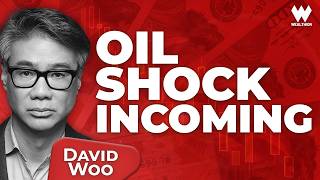
Is Oil a Good Investment? David Woo
Key Takeaways
Woo thinks Iran has an incentive to spike oil, and that would hit stocks. In his framing, Iran would like to see Brent quickly at "$100, $120," which would push the US stock market lower and force a response, so he says such a move would be "bullish oil and bearish for the stock market."
He is long oil and cautious on stocks. Woo says he is "long oil because I find it difficult to see how this thing is going to end," and is looking for a level to bet against the AI trade.
The China lever is the escalation risk markets should watch. He argues the US has nearly exhausted sanctions on Iran except targeting Chinese banks and refiners, a step that would invite retaliation and, in his view, prove bullish for oil and bearish for stocks.
He likes defense stocks. Woo points to recovering US and European defense shares amid reports of ammunition shortages and rearmament as an interesting trade for the months ahead.
His portfolio leans on uncorrelated trades. Beyond long oil, he is long bonds (calling them "very very cheap"), short the Japanese yen ("the yen is doomed"), and waiting for a level to short AI.
Key Moments
00:21 - Iran, the Strait of Hormuz and the oil shock Why Brent is soft even with Hormuz nearly closed, and what Woo expects next.
04:33 - How China could send oil higher and stocks lower The escalation lever Woo says is the key risk for markets.
08:48 - Could the U.S.-Iran conflict escalate? His read on carrier movements and the political timeline.
10:32 - Are markets underpricing the Iran risk? Why Woo thinks markets are complacent, and why others disagree.
14:17 - Russia-Ukraine: is Russia gaining momentum? Battlefield shifts and what they mean for Europe.
18:33 - Why David Woo likes defense stocks The rearmament trade he finds attractive.
21:51 - Europe's energy crisis and China trade-war risk Natural gas, drought and a possible EU-China clash this fall.
24:08 - David Woo's portfolio: oil, bonds, AI and the yen How he is positioned across the risks he describes.
Is Oil a Good Investment? David Woo on the Iran Risk That Could Shock Stocks
Whether oil is a good investment right now depends heavily on geopolitics, and strategist David Woo, founder of the research firm Unbound and speaking to Wealthion from Israel in August 2026, argues the risks point higher. His central thesis is that Iran has every incentive to push oil sharply upward, that an escalation would drag the stock market down, and that this is why he remains long oil. It is a deliberately contrarian view, and one many in the market disagree with.
Could oil hit $120, and is it a good investment now?
Woo's case starts with a puzzle: even with very little traffic getting through the Strait of Hormuz, Brent has stayed soft, around $89. His explanation is that tankers are rerouting, loading Saudi oil and heading north through the Suez Canal into Europe rather than risking the Red Sea, which has kept the European physical market from tightening. He does not expect that calm to last. In his view, Iran's objective is to "push oil price up as fast as possible," because they "would love to see a $100, $120 basically Brent right now" to knock the US stock market down and force a response. That is why he is "long oil because I find it difficult to see how this thing is going to end." His related interview history on this theme includes Wealthion's earlier Iran war panel.
Could Iran trigger a stock market shock?
This is where Woo sees the real market risk, and it runs through China. He argues the US has used nearly every economic lever against Iran except one: hitting Chinese banks and refiners that buy Iranian oil. If Washington takes that step, he expects China to retaliate using its leverage over critical minerals and refining capacity, an outcome he says would be "bullish oil and bearish for the stock market." In other words, the escalation that would most move markets may come not from the Gulf directly, but from a US-China confrontation over enforcement.
Are markets underpricing the Iran risk?
Woo thinks so, arguing markets are complacent and assuming an offramp that keeps oil lower. He reads recent carrier movements as a sign no immediate military action is planned, while noting the political window narrows heading toward the US midterms. Wealthion's host pushed back on this directly, asking whether widespread opposition to the administration is biasing investors toward assuming de-escalation, and, equally, whether Woo's own conviction cuts the other way. The balanced takeaway is that the market is pricing a resolution and lower oil, while Woo is positioned for the opposite; readers should weigh both. A related argument that the conflict has already reset markets appears in Kevin Muir's markets have changed forever.
What does a stronger Russia mean for markets?
Woo argues the Russia-Ukraine battlefield has shifted, with Russian forces gaining ground and adapting quickly to new technology, and that the deeper contest is one of innovation and engineering capacity. The market consequence he draws is for Europe: if Ukraine is weakened, European governments must either rearm significantly or seek an accommodation with Russia, both of which carry major implications for defense spending and energy.
Why does Woo like defense stocks?
Because he expects rearmament to accelerate. Woo notes that US and European defense shares have recovered on reports that the US is running low on ammunition, including a warning to major contractors to produce plans to ramp up output, which markets read as a signal of higher defense spending. He points to a leading European defense manufacturer as an example and says "defense might actually do pretty well" over the next couple of months. A complementary geopolitics-driven trade idea appears in Peter Tchir's at the sound of the guns, buy.
Is Europe facing an energy and trade crisis?
Woo is bearish on Europe in the short term for two reasons. First, energy: he notes European natural gas prices jumped about 10% in a week as drought forced reductions in nuclear and hydro generation, leaving gas storage at its lowest level in about a decade before winter has even started. Second, trade: he flags a rising risk of an EU-China trade war this fall, with both sides having set a roughly three-month ultimatum to reach a compromise. Combined with political shifts he expects across Europe, he sees the near-term picture as clearly negative.
What about gold and the dollar?
Woo is skeptical of the simplest version of the dollar-bearish, gold-bullish trade. He acknowledges many investors want to sell the dollar and buy gold on the view that US strategic difficulties will weaken it, but argues gold is ultimately a dollar trade, and with the euro and yen also weak, there is a limit to how far the dollar can fall. He attributes gold's recent rally largely to Chinese buying rather than a broad dollar collapse. This is his attributed analysis, not a recommendation.
How is David Woo positioned?
Woo describes a portfolio of uncorrelated trades. He is long oil, given the Iran risk; long bonds, calling them "very very cheap" because he does not expect the Fed to hike, sees growth slowing and little inflation; and short the Japanese yen, having faded official intervention, with the blunt view that "the yen is doomed." He also says "I want to short AI," though he is waiting for better levels rather than being short now. As always on Wealthion, this is Woo's attributed positioning, not investment advice.
What Investors Should Watch
- Red Sea tanker attacks: a resumption would be Woo's catalyst for higher oil.
- US action against Chinese banks or refiners: the escalation lever he says would be bullish oil and bearish stocks.
- Carrier deployments and the midterm timeline: his gauge of escalation odds.
- European natural gas and storage: prices and inventories heading into winter.
- The Japanese yen and official intervention: the trade he is currently expressing.
FAQ
Is oil a good investment right now? David Woo is long oil and views it as attractive given the risk of Middle East escalation. He argues Iran has an incentive to push oil sharply higher and that he finds it hard to see the conflict resolving soon. This is his attributed view, not advice, and many in the market expect oil to move lower instead.
Could oil hit $120? Woo believes Iran would like to see Brent quickly at $100 to $120 to pressure the US stock market and force a response. He notes oil has stayed soft, near $89, because tankers are rerouting through the Suez Canal, but expects that to change if Red Sea attacks resume.
Could Iran trigger a stock market shock? In Woo's view the key risk is a US move against Chinese banks and refiners buying Iranian oil, which he expects would prompt Chinese retaliation, an outcome he calls bullish for oil and bearish for stocks.
Why does Woo like defense stocks? He points to recovering US and European defense shares amid reports of ammunition shortages and rearmament, and says defense could perform well in the coming months.
How is David Woo positioned? Woo says he is long oil, long bonds (which he calls very cheap), short the Japanese yen, and looking for a level to short the AI trade. He frames these as uncorrelated trades to express his views.
Which expert and interview does this article reference? This article draws on Wealthion's interview with strategist David Woo, founder of Unbound: "Oil to $120? Iran Could Trigger the Next Stock Market Shock."
Full Transcript (cleaned)
Speakers: Maggie Lake (Wealthion host) and David Woo (founder, Unbound). ASR errors corrected and filler removed; meaning preserved. This interview contained extensive inflammatory political and personal rhetoric, including violent commentary about public figures; that material has been removed, and what remains is Woo's market and geopolitical analysis, attributed to him. A mid-interview membership message has been noted rather than reproduced.
David Woo (cold open): They would love to see $100, $120 Brent right now. If they do that, that's bullish oil and that's bearish for the stock market. I'm long oil because I find it difficult to see how this thing is going to end.
Maggie Lake: You're in Israel. What's the state of the situation with Iran and the Strait of Hormuz? The US strategy right now seems to be economic pressure rather than military action. Can that succeed?
David Woo: I've been trading oil from the long side and I'm still long, so I've made money, though not as much as I'd have liked, because even with oil up recently it's nowhere near what we saw in March and April. The real question is, with the negotiation collapsing, why is Brent still around $89 and WTI even lower? We know very little is getting through the Strait of Hormuz officially. There may be small ships siphoning some oil across, but I'm not convinced that's the story. What we've seen over the past two weeks is a pickup in tankers crossing into the Mediterranean from the Suez Canal. Since around August 5th the Houthis haven't attacked a tanker in the Red Sea, so the assumption is that many tankers turn off their transponders, and rather than head south, which is vulnerable, they load Saudi oil and go north into Europe. That's why the European physical crude market isn't especially tight. So the near-term question is whether Washington can say this is working, oil in the 80s while Iran stays under blockade, which requires the Houthis not resuming attacks. From Iran's standpoint, they don't want a prolonged stalemate; their objective is to push oil up as fast and as much as possible, because they'd love $100 to $120 Brent to push the US stock market down and force a response. So I'd assume they lean on proxies to resume Red Sea attacks fairly soon. If that happens, it supports my long-oil view; if it doesn't, something else may be going on that would make me reconsider.
David Woo: The second, and maybe more important, factor is what the US does next. At this point Washington has used nearly every economic lever except targeting Chinese banks and refiners with large fines for buying Iranian oil. So either the next move has no teeth, or it takes the battle to China, and if it does that, that's bullish oil and bearish for the stock market.
Maggie Lake: The Chinese have made clear they'll use their leverage in minerals and refining, so it's hard to see how the US pressures them without retaliation.
David Woo: I agree, and that's exactly why it would be bearish for stocks. It's clear the US isn't ready to move militarily right now, given the carrier movements, so it seems the administration has become reconciled to economic pressure for now. There's a broader market narrative that some investors want to sell the dollar and buy gold on the view that a US strategic setback is inevitable, and it's hard to fully dismiss that thinking, though I'd be cautious about it.
Maggie Lake: [Membership message noted.] There's a lot of rhetoric around selling the dollar, but when people tried that earlier this year it didn't work. Is there an anti-administration bias blinding investors to other outcomes?
David Woo: Possibly, in both directions. I'd note that senior US military advice, as publicly discussed, has been that an air campaign alone cannot achieve the objectives, so the choice is essentially to step back or to escalate significantly. Markets seem to assume an offramp. I'd just say the window narrows as we approach the midterms, and politically there's an argument that resolving the Iran situation decisively would matter for the administration's standing. What's clear is that markets are treating a de-escalation as the base case, and I'm positioned for the opposite.
Maggie Lake: With so much attention on Iran, are we underappreciating Ukraine? Ukraine has been striking deep into Russia, hitting refineries.
David Woo: That's true, but the more important story is on the ground. The last six weeks have been remarkable in terms of the speed of Russian advances. Earlier this year the Russians were inching forward with difficulty, partly because Ukraine had raised its drone capabilities over the winter. But recently the Russians have broken through hardened defenses, not just in the Donbas but in the south around Zaporizhzhia, and are pressing in the north around Sumy and Kharkiv while bombing Odessa. What matters is the ground situation, because it shapes any negotiation. Ukraine's former commander-in-chief, Valeriy Zaluzhny, gave a speech last week noting how effectively the Russians adapt: NATO sends ever more sophisticated weapons, and within three to six months the Russians figure out how to counter them. The latest is new Russian tanks with anti-drone capabilities that reportedly require many drones to disable. The deeper point is that this contest, like the broader rivalry with China, comes down to innovation and engineering capacity.
David Woo: For investors, defense stocks have been recovering over the last couple of weeks, ever since reports that the US is running low on ammunition and that major contractors were asked to produce plans within 21 days to ramp up production. A premier European defense manufacturer has also been recovering. I actually think defense might do pretty well over the next couple of months.
Maggie Lake: In a world where Russia makes those gains, are we looking at a more powerful Russia, and what does that mean for commodity prices?
David Woo: A lot depends on how Europe reacts, because Europe sees Ukraine as a buffer. If Ukraine is debilitated, Europe must either make peace with Russia or ramp up defense spending even more. Politically, I think the ascendancy of the right in Europe is hard to stop, which over time means a more pro-Russia tilt and complications for the US, though it will take time.
Maggie Lake: Do you like European assets, or is Europe a risk?
David Woo: In the short term, very negative. European natural gas prices rose about 10% last week alone, partly because drought is forcing reductions in nuclear and hydro generation, and gas storage is already at its lowest level in about ten years before winter. On top of that, there's a real chance of an EU-China trade war this fall; both sides have set roughly a three-month ultimatum to find a compromise, and right now both look uncompromising. This is also part of why gold has struggled: gold is ultimately a dollar trade, and with the euro and yen both weak, there's a limit to how far the dollar can fall. The recent gold rally has been driven largely by Chinese buying; without that, it probably wouldn't have gone as far.
Maggie Lake: With all this risk, where do you hedge? What's the hedge in your portfolio?
David Woo: My fundamental view is that I want to short the AI trade, though I'm not short at this moment; I'm looking for better levels. Two, I'm long oil, because I find it difficult to see how this ends. Three, I think bonds are very, very cheap: looking at five-year yields, given everything going on, I don't believe the Fed is going to hike, I don't see inflation, and I think growth is actually slowing, so I like being long bonds. And I've been short the Japanese yen over the last couple of weeks; once officials started intervening, I decided to sell some, and so far it's worked. I think the yen is doomed longer term. The idea is to find uncorrelated trades to express these views.
Maggie Lake: Fascinating stuff, David. It's always a pleasure to catch up with you.
David Woo: Thank you so much for having me back, Maggie. Always a pleasure.
What Serious Investors Are Watching
Dive into expert interviews, market analysis, and long-form content built to help serious investors think long-term.
Is the US Economy in a Recession? David Rosenberg
Key Takeaways Rosenberg says the economy is far weaker than record markets suggest. He argues...
Why Is Gold Going Up? Grant Williams
Key Takeaways Williams says gold's rise is really about falling currency values. In his framing,...
Is Oil a Good Investment? David Woo
Key Takeaways Woo thinks Iran has an incentive to spike oil, and that would hit...
Enjoyed This? Get More Insights
Expert insights and curated opportunities, delivered to your inbox.
Ready to Position for What's Coming?
Whether you're still learning or ready to act, your next step starts here.
- Independent
- Macro-Informed
- Real Asset Focused

The Wealthion Network
Stay ahead of the curve. Subscribe to Wealthion’s newsletter and get timely videos, articles, and alerts featuring insights from the world’s leading experts in investing and wealth-building.
Network Discussion
Sign in to share your thoughts and connect with other readers.
Join the Wealthion Network to Comment