

Rare-Earth Mining: Where the Investment Case Depends on Processing
Digging rare earths out of the ground is the easy part to picture. The harder, more concentrated and more expensive part is turning rock into something a carmaker will buy. That is where the investment case is decided.
The numbers at a glance
Why is rare earth mining only half the business?
A rare earth miner can book tens of millions of dollars of income without selling a single extra metric ton of ore. MP Materials did. It runs the Mountain Pass rare earth mine in California, and in the first half of 2026 it booked $59.9 million of income under a price floor paid by the Pentagon 3.
The floor was agreed in July 2025. It guarantees $110 per kilogram for NdPr, the main rare earths used in magnets 1. In practice, the government pays MP the shortfall between $110 and a benchmark market price. The US Geological Survey (USGS) puts the 2025 average market price of NdPr oxide at $69 per kilogram 2. An oxide is the powder form in which rare earths are usually sold.
That gap captures the economics. Digging ore is the familiar part. For the magnet-focused projects examined here, important sources of value and risk sit in the steps that turn a mixed concentrate into separated oxides, metals, magnets and finally a part that a carmaker or defense contractor has approved.
Those later steps are also where supply is most concentrated. The International Energy Agency (IEA), an intergovernmental energy research body, says China accounts for around 60% of mined magnet rare earths, more than 90% of refining and almost 95% of permanent magnet production 4. A deposit outside China can be large and still lack a profitable route to a buyer.
The rest of this article follows that route in order: the steps after the mine, who controls them, which elements pay, how deals are being struck, and why a big resource is not yet a business.
What happens between a rare-earth deposit and a paying customer?
The magnet supply chain has six stages from deposit to qualified end product. Each can stall supply, but an individual miner can sell concentrate without carrying out every stage itself 1.
The bottlenecks sit after the mine: separation and magnet making
The six stages across the magnet supply chain. Shaded stages are where capacity outside China is thinnest. 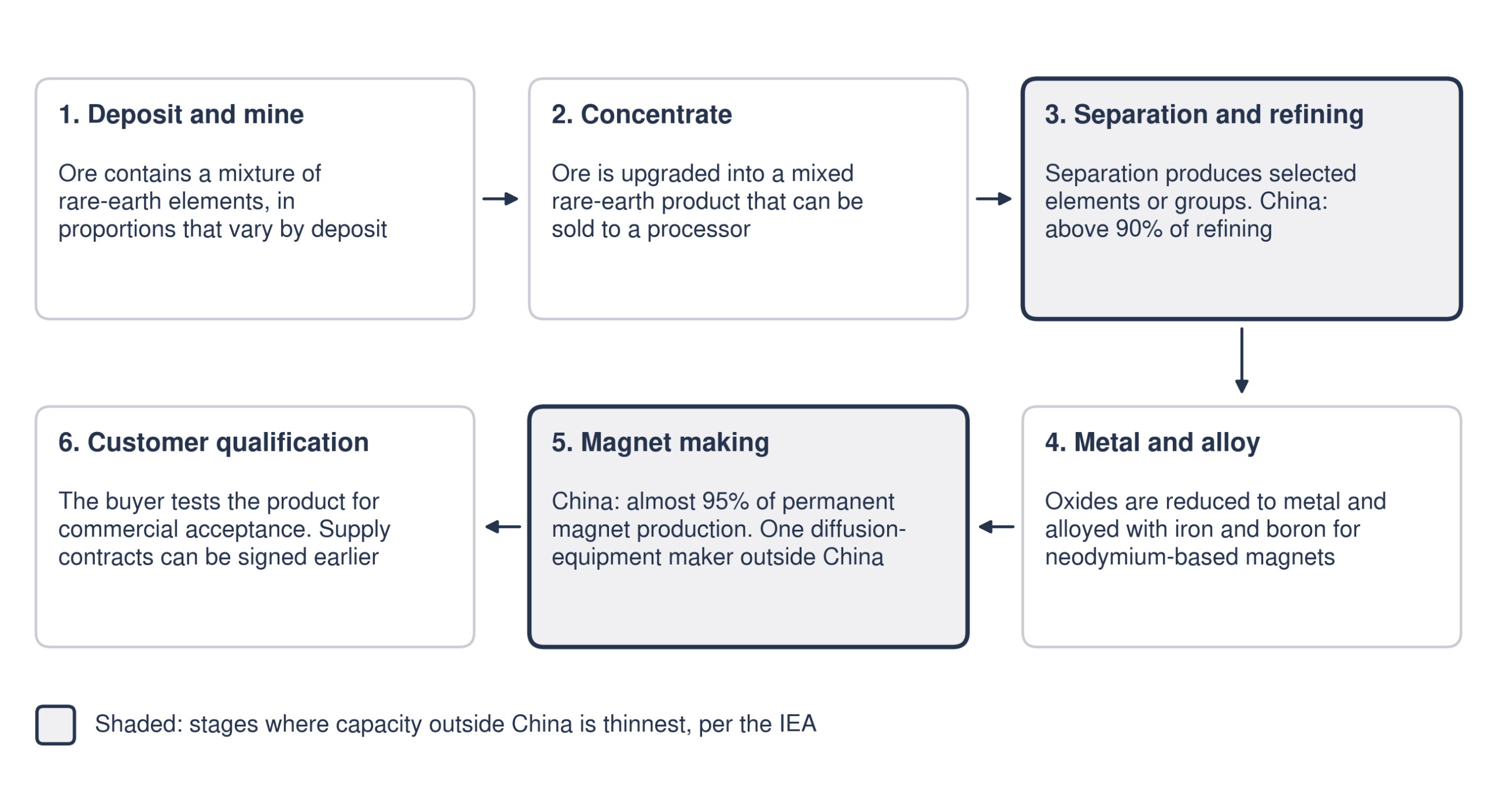
Wealthion illustration based on IEA 2026 4 6. China's shares are the IEA's rounded descriptions.
Four things matter along this supply chain: separation, magnet making, the money to build them, and qualification.
Separation is chemistry, not digging. Ore holds a mixture of rare-earth elements, and a separation plant separates selected elements or groups into saleable products. Lynas, the Australian producer, does this at its plant in Kuantan, Malaysia, which also makes heavy rare earth products 7.
Magnet making has its own chokepoint. Grain boundary diffusion, a technique that improves magnet performance, is heavily patented. The IEA says only one equipment supplier exists outside China, and its equipment reportedly costs more than ten times as much 6.
The money follows the bottlenecks. The IEA estimates that building diversified supply chains needs around $60 billion of investment over the next decade. It says existing and announced projects outside China would by 2035 cover only about half of mining requirements, about a quarter of refining needs and less than a fifth of magnet demand outside China 4.
Qualification is the last gate for the finished magnet. This means proving to a buyer that the product works. In September 2025, Energy Fuels said 1.2 metric tons of its US-made NdPr oxide had become about 3.0 metric tons of magnets that passed quality benchmarks for electric-vehicle drive motors. The announcement included no supply contract. The parties said only that they intend to negotiate one 8.
A project that has cleared only the first stage has not yet shown it can supply qualified magnets. It may still earn revenue by selling concentrate 1.
Who controls rare-earth processing today?
China's share grows at each step away from the mine. Existing and announced capacity outside China would cover a smaller share of projected needs at each later stage by 2035 4.
China's share rises downstream, while projected demand coverage outside China falls
Left: China's share of each stage. Right: share of needs outside China that existing and announced capacity would cover by 2035.
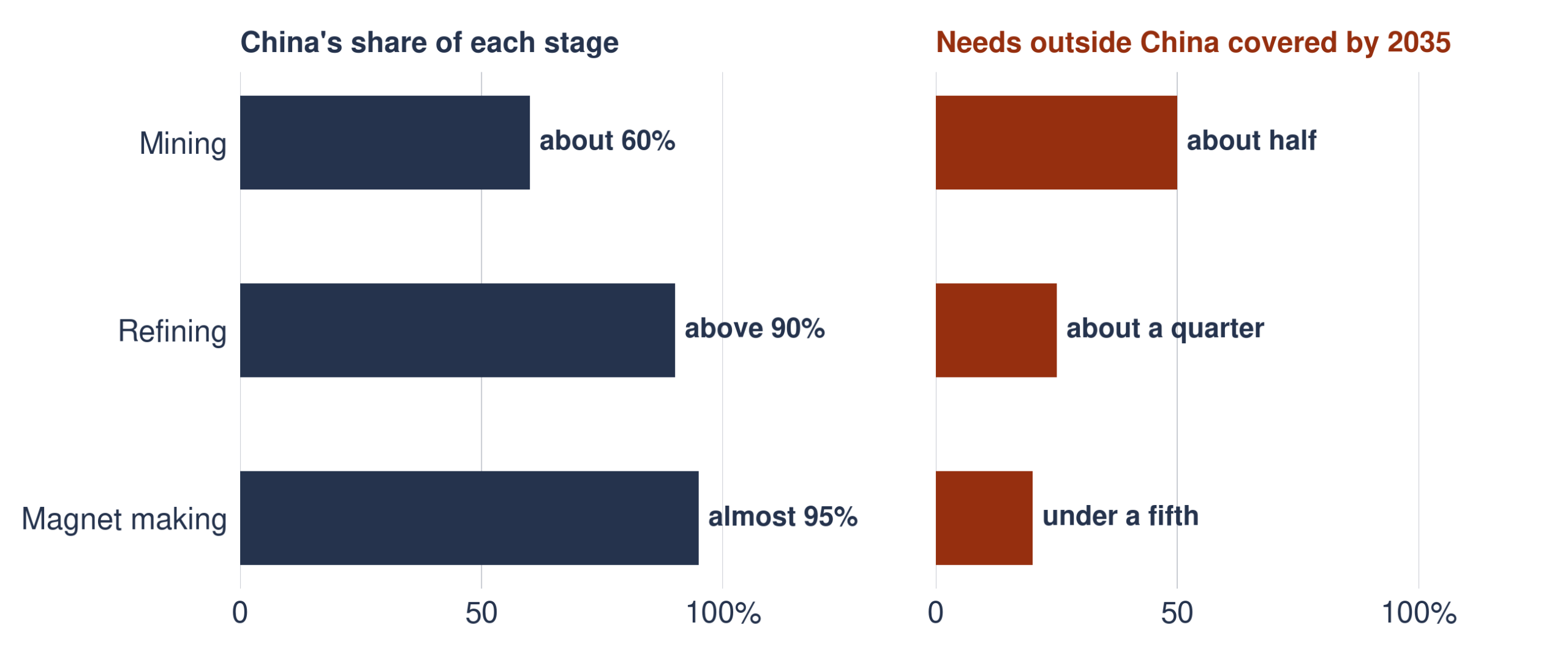
IEA, 2026 4. China shares: about 60% of mined magnet rare earths, above 90% of refining, almost 95% of permanent magnet production. Coverage by 2035: about half of mining requirements, about a quarter of refining needs, less than a fifth of magnet demand outside China. Bars for "above", "almost" and "under" are drawn at the rounded value.
The left panel uses the IEA's measure of magnet rare earths. The USGS uses a broader rare-earth production series and puts China at 270,000 of 390,000 metric tons mined in 2025, about 69% on Wealthion's arithmetic 2. Either way, mining is the least concentrated stage.
Trade policy sits on top of that concentration. In April 2025, China tightened export controls on several medium and heavy rare earths, including dysprosium and terbium, and those controls were still in force when the USGS reported in February 2026 2. The wider October 2025 expansion was suspended in November 2025 9.
Why does the mix of minerals matter as much as the tonnage?
A rare-earth deposit gives a fixed basket of elements, and the miner does not get to choose. Prices across the basket differ widely. The USGS puts 2025 average prices at $69 per kilogram for NdPr oxide, $1.71 for cerium oxide and $1.00 for lanthanum oxide 2. On Wealthion's arithmetic, a metric ton of NdPr oxide has about 40 times the market price of the same mass of cerium oxide. Yet the cerium still has to be mined, separated and then sold or stored.
Heavy rare earths add a second layer. Dysprosium and terbium are heavy elements that help magnets keep working at high temperatures. Iluka's Eneabba refinery in Western Australia is designed to make 23,000 metric tons a year of rare earth oxides, including 5,500 metric tons of NdPr and 750 metric tons of dysprosium and terbium 10.
Filling that heavy capacity depends on feed, the ore or concentrate that goes into the plant. Iluka's illustrative case using only its own operational feed gives about 180 metric tons a year of dysprosium and terbium. Its higher cases include additional feed from its own Wimmera project and third-party sources. As of November 2, 2026, VHM Goschen, Iluka Wimmera and Northern Minerals Wolverine had not reached final investment decisions 10.
Smaller elements are starting to win contracts of their own. MP issued a $150 million loan note to the Pentagon in August 2025 to expand heavy rare earth separation, which its filing calls the Samarium Project Loan 11. In the second quarter of 2026, MP also reported a long-term offtake agreement for separated gadolinium with an American aerospace and defense customer, without disclosing terms 3. An offtake is a contract in which a buyer agrees to take a producer's output. Such contracts favor producers that can separate elements, not those that only mine them.
How do qualification, offtakes and government support decide whether a project works?
A separated oxide needs a buyer, agreed commercial terms and money to keep the producer operating. Qualification tests whether the product meets the buyer's requirements, but contracts can be signed before testing is complete 1. Recent deals show how each is being handled.
Testing. Qualification takes time, even for an established producer. MP began manufacturing neodymium-iron-boron magnets in December 2025 11. In the second quarter of 2026 its chief executive said magnet qualification advanced through additional deliveries for customer qualification and regulatory testing. The company also reported $14.4 million of start-up costs in the quarter 3.
Contracts. Offtakes turn testing into revenue. Iluka's first, with an unnamed automaker, is take-or-pay, with that protection covering 90% of the contracted material volume, meaning the buyer pays for that volume even if it does not take delivery. Its pricing is linked to the higher of agreed minimum prices or market-linked prices 5 10. Lynas's revised deal with Japan Australia Rare Earths (JARE) adds a sharing rule: above US$150 per kilogram, Lynas pays JARE 30% of the upside, capped at US$10 million a year. JARE also committed to buy the equivalent of half of Lynas's heavy rare earth oxides, and the agreement has an annual review 12.
Government money. The Pentagon's July 2025 deal with MP includes a $400 million equity investment. Once MP's planned 10X magnet plant reaches full production capacity, the government is also entitled to 30% of the amount by which the NdPr benchmark price exceeds $110 per kilogram 1 11. In Australia, Iluka's refinery has an estimated capital cost of A$1.7 billion to A$1.8 billion and is backed by a non-recourse loan, meaning the lender can look only to the project for repayment. Commissioning is scheduled for mid-2027 13.
Side by side, the three deals follow the same pattern: a committed buyer, a price floor or minimum revenue, and the state standing behind the project.
The three deals side by side
Who is committed and what is locked in.
| Deal | Who is committed | What is locked in |
|---|---|---|
| MP Materials (United States), July 2025 | Pentagon | A $110 per kilogram NdPr floor for 10 years. A promise to buy all magnets from MP's planned 10X plant for 10 years. A $400 million equity investment 1. |
| Lynas (Australia), March 2026 | JARE, buying for Japanese industry | A firm purchase of 5,000 metric tons of NdPr a year until 2038, with a US$110 per kilogram floor 12. |
| Iluka (Australia), June 2026 | An unnamed global automaker, plus the Australian government as lender | 1,200 metric tons of magnet rare earth oxides over four years from 2028; US$155 million at minimum prices for the full volume, with take-or-pay covering 90% of material volume 5. A government loan of A$1.65 billion for the refinery 13. |
The 10X plant sits at the center of MP's deal. The Pentagon agreed to buy all of its magnet output for ten years from commercial operation, and MP can pass up to all of that production to commercial buyers with the government's consent 1.
Why doesn't a large rare-earth resource guarantee a profitable business?
Because a resource only answers the first question. Three gaps sit between rock in the ground and profit: processing, price and proof of profit.
Gap one: processing. Reserves estimate material that could be economically extracted at the time of determination. They do not establish that processing facilities or buyer relationships are already operating 2. By USGS estimates, Vietnam holds 3.5 million metric tons of rare-earth oxide reserves but mined about 150 metric tons in 2025 2. Reserve figures are estimates drawn from each country's own reporting, so comparisons between countries are rough. Mining output does not guarantee processing either. The US mined 51,000 metric tons of rare-earth oxide in 2025, about 13% of world output on Wealthion's arithmetic. Yet China supplied 71% of US imports of rare-earth compounds and metals from 2021 to 2024, a share that includes Hong Kong 2.
Gap two: price. USGS data put average NdPr oxide prices at $124 per kilogram in 2022, $55 in 2024 and an estimated $69 in 2025 2. The floors in the MP and Lynas agreements sit at $110, well above the 2025 average. For the projects with these agreements, the floors change the prices received under the covered sales 1 12.
The 2025 market price sat well below the $110 floors
Average NdPr oxide price per kilogram. The dashed line is the floor in the MP and Lynas agreements.
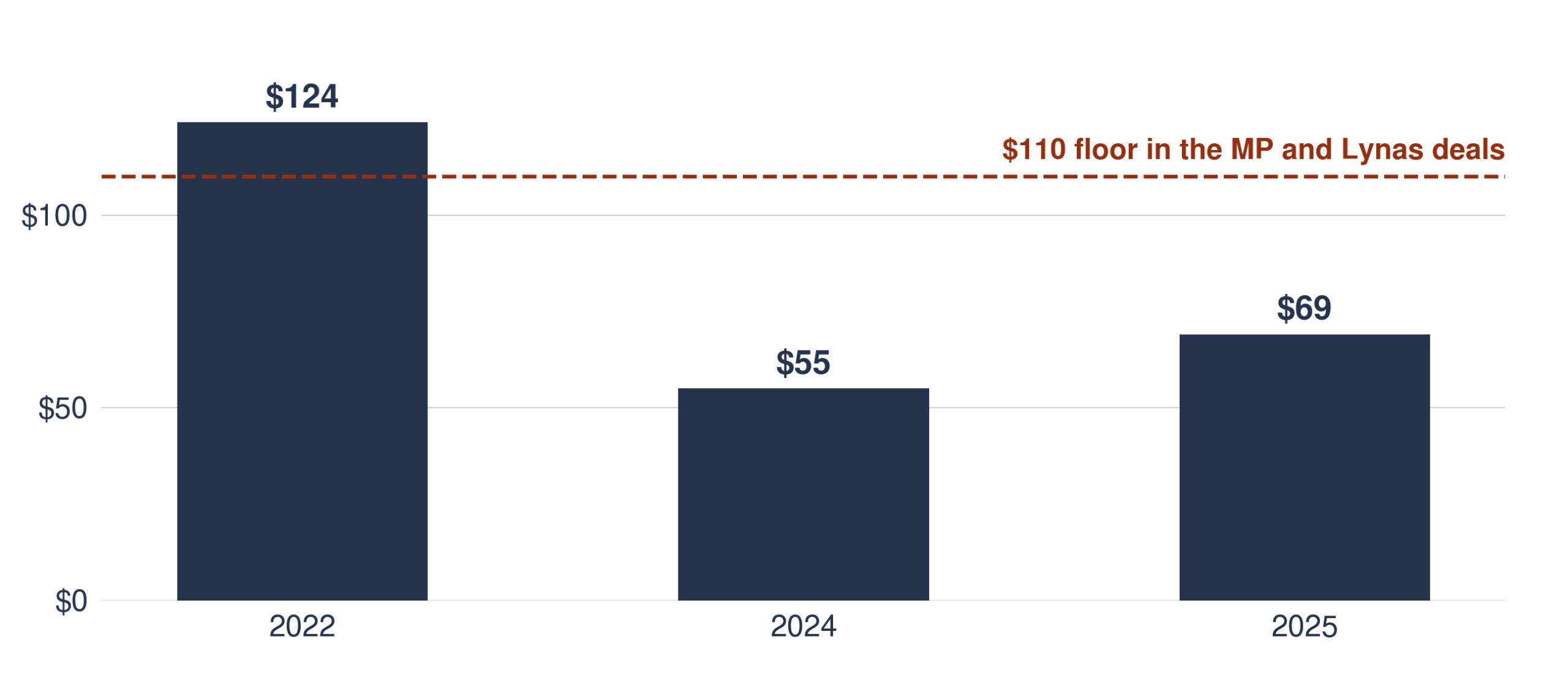
USGS average NdPr oxide price, 99% minimum, free on board: 2022, 2024 and 2025 (estimated) 2. Floor of $110 per kilogram 1 12.
Gap three: profit. A floor does not guarantee a profit. In the second quarter of 2026, MP recorded $17.6 million of floor income and still reported a $20.3 million net loss, as magnet start-up costs ran through its results 3.
The strongest counterargument is that rare earth economics are being rebuilt by policy. Floors, government equity, state loans and take-or-pay offtakes now span the US, Japan and Australia. Demand is growing too: the IEA says magnet rare earth demand has doubled since 2015 and projects an increase of more than 30% by 2030 4. The IEA also notes that tripling rare earth prices would raise the cost of a car by only about 0.1%, because rare earths are around 40% of permanent magnet costs but under 1% of a car's value 6.
That support is real but narrow. It attaches to named plants and comes with conditions, such as the annual review in the Lynas and JARE agreement 12. Capacity outside China still has far to go, as the IEA's 2035 coverage figures show 4.
Processing capacity and buyer contracts are central to the magnet-focused projects examined here. A large resource alone does not establish a profitable route to market: the outcome also depends on the element mix, processing costs and commercial terms. A miner can sell concentrate without making magnets itself 1. This article describes what the sources show. It makes no investment recommendation.
Frequently asked questions
What is rare earth mining? It is the extraction of ore containing some of the 17 rare-earth elements, followed by upgrading it into a mixed concentrate. The concentrate can be sold to a processor. Further processing separates selected elements or groups before metal and magnet production 7.
Why is separation the bottleneck? Separation needs specialized chemical plants, and the IEA says China holds more than 90% of refining. Existing and announced capacity outside China would meet only about a quarter of refining needs by 2035 4.
What is an NdPr price floor? It is a contract term that sets a minimum price for neodymium-praseodymium. In MP's case the Pentagon pays any shortfall below $110 per kilogram 1. In Lynas's case the floor of US$110 applies to sales to Japanese industry 12.
Does a bigger deposit mean a better project? Not by itself. For magnet-focused projects, revenue depends on the element mix, processing access and buyer terms. A miner can sell concentrate without qualifying a finished magnet itself 1. Vietnam's large reserves and tiny 2025 output show the gap 2.
Sources
1 MP Materials Corp. Form 8-K. MP Materials / US Securities and Exchange Commission, July 10, 2025 (event date July 9, 2025); $400 million preferred stock investment, $110/kg price protection and 10-year term, 30% upside share after 10X reaches full capacity, 10X magnet offtake and consent rights, $150 million Samarium Project Loan. 2 Mineral Commodity Summaries 2026: Rare Earths. US Geological Survey, February 2026; 2025 mine production and reserves by country, 2022, 2024 and 2025 oxide prices, 2025 basket prices, US import sources, China export-control timeline. Appendix C, reserves definition. 3 MP Materials Reports Second Quarter 2026 Results. MP Materials, August 6, 2026; price-floor income ($17.6 million in the second quarter, $59.9 million in the first half), second-quarter net loss, magnet start-up costs, qualification deliveries, gadolinium offtake. 4 New projects, partnerships and policies are needed to address supply chain risks for rare earth elements. International Energy Agency (IEA), April 8, 2026; China concentration shares, approximately $60 billion investment need, 2035 demand coverage outside China, and demand growth. Also: Rare Earth Elements: Pathways to Secure and Diversified Supply Chains, April 2026; supply-chain stages. 5 Rare earths offtake agreement. Iluka Resources, June 22, 2026; 1,200 metric tons over four years from 2028; US$155 million for full-volume sales at minimum prices; footnote 3 limits take-or-pay coverage to 90% of material volume. 6 Global Critical Minerals Outlook 2026, Executive summary. International Energy Agency, 2026; grain boundary diffusion patents and equipment supplier, rare-earth share of magnet and vehicle costs, and modeled effect of tripled rare-earth prices on vehicle cost. 7 Kuantan, Malaysia. Lynas Rare Earths, company operations page, accessed November 5, 2026; separation of groups and individual elements, product finishing, and light and heavy rare-earth products. 8 U.S. Mined and Processed Rare Earths Successfully Manufactured into Permanent Magnets for Use in EVs and Hybrids. Energy Fuels, September 9, 2025; magnet trial volumes and the absence of a supply agreement. 9 Announcement No. 70 of 2025. Ministry of Commerce and General Administration of Customs of China, November 7, 2025; suspension of the specified October 2025 export-control measures. 10 Eneabba rare earths refinery investor site visit. Iluka Resources, November 2, 2026; slides 7 and 9-10, refinery capacity, internal and third-party feed sources, illustrative production blends and project investment-decision status. 11 MP Materials Corp. Form 10-Q for the quarter ended March 31, 2026. MP Materials / Securities and Exchange Commission (SEC), 2026; Note 3, benchmark-based price protection and upside-sharing terms; Note 9, US$150 million Samarium Project Loan issued in August 2025; December 2025 start of magnet manufacturing. 12 Lynas and JARE revised agreement (Australian Securities Exchange announcement). Lynas Rare Earths, March 10, 2026; JARE's 5,000 metric tons a year commitment, term to 2038, US$110/kg floor, upside share and cap, heavy rare earth commitment, annual review. 13 Rare earths update. Iluka Resources, June 22, 2026; A$1.65 billion non-recourse loan through Export Finance Australia, A$1.7 billion to A$1.8 billion capital estimate, and mid-2027 commissioning schedule.
Wealthion is a dba of Greylock Peak Investments, a registered investment adviser. This article is general information only. It is not investment advice or an offer or solicitation, and it is not tailored to your circumstances. Guests’ views are their own and may not reflect those of Wealthion. Wealthion has not verified guest statements, including any performance figures. Investing involves risk, including loss of principal, and past performance does not guarantee future results. Wealthion refers readers to other registered investment advisers and shares in the fees they receive from referred clients, which creates a conflict of interest. Please see our Form ADV Part 2A and consult your own financial advisor before investing.
What Serious Investors Are Watching
Dive into expert interviews, market analysis, and long-form content built to help serious investors think long-term.
Rare-Earth Mining: Where the Investment Case Depends on Processing
Digging rare earths out of the ground is the easy part to picture. The harder,...
Silver Supply: Why Higher Prices Don’t Quickly Increase Production
Silver hit record prices, yet mine output is forecast to stay flat. Most silver is...
America Has Plenty of Natural Gas. What Could Make It More Expensive?
The US produces more gas than ever, and exports now take a large and growing...
Enjoyed This? Get More Insights
Expert insights and curated opportunities, delivered to your inbox.
Ready to Position for What's Coming?
Whether you're still learning or ready to act, your next step starts here.
- Independent
- Macro-Informed
- Real Asset Focused

The Wealthion Network
By subscribing, you agree to receive Wealthion emails. Unsubscribe anytime.
The Wealthion Network
By subscribing, you agree to receive Wealthion emails. Unsubscribe anytime.
Network Discussion
Join the Wealthion Network to Comment