

Silver Supply: Why Higher Prices Don’t Quickly Increase Production
Silver hit record prices, yet mine output is forecast to stay flat. Most silver is a by-product of other metals, so its price is one of several factors behind what comes out of the ground.
The numbers at a glance
Why hasn't record silver brought a flood of new mine supply?
Silver's London price averaged $40.03 an ounce in 2025, and the London Bullion Market Association (LBMA) recorded a 2026 high of $118.45 on January 29 2 1. Yet Metals Focus, the research firm behind the Silver Institute's World Silver Survey, forecasts 2026 mine output slipping 0.3% to 844.1 million ounces (Moz) 2. That gap between price and production sits behind much of the talk of a silver shortage.
The main reason is how silver is mined. Nearly three-quarters of it comes out of the ground at mines run for lead, zinc, copper or gold 2. Those mines are planned around their main metal, but silver's price also affects their combined revenue and economics.
The price has also swung hard since the forecast. LBMA data put silver at $60.73 on September 30, 2026 1. On Wealthion's arithmetic, that is about half the January high. The Metals Focus figures cited here were published in April 2026, so they predate the later slide.
Where does mined silver actually come from?
Lead and zinc mines were the largest single source of mined silver in 2025, at 249.1 Moz 2. Copper and gold mines together added another 372 Moz. Primary silver mines, where silver is the main product, supplied 221.1 Moz.
Most mined silver is a by-product
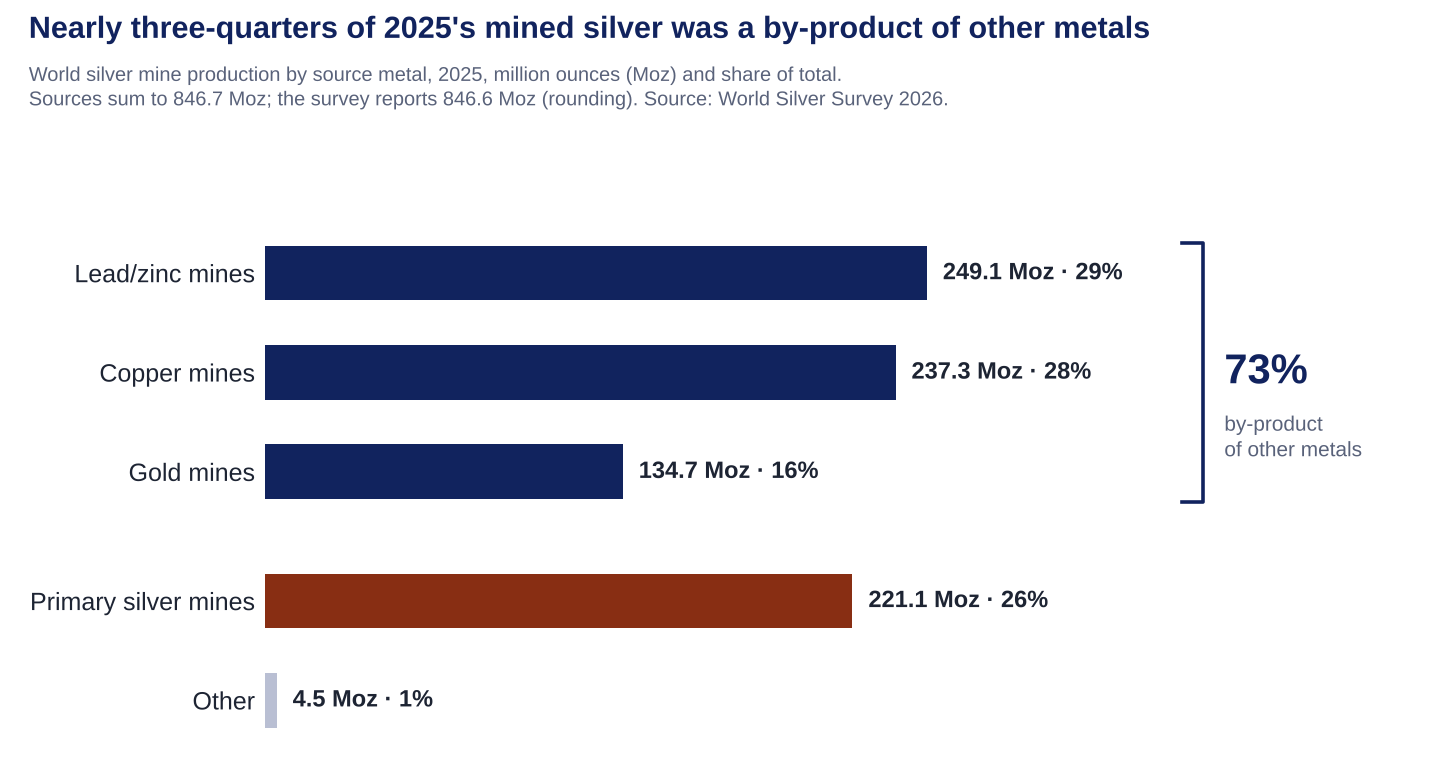
Source totals by mine type from the World Silver Survey 2026 [2]. The 73% is lead and zinc, copper and gold mines combined (621.1 Moz of 846.7 Moz), Wealthion's addition; primary silver mines supplied 26%.
Primary silver output fell for a third straight year, and its share of supply dropped to a new low of 26% 2. Metals Focus attributes the decline to closures from reserve depletion and lower output at several large operations. By contrast, by-product silver from copper mines has grown at a 2% compound annual rate, meaning an equivalent annual growth rate of 2% over the period, since 2016.
The US follows the same pattern. The US Geological Survey (USGS) estimates US mines produced about 1,100 metric tons of silver in 2025, from 4 silver mines and 31 base- and precious-metal operations that produced silver as a by-product or co-product 3. The USGS also says polymetallic deposits, which hold several metals, account for more than two-thirds of US and world silver resources.
This mix is why forecasts of mined silver lean heavily on mine plans for copper, zinc, lead and gold. It also explains why total mine output can rise while primary silver output falls, as it did in 2025.
The labels describe each mine's main metal, not a clean split. A "primary" silver mine still sells gold, lead or zinc, as the cost data below show.
Why is by-product silver less responsive to the silver price?
At a copper or zinc mine, silver is usually a secondary source of revenue. The mine plan, meaning how much ore is moved, at what grade and whether a pit expands, is built around the host metal, the main metal the mine exists to produce. Silver comes along in proportion to the ore processed and the metallurgy that recovers it.
A zinc miner cannot dig only the silver. More silver means moving more zinc ore, which pays only when the combined revenue from payable metals covers the extra cost 4. Silver usually leaves these mines inside lead, zinc or copper concentrate, a partly processed product, and smelters pay for the metal contained.
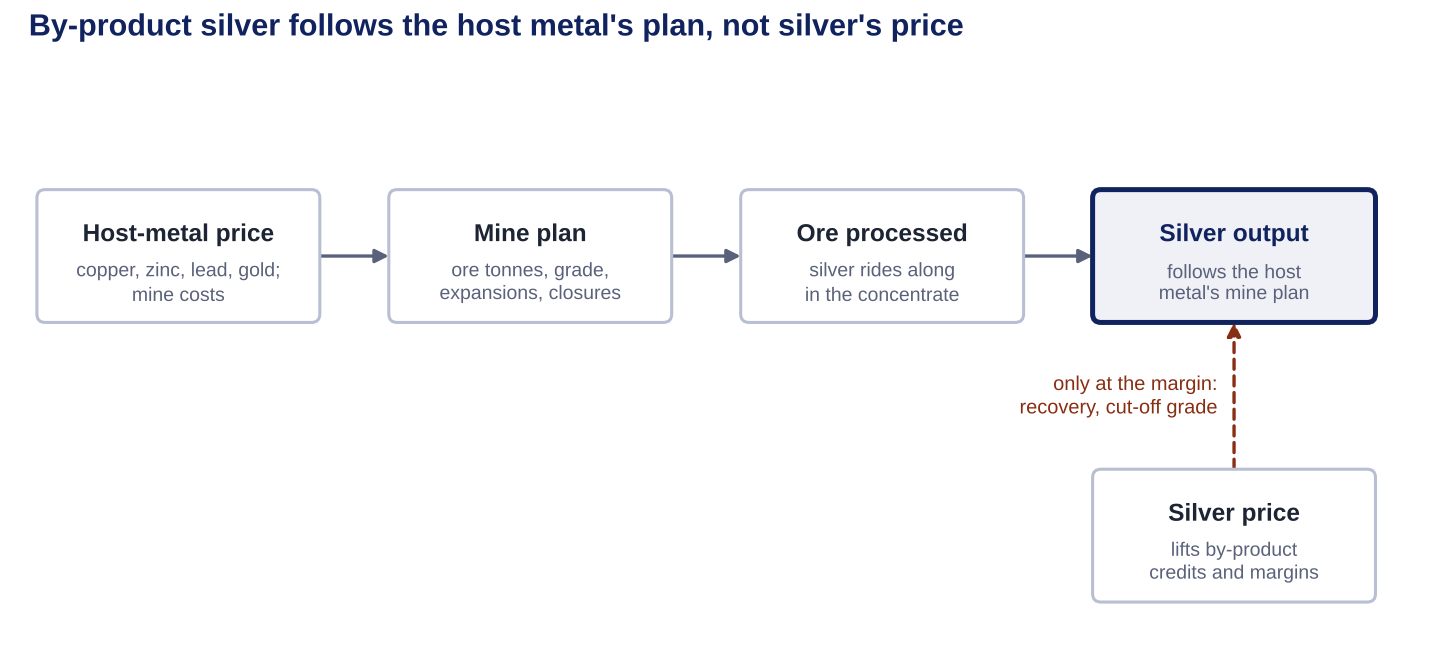
Metals Focus says global silver supply is increasingly dependent on gold and base metal prices 2. Most of those producers still gain from higher silver prices, but as by-product credits, revenue from silver that lowers their reported costs. The credit improves the host mine's economics, but output also depends on host-metal prices, costs and processing limits 2.
That cuts both ways. Cobre Panamá, a large copper mine, remained suspended through 2025, and the survey records no Panamanian silver output for 2024 or 2025 2. Idaho's Bunker Hill mine sat on care and maintenance because of weak base metal prices and environmental issues 2.
Those outcomes turned on a government decision, base-metal prices and environmental issues. A silver rally could not quickly reverse any of them.
Gold mines work the same way. They supplied 134.7 Moz of silver in 2025, but their plans follow gold's price, grades and reserves, with silver as an add-on 2.
When do higher silver prices add supply?
Higher prices do change behavior, mostly at primary silver mines and in recycling. Metals Focus reports that producers have raised the silver price they assume when estimating reserves, so higher-cost ores now count as economic to mine 2. Fresnillo, for example, reported a reserve increase partly from lowering its cut-off grades, the minimum grade worth mining 2.
Turning reserves into metal takes time, because ore must be drilled, permitted and scheduled into the mine plan. The survey says building reserves through resource conversion, expansion programs and initial reserve declarations typically takes at least 18 to 24 months. That is a reserve-development interval, not a timetable for producing metal. New mines face longer development timelines and high capital requirements 2.
Restarts are the quicker route. Sierra Madre Gold & Silver resumed commercial production at La Guitarra in early 2025, supported by elevated silver prices 2. Bunker Hill shipped its first concentrate in July 2026, while its October 28 update still targeted commercial production by the end of 2026 4. Each adds ounces, but at the scale of individual mines against about 847 Moz of world mine output.
By-product mines respond in smaller ways. Where silver is a meaningful share of revenue, higher credits can keep a marginal operation open longer or justify better recovery. They rarely justify a new copper or zinc mine on their own.
Recycling responds fastest. It rose 2% in 2025 to 197.6 Moz, a 12-year high, as rising prices encouraged selling back, though refinery bottlenecks capped volumes 2 5. Metals Focus forecasts a 7% rise to 211.3 Moz in 2026, citing a full year of higher prices 2.
Hedging can also affect reported supply. Producers use forward sales to fix a price, or options to protect a minimum price or a price range 6. Producers hedged more in 2025, lifting the estimated hedge book to 50 Moz, its highest since 2013; that figure converts options into equivalent silver exposure. The survey counts 44.7 Moz of net hedging as 2025 supply, rather than extra metal mined 2.
What does a "silver shortage" figure actually measure?
The headline deficit compares two estimated flows. Supply is mine output, recycling, net hedging and net official-sector sales, totaling 1,090.4 Moz in 2025 2. Demand is industrial use, jewelry, silverware, photography, and coins and bars, totaling 1,130.6 Moz.
The 2025 gap was about 40 million ounces
Million ounces (Moz). Supply includes mine output, recycling, net hedging and net official-sector sales.
Mine output 846.6 Moz, recycling 197.6 Moz, net hedging 44.7 Moz and net official-sector sales 1.5 Moz 2. Reported gap 40.3 Moz; independently rounded totals may not subtract exactly.
The 40.3 Moz gap was the fifth deficit in a row, and Metals Focus forecasts 46.3 Moz for 2026 2 5. Exchange-traded product (ETP) buying of 278.1 Moz sits outside that balance. An ETP is an investment product traded on an exchange; the silver products measured here hold physical metal 7. Including it, the 2025 gap was 318.4 Moz. Which line a commentator quotes changes the size of the "silver shortage" about eightfold, on Wealthion's arithmetic.
Year-to-year comparisons need care too. Net hedging added 44.7 Moz to 2025 supply but is forecast at 10 Moz in 2026, a swing larger than the change in the deficit itself.
A deficit does not mean buyers went unfilled. The difference is met from metal already above ground. Identifiable bullion inventories in London vaults and exchange warehouses, including those approved by CME Group, a US derivatives exchange operator, totaled 1,394.5 Moz at end-2025 2. Some holdings were allocated to exchange-traded products and unavailable for day-to-day trading or lending, so gross inventories do not measure freely available supply 2.
Those identifiable inventories rose 13% in 2025 despite the deficit. An increase in that measured subset does not establish an increase in total global stocks. Tariff concerns pulled about 225 Moz into CME vaults between December 2024 and early October 2025. Tightness showed up instead as location and availability: Metals Focus describes metal being pulled out of London or tied up in exchange-traded products 2. London vaults held 28,985 tonnes at the end of September 2026 1.
The figures are modeled estimates, compiled from producer reports, trade data and surveys, and they are revised each year. Unidentified stocks held by fabricators, dealers and households sit outside the count entirely. A 40 Moz gap is under 4% of estimated demand, so a modest change in any one estimate moves the balance noticeably.
Deficits also say little about price direction on their own. The Silver Institute linked 2025's record prices to elevated lease rates, which are the cost of borrowing silver, along with regional liquidity tightness and robust investor interest 5. A larger deficit was forecast for 2026, yet the LBMA price fell from $118.45 in January to $60.73 at end-September 1.
How do silver producers differ, and what is the counter-case?
Silver miners usually report unit costs after by-product credits. Metals Focus puts primary silver mines' 2025 all-in sustaining cost (AISC), which adds the ongoing costs of keeping a mine running to its cash cost of production, at $12.21 an ounce, with a total cash cost of $5.21 2. Gold revenue was the largest credit, rising 36% and offsetting lower lead and copper credits.
Company filings show the same practice. Hecla's full-year 2025 results define by-product credits as "revenues earned from all metals other than the primary metal produced at each unit" 8. For Greens Creek and Lucky Friday, it reported silver cash cost of negative $1.75 an ounce and AISC of $11.28 8. Both are non-GAAP measures, meaning they are not defined by US generally accepted accounting principles (GAAP).
A negative silver cash cost means other metals earned more than the cash cost of mining. So a "silver" producer's reported cost moves with gold, lead and zinc prices as well as silver.
The same metal can also switch roles. In its 2025 results, Hecla treated gold as primary at its Casa Berardi mine and silver there as a by-product 8. Definitions of AISC and of the "primary" metal vary between companies, and revenue mix by metal sits in segment disclosures.
Three disclosures shape how a producer's results track silver. One is silver's share of revenue, which can range from most of sales to a small by-product line. The others are reserve life at primary mines and hedge positions, which can fix prices or establish price floors or ranges on part of future output 6.
The counter-case is real: supply did respond. Mine output rose 3% in 2025, recycling hit a 12-year high, and copper and gold mines lifted by-product silver 6% and 5% 2 5. Primary miners' average AISC margin reached $27.81 an ounce, with an estimated 99% of output profitable 2.
But the response ran mainly through recycling and the host-metal cycle, helped by record gold prices that also swelled by-product credits. Primary silver output still fell despite much wider margins, and Metals Focus forecast flat mine supply for 2026. That is the answer to the headline: most silver follows other metals' mine plans, and the mines that do follow silver need years to add ounces.
Frequently asked questions
Is there a silver shortage? Metals Focus estimates five straight annual deficits, including 40.3 Moz in 2025, and forecasts 46.3 Moz for 2026 2. The historical deficits were met from above-ground stocks. Identifiable bullion inventories totaled 1,394.5 Moz at end-2025, but were not all freely available 2.
What is a by-product credit? It is revenue from metals other than a mine's main metal, subtracted from costs to report a net unit cost 8. A silver producer's reported cost can therefore fall when gold, lead or zinc prices rise.
Why does copper matter for silver supply? Copper mines produced 237.3 Moz of silver in 2025, 28% of mine supply on Wealthion's arithmetic 2. Their output depends heavily on copper's economics, so a copper mine's closure or expansion can change silver supply even when silver's own price moves in the opposite direction.
Does recycling respond faster than mining? Generally, yes. Recycling reached 197.6 Moz in 2025 as higher prices encouraged selling back, and Metals Focus forecasts 211.3 Moz in 2026, though refinery capacity limited how fast scrap was processed 2.
Sources
1 LBMA Precious Metals Market Report: Q3 2026. LBMA, October 14, 2026; silver price at September 30, 2026 and the 2026 high of $118.45 on January 29. London vault holdings of 28,985 tonnes at end-September 2026 reported on the LBMA London vault data page. 2 World Silver Survey 2026. The Silver Institute / Metals Focus, April 15, 2026; printed page 9, supply-demand balance and forecasts; pages 26-38, inventories, mine supply, costs, reserves, restarts and hedging; page 39, recycling; page 88, definitions and independent rounding. 3 Mineral Commodity Summaries 2026: Silver. US Geological Survey, February 2026; US 2025 mine production, number of silver and by-product operations, polymetallic share of resources. 4 Bunker Hill Mining Provides Corporate Update, Confirming Project Restart on Track for H1 2026, Improved Metal Mix, And Several New AI-Validated Exploration Opportunities. Bunker Hill Mining, February 2, 2026; silver-price sensitivity of projected mine economics. Also: Bunker Hill Ships First Concentrate to Trail Smelter and Announces Drawdown of Standby Facility, July 31, 2026; first concentrate shipment. Bunker Hill shareholder and financing update, October 28, 2026; commercial production targeted for the end of 2026. 5 Elevated Lease Rates, Regional Liquidity Tightness, and Robust Investor Interest Resulted in Record Silver Prices in 2025 (press release). The Silver Institute, April 15, 2026; factors linked to 2025 prices, 2025 recycling, mine output growth and 2026 deficit forecast. 6 The Challenges of Hedging. LBMA Alchemist, issue 66, undated article, accessed November 5, 2026; forward sales, put options and price collars. Also: World Silver Survey 2026, printed pages 37-38; producer hedge-book composition and equivalent option exposure. 7 Exchange-Traded Products (ETPs). Securities and Exchange Commission (SEC), Investor.gov, undated, accessed November 5, 2026; exchange-traded funds, commodity trusts and notes. Silver inventory context: World Silver Survey 2026, printed pages 22 and 26. 8 Hecla Reports Fourth Quarter and Full Year 2025 Results. Hecla Mining Company, Form 8-K Exhibit 99.1 filed with the SEC, February 17, 2026; by-product credit definition, Greens Creek and Lucky Friday silver cash cost and AISC after by-product credits, primary metal at Casa Berardi.
Wealthion is a dba of Greylock Peak Investments, a registered investment adviser. This article is general information only. It is not investment advice or an offer or solicitation, and it is not tailored to your circumstances. Guests’ views are their own and may not reflect those of Wealthion. Wealthion has not verified guest statements, including any performance figures. Investing involves risk, including loss of principal, and past performance does not guarantee future results. Wealthion refers readers to other registered investment advisers and shares in the fees they receive from referred clients, which creates a conflict of interest. Please see our Form ADV Part 2A and consult your own financial advisor before investing.
What Serious Investors Are Watching
Dive into expert interviews, market analysis, and long-form content built to help serious investors think long-term.
Rare-Earth Mining: Where the Investment Case Depends on Processing
Digging rare earths out of the ground is the easy part to picture. The harder,...
Silver Supply: Why Higher Prices Don’t Quickly Increase Production
Silver hit record prices, yet mine output is forecast to stay flat. Most silver is...
America Has Plenty of Natural Gas. What Could Make It More Expensive?
The US produces more gas than ever, and exports now take a large and growing...
Enjoyed This? Get More Insights
Expert insights and curated opportunities, delivered to your inbox.
Ready to Position for What's Coming?
Whether you're still learning or ready to act, your next step starts here.
- Independent
- Macro-Informed
- Real Asset Focused

The Wealthion Network
By subscribing, you agree to receive Wealthion emails. Unsubscribe anytime.
The Wealthion Network
By subscribing, you agree to receive Wealthion emails. Unsubscribe anytime.
Network Discussion
Join the Wealthion Network to Comment