

The AI Chip Shortage: How Memory Demand Changes Prices and Margins
In the quarter ended September 3, 2026, Micron kept 86.8 cents of gross profit from every dollar of sales, up from 44.7 cents a year earlier. SK hynix and Samsung also reported strong results. The question for investors is how much of it contracts can protect if supply catches up.
The numbers at a glance
Artificial intelligence (AI) has turned memory into one of the tightest parts of the chip shortage.
Every phone, laptop and server depends on memory chips, and right now the three largest makers have more orders than they can fill. Micron reported revenue of $54.23 billion for its fiscal fourth quarter, which ended September 3, 2026, up from $11.32 billion a year earlier 1.
The profit side is just as striking. Micron's gross margin, the share of each sales dollar left after cost of goods sold, including manufacturing overhead and depreciation, reached 86.8% under generally accepted accounting principles (GAAP), the standard US accounting framework. A year before it was 44.7% 1 4. That is not profit after every expense, but it shows how wide the gap has become between what the chips cost to make and what customers pay.
The other two large memory makers also reported strong results. SK hynix posted an operating margin, the share of revenue left after all operating costs, of 80% in the third quarter of 2026, up from 47% a year earlier, on revenue of 104.6 trillion Korean won (KRW) 2. Samsung's chip division earned KRW 106.5 trillion of operating profit on KRW 147.1 trillion of revenue in the same quarter 5. These figures use different profit measures, and Samsung's chip division includes businesses beyond memory.
Micron's chief executive, Sanjay Mehrotra, said on September 30, 2026, that the company does “not have line of sight to when supply and demand will return to balance” 6.
The question for investors is not whether demand is strong. All three companies say it is. It is how much of today's margin is protected if supply catches up. The sections below trace how AI memory pulls supply away from ordinary chips, who pays, what new capacity costs, and what history says about margins like these.
Every wafer sent to AI memory is a wafer not making the chips in your laptop.
Memory chips come in two main kinds. Dynamic random-access memory (DRAM) is the fast working memory in servers, personal computers (PCs) and phones. NAND is the flash storage in solid-state drives (SSDs). High-bandwidth memory (HBM) is a special form of DRAM that stacks several DRAM chips together and sits right next to an AI processor. It competes with standard DRAM for the same production capacity 7.
That is the heart of the squeeze. Every silicon wafer, the thin disc that chips are cut from, sent to HBM is a wafer not making conventional chips. S&P Global Market Intelligence reported in January 2026 that AI demand for HBM is diverting DRAM capacity and squeezing supply of conventional chips 8.
The trade is lopsided. In March 2024, Micron said that, industrywide, HBM3E, one generation of HBM, “consumes approximately three times the wafer supply” of DDR5, the current mainstream DRAM generation, to produce the same number of bits on the same technology node 3. A bit is the basic unit of stored data, and a node is a generation of chip-making technology. That ratio is Micron's figure for one HBM generation, and later generations may differ.
Consider a simple example. Say a maker moves one wafer in ten to HBM. Conventional output falls by 10%. Because those HBM wafers yield only a third as many bits, total bit output falls by only about 7%. That is Wealthion's arithmetic from Micron's ratio, not a company figure. The bits that disappear are the ones PCs, phones and ordinary servers would have used.
TrendForce, an industry research firm, said in January 2026 that DRAM suppliers would “continue to reallocate advanced process nodes and new capacity toward server and HBM products” 9. Earlier forecasts also covered older chips. In August 2025, TrendForce forecast that contract prices for consumer DDR4, an older DRAM generation still common in PCs and consumer devices, would rise 85% to 90% in a single quarter, because server orders were crowding out PC and consumer supply 10.
TrendForce forecast that conventional DRAM contract prices, the prices large buyers agree with suppliers, would rise 55% to 60% from the prior quarter in the first quarter of 2026 9.
The flow can run both ways. In October 2025, TrendForce projected that DDR5 would become more profitable than HBM3E from early 2026, because the two compete for the same production capacity. It said suppliers might then shift resources to server DDR5, or raise HBM3E prices to balance profitability 7.
TrendForce's forecasts pointed to increases in ordinary memory prices too 9.
Memory makers have found pricing power, and contracts are how they are trying to keep it.
Micron's annual report for the year ended September 3, 2026, shows DRAM revenue rising from $28.58 billion to $100.68 billion. DRAM selling prices rose about 180% while bit shipments rose in the mid-20% range 4. Prices, not volume, drove the gain. In the final quarter alone, DRAM prices rose by a high-teens percentage and NAND prices by about 30% from the prior quarter 6.
Micron's quarterly releases trace the full swing in gross margin since 2022 11 12 13 14 15 16 17 1.
Micron's gross margin swung from negative to 87% in four years
GAAP gross margin, percent of revenue, by fiscal quarter. Fiscal Q4 2026 ended September 3, 2026.
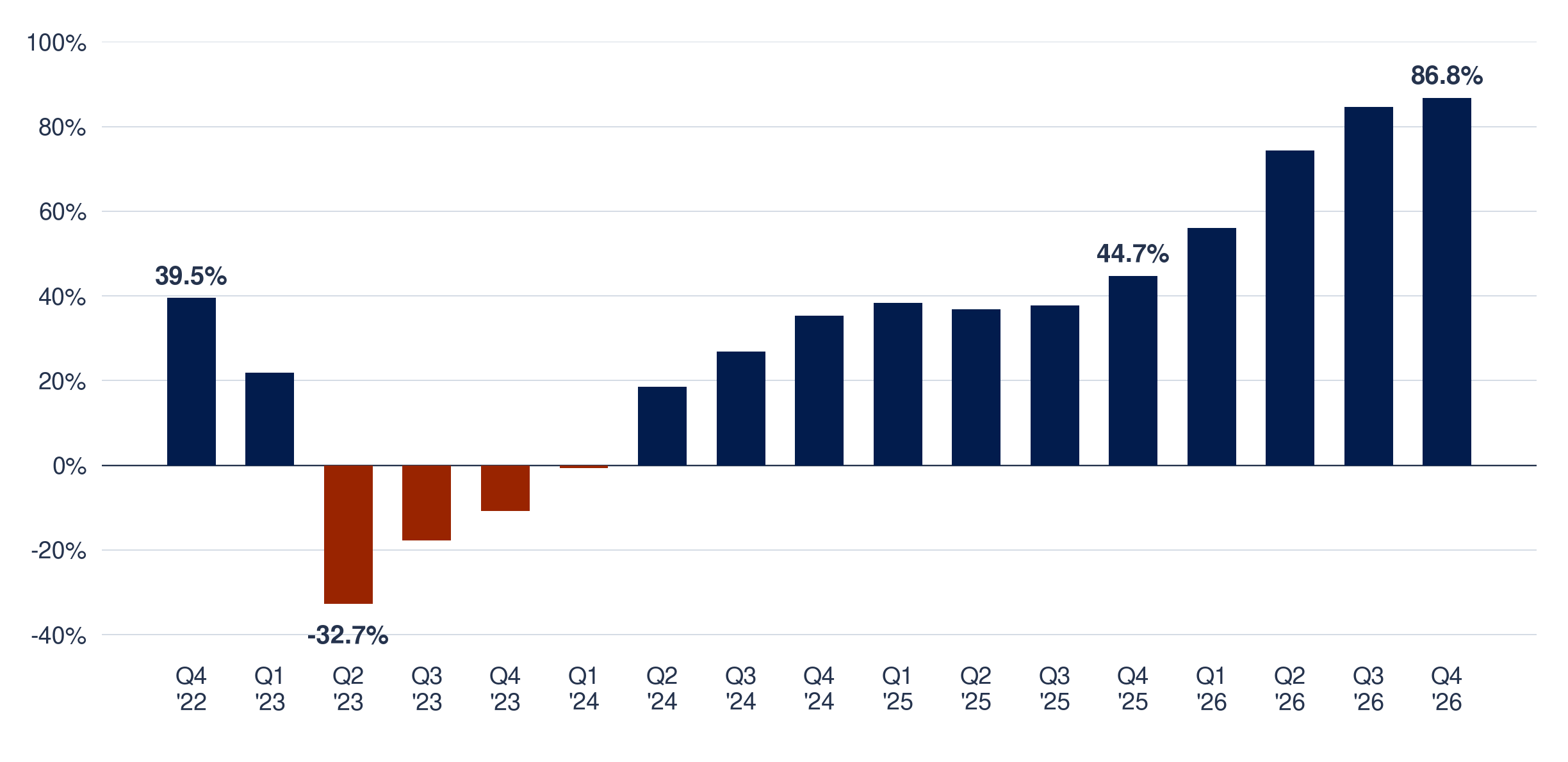
Source: Micron quarterly earnings releases for each quarter shown 11 12 13 14 15 16 17 1. Chart drawn by Wealthion from the reported percentages.
The chart shows how far margin can travel. Contracts could give suppliers more visibility over future prices and volumes. Micron has signed 26 Strategic Customer Agreements, estimated at over 35% of its revenue through 2030, all with take-or-pay volumes, meaning the customer must buy the agreed amount or pay anyway 6.
About three-quarters of that contracted revenue has a defined pricing framework, mostly with floor and ceiling prices. The rest is priced periodically at market 6. Customers have also committed financial security. Micron reported $32 billion of customer financial commitments, “the vast majority” of them cash deposits 6. Its annual report says the deposits are refundable if customers meet minimum purchase commitments 4. SK hynix says long-term agreements with 14 major customers cover more than half of its 2027 and 2028 production capacity 2.
HBM is priced further ahead. Micron said it had completed agreements for “the vast majority” of its calendar 2027 HBM bit supply, at significant year-over-year price increases 6. On September 29, 2026, TrendForce projected that blended HBM average selling prices would rise 121% in 2027. That estimate includes a shift toward higher-priced HBM generations, as well as price increases 18.
Floors limit how far contract prices can fall, and ceilings limit how far they can rise. TrendForce noted that some long-term agreements signed from the second quarter of 2026 onward have included price ceilings that could limit further increases 19.
So the useful question is not how high prices have gone. It is how much of a memory maker's revenue is protected by a pricing framework, and how much is priced at whatever the market pays that quarter. For Micron, the company puts that second share at about a quarter of its contracted revenue 6.
The bill for AI memory lands on the companies that build PCs, phones and cloud data centers.
Device makers feel the AI chip shortage first. HP's Personal Systems segment, its PC business, grew revenue 18% in the quarter ended July 31, 2026, while units fell 16% and the segment's operating margin slipped to 4.6% from 5.4% 20. HP lists “increasing memory and storage costs” among its supply risks 20.
Revenue up and units down means each PC sold brought in more money. HP reported average selling prices up 40.8%, reflecting pricing actions, currency and product mix 20. Micron's management expects PC and mobile industry revenue to grow this calendar year despite “potential double-digit overall unit declines in both markets” 6. TrendForce reported in September 2026 that PC brands were cutting SSD capacity in mainstream models to lower costs, and that TVs, set-top boxes and wearables have “even less room to absorb higher prices” 21.
Cloud buyers pay too. Microsoft's chief financial officer, Amy Hood, said in April 2026 that roughly $190 billion of planned calendar 2026 capital spending, meaning money for buildings and equipment, “includes approximately $25 billion from the impact of higher component pricing” 22. That covers components broadly, not memory alone. She also cited a lower PC market “as prices increase due to memory costs” 22.
TrendForce estimates that DRAM and NAND will take 47% of major cloud providers' capital spending in 2026 and 68% in 2027 19. Those are research estimates, not company disclosures.
Samsung shows both sides inside one company. Its chip division earned KRW 106.5 trillion, while its mobile and networks business posted a KRW 0.6 trillion third-quarter operating loss, citing “cost pressures” without naming memory 5.
Higher memory prices add to buyers' component costs. The useful question is who can pass that cost along. HP's margin slipped, and Microsoft's capital budget included about $25 billion for higher component prices.
New memory capacity takes years and tens of billions of dollars.
Micron spent $30.71 billion on property, plant and equipment, meaning factories and the machines in them, in fiscal 2026, or $27.37 billion net of government incentives and asset-sale proceeds 1. It expects about $25 billion of capital spending, net of anticipated government incentives, in the first half of fiscal 2027. Management said most of the increase is construction 6.
New buildings take years. Selected Micron projects and stated timing for first output, as of September 30, 2026 6:
| Site | What | First output (calendar) |
|---|---|---|
| Singapore | HBM packaging | Early 2027 |
| Idaho, first fab (ID1) | DRAM wafers | Mid-2027 |
| Japan | DRAM wafers | Late 2028 |
| Idaho, second fab (ID2) | DRAM wafers | Late 2028 |
| New York, first fab | DRAM wafers | 2030 |
The other makers are spending heavily as well. Samsung expects about KRW 84.4 trillion of 2026 capital spending, KRW 76.8 trillion of it in its chip division 5. SK hynix plans to ramp its M15X plant to maximum capacity by the end of the year to increase HBM4 production. It also says investment will rise significantly as its Yongin site, whose first phase enters full-scale operation next year, ramps up 2.
Government money covers a slice. In December 2024, the US Commerce Department awarded Micron up to $6.165 billion in direct funding under the Creating Helpful Incentives to Produce Semiconductors (CHIPS) Act, a US law that funds domestic chip manufacturing, for Idaho and New York. The money is paid as milestones are met 23. Micron finalized its Virginia agreement for up to $275 million in June 2025. Its fiscal 2026 annual report puts total CHIPS Act grants at up to about $6.4 billion 4. Micron reported $3.32 billion of government incentives received globally in fiscal 2026, separate from that total US award commitment 1.
SK hynix's planned packaging and research plant in Indiana won up to $458 million in direct funding and up to $500 million in loans, against an investment of about $3.87 billion. Direct funding is tied to project milestones 24. Customers also provided refundable deposits to secure supply. Micron received $12.75 billion of customer deposits in fiscal 2026 1. Nearly all are scheduled to be repaid between 2029 and 2031 if customers meet their minimum purchase commitments 4.
New supply is also coming from China. Visible Alpha analyst consensus published by S&P Global Market Intelligence on October 7, 2026, projects that revenue at ChangXin Memory Technologies (CXMT), a Chinese DRAM maker, will rise 506% in 2026 25. CXMT shares began trading on the Shanghai Stock Exchange on July 27, 2026 26.
These dates mark first output, not full capacity. Existing-site ramps and process improvements also affect supply 6 2.
The bull case rests on physics and paper. The bear case rests on history.
Start with the bull case. HBM's heavy use of wafers absorbs capacity, and Micron expects industry DRAM bit shipments to grow only in the low-20% range in each of 2027 and 2028, with supply constrained 6. Samsung's outlook says AI-driven demand will “far exceed the industry supply” 5, and SK hynix expects demand to exceed supply through 2030 2. The contracts described above could provide more price and volume visibility, without guaranteeing margins against higher costs or customer defaults 4.
Now the counter-case. In fiscal 2023, Micron's revenue fell to $15.54 billion from $30.76 billion, and its full-year GAAP gross margin was negative 9.1% 11. It wrote down $1.43 billion of inventory in the first half of that year to its estimated net realizable value, meaning expected selling proceeds after remaining costs to complete and sell the inventory 27. Its latest annual report still warns that “an oversupplied DRAM market may lead to downward pressure on pricing” 4.
Several forces could bring that pattern back. Micron's new fabs start output between 2027 and 2030, SK hynix's Yongin site begins full-scale operation in 2027, and CXMT is expanding 6 2 25. Margins this high give rivals a strong reason to add supply.
TrendForce's forecasts pointed to slower price growth. Its January 2026 forecast put first-quarter conventional DRAM contract price increases at 55% to 60% from the prior quarter. Its September forecast put fourth-quarter increases at 10% to 15% 9 21. These are dated forecasts, not a series of observed quarterly price changes.
Some demand may also have been pulled forward. Microsoft said in April that its Windows original equipment manufacturer (OEM) revenue, sales to PC makers, was ahead of expectations because OEMs and channel partners “continued to build inventory given increasing memory prices” 22. Falling PC and phone unit sales can reduce memory demand, although greater memory content per device may offset some of that decline 6.
Micron's two business units serving cloud and data center customers made up about 61% of its fiscal 2026 revenue, on Wealthion's calculation from segment revenue of $43.09 billion and $37.59 billion against $133.19 billion in total 4 1. That ties it closely to data-center spending, including AI. Contracts soften rather than remove that exposure, since a quarter of Micron's contracted revenue is priced at market 6.
So does AI memory demand change prices and margins? On the disclosed numbers, yes. Shifting wafers to HBM tightened conventional DRAM, Micron's DRAM prices nearly tripled in a year, and all three major makers reported record results.
What the filings cannot show is how long the AI chip shortage lasts. In 2022 and 2023, Micron's gross margin went from 39.5% to below zero within two quarters as supply outran demand 11 12. The new contracts change the terms of such a turn without ruling it out. Both stories can be true at once: demand can stay strong while prices stop rising.
Frequently asked questions
What is the AI chip shortage in memory? It is the gap between demand for memory chips from AI data centers and what manufacturers can produce. Micron, SK hynix and Samsung all described demand outrunning supply in their latest results 2 5. Micron said it has no line of sight to when supply and demand will balance 6.
What is HBM, and why does it use more wafers? High-bandwidth memory stacks several DRAM chips into one package placed beside an AI processor. Micron said in March 2024 that HBM3E needs about three times the wafer supply of DDR5 for the same number of bits on the same node 3.
Why do PCs and phones cost more when AI servers need memory? HBM and conventional DRAM compete for the same production capacity, so capacity used for AI products is unavailable for PCs and phones 7. HP reported average selling prices up 40.8% in its July 2026 quarter, reflecting pricing actions, currency and product mix 20.
Do long-term contracts end the memory cycle? Not on the evidence in the filings. Micron's agreements cover an estimated 35% or more of its revenue through 2030, with three-quarters under a defined pricing framework, a majority of which includes floors and ceilings, and a quarter of contracted revenue priced at market 6. Its annual report still lists oversupply and falling prices as risks 4.
How bad was the last memory downturn? Micron's fiscal 2023 revenue roughly halved to $15.54 billion, and its full-year GAAP gross margin was negative 9.1% 11.
Sources
1 Micron Technology, Inc. Reports Record Fiscal Fourth-Quarter and Full-Year 2026 Results (Form 8-K exhibit). Micron Technology, September 30, 2026; FQ4-26 and FQ3-26 revenue and gross margin, FY26 capital spending, government incentives and customer deposits received. 2 SK hynix Announces 3Q26 Financial Results. SK hynix, October 28, 2026; revenue, 80% operating margin, long-term agreements, M15X and Yongin plans, demand outlook. 3 Micron Fiscal Q2 2024 Earnings Call Prepared Remarks. Micron Technology, March 20, 2024; HBM3E wafer supply about three times DDR5 per bit on the same technology node. 4 Micron Technology Form 10-K for fiscal 2026. Securities and Exchange Commission (SEC) filing, fiscal year ended September 3, 2026; DRAM revenue, DRAM price and bit-shipment changes, segment revenue, oversupply risk, inventory cost accounting, customer-deposit refund terms and current CHIPS grant status. 5 Samsung Electronics Announces Third Quarter 2026 Results. Samsung Electronics, October 29, 2026; chip division results, 2026 capital spending, mobile and networks operating loss, outlook. 6 Micron Fiscal Q4 2026 Earnings Call Prepared Remarks. Micron Technology, September 30, 2026; supply outlook, price changes, Strategic Customer Agreements, deposits, fab timing, unit declines, capital spending plans. 7 Tight DRAM Supply to Boost DDR5 Contract Prices: Profitability in 2026 Expected to Surpass HBM3e. TrendForce (industry research), October 29, 2025; DDR5 versus HBM3E profitability and shared capacity. 8 AI memory boom squeezes legacy DRAM supply, pushing prices higher. S&P Global Market Intelligence (Visible Alpha research), January 28, 2026; HBM demand diverting DRAM capacity. 9 Memory Makers Prioritize Server Applications, Driving Across-the-Board Price Increases in 1Q26. TrendForce (industry research), January 5, 2026; capacity reallocation to server and HBM, 1Q26 contract price forecast. 10 DDR4 and LPDDR4 Supply Tightens Sharply in 2H25 as Structural Shortage Drives Strong Price Surge. TrendForce (industry research), August 11, 2025; consumer DDR4 price forecast for 3Q25. 11 Micron Reports Results for the Fourth Quarter and Full Year of Fiscal 2023 (Form 8-K exhibit). Micron Technology, September 27, 2023; FQ4-22, FQ3-23 and FQ4-23 margins and FY23 results. 12 Micron Reports Results for the Second Quarter of Fiscal 2023 (Form 8-K exhibit). Micron Technology, March 28, 2023; FQ1-23 and FQ2-23 margins. 13 Micron Reports Results for the Second Quarter of Fiscal 2024 (Form 8-K exhibit). Micron Technology, March 20, 2024; FQ1-24 and FQ2-24 margins. 14 Micron fiscal Q4 2024 press release (Form 8-K exhibit). SEC filing, September 25, 2024; FQ3-24 and FQ4-24 margins. 15 Micron fiscal Q2 2025 press release (Form 8-K exhibit). SEC filing, March 20, 2025; FQ1-25 and FQ2-25 margins. 16 Micron Reports Results for the Fourth Quarter and Full Year of Fiscal 2025 (Form 8-K exhibit). Micron Technology, September 23, 2025; FQ3-25 and FQ4-25 margins. 17 Micron Reports Results for the Second Quarter of Fiscal 2026 (Form 8-K exhibit). Micron Technology, March 18, 2026; FQ1-26 and FQ2-26 margins. 18 HBM Supply Constraints Persist, 2027 Price Outlook Revised Upward with Blended ASP Forecast to Rise 121% YoY. TrendForce (industry research), September 29, 2026; blended HBM average selling price forecast, including product mix. 19 Memory Prices Soar; DRAM and NAND Flash to Account for 68% of Major CSP CapEx in 2027. TrendForce (industry research), August 25, 2026; price ceilings, memory share of cloud capital spending. 20 HP Inc. fiscal Q3 2026 earnings release, August 26, 2026, and Form 10-Q for the quarter ended July 31, 2026. HP Inc.; Personal Systems revenue, units, margin, memory cost risk and the directly reported 40.8% rise in average selling prices. 21 AI Server Demand Sustains Memory Contract Price Increases in 4Q26, While Consumer-Side Pressure Persists. TrendForce (industry research), September 30, 2026; 4Q26 price forecast, device makers' spec cuts. 22 Microsoft Fiscal Year 2026 Third Quarter Earnings Conference Call. Microsoft, April 29, 2026; component pricing in capital spending, PC market and OEM inventory remarks. 23 Department of Commerce Awards CHIPS Incentives to Micron for Idaho and New York Projects. US Department of Commerce, December 2024; Micron award and Virginia preliminary terms. 24 CHIPS Incentives Award with SK hynix. US Department of Commerce, December 19, 2024; Indiana direct funding, loans and investment. 25 CXMT revenue set for sharp acceleration as memory prices surge. S&P Global Market Intelligence (Visible Alpha research), October 7, 2026; Visible Alpha analyst consensus for 2026 revenue growth of 506%. 26 Notice on the listing and trading of CXMT ordinary shares on the Science and Technology Innovation Board, announcement 2026 No. 21. Shanghai Stock Exchange, July 24, 2026; confirms trading began July 27, 2026. 27 Micron Technology Form 10-Q for the quarter ended February 29, 2024. SEC filing, March 2024; inventory write-down of $1.43 billion in the six months ended March 2, 2023.
Wealthion is a dba of Greylock Peak Investments, a registered investment adviser. This article is general information only. It is not investment advice or an offer or solicitation, and it is not tailored to your circumstances. Guests’ views are their own and may not reflect those of Wealthion. Wealthion has not verified guest statements, including any performance figures. Investing involves risk, including loss of principal, and past performance does not guarantee future results. Wealthion refers readers to other registered investment advisers and shares in the fees they receive from referred clients, which creates a conflict of interest. Please see our Form ADV Part 2A and consult your own financial advisor before investing.
What Serious Investors Are Watching
Dive into expert interviews, market analysis, and long-form content built to help serious investors think long-term.

Rare-Earth Mining: Where the Investment Case Depends on Processing
Digging rare earths out of the ground is the easy part to picture. The harder,...

Silver Supply: Why Higher Prices Don’t Quickly Increase Production
Silver hit record prices, yet mine output is forecast to stay flat. Most silver is...

America Has Plenty of Natural Gas. What Could Make It More Expensive?
The US produces more gas than ever, and exports now take a large and growing...
Enjoyed This? Get More Insights
Expert insights and curated opportunities, delivered to your inbox.
Ready to Position for What's Coming?
Whether you're still learning or ready to act, your next step starts here.
- Independent
- Macro-Informed
- Real Asset Focused


The Wealthion Network
By subscribing, you agree to receive Wealthion emails. Unsubscribe anytime.
The Wealthion Network
By subscribing, you agree to receive Wealthion emails. Unsubscribe anytime.
Network Discussion
Join the Wealthion Network to Comment