

What US Debt Means for Investors: What Lyn Alden, Ed Yardeni and Steven Feldman Say
For anyone who owns Treasury bonds, getting paid is only part of the story. Inflation changes what those payments buy, while changing interest rates can affect what the bonds are worth.
You may own Treasuries through a money market fund, a bond fund or your retirement savings. That makes the government’s borrowing relevant even if you have never bought a Treasury directly.1
A missed payment would be serious. But investors can also lose purchasing power or see their bonds fall in value while every payment arrives on time.2 Across six Wealthion interviews published between August and November 2026, the guests explored how those risks arise and what the growing debt means for investors.
Money market funds alone held $3.28 trillion of Treasury securities in mid-2026, more than six times what they held at the end of 2015.1 The national debt passed $40 trillion during fiscal 2026.3
What will the interest on my bonds buy after inflation? What yield will lenders want before they keep lending? And who ends up carrying the cost of the debt, and in what form?
This article starts with what a default means and where the debt ceiling fits in, then follows three other concerns raised by the guests: the interest bill, the price of borrowing and the purchasing power of the dollar.
Key takeaways
- The debt ceiling can constrain Treasury’s ability to borrow, even though its obligations are in dollars.
- The interest bill reflects both the amount of debt and the rates paid on it.
- Payment reliability and purchasing power are different questions for Treasury holders.
What would a US default actually mean?
A missed payment is one way government debt can affect investors.
A default means a borrower fails to pay interest or principal on time. The U.S. government borrows in dollars, the currency issued by its own central bank. In 1979, a technical glitch delayed payments on about $120 million of Treasury bills, the government’s short-term IOUs. By the Treasury’s later account, it was quickly corrected.4
Ed Yardeni, president of Yardeni Research, notes he has heard warnings of a debt crisis for more than 45 years. As long as Treasury auctions go reasonably well and the resulting yields do not threaten the economy, he says, “all that debt is somebody’s wealth.”5 Every Treasury was bought by a lender who chose to buy it; the public held $32.95 trillion of them on November 24, 2026.3
Where does the debt ceiling come in?
In recent debt-ceiling confrontations, a legal borrowing limit has threatened Treasury’s ability to raise the cash needed to make payments.6
The debt ceiling is a legal limit on how much the Treasury may borrow, set by Congress. When borrowing reaches it, the Treasury uses “extraordinary measures,” accounting steps such as pausing new investments of certain federal retirement funds, to create temporary borrowing room. If those measures and available cash run out before Congress acts, payments could be delayed. It has used these measures in at least a dozen periods since 2011, most recently from January 21 to July 4, 2025.7,8,9
Those periods can carry a cost even though every bill is paid. The Government Accountability Office (GAO) estimates the 2011 episode added about $1.3 billion to federal borrowing costs that fiscal year 7; for 2013 its estimate is roughly $38 million to over $70 million, measured differently 10. In 2023, the yield on one-month Treasury bills reached 6.02% on May 26, eight days before the deal became law on June 3. By June 7 it was 5.07% 11.
The limit was raised by $5 trillion in July 2025,6 leaving about $777 billion of room at the end of October 2026.12 That is remaining borrowing authority, not an estimate of how long Treasury could keep making payments.
What does a bigger interest bill mean for Treasury holders?
Every dollar of interest the government pays lands in a lender's account. That makes the interest bill both a cost and someone's income.
Net interest, the interest the government pays minus what it receives, came to $1.05 trillion in fiscal 2026 13. As a share of the economy it rose from 1.23% in fiscal 2015 to 3.20% in fiscal 2025, the highest in the 26 years of data shown here 14.
Interest has taken a larger share of the economy since 2015
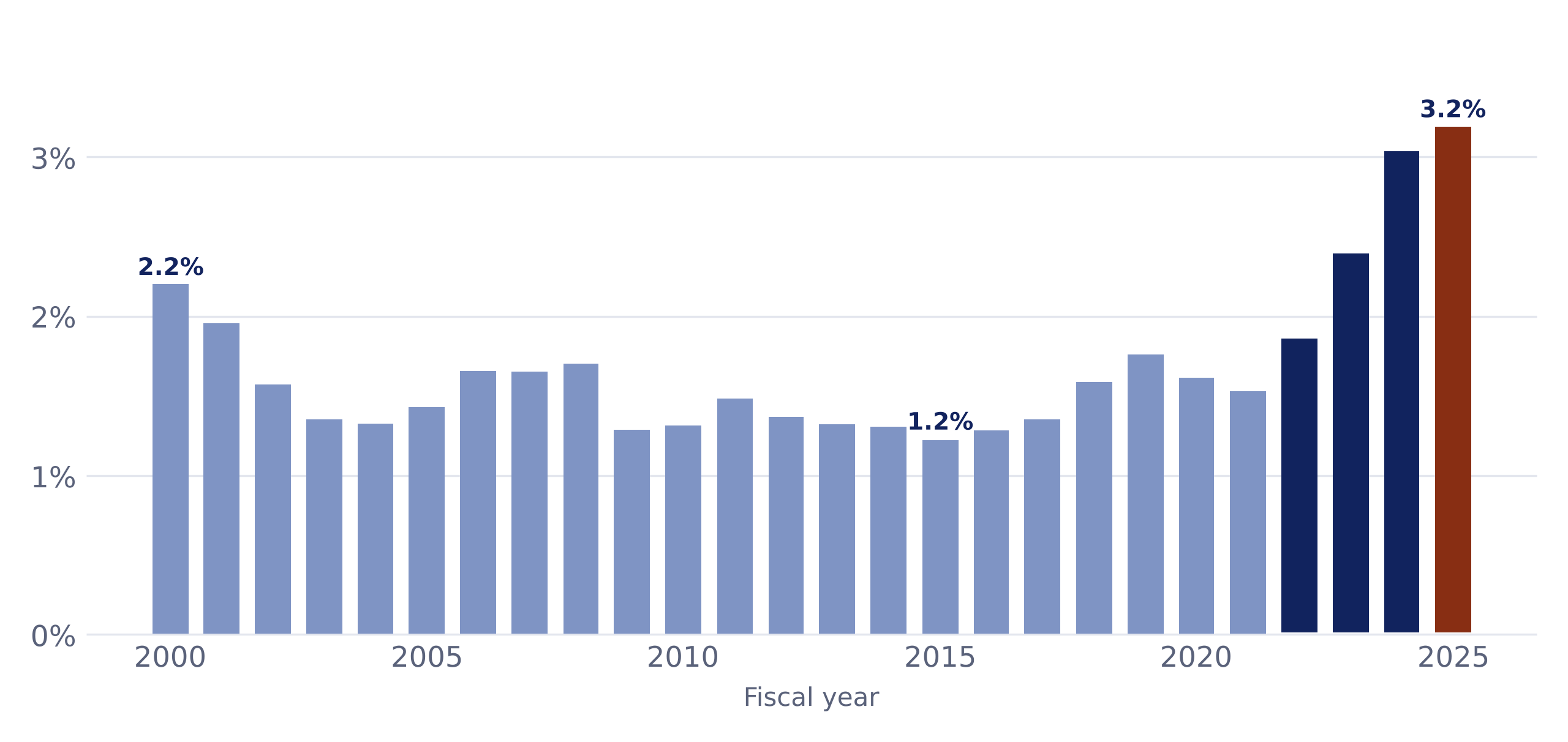
Wealthion illustration. Source: Congressional Budget Office, Historical Budget Data.14 Net interest outlays as a percentage of gross domestic product (GDP), fiscal years 2000 to 2025; fiscal 2022 to 2024 in dark blue and fiscal 2025, the latest year in this dataset, in rust.
Two things moved together. The debt held by the public grew from $13.1 trillion at the end of fiscal 2015 to $32.4 trillion at the end of fiscal 2026,3 and Treasury’s average rate for marketable debt, excluding inflation-protected and floating-rate securities, rose from 1.42% in January 2022 to 3.57% in October 2026.15 That average keeps adjusting because old debt is constantly replaced: $10.64 trillion was due to mature within a year as of September 30, 2026.16 The Congressional Budget Office (CBO), Congress’s nonpartisan budget scorekeeper, projects debt held by the public at 120% of GDP by 2036.17
For the guests, this is where the real question begins. Lyn Alden, asked when the debt starts to matter, answers: “it has been mattering.”18 Her point is about who carries the cost: families buying a first home, for example, pay part of it through higher rates. Jonathan Wellum, chief executive officer of RockLinc, describes the wider picture as “a debt bubble,”19 and Steven Feldman, Wealthion’s co-founder and chief executive officer, expects the interest bill to keep climbing.20
What are bond yields telling investors?
Lenders rarely refuse to lend. They change the price.
Yardeni says he coined the term "bond vigilantes" in 1983 for investors who sell government bonds, pushing yields up, when they doubt fiscal or monetary policy. In August he warned that even if short-term rates were lowered, "You could have a revolt on the long end" 5. In October 2026 the 10-year Treasury yield averaged 5.13%, its highest monthly average since 2002 and up from 0.62% in July 2020 21.
Trey Reik, chief economist at Gold Bullion International (GBI), described the bond market as being in “complete revolt” in September.22 Feldman calls long-term yields “a fiscal phenomenon”: lenders want a little more in case the debt is eventually inflated away.20
Two numbers temper the picture. The term premium, the extra yield investors demand to hold a 10-year bond instead of rolling over short-term ones, was 0.68 percentage points at the end of October 2026 on the New York Fed's model estimate, far below 3.43 in late 2008 23. And foreign investors still held $9.24 trillion of Treasuries in September 2026, a little below February's record of $9.49 trillion 24. Yardeni recalls that in 2023, when yields neared 5%, buyers suddenly appeared 5.
What happens to what each dollar buys?
A bond can pay back every dollar it promises and still return less than you lent in purchasing-power terms.
That is the pressure several guests point to. The Bureau of Labor Statistics tracks what a dollar buys against 1982 to 1984 prices. In 2000 a dollar bought what 58.1 cents had bought then; in 2025 it bought what 31.1 cents had, a loss of about 46% over 25 years on Wealthion’s arithmetic.25 That measures a dollar’s buying power, not the total return on a Treasury investment. Consumer prices rose 9.1% in the 12 months to June 2022, the high point of the recent inflation wave.26
Feldman expects real rates, interest after inflation, to turn negative over time.20 Wellum expects financial repression, policies that hold interest rates below inflation, and pressure on currencies.19 Chris Casey, founder of WindRock Wealth Management, describes the debt as “the present value of future inflation.”27 Reik reads recent Treasury steps as a move toward yield curve control, a central bank capping long-term yields by buying bonds, which he calls “money printing light” while stressing it isn’t money printing yet.22 That is his interpretation; Treasury describes its buybacks as liquidity-support and cash-management operations.28
The other reading is just as visible in the data. In October 2026 the 10-year inflation-protected Treasury yield averaged 2.78%, its highest monthly average since 2008.29 That is a real yield above the bond’s inflation adjustment for a buyer holding to maturity, before tax; the principal adjusts with changes in the Consumer Price Index.30 The dollar was also about 6% below its January 2025 high against a broad basket of currencies in October 2026.31 That measures its value against other currencies, not what it buys at home.
Why are central banks adding gold?
Some of the world's largest holders of dollars have been adding a reserve that no government issues.
Central banks hold foreign-exchange reserves to back their currencies and settle trade. The dollar’s share of those reserves fell from 69.7% at the end of 2000 to 56.5% at the end of 2025, though it remains well over half.32 Central banks bought more than 1,000 tonnes of gold a year from 2022 to 2024 and about 850 tonnes in 2025, on World Gold Council estimates that include unreported buying.33
Central banks have bought gold at a faster pace since 2022
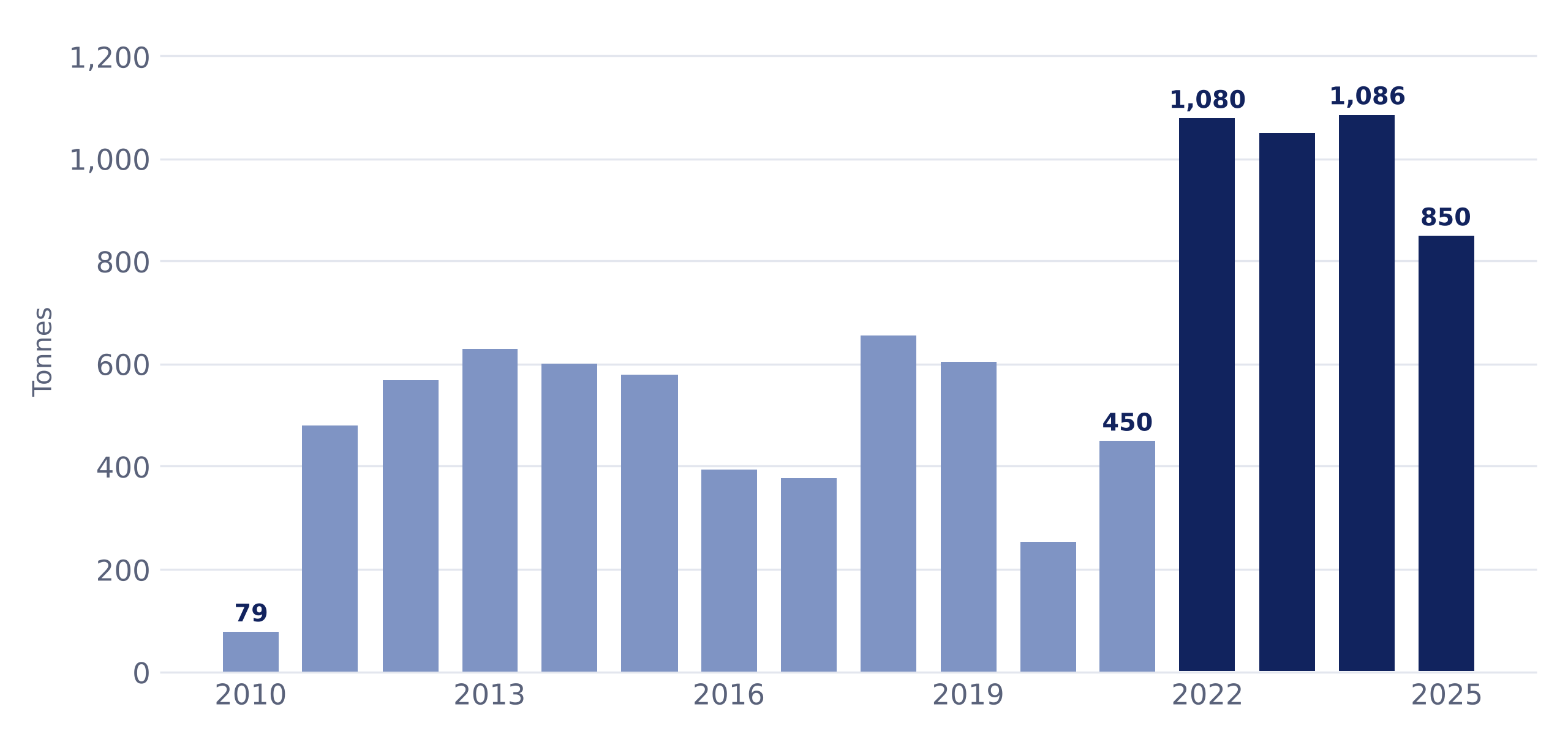
Wealthion illustration. Source: World Gold Council / Metals Focus.33 Net purchases by central banks and other official institutions in tonnes, including the council’s estimates of unreported buying. 2021 onward shown in dark blue.
Alden describes gold as a store of value that competes with Treasuries.18 Wellum links gold repatriation to trust: when nations trust each other less, he argues, they want more control over where their gold is held.19 The purchase data shows how much gold was added, not why each central bank bought it.
What questions do the six guests raise?
Each guest points to a different question. Together they show how the debt can affect investors even when payments arrive on time.
Six guests, six questions
| Guest | The question they point to | Published |
|---|---|---|
| Lyn Alden 18 | Who ends up paying for the debt, and how? | October 2026 |
| Ed Yardeni 5 | Are buyers still showing up for Treasuries? | August 2026 |
| Steven Feldman 20 | Is the yield keeping up with inflation? | October 2026 |
| Jonathan Wellum, RockLinc 19 | Will savings hold their purchasing power? | September 2026 |
| Trey Reik, GBI 22 | What would officials do if yields kept climbing? | September 2026 |
| Chris Casey, WindRock 27 | How exposed is a portfolio to rising long-term rates? | November 2026 |
Wealthion's summary of each guest's interview; guests' views are their own and are not Wealthion forecasts.
What does this mean for investors?
A Treasury payment can arrive on time and still buy less after inflation. Rising yields can offer a better return to a new buyer while reducing the value of a bond already held. A missed payment would create a different, potentially wider disruption.2,6 Understanding those differences gives investors a more useful picture of US debt than the headline total alone.
Frequently asked questions
What are "extraordinary measures"? Accounting steps the Treasury takes when borrowing reaches the debt ceiling, such as temporarily suspending new investments of certain federal retirement funds, which are restored once the limit is raised 9.
Who owns US Treasury debt? Of the marketable Treasuries held outside the federal government in mid-2026, foreign holders owned $9.27 trillion, the Federal Reserve $4.08 trillion and money market funds $3.28 trillion 1.
What is a gold revaluation? A gold revaluation would raise the official accounting value of Treasury gold. Alden describes it as a “break the glass” option that could help finance spending without matching bond issuance if the necessary legal and accounting changes were made. She sees possible inflationary effects, depending on the amount and wider policy mix.18,34
Sources & Disclosure
1 Federal Reserve, Financial Accounts of the United States, September 11, 2026, Table F3.2.s. 2 Securities and Exchange Commission, Fixed Income Investments: When Interest Rates Go Up, Prices of Fixed-Rate Bonds Fall, June 26, 2013. 3 U.S. Treasury, Debt to the Penny, fiscal year-ends and November 24, 2026. 4 U.S. Treasury, Managing Our National Debt Responsibly, January 4, 2017, “The Potential Costs of an Actual Default.” 5 Wealthion, Ed Yardeni interview, published August 11, 2026. 6 Government Accountability Office, GAO-27-108795, November 9, 2026. 7 Government Accountability Office, GAO-12-701, July 23, 2012, pp. 9–10, 20. 8 U.S. Treasury, Debt Limit letters and reports, 2011–2025. 9 U.S. Treasury, Report on Fund Operations and Status, January 30, 2026, p. 1. 10 Government Accountability Office, GAO-15-476, July 9, 2015, p. 30. 11 Federal Reserve, H.15, one-month Treasury yield (DGS1MO), May–June 2023, via FRED. 12 U.S. Treasury, Monthly Statement of the Public Debt, October 2026, Table 2. 13 U.S. Treasury, Monthly Treasury Statement, September 2026, Table 9. 14 Congressional Budget Office, Historical Budget Data, February 11, 2026, Table 3a. 15 U.S. Treasury, Average Interest Rates, Total Marketable, January 2022 and October 2026; data dictionary. 16 U.S. Treasury, Quarterly Release Data, fourth quarter 2026, October 16, 2026, maturity distribution at September 30. 17 Congressional Budget Office, The Budget and Economic Outlook: 2026 to 2036, February 11, 2026, Table 1-1. 18 Wealthion, Lyn Alden interview, published October 19, 2026. 19 Wealthion, Jonathan Wellum interview, published September 21, 2026. 20 Wealthion, Steven Feldman interview, published October 30, 2026. 21 Federal Reserve, H.15, 10-year Treasury yield (GS10), monthly through October 2026, via FRED. 22 Wealthion, Trey Reik interview, published September 14, 2026. 23 Federal Reserve Bank of New York, Treasury Term Premia, ACM Monthly, October 2008 and October 2026. 24 U.S. Treasury, Major Foreign Holders of Treasury Securities, Table 5 and historical data, November 18, 2026. 25 Bureau of Labor Statistics, Purchasing Power of the Consumer Dollar (CUUR0000SA0R), annual averages, 2000 and 2025. 26 Bureau of Labor Statistics, Consumer Price Index, June 2022, July 13, 2022. 27 Wealthion, Chris Casey interview, published November 2, 2026. 28 U.S. Treasury, Regular Treasury Buyback Program Details, April 2024, pp. 2, 8. 29 Federal Reserve, H.15, 10-year inflation-indexed Treasury yield (FII10), monthly through October 2026, via FRED. 30 U.S. Treasury, TreasuryDirect, Treasury Inflation-Protected Securities, inflation-adjustment mechanics. 31 Federal Reserve, G.5, Nominal Broad U.S. Dollar Index (TWEXBGSMTH), January 2025 and October 2026, via FRED. 32 International Monetary Fund, COFER, dataset 7.0.1, September 30, 2026, year-end dollar shares. 33 World Gold Council/Metals Focus, Gold Demand Trends: Q3 2026, November 3, 2026, annual central-bank demand data. 34 31 U.S.C. §5117(b), Transferring Gold and Gold Certificates.
Wealthion is a dba of Greylock Peak Investments, a registered investment adviser. This article is general information only. It is not investment advice or an offer or solicitation, and it is not tailored to your circumstances. Guests’ views are their own and may not reflect those of Wealthion. Wealthion has not verified guest statements, including any performance figures. Investing involves risk, including loss of principal, and past performance does not guarantee future results. Wealthion refers readers to other registered investment advisers and shares in the fees they receive from referred clients, which creates a conflict of interest. Please see our Form ADV Part 2A and consult your own financial advisor before investing.
What Serious Investors Are Watching
Dive into expert interviews, market analysis, and long-form content built to help serious investors think long-term.

How to Invest in Copper: Funds, Miners and Key Risks
Copper is one metal, but investing in it can mean owning very different things: contracts tied to its price, shares in a working mine or a stake in a project that may take years to produce. Each comes with its own risks.

What US Debt Means for Investors: What Lyn Alden, Ed Yardeni and Steven Feldman Say
US debt can affect borrowing costs and purchasing power even when payments arrive on time. Six Wealthion guests discuss the risks, alongside current primary data.

Global Index Funds and AI: The Semiconductor Exposure Investors Can Miss
Your international fund may own more of the AI boom than you'd expect. Some of its largest holdings make the chips, memory and machines the boom runs on.
Enjoyed This? Get More Insights
Expert insights and curated opportunities, delivered to your inbox.
Ready to Position for What's Coming?
Whether you're still learning or ready to act, your next step starts here.
- Independent
- Macro-Informed
- Real Asset Focused


The Wealthion Network
By subscribing, you agree to receive Wealthion emails. Unsubscribe anytime.
The Wealthion Network
By subscribing, you agree to receive Wealthion emails. Unsubscribe anytime.
Network Discussion
Join the Wealthion Network to Comment