

Why AI Data Centers Need Liquid Cooling and What Changes for Suppliers
One cabinet of Nvidia's GB200 NVL72 servers for artificial intelligence (AI) draws about 120 kilowatts (kW) of power 1. That is more than twelve times the under-10-kW rack reported as the most common by 69% of operators in Uptime Institute's 2026 survey 2. Air cannot practically carry away that much heat, so data centers are switching to liquid cooling, which pipes liquid to the hottest chips instead. Companies selling data center power and cooling equipment have reported record orders and wider margins, alongside multibillion-dollar acquisition activity 3,4,5.
The numbers at a glance
Why are AI data centers moving to liquid cooling?
Because the newest AI servers give off more heat than air can practically remove. Liquid cooling means circulating a liquid, instead of blowing air, to carry heat away from the chips. Servers sit in tall metal cabinets called racks, stacked like shelves. Each rack draws electricity, measured in kilowatts (kW), and nearly all of that power ends up as heat. A kilowatt is 1,000 watts, and a 1,500-watt hair dryer, for example, draws 1.5 kW.
That heat is creating demand for liquid cooling equipment, alongside broader demand for data center power and cooling systems. On October 28, 2026, Vertiv, a large maker of data center power and cooling equipment, reported third-quarter sales of $4.31 billion, up 61%. Its chief executive said new orders grew more than 100% on an organic basis, meaning they more than doubled even after leaving out acquisitions and currency swings 3.
The scale of the electricity involved explains the urgency. US data centers used about 176 terawatt-hours in 2023, or 4.4% of the nation's electricity, according to Lawrence Berkeley National Laboratory (LBNL). A terawatt-hour is a billion kilowatt-hours. In its 2024 report, LBNL projected 325 to 580 terawatt-hours by 2028, or 6.7% to 12% of US electricity 7. Every watt that runs a server ends up as heat, and that heat has to leave the building.
The short answer to the headline: Nvidia's GB200 rack draws more than ten times as much power as the under-10-kW racks most surveyed operators report 1,2. Air cannot carry that much heat away efficiently. Liquid absorbs and moves heat far better, but retrofits can require pipes, pumps and floor reinforcement 8. For suppliers, broader data center demand has brought record orders and wider reported margins, along with new risks 3,4.
How much more power does an AI rack draw?
Far more than a typical one. In Uptime Institute's 2026 survey of data center operators, 69% said the most common rack at their sites draws under 10 kW, and only 3% said 50 kW or more 2. Uptime, an industry research group, has written that direct liquid cooling, where liquid is piped to the chips themselves, and precision air cooling tend to become more economical above roughly 20 to 25 kW per rack 9.
One Nvidia GB200 rack draws about 120 kW; 69% of surveyed operators report a most common rack under 10 kW
Kilowatts per rack. Survey rows show the rack density operators say is most common at their sites.
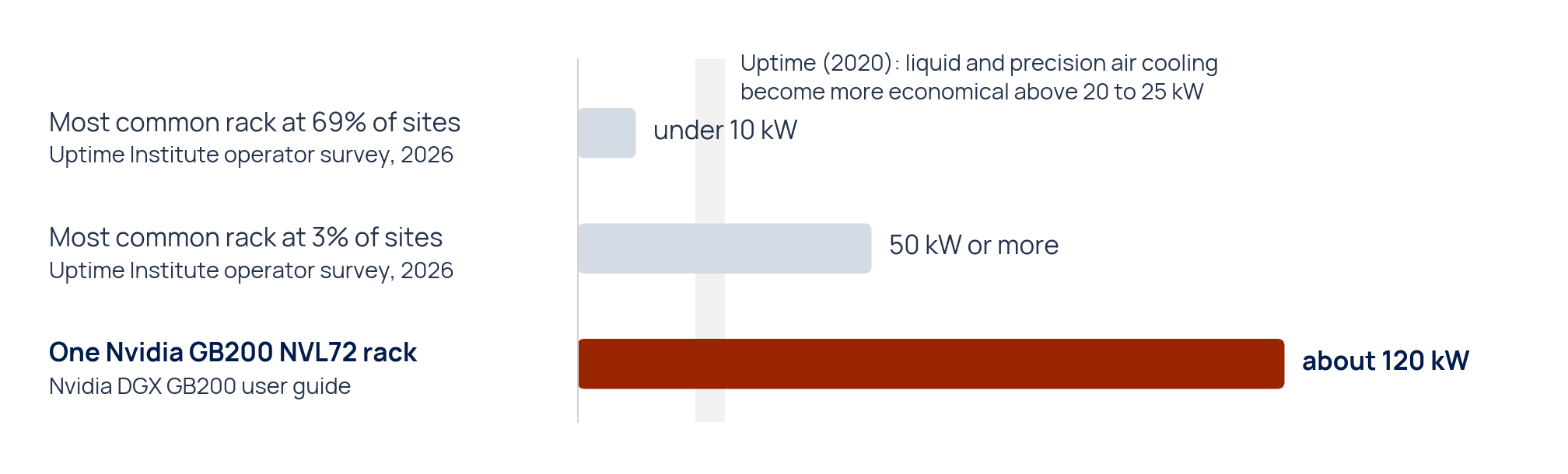
Sources: Uptime Institute 2026 operator survey 2 and 2020 analysis 9; Nvidia DGX GB200 user guide 1. Survey bands are self-reported; the GB200 figure is one product's spec.
The AI rack in the chart, Nvidia's GB200 NVL72, packs 72 graphics processing units (GPUs), the chips that do most of the AI work, into one cabinet 1. Nvidia has said racks once drew about 20 kW, while some of the largest cloud operators' facilities now support more than 135 kW 10. Nvidia's Vera Rubin NVL72 is designed for liquid cooling at 45 degrees Celsius (113 degrees Fahrenheit). In its October 2025 roadmap, Nvidia planned a later rack design called Kyber to hold 576 Rubin Ultra GPUs by 2027 11.
Air has a physical limit. Many data centers push cold air up through perforated tiles in a raised floor. ASHRAE, the American Society of Heating, Refrigerating and Air-Conditioning Engineers, notes that a dense rack can need more air than one tile can supply. Even the best data centers deliver about 1,900 cubic feet of air a minute through a tile, and a 40 to 50 kW rack may need up to 5,000 8.
One caveat on the chart: it sets a single product beside survey answers, so it shows scale, not a like-for-like average. The survey answers are self-reported by the 679 operators who answered that question 2. The 20 to 25 kW threshold also dates from 2020, before today's AI racks shipped.
How does liquid cooling actually work?
Liquid cooling moves heat with fluid instead of air, and there are two main designs. In direct-to-chip cooling, coolant flows through a small metal plate, called a cold plate, that sits on each chip and draws heat out of it. In immersion cooling, whole servers sit in a tank of fluid that does not conduct electricity.
Both designs can move chip heat through a pumped loop to building water
Simplified heat path for two liquid-to-liquid cooling designs. CPU means central processing unit.
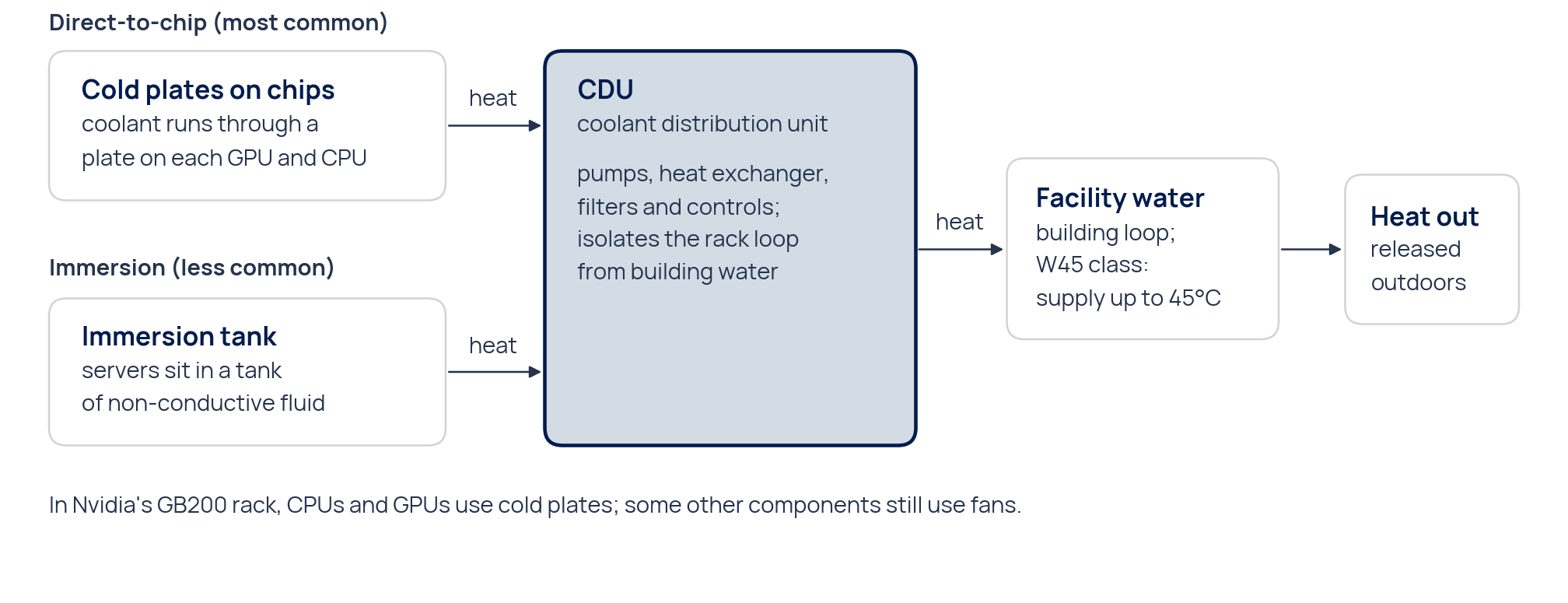
Sources: Nvidia 1, ASHRAE Technical Committee (TC) 9.9 8, Uptime Institute 12, Vertiv 13.
Cold plates are the more common route. Among operators using direct liquid cooling in Uptime's 2024 survey, 64% used water-cooled cold plates and 30% used plates cooled with a non-conductive (dielectric) fluid. Only 26% used full immersion in a single-phase fluid, one that stays liquid instead of boiling 12. Respondents could pick more than one, and only 94 operators answered, so treat the shares as rough.
Adoption was still early. In the same survey, 22% of the 453 respondents to the adoption question used some direct liquid cooling and another 61% said they would consider it. Among the 93 users answering the deployment question, 47% used it on some racks, and only 5% ran facilities that were mostly liquid-cooled 12.
The coolant distribution unit (CDU) sits at the center of the system. In liquid-to-liquid systems, its pump and heat exchanger keep the coolant serving the racks separate from the building's water. Vertiv, which makes CDUs, says it lets operators control the loop's pressure, temperature, flow and filtering. It also keeps the coolant warmer than the dew point, the temperature at which moisture condenses, so water does not form on the equipment 13. Liquid-to-air CDUs instead transfer heat to the data hall's air 13. On the building side of liquid-to-liquid systems, what ASHRAE calls the facility water system carries the heat on to equipment that releases it outdoors 8.
Liquid cooling is rarely total. In the GB200 rack, cold plates cool the central processing units (CPUs) and GPUs, while some networking and storage parts still use fans 1. ASHRAE groups liquid cooling into classes from W17 to W45, plus the higher-temperature W+ class. The numbered classes are named for the highest supply water temperature they allow, in Celsius. A W45 system, for example, can run on water up to 45°C 8. Nvidia says Vera Rubin uses 45°C liquid cooling 11.
What does it cost to retrofit an existing data center?
Cost is a major obstacle. A retrofit means converting an existing data center instead of building a new one. In Uptime's 2024 survey, 41% of 86 existing direct liquid cooling users named increased cost as a major barrier, the most-cited answer; 38% named reliability concerns 12. Estimates of the bill vary widely from site to site.
In May 2026, research firm STL Partners put a retrofit at around $2 million per megawatt (MW) of capacity, against upwards of $11 million for a new liquid-cooled build. A megawatt is 1,000 kW. Those are one firm's headline estimates, not audited project costs. STL cautioned that hidden costs, including downtime, moving customers' workloads and revenue lost while tenants are out, can materially change the comparison 6.
The work goes beyond the cooling equipment. ASHRAE's guidance flags pipes that run deeper into the room, drip pans with leak detection wherever pipes cross over equipment, and floor-weight limits, including the route heavy racks take to reach the room 8. Nvidia's own GB200 rack design added more than 100 pounds of steel reinforcement and special connectors, called blind-mate manifolds, that join the coolant lines to each server tray as it slides in 14.
The pipes also have to carry enough coolant. Vertiv's rule of thumb is about 1.5 liters per minute for every kW of heat, varying with the equipment 13. At that rate, a 120 kW heat load transferred to liquid would need roughly 180 liters a minute. Existing pipework may need adapting to match the CDU's connections, adding reducers where needed. CDU supply filters are usually about 50 microns, and a micron is a millionth of a meter 13.
Operators also choose where CDUs sit. Vertiv lists options from one unit serving a single rack, to one at the end of each row, to centralized units feeding a shared loop for the whole hall 13.
Operating savings can offset part of the outlay. Nvidia says its liquid-cooled GB200 NVL72 is 300 times more water-efficient than air-cooled designs, and estimates over $4 million in annual savings for a 50 MW hyperscale data center 10. Both are vendor figures, not independent measurements.
Industry groups are also working to standardize the plumbing. The Open Compute Project (OCP), an industry group that shares hardware designs, runs a CDU working group that develops guidance and reference designs for new and existing data centers 15.
What does growing demand mean for suppliers' revenue and margins?
Revenue arrives project by project. Suppliers book an order when an operator designs and commits to a facility, then generally count it as sales when control of the equipment passes to the customer. Some contracts recognize revenue over time 16. That is why backlog, meaning orders not yet delivered, and new orders tend to lead reported sales.
Vertiv shows the pattern clearly. It ended 2025 with a backlog of $15.0 billion, up 109%, and a fourth-quarter book-to-bill ratio of about 2.9, meaning it booked about $2.90 of new orders for every $1 of sales 17. In the third quarter of 2026, organic sales rose 55%. Its adjusted operating margin, the share of each sales dollar left after operating costs, reached 25.2%, up from 22.3% 3.
Vertiv now expects 2026 sales of $14.45 billion to $14.85 billion 3, up from $13.25 billion to $13.75 billion in February 17. Third-quarter organic sales rose 66% in the Americas, against 48% in Asia-Pacific and 19% in Europe, the Middle East and Africa. Current deferred revenue, which is money billed or received before revenue is recognized, rose to $4.12 billion at quarter-end from $1.81 billion at the end of 2025 3,16.
Large electrical equipment makers that sell many kinds of products report the same pull. Schneider Electric said third-quarter 2026 revenue rose 16.9% organically to €11.46 billion, with data center demand rising more than 100% and cooling among the drivers 18. It expects its 2026 company-defined adjusted earnings before interest, taxes and amortization of purchase accounting intangibles (EBITA) margin to widen by 100 to 120 basis points organically 18,19. That is 1.0 to 1.2 percentage points.
nVent, an electrical equipment maker, reported on October 30 that third-quarter sales rose 44% organically and operating income rose 70%. One of its business units, Systems Protection, grew 53% as reported (54% organic), and that unit's adjusted return on sales, its profit as a share of sales, rose 260 basis points, or 2.6 percentage points, to 23.0% 4. nVent said new products added about 30 percentage points of growth and raised its full-year organic growth outlook to 38% to 39%.
None of the Vertiv, Schneider or nVent releases cited here breaks out liquid-cooling revenue, so their growth also reflects power equipment and other products. Acquisitions give a cleaner read on what buyers will pay for liquid-cooling businesses.
In October 2024, Schneider agreed to pay $850 million in cash, including the value of a tax step-up, a tax benefit from how the deal is structured, for 75% of Motivair, a maker of CDUs and cold plates. The deal valued Motivair at a mid-single-digit multiple of its expected 2025 revenue, and Schneider said it expected to buy the remaining 25% in 2028 20.
Eaton agreed in November 2025 to buy Boyd Thermal for $9.5 billion, about 22.5 times Boyd Thermal's estimated 2026 adjusted EBITDA, a measure of operating earnings before interest, taxes, depreciation and amortization 5. Eaton said Boyd Thermal expected 2026 sales of $1.7 billion, $1.5 billion of it from liquid cooling. Boyd said in March 2026 that the sale had closed 21.
What could slow the shift, and what does it add up to?
Warmer water could move spending around within cooling. In October 2026, Nvidia said its Vera Rubin infrastructure supports liquid cooling with coolant temperatures up to 45°C. Dry coolers can release the heat without evaporating water, while local climate determines whether supplemental mechanical cooling is needed during the hottest periods 22. A chiller is a large refrigeration unit that cools water. If warm-water designs spread, spending could tilt away from chillers and toward cold plates, CDUs and pumps.
Most operators still report a typical rack under 10 kW 2. STL Partners warns that “operators should not retrofit simply because liquid cooling is the direction of travel” 6. Demand also depends on how fast AI construction continues. LBNL's wide 2028 range in its 2024 report illustrates uncertainty around future data center electricity demand 7.
Open designs could also change competition. Nvidia contributed its GB200 NVL72 rack and liquid-cooling designs to the Open Compute Project 14, and OCP hosts the Project Deschutes CDU design, a shared design for these units 15. When specifications are shared, more manufacturers can build compatible equipment and compete for the same orders.
Power delivery is changing alongside cooling, which widens what customers need to buy. Nvidia says a design that delivers power at 800 volts of direct current carries over 150% more power through the same copper wiring, and its planned Kyber racks shift to 800 volts 11.
So why do AI data centers need liquid cooling? Because a GB200 NVL72 AI rack draws around 120 kW, far beyond what air moves efficiently, and Nvidia's published plans point to denser racks still 1,11. For suppliers, company filings show broader power and cooling orders, backlogs and margins rising 3,4. Changes in cooling design could shift spending from chillers toward pumps and cold plates 22.
Frequently asked questions
What is a data center rack? It is the standard metal cabinet that holds servers, stacked like shelves. Power and cooling are usually planned rack by rack, which is why kilowatts per rack is the figure operators watch.
What is a coolant distribution unit? A CDU regulates coolant distribution. Liquid-to-liquid units separate the rack coolant from building water; liquid-to-air units transfer heat to air instead. Vertiv says it controls the loop's pressure, temperature, flow and filtering 13.
Is immersion cooling replacing cold plates? Not on the evidence so far. In Uptime Institute's 2024 survey, cold plates were far more common than full immersion among operators using direct liquid cooling 12.
Can an existing data center be converted to liquid cooling? Often, depending on power, piping, floor strength and space. STL Partners puts retrofit capital costs around $2 million per megawatt, though it says hidden costs can change the case 6.
Do suppliers report liquid-cooling revenue separately? Mostly not in the releases reviewed here. Eaton's statement that Boyd Thermal expected $1.5 billion of 2026 liquid-cooling sales is a rare disclosed figure 5.
Does liquid cooling use more water? Nvidia says its liquid-cooled GB200 NVL72 is 300 times more water-efficient than air-cooled designs, a vendor claim 10. Actual use depends on how each building rejects heat.
Sources
1 NVIDIA DGX GB Rack Scale Systems User Guide: Hardware. Nvidia, updated September 17, 2026; rack configuration, approximately 120 kW rack power consumption, and compute-tray cooling. 2 Data Center Capacity Growth Trends: Findings from the 2026 Global Data Center Survey. Uptime Institute, August 2026, page 2; most common rack density bands, 679 respondents. 3 Vertiv Third Quarter 2026 Earnings Release. Vertiv Holdings Co via the US Securities and Exchange Commission, October 28, 2026; third-quarter (Q3) sales, organic growth, orders, adjusted operating margin, regional growth and 2026 guidance. 4 nVent Q3 2026 press release, Form 8-K. nVent Electric plc via the US Securities and Exchange Commission, October 30, 2026; record sales and orders, company and segment growth, adjusted margins, new products and raised outlook. 5 Eaton Signs Agreement to Acquire Boyd Thermal. Eaton, November 3, 2025; $9.5 billion price, 22.5 times estimated 2026 adjusted EBITDA, and expected 2026 sales and liquid-cooling share. 6 Liquid cooling retrofits can cost roughly 80% less. STL Partners (research firm press release), May 28, 2026; retrofit versus new-build cost per MW, hidden costs, retrofit caution. 7 Berkeley Lab Report Evaluates Increase in Electricity Demand from Data Centers. Lawrence Berkeley National Laboratory, January 17, 2025, summariouyzing the December 2024 report; 2023 electricity-use estimates and 2028 projections. 8 Emergence and Expansion of Liquid Cooling in Mainstream Data Centers. ASHRAE TC 9.9, 2021; airflow per tile, water temperature classes, piping, leak and floor-loading guidance. 9 2020 Uptime Institute Data Center Survey, Density is rising. Uptime Institute, 2020, page 11; direct liquid cooling and precision air cooling economics above roughly 20 to 25 kW per rack. 10 Chill Factor: NVIDIA Blackwell Platform Boosts Water Efficiency by Over 300x. Nvidia, April 22, 2025; attributed architecture-level water-efficiency and modeled savings claims, rack densities and air-cooling limits. 11 NVIDIA, Partners Drive Next-Gen Efficient Gigawatt AI Factories in Buildup for Vera Rubin. Nvidia, October 13, 2025; Vera Rubin 45°C liquid cooling and the dated Kyber and 800-volt direct-current roadmap. 12 2024 Cooling Systems Survey: Direct Liquid Cooling Results. Uptime Institute, May 2024, pages 1 and 2; technology types used, adoption, deployment categories and cost/reliability barriers, with question-specific respondent counts. 13 Deploying liquid cooling in data centers: installing and managing coolant distribution units (CDUs). Vertiv, March 2024; CDU functions, flow rule of thumb, filtration, placement options. 14 NVIDIA Contributes NVIDIA GB200 NVL72 Designs to Open Compute Project. Nvidia Developer blog, October 15, 2024; steel reinforcements, blind-mate liquid-cooling manifolds, OCP contribution. 15 Coolant Distribution Unit sub-project. Open Compute Project; CDU guidance and reference designs for new and existing data centers, Project Deschutes resources. 16 Third-quarter 2026 Form 10-Q, Note 4, Revenue. Vertiv Holdings Co via the US Securities and Exchange Commission; quarter ended September 30, 2026; recognition when control transfers, point-in-time and over-time revenues, and current/noncurrent deferred revenue. 17 Vertiv Fourth Quarter and Full Year 2025 results, Form 8-K, Exhibit 99.1. Vertiv Holdings Co via the US Securities and Exchange Commission, February 11, 2026; year-end backlog, book-to-bill and initial 2026 guidance. 18 Schneider Electric: Third quarter revenues 2026. Schneider Electric (company release, via WebDisclosure), October 16, 2026; Q3 revenue, data center demand, cooling, margin outlook. 19 Consolidated Financial Statements 2024. Schneider Electric regulated company release, February 20, 2025; definitions and specified exclusions for EBITA and adjusted EBITA. 20 Schneider Electric Acquires Controlling Interest in Motivair. Company announcement published by Motivair, October 17, 2024; stake, cash consideration including tax step-up, whole-company valuation multiple and the expected remaining-stake acquisition. 21 Boyd Completes the Sale of its Thermal Business to Eaton for $9.5 Billion. Boyd Corporation, March 12, 2026; completion of the sale. 22 European Ecosystem Builds World’s Most Efficient AI Factories With NVIDIA DSX. Nvidia, October 21, 2026; 45°C liquid cooling, dry-cooler heat rejection and climate-dependent supplemental mechanical cooling.
Wealthion is a dba of Greylock Peak Investments, a registered investment adviser. This article is general information only. It is not investment advice or an offer or solicitation, and it is not tailored to your circumstances. Guests’ views are their own and may not reflect those of Wealthion. Wealthion has not verified guest statements, including any performance figures. Investing involves risk, including loss of principal, and past performance does not guarantee future results. Wealthion refers readers to other registered investment advisers and shares in the fees they receive from referred clients, which creates a conflict of interest. Please see our Form ADV Part 2A and consult your own financial advisor before investing.
What Serious Investors Are Watching
Dive into expert interviews, market analysis, and long-form content built to help serious investors think long-term.
Why AI Data Centers Need Liquid Cooling and What Changes for Suppliers
One cabinet of Nvidia's GB200 NVL72 servers for artificial intelligence (AI) draws about 120 kilowatts...

Why Gold Can Fall When Inflation Rises | Trey Reik
Higher inflation does not guarantee a higher gold price. Trey Reik discusses the competing pressures from interest rates, liquidity and confidence in monetary policy.

Why Housing Weakness Is Reaching Wealthier Buyers | Ivy Zelman
Housing can remain expensive even as buyers pull back. Ivy Zelman traces the pressure from mortgage costs into builder margins and land prices, before Trey Reik discusses the Fed.
Enjoyed This? Get More Insights
Expert insights and curated opportunities, delivered to your inbox.
Ready to Position for What's Coming?
Whether you're still learning or ready to act, your next step starts here.
- Independent
- Macro-Informed
- Real Asset Focused


The Wealthion Network
By subscribing, you agree to receive Wealthion emails. Unsubscribe anytime.
The Wealthion Network
By subscribing, you agree to receive Wealthion emails. Unsubscribe anytime.
Network Discussion
Sign in to share your thoughts and connect with other readers.
Join the Wealthion Network to Comment