

Why Fuel Prices Stayed High When Oil Fell: The Refinery Bottleneck Explained
Oil prices have fallen from their peaks, but fuel remains expensive. Refinery disruptions help explain why. For investors, the gap matters because the price of crude and the profit from turning it into fuel can move in different directions.
When oil gets cheaper, it is reasonable to expect gasoline and diesel to follow. But crude is only the starting point. It still has to pass through a refinery before it becomes the fuel households and businesses use.
When refineries cannot supply enough fuel, prices can stay elevated even as crude becomes less expensive as the price of refined products is also influenced by inventories, imports, exports and distribution costs. That puts pressure on fuel users while creating an opportunity for refineries that can keep operating. Understanding that difference helps explain both the cost of filling a tank and the earnings reported by energy companies.
Key takeaways
Diesel's price gap over crude has widened. It reached about $108 a barrel in September 2026, against about $32 a year earlier.1,2
Some refining businesses have reported much higher profits. Valero's refining operating income rose from $1.6 billion to $8.8 billion between the third quarters of 2025 and 2026.3
High margins have eased before. However, the US Energy Information Administration (EIA) expects crack spreads to remain elevated through most of 2027.4
Why haven't fuel prices fallen as much as oil?
Crude and finished fuels have both become cheaper recently, but the declines have been uneven. In its November 13 report, the International Energy Agency (IEA) said North Sea Dated crude had fallen 32% from its early-October high. European diesel fell 11% over the same period and remained 77% above its level before the war in Iran. These are wholesale market comparisons, not US pump prices.5
US retail diesel also remained expensive. It averaged $6.25 a gallon in October, against $3.68 a year earlier, before falling to $5.94 in the week of November 16.6
Art Berman, a geologist and energy consultant, put the crude-versus-fuel distinction simply in a September interview: “Nobody uses oil except refineries.” He emphasized the products: “gasoline, diesel, jet fuel, the things that people buy and use.”7
How do refiners make money?
A refinery processes crude oil into usable fuels. Its gross margin depends on the difference between the price of those products and the price of the crude it buys.
A common indicator, the 3:2:1 crack spread, assumes three barrels of crude yield two barrels of gasoline and one of distillate, such as diesel. This is a gross price gap: refiners still have to cover energy, labor, maintenance and other costs.8
Diesel's margin over crude has passed its 2022 peak
Wealthion calculation. Individual diesel and gasoline price spreads over West Texas Intermediate (WTI) crude, using monthly averages. These are not the combined 3:2:1 spread.1,2,9
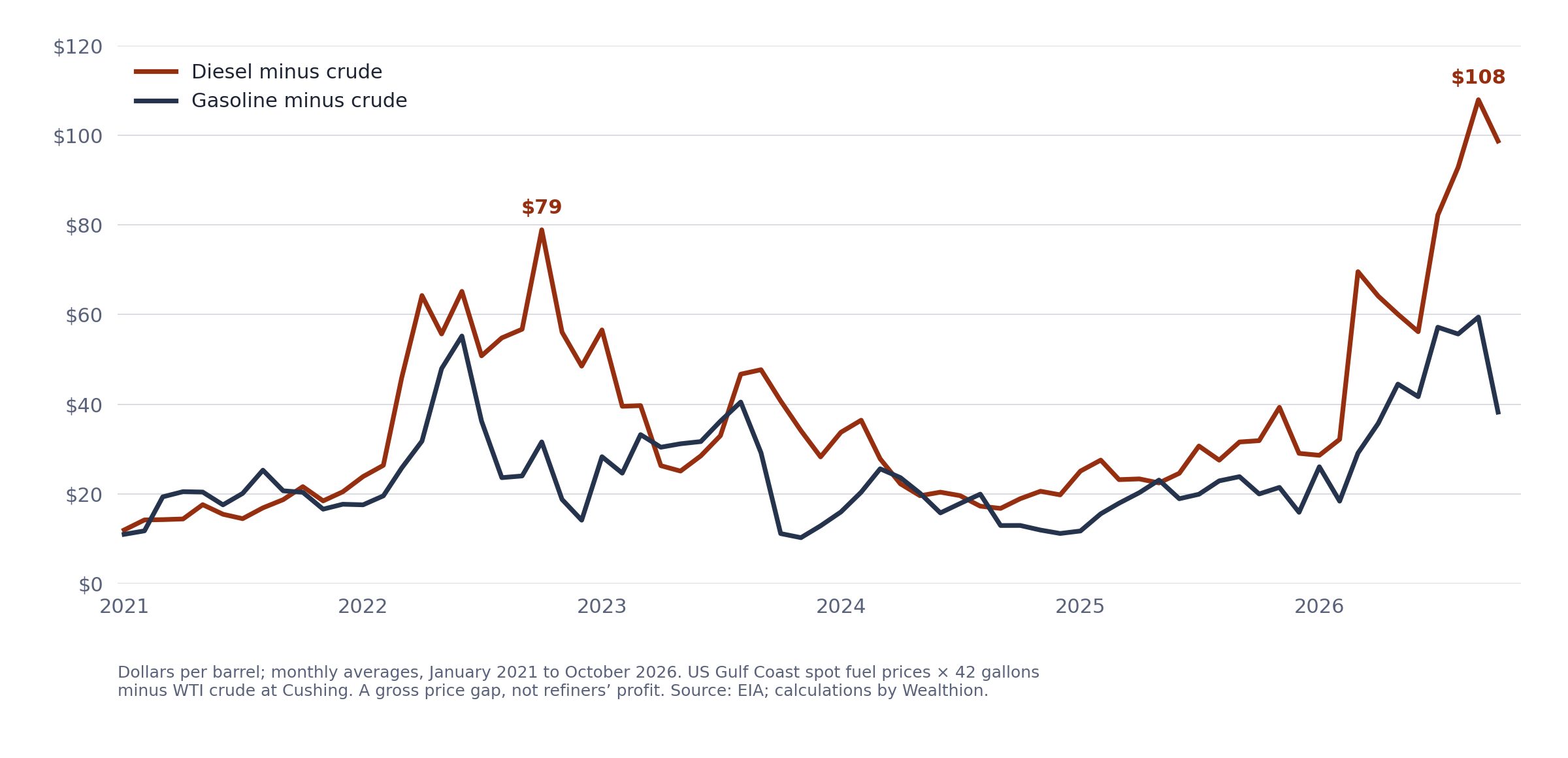
Measured as the Gulf Coast spot price of diesel minus WTI crude, diesel's gap reached about $108 a barrel in September 2026, above its highest 2022 monthly average of about $79. Gasoline's gap reached about $59 in September, compared with its 2022 peak of about $55, before easing to $38 in October.1,2,9
Why is refining capacity so tight?
US closures. The US had 130 operable refineries at the start of 2026, down from 132 a year earlier, with capacity down about 263,000 barrels a day.10,11 Closures during 2025 included LyondellBasell's Houston plant and Phillips 66's Los Angeles plant.12 Valero's Benicia refinery stopped fuel production in the first quarter of 2026 and completed full idling in April, after that annual count.13
Running near full. US refineries ran at 97.6% of operable capacity in August 2026, leaving limited room to increase output.14
Damage abroad. The EIA attributes high crack spreads to refinery damage in the Middle East and Russia, which has reduced fuel exports.4 The IEA says Persian Gulf exports of refined products and liquefied petroleum gas remain roughly half their pre-war levels, even as crude exports recover.5
Those overseas shortages affect US prices too. They raise the cost of importing diesel and increase demand for US exports. High domestic production therefore does not automatically mean plentiful fuel at home.15
Why is fuel demand relatively insensitive to price?
Demand for essential refined fuels such as diesel and gasoline is relatively price-inelastic, particularly in the short term. Transport, freight, agriculture and several industrial activities depend on these fuels, leaving businesses and consumers with limited immediate alternatives when prices rise. As a result, a reduction in available supply cannot always be matched by an equally quick reduction in demand. Buyers continue competing for the fuel they need, pushing prices higher, sometimes sharply. Households are an important exception in terms of their ability to absorb the increase: lower-income families, in particular, may be forced to cut other expenditure or reduce fuel consumption as prices climb. Over time, sustained high prices can encourage conservation, efficiency and a shift to alternative energy sources, but these adjustments take time.
Limited stocks. US distillate inventories, which include diesel and heating oil, fell to 99.3 million barrels in the week ending October 30. They recovered to 104.9 million by November 13, but remained below 111.1 million a year earlier.16
How have different energy businesses performed?
In the third quarter (Q3) of 2026, the selected refining businesses below reported much larger year-over-year earnings increases than the oil-and-gas production businesses shown. However, market prices are only part of the explanation: acquisitions, costs and one-off charges also affect results.
Three months ended September 30; amounts in billions of dollars. Measures differ and are not directly comparable across companies. “Adjusted” measures exclude selected company-defined items. EBITDA means earnings before interest, taxes, depreciation and amortization; EBDA means earnings before depreciation, depletion and amortization. Chevron and ExxonMobil are integrated companies; only their upstream, or oil-and-gas production, businesses are shown.3,17,18,19,20,21
| Business shown | Segment measure | Q3 2025 | Q3 2026 |
|---|---|---|---|
| Valero refining | Operating income | $1.61 | $8.78 |
| Marathon Petroleum refining and marketing | Adjusted EBITDA | $1.76 | $9.90 |
| Phillips 66 refining | Adjusted pre-tax income | $0.43 | $6.06 |
| Chevron upstream | Earnings | $3.30 | $5.70 |
| ExxonMobil upstream | Earnings | $5.68 | $7.09 |
| Kinder Morgan products pipelines | Adjusted EBDA | $0.29 | $0.31 |
Valero's refining margin rose from $13.14 to $39.24 per throughput barrel.3 Chevron's upstream earnings rose 73% and ExxonMobil's 25%; Chevron's realized price for US liquids rose from $48.12 to $62.72 a barrel.19,20
Phillips 66's comparison includes an enlarged business: from October 2025, it consolidated full ownership of the Borger and Wood River refineries after buying the remaining 50% interest. The entire earnings increase cannot be attributed to wider spreads.18
Kinder Morgan shows why the measure matters. Reported Products Pipelines EBDA fell from $288 million to $172 million, including $138 million of legal, environmental and other accruals. The adjusted figure shown above rose to $313 million. Its reported decline does not establish that the fuel-price environment hurt underlying earnings.21
Profit incentives and the limits of price intervention.
In a market-based energy industry, refiners and fuel distributors have a commercial incentive to maximise returns, particularly when supply is tight and demand remains strong. Wider margins can therefore translate into substantially higher earnings for companies that have the capacity to keep producing. This is a normal feature of market pricing, although it can impose a significant burden on fuel users. Governments generally have several ways to respond, including releasing emergency stocks, adjusting fuel taxes and enforcing competition rules, but direct controls on prices are often limited in market-oriented economies. This leaves prices largely influenced by the balance between supply and demand, while companies respond to the opportunity to earn higher margins. The tension between commercial returns and the affordability of essential fuels becomes particularly visible when supply disruptions persist.
Have high refining margins fallen before?
Yes, after the 2022 surge. Valero's refining operating income fell from $15.8 billion in 2022 to $11.5 billion in 2023 and $4.0 billion in 2024. Marathon's Refining & Marketing margin per barrel fell from $28.18 to $23.00 and then $16.01.22,23,24
In November 2023, the EIA reported that a gasoline crack-spread measure had reached its lowest monthly average since December 2020 in October. Weak gasoline demand was one reason, although diesel spreads remained higher.25
That history shows how quickly favorable refining conditions can change. It does not establish when today's margins will fall.
What could bring fuel prices and margins down?
New capacity and repairs. Aramco reported in October that China's Huajin Aramco project, designed to include a 300,000-barrel-a-day refinery, had entered commissioning. That is a step toward additional supply, not confirmation that full commercial output has begun.26 Restoring damaged refineries would also help rebuild fuel supply.4
Emergency stocks. The US authorized a 172-million-barrel Strategic Petroleum Reserve release in March as part of a 400-million-barrel international action. By October, the IEA said about 325 million barrels had been released; its members' public emergency stocks still included more than 200 million barrels of diesel.27,28
The distinction matters: releasing crude supplies feedstock but does not restore refining capacity. Releasing stored diesel provides the finished fuel more directly.
Weaker demand. High prices can reduce fuel use over time. The IEA identifies high prices, electrification and efficiency as factors limiting the recovery in road-fuel demand.5
What does this mean for investors?
Fuel prices affect more than energy-company profits. Steven Feldman, Wealthion's co-founder and chief executive, has emphasized how diesel and gasoline costs flow through the economy.29 Diesel prices can raise freight costs and affect farming and home heating.15
A falling oil price tells investors only part of the story. Fuel prices also depend on how much refineries can produce, how much buyers need and how much is available in storage.
If repairs and new capacity make fuel more plentiful, the same change that helps households and businesses could narrow refiners' margins. That is why strong refining earnings need to be understood in the context of the cycle. For investors, the useful question is what is driving those earnings and what could change them.
Frequently asked questions
What is a crack spread? The difference between crude's price and the price of the fuels refined from it. It is an indicator of gross refining margins, not net profit.8
Why has diesel been especially expensive? Refinery damage, restricted exports and low inventories have tightened diesel supplies. Pump prices also include crude costs, taxes, distribution and retail margins.4,5,15
Why can't refineries simply make more diesel? Refineries produce a mixture of fuels. Their equipment limits how far they can switch output from one product to another, even when diesel becomes more profitable.30
Does cheaper crude always help refiners? No. The selling prices of their products matter too. If fuel prices fall faster than crude, the price gap can shrink even while crude becomes cheaper.8
Has a new US refinery opened since the 1970s? Yes. A 45,000-barrel-a-day refinery in Galveston, Texas, began operating in February 2022. Existing refineries can also add capacity through expansions.31
Sources & Disclosure
1 Cushing, OK WTI Spot Price FOB. US Energy Information Administration, series RWTC; monthly observations through October 2026, release of November 18, 2026. 2 US Gulf Coast Ultra-Low Sulfur No. 2 Diesel Spot Price. US Energy Information Administration, series EER_EPD2DXL0_PF4_RGC_DPG, release of November 18, 2026; spread over WTI calculated by Wealthion. 3 Valero Energy Reports Third Quarter 2026 Results. Valero, October 22, 2026; refining operating highlights and operating income reconciliation. 4 Short-Term Energy Outlook. US Energy Information Administration, November 10, 2026; petroleum products chapter and Table 4a. 5 Oil Market Report, November 2026. International Energy Agency, November 13, 2026; refined products discussion. 6 US No. 2 Diesel Retail Prices. US Energy Information Administration, Gasoline and Diesel Fuel Update, November 17, 2026. 7 Wealthion, Oil Near $100: China's Demand Story Doesn't Add Up, Art Berman interview, video published September 8, 2026. 8 3:2:1 Crack Spread. US Energy Information Administration, updated February 4, 2013; calculation explanation. 9 US Gulf Coast Conventional Gasoline Regular Spot Price FOB. US Energy Information Administration, series EER_EPMRU_PF4_RGC_DPG, release of November 18, 2026; spread over WTI calculated by Wealthion. 10 Refinery Capacity Report 2025. US Energy Information Administration, June 20, 2025; Table 1. 11 Refinery Capacity Report 2026. US Energy Information Administration, June 26, 2026; Table 1. 12 US refining capacity decreased during 2025. US Energy Information Administration, Today in Energy, June 29, 2026; closures and capacity changes. 13 Valero Energy Reports Second Quarter 2026 Results. Valero, July 30, 2026; notes to earnings release tables. 14 US Percent Utilization of Refinery Operable Capacity. US Energy Information Administration, series MOPUEUS2, release of October 30, 2026. 15 What goes into diesel prices? US Energy Information Administration, September 18, 2026; import/export effects, retail price components and fuel-use examples. 16 Weekly US Ending Stocks of Distillate Fuel Oil. US Energy Information Administration, Weekly Petroleum Status Report, November 18, 2026. 17 Marathon Petroleum Corp. Reports Third-Quarter 2026 Results. Marathon Petroleum, November 3, 2026; Refining and Marketing segment results. 18 Phillips 66 Reports Third-Quarter Results: Delivers 98% Refining Utilization and Strong Midstream Volumes. Phillips 66, October 28, 2026; adjusted refining pre-tax income reconciliation and Basis of Presentation, including WRB acquisition. 19 Chevron Reports Third Quarter 2026 Results. Chevron, October 30, 2026; financial highlights and US upstream table. 20 ExxonMobil Announces Third-Quarter 2026 Results, October 30, 2026, and ExxonMobil Announces Third-Quarter 2025 Results, October 31, 2025. ExxonMobil; Earnings and Volume Summary by Segment, worldwide upstream earnings. 21 Kinder Morgan Reports Record Third Quarter 2026 Financial Results. Kinder Morgan, October 21, 2026; segment EBDA reconciliation. 22 Valero Energy Reports 2023 Fourth Quarter and Full Year Results. Valero, January 25, 2024; full-year refining operating income. 23 Valero Energy Reports 2024 Fourth Quarter and Full Year Results. Valero, January 30, 2025; full-year refining operating income. 24 Marathon Petroleum Corporation 2024 Annual Report and Form 10-K; pages 51 to 52, segment results and operating statistics. 25 Low US gasoline demand is making gasoline less profitable, reducing crack spreads. US Energy Information Administration, November 1, 2023. 26 North Huajin, Panjin Xincheng, and Aramco announce first Arabian crude oil shipment to HAPCO, October 9, 2026; Aramco highlights deepening cooperation in Liaoning at 7th China Liaoning International Fair for Investment and Trade, October 13, 2026. Aramco China; planned 300,000-barrel-a-day refinery and commissioning status. 27 United States to Release 172 Million Barrels of Oil From the Strategic Petroleum Reserve. US Department of Energy, March 11, 2026. 28 Statement by IEA Executive Director on meeting of IEA Member governments on 7 October 2026. International Energy Agency, October 7, 2026. 29 Wealthion, What to Own if the Tech Boom Falters, Steven Feldman interview, video published October 30, 2026. 30 What drives petroleum product prices: Production. US Energy Information Administration, accessed November 20, 2026; refinery processes and limited ability to shift product yields. 31 When was the last refinery built in the United States? US Energy Information Administration, frequently asked questions, current as of January 1, 2026.
Wealthion is a dba of Greylock Peak Investments, a registered investment adviser. This article is general information only. It is not investment advice or an offer or solicitation, and it is not tailored to your circumstances. Guests’ views are their own and may not reflect those of Wealthion. Wealthion has not verified guest statements, including any performance figures. Investing involves risk, including loss of principal, and past performance does not guarantee future results. Wealthion refers readers to other registered investment advisers and shares in the fees they receive from referred clients, which creates a conflict of interest. Please see our Form ADV Part 2A and consult your own financial advisor before investing.
What Serious Investors Are Watching
Dive into expert interviews, market analysis, and long-form content built to help serious investors think long-term.
Why Fuel Prices Stayed High When Oil Fell: The Refinery Bottleneck Explained
Refinery disruptions help explain why cheaper crude does not always bring cheaper fuel, and why energy businesses can report very different earnings.

Macro Bites – OMFIF’s Gold Report, Copper Challenges and More
In 2026, the Official Monetary and Financial Institutions Forum (OMFIF) formed a Gold and Precious...

What’s Driving AI Stock Volatility in 2026, and What It Means for Investors
AI-stock declines can reflect changing profit expectations and selling pressure. Company results, leverage data and past recoveries help explain the differences.
Enjoyed This? Get More Insights
Expert insights and curated opportunities, delivered to your inbox.
Ready to Position for What's Coming?
Whether you're still learning or ready to act, your next step starts here.
- Independent
- Macro-Informed
- Real Asset Focused


The Wealthion Network
By subscribing, you agree to receive Wealthion emails. Unsubscribe anytime.
The Wealthion Network
By subscribing, you agree to receive Wealthion emails. Unsubscribe anytime.
Network Discussion
Join the Wealthion Network to Comment