

Artificial Intelligence (AI) Capital Spending: What the Headline Numbers Actually Measure
Big tech's AI spending gets quoted as if it were one number. It's really several: cash out the door, data centers on long leases and contracts that run for years. Adding overlapping measures can count the same building more than once.
Every quarter, headlines add up what the biggest tech companies are spending on artificial intelligence. The totals are enormous, and easy to misread.
The problem is the word capex, short for capital expenditure, the money invested in long-lasting assets such as servers and buildings. It doesn't mean the same thing at every company. One counts the cash it paid. Another counts a finance-leased asset at its principal value when the lease starts. A third adds lease principal payments to its cash purchases.
One data center can appear in a commitment when the contract is signed, in capex when a finance lease commences and in cash flows as it's paid for. This article lines those stages up, shows how Microsoft, Alphabet, Amazon and Meta each report them and explains what each number can and can't tell you, especially about free cash flow.
The numbers at a glance (B = billion)
How big is AI capex, and why don't the headline numbers match?
Four figures from the same three months look comparable. They aren't.
For July to September 2026, Microsoft reported $45.2 billion of capital expenditures 1. Alphabet reported $51.4 billion 5. Amazon paid $77.3 billion for property and equipment, and Meta paid $33.9 billion 2, 6. These are company-wide figures, not AI-only totals.
But they're built differently. Microsoft's includes the full principal value of finance leases at commencement 1. Alphabet's and Amazon's figures above are cash paid in the quarter. Meta's headline capex of $34.91 billion adds $964 million of finance lease principal payments to its cash purchases 6. Other disclosures cover leases that haven't started and multiyear supplier contracts. Lined up, these layers tell you a lot. Adding overlapping layers can double-count.
What is the difference between cash capex, finance leases and commitments?
Microsoft makes the clearest example, because its finance chief walks through every layer each quarter.
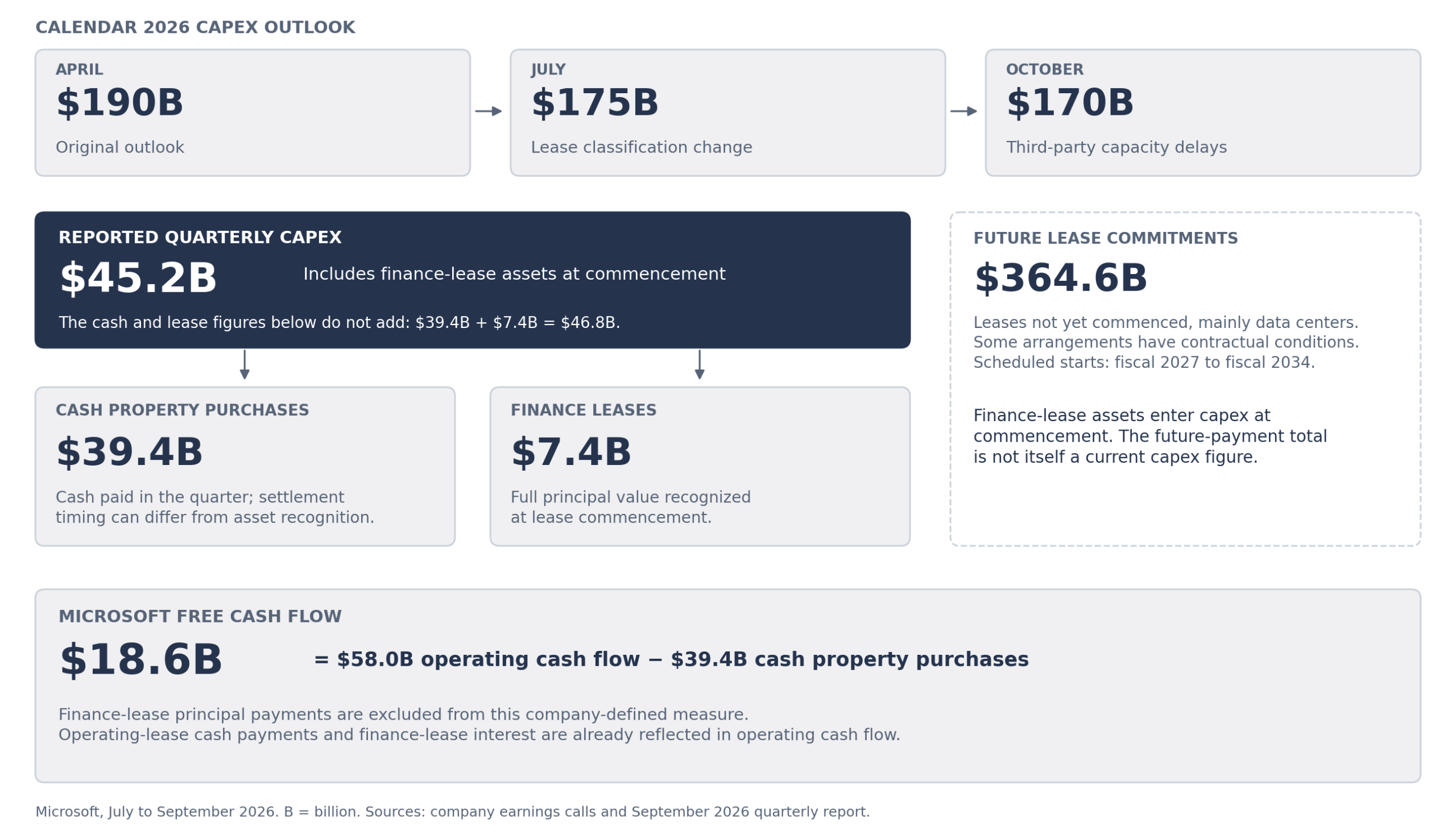
Microsoft's fiscal year runs July to June, so July to September 2026 was the first quarter (Q1) of fiscal 2027. That quarter, capex was $45.2 billion, finance leases were $7.4 billion and cash paid for property, plant and equipment (PP&E) was $39.4 billion 1. Microsoft says it recognizes "the full principal value of finance leases in capex at the time of lease commencement" 1. So the $45.2 billion includes finance-leased assets whose payments stretch over years. The cash purchases line excludes that initial noncash lease recognition.
The pieces don't add up exactly: $39.4 billion plus $7.4 billion is $46.8 billion, not $45.2 billion. In its year-earlier call, Microsoft identified goods received but not yet paid for as another timing difference 7. It didn't reconcile the current quarter's gap on the October 2026 call 1.
Beyond the quarter sits a much larger layer. Microsoft's quarterly report shows $364.6 billion of leases, primarily for data centers, that haven't commenced. They are scheduled to begin between fiscal 2027 and fiscal 2034, with some arrangements subject to contractual conditions 3. Finance-leased assets enter capex at lease commencement; this future-payment total is not itself the amount of future capex.
That label can move the headline on its own. In July 2026, Microsoft lengthened the accounting lives of its data center buildings and said that, as a result, more future data center leases would shift to operating leases, which don't count toward capex. Its calendar 2026 capex expectation fell to about $175 billion 8. The buildings didn't change. The accounting label did.
Microsoft subtracts cash property purchases in its free cash flow
Microsoft, July to September 2026 (Q1 of fiscal 2027). The measures overlap and are not added; cash settlement timing can differ from asset recognition 1, 3, 4, 8, 7.
These are different stages of investment. Each answers a different question:
| Layer | What it counts | What it tells you |
|---|---|---|
| Cash capex | Cash paid for property and equipment in the period | The strain on this year's free cash flow |
| Capex including finance leases | Reported capital investment including finance-lease assets at commencement | Investment in assets, including newly commenced finance leases |
| Leases not yet started | Contracted leases that have not commenced; some may be conditional | Potential future investment; finance-lease assets enter capex at commencement |
| Purchase commitments | Multiyear contracts with suppliers | Potential future cash outlays under contract terms |
Why do fiscal years and company-wide totals distort comparisons?
Even when two companies use the same word, they may not be measuring the same year, or the same thing.
Microsoft expects about $170 billion of capex for calendar 2026 1. In July it also said fiscal 2027 spending would grow 8. That calendar figure has already moved twice, from roughly $190 billion in April to about $175 billion in July after the lease change, then about $170 billion in October after delays at third-party capacity providers 4, 8, 1.
The others' plans use different yardsticks. Alphabet kept its 2026 guidance at $195 billion to $205 billion 5. Amazon expects about $220 billion of 2026 "cash capital expenditures" 2. Meta's range of $135 billion to $145 billion includes principal payments on finance leases 6. A combined total would mix cash purchases, lease asset values and lease principal payments. It would not be an AI-only total.
These quarterly disclosures don't provide a comparable AI-only share. Microsoft says roughly three quarters of its July to September spending went to short-lived assets, primarily central processing units and graphics processing units 1. Alphabet says about 65% of its technical infrastructure spending went to servers and networking equipment and 35% to data centers 5. Amazon and Meta describe their buildouts without quantifying an AI-only share alongside these totals 2, 9.
What does the gap mean for free cash flow?
Free cash flow is where the spending shows up, and where definitions matter.
Microsoft and Alphabet subtract cash property purchases from operating cash flow. Meta also subtracts finance lease principal; Amazon nets property purchases against property sales and incentives 1, 5, 6, 2. Microsoft's free cash flow was $18.6 billion in July to September 2026, down from $25.7 billion a year earlier, even as operating cash flow rose 29% to $58 billion 1, 7. Amazon's was an outflow of $42.4 billion over the 12 months to September, against an inflow of $14.8 billion a year earlier 2. The chart compares operating cash flow with gross cash property purchases for the quarter.
Cash capex topped operating cash flow at three of four big AI spenders
July to September 2026, $ billions. Differences use unrounded figures and a common gross-purchases calculation, rather than each company's reported free cash flow 1, 5, 2, 6.
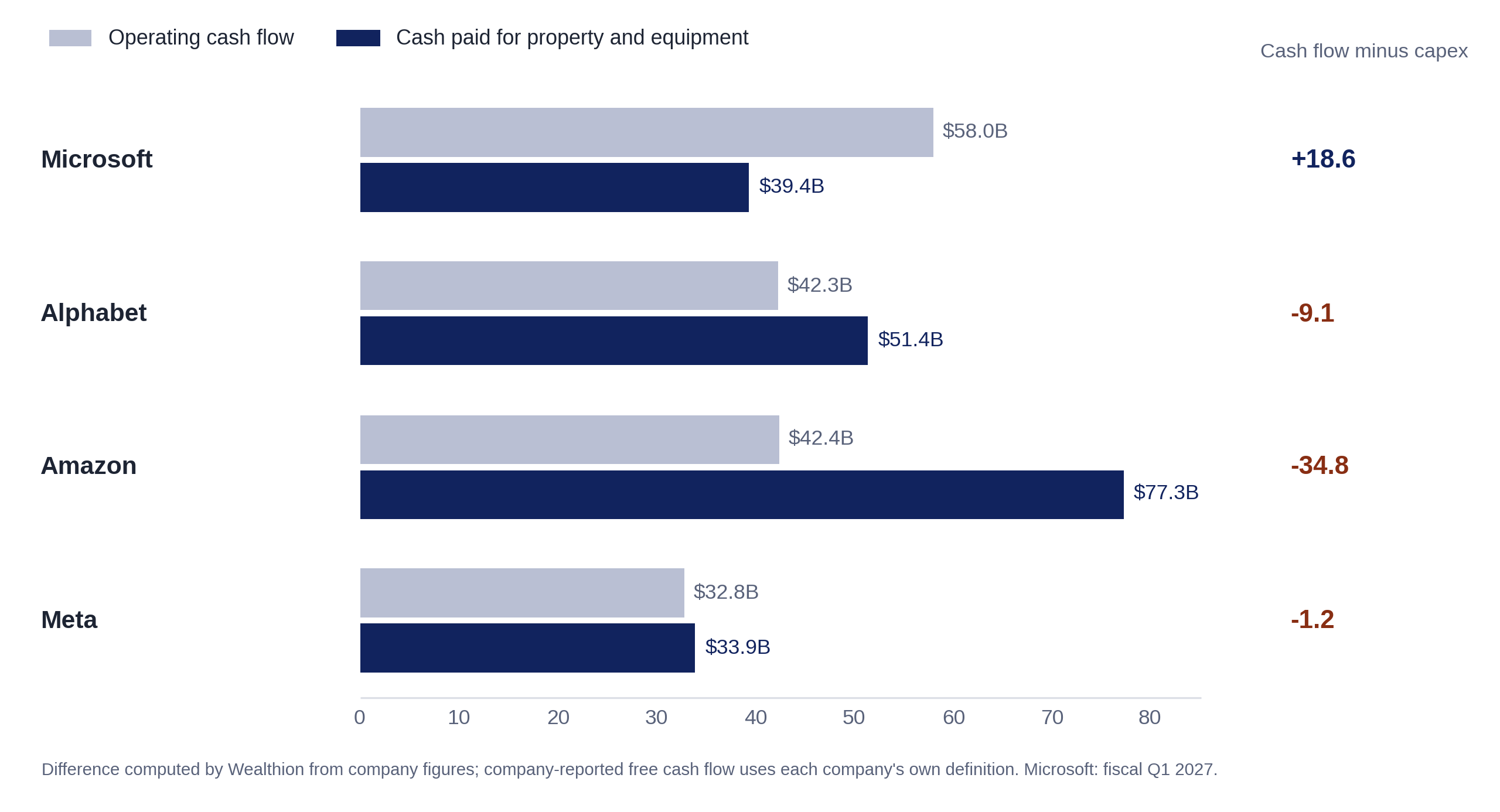
Lease timing also matters. A finance-leased asset enters Microsoft's capex at lease commencement, while principal repayments are financing cash flows excluded from its free cash flow. Operating-lease cash payments and finance-lease interest already run through operating cash flow 3. So free cash flow shows the current cash burden under that definition, not the full cost of assets being added.
Financing is another layer. Alphabet announced an $84.75 billion equity-financing package in June 2026, including a potential $40 billion program to sell shares over time. AI infrastructure was one intended use of proceeds from the concurrent offerings and private placement; the $40 billion program primarily addressed tax payments associated with employee equity grants 10.
What do the numbers say about replacement needs and suppliers?
More of Microsoft's spending is going into assets with shorter accounting lives.
Microsoft's short-lived share of spending was roughly half in July to September 2025 and roughly three quarters a year later, as capex including finance leases rose from $34.9 billion to $45.2 billion 7, 1. Buildings point the other way: Microsoft stretched the accounting lives of its data center buildings from 15 to 25 years 8, but that covers buildings, not the chips inside them. Accounting lives spread costs over time; they are not physical replacement schedules. Depreciation is already affecting expenses: alongside sales of its own AI chip hardware, Alphabet cited depreciation as a driver of a 32% rise in other cost of revenues 5.
Spending isn't the same as more equipment, either. Microsoft's April outlook for calendar 2026 included about $25 billion "from the impact of higher component pricing" 4: higher prices for parts, not more of them. And Microsoft says it still has "demand that exceeds supply" 1.
Do the headline numbers overstate or understate the AI buildout?
It depends on which question you're asking.
One reading favors the bigger numbers because unstarted leases and commitments show contracted obligations beyond any one year, even though conditions can change the eventual outlay. Contracted demand is large too: Microsoft's commercial revenue under contract but not yet recognized rose 73% to $677 billion 11, and Google Cloud's backlog was $561 billion 5. Neither is an AI-only measure.
The other reading is that each layer answers a different question. Cash capex shows the strain on current cash flow. Capex including finance leases captures investment in assets, including newly commenced leases. Commitments show potential future outlays under contracts. A total that adds overlapping stages can count a data center when it's contracted, when a finance lease commences and when it's paid for.
One data center can produce several numbers. The difference is what each measures, and when. We are not making any recommendations.
Frequently asked questions
What does "capex including finance leases" mean? Microsoft recognizes the full principal value of finance-leased assets in capex at lease commencement, even though payments run for years. The initial noncash lease recognition is excluded from cash property purchases 1.
Why can free cash flow stay positive while capex rises? Operating cash flow can grow, and finance-leased assets need not be paid for up front. Microsoft's operating cash flow rose 29% to $58 billion in July to September 2026, while cash property purchases were $39.4 billion, leaving $18.6 billion of free cash flow under its definition 1.
Sources & Disclosure
1 Microsoft Fiscal Year 2027 First Quarter Earnings Conference Call. Microsoft Investor Relations, October 28, 2026; capex of $45.2 billion, finance leases of $7.4 billion, cash paid for property, plant and equipment of $39.4 billion, short-lived share, operating and free cash flow, calendar 2026 outlook of about $170 billion, capacity delays and supply comments. 2 Amazon.com Announces Third Quarter Results. Amazon.com, Inc., October 29, 2026; gross property purchases, proceeds from property sales and incentives, operating cash flow, trailing free cash flow and its definition, and 2026 cash capital expenditures expectation. 3 Microsoft Corporation Form 10-Q for the quarter ended September 30, 2026, Note 12 (Leases). Microsoft, filed with the United States Securities and Exchange Commission October 28, 2026; conditional arrangements within $364.6 billion of leases not yet commenced, scheduled starts in fiscal 2027 to fiscal 2034, and operating and financing cash flows from leases. 4 Microsoft Fiscal Year 2026 Third Quarter Earnings Conference Call. Microsoft Investor Relations, April 29, 2026; calendar 2026 capex of roughly $190 billion including about $25 billion from higher component pricing. 5 Alphabet Third Quarter 2026 Earnings Conference Call and earnings release. Alphabet Investor Relations, October 28, 2026; capital expenditures, technical-infrastructure split, 2026 guidance, exact quarterly operating cash flow and cash property purchases, free cash flow, commitments and their flexibility, other cost of revenues and Google Cloud backlog. 6 Meta Reports Third Quarter 2026 Results. Meta Platforms, October 21, 2026; purchases of property and equipment, finance lease principal, operating cash flow, free cash flow and its definition, 2026 capex outlook. 7 Microsoft Fiscal Year 2026 First Quarter Earnings Conference Call. Microsoft Investor Relations, October 29, 2025; year-earlier capex of $34.9 billion, roughly half short-lived, free cash flow of $25.7 billion, and timing differences between asset receipt and cash settlement. 8 Microsoft Fiscal Year 2026 Fourth Quarter Earnings Conference Call. Microsoft Investor Relations, July 29, 2026; useful-life change from 15 to 25 years, shift to operating leases, calendar 2026 expectation of about $175 billion, fiscal 2027 capex growth. 9 Meta Platforms Third Quarter 2026 Results Conference Call. Meta Investor Relations, October 21, 2026; what third-quarter capex was spent on; cash and debt at quarter end. 10 Alphabet Announces Upsize and Pricing of $84.75 Billion Equity Capital Raise to Expand AI Infrastructure and Compute. Alphabet Investor Relations, website posting June 3, 2026; linked release dated June 2, 2026. Package includes a potential $40 billion share-sale program; planned uses differ between that program and the concurrent offerings/private placement. 11 Microsoft Announces First Quarter Results. Microsoft Investor Relations, October 28, 2026; commercial remaining performance obligation of $677 billion, up 73%.
Wealthion is a dba of Greylock Peak Investments, a registered investment adviser. This article is general information only. It is not investment advice or an offer or solicitation, and it is not tailored to your circumstances. Guests’ views are their own and may not reflect those of Wealthion. Wealthion has not verified guest statements, including any performance figures. Investing involves risk, including loss of principal, and past performance does not guarantee future results. Wealthion refers readers to other registered investment advisers and shares in the fees they receive from referred clients, which creates a conflict of interest. Please see our Form ADV Part 2A and consult your own financial advisor before investing.
What Serious Investors Are Watching
Dive into expert interviews, market analysis, and long-form content built to help serious investors think long-term.

Gold IRAs Explained: What the Rules Allow and What They Cost
An annual account fee is easy to spot. The extra amount built into a gold...
Uranium Spot vs Term Prices: Why the Headline Price Isn’t What Most Utilities Pay
Uranium headlines quoted $91.55 a pound at the end of October 2026. Reactor owners in...
REITs Explained: How Real Estate Investment Trusts Work
A REIT lets you own a share of real estate income without owning a building....
Enjoyed This? Get More Insights
Expert insights and curated opportunities, delivered to your inbox.
Ready to Position for What's Coming?
Whether you're still learning or ready to act, your next step starts here.
- Independent
- Macro-Informed
- Real Asset Focused


The Wealthion Network
By subscribing, you agree to receive Wealthion emails. Unsubscribe anytime.
The Wealthion Network
By subscribing, you agree to receive Wealthion emails. Unsubscribe anytime.
Network Discussion
Join the Wealthion Network to Comment