

Data Center REITs: Why a Signed Lease Isn’t Rent Yet
A signed data center lease is a promise of future rent, not rent. Digital Realty's filings show how long the wait is, how much of the headline belongs to the company, and why accounting revenue and cash can differ.
The numbers at a glance
Why can a signed data center lease take more than a year to become rent?
For a data center real estate investment trust (REIT), a company that owns income-producing property, the day a tenant signs and the day rent starts can sit more than a year apart. On October 29, 2026, Digital Realty reported third-quarter bookings, the value of leases signed in the quarter, expected to generate $855 million of annualized GAAP base rent at 100% share, or $627 million at its own share 1. Annualized means scaled to a full year of rent, and GAAP means generally accepted accounting principles, the US accounting rules. The company said leases signed in the quarter carried a weighted-average lag of 17 months to contractual commencement 1.
Bookings measure signed business, rather than rental revenue already earned. The company put its signed-but-not-commenced backlog, meaning leases signed but not yet started, at a record $2.5 billion of annualized GAAP base rent at 100% share, or $1.8 billion at its share 1. Nareit, the REIT industry association, describes data center REITs as owners of specialized facilities housing information technology (IT) infrastructure, and its FTSE-based tracker counted three in the sector on September 30, 2026 4.
This article follows one preleased building, meaning one leased before it is finished, from signature to first cash payment. Along the way it separates three pairs of numbers that are easy to blur: leased versus occupied, accounting revenue versus cash rent, and a joint venture's total bookings versus the owner's share. Financing and debt risk are covered in a separate Wealthion article.
What happens between signing a data center lease and collecting rent?
A preleased data center can be signed before the space is built. Digital Realty's new leases above 1 megawatt (MW) signed in the first nine months of 2026 averaged 15.4 years 3. A megawatt is a unit of electrical power, and data center capacity is counted in it. That long term is what the owner is building toward, but it only starts paying at the end of the sequence below.
1. Signing. The lease is counted as a booking, measured as annualized GAAP base rent, and enters the backlog 2.
2. Construction. The owner builds or fits out the hall, cooling and electrical systems. Before the leased space is available to the tenant, capital goes out and no base rent comes in.
3. Power energization. The utility connection goes live and systems are commissioned. Digital Realty's quarterly report to the US Securities and Exchange Commission (SEC), known as a 10-Q, lists "delays or disruptions in connectivity or availability of power" among factors that could change results 3.
4. Lease commencement. US lease accounting standard Accounting Standards Codification (ASC) 842 defines commencement as "the date on which a lessor makes an underlying asset available for use by a lessee" 5. A lessor is the landlord. For Digital Realty's operating leases with probable collection, fixed base rent is recognized from accounting commencement on a straight-line basis 3.
5. First cash rent. The standard says the timing of when payments begin "does not affect the commencement date" 5. A rent holiday, a period at the start of a lease when no rent is due, can push the first check past the start of revenue.
Revenue starts at commencement; cash can start later still
Illustrative preleased building. Digital Realty's third-quarter 2026 signings averaged 17 months from signing to contractual commencement; accounting commencement depends on when the space becomes available.
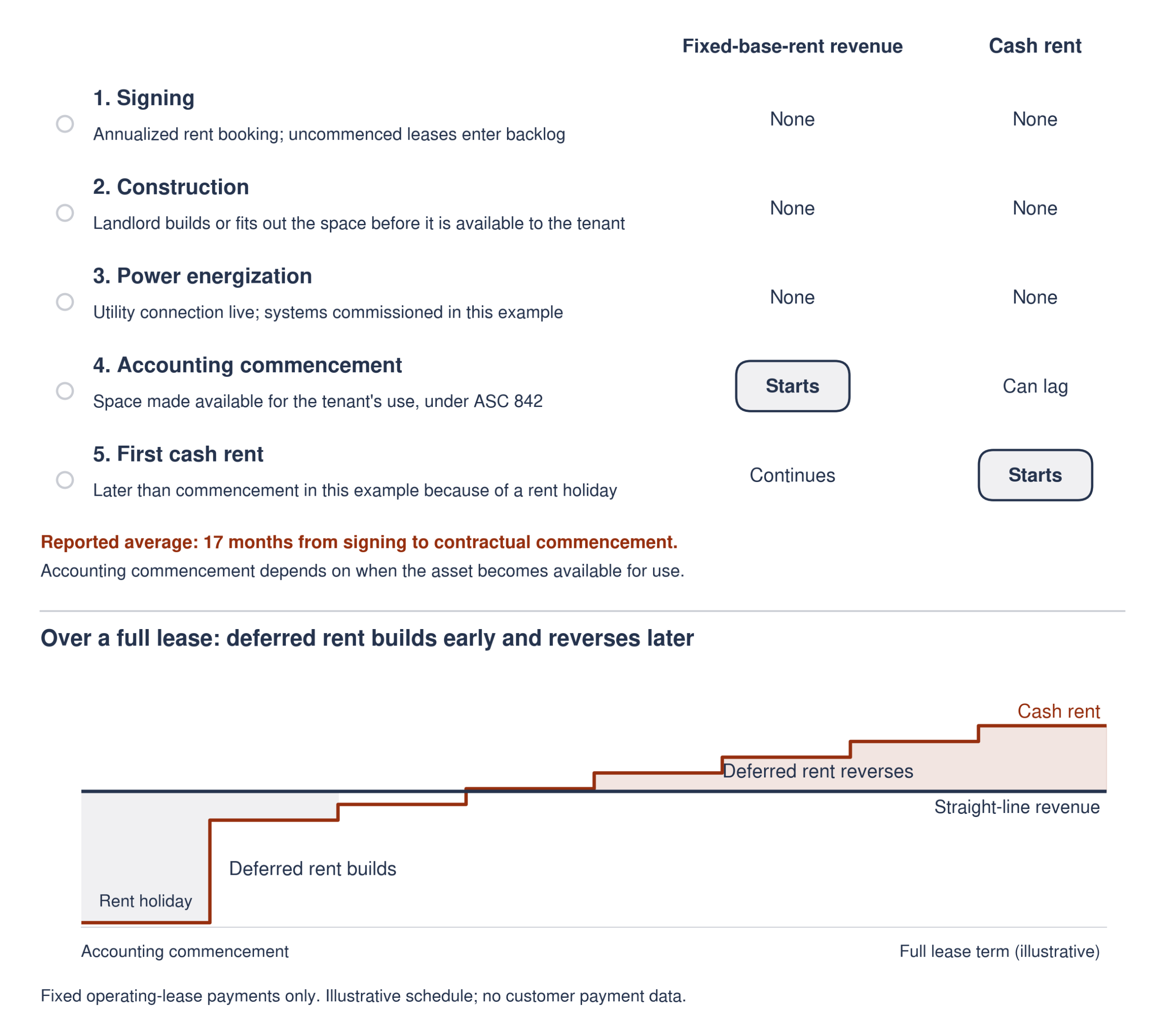
Wealthion illustration based on Digital Realty's disclosures 1 3 and the ASC 842 text 5. Not to scale.
The 17-month figure is Digital Realty's average for one quarter's signings, from signature to contractual commencement. Accounting commencement depends on when the asset becomes available for use 5. It is not a fixed schedule, and the filings do not split it into construction and power stages.
How big is the backlog at data center REITs like Digital Realty, and when does it start paying?
Digital Realty's backlog at its share rose from $1,427 million to $1,846 million in the third quarter. It signed $627 million and moved $207 million into commenced leases 2. The company says the backlog equals roughly 40% of its in-place data center rent at its share 2. In-place rent is rent from leases already running. The figures are rounded, so they differ by a million dollars when added.
Most of Digital Realty's signed backlog is now scheduled for 2027 or later
Signed, not yet commenced leases at Digital Realty's share, by expected commencement year; annualized GAAP base rent. Total: $1,427M at Jun 30, 2026 and $1,845M at Sep 30, 2026.
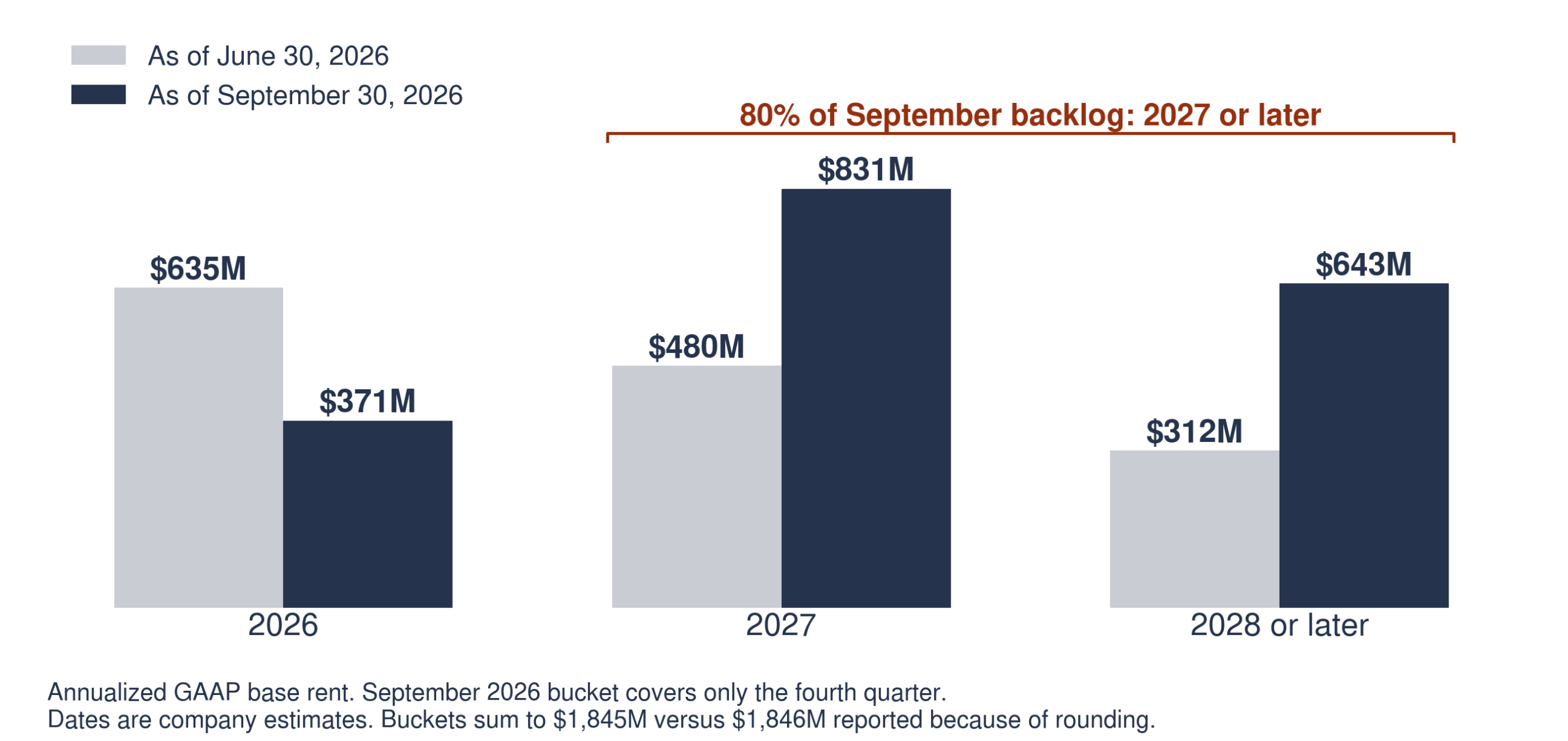
September 30 figures from the third-quarter presentation 2; June 30 figures from the second-quarter presentation 6. The September 30 bar for 2026 covers only the fourth quarter. Dates are company estimates and may vary. Buckets sum to $1,845M against $1,846M reported (rounding). The 80% is Wealthion's arithmetic: ($831M + $643M) divided by $1,845M.
The chart cannot show what moved between buckets. The 2026 bucket shrank by $264 million, more than the $207 million that commenced, but the presentation does not say whether the rest slipped into later years or left the backlog another way 2. The company also restates past backlog for asset sales and fund contributions, and its second-quarter presentation flagged about $380 million of extra backlog tied to a Northern Virginia acquisition 6.
One labeling caveat applies. The slide also shows a separate backlog for consolidated entities, those the company controls and reports in full, of $1,229 million. The series charted here is the one whose total matches the $1.8 billion at-share figure in the earnings release 1.
Why don't leased space, occupancy and revenue line up?
Leased and occupied are different counts. Digital Realty's consolidated portfolio was 90.7% occupied on September 30, 2026, measured across 2,555 MW of IT load, the electrical capacity set aside for customers' computing equipment 3. That figure "excludes capacity under active development and capacity held for development" 3.
Separately, the company had 1,464 MW of projects underway, 63% of it preleased 3. This pipeline includes consolidated and unconsolidated projects. Consolidated development capacity is excluded from the occupancy figure while under construction; unconsolidated capacity remains outside that consolidated measure even after delivery. A rising preleased share and a flat occupancy rate can therefore both be accurate in the same quarter.
Revenue and cash diverge next. Digital Realty recognizes "the total minimum lease payments provided for under the leases on a straight-line basis over the lease term" 3. Straight-line means the same amount of revenue is booked each year. When payments step up each year, or start after a rent holiday, early revenue runs ahead of the cash actually due.
That gap accumulates on the balance sheet as deferred rent, which the company defines as "rental income that has been recognized as revenue but which is not yet due from customers" 3. It stood at $832.8 million on September 30, 2026, up from $750.9 million at the end of 2025 3. Third-quarter renewals show the same split from another angle: rents on renewed leases rose 11.8% on a cash basis and 17.0% on a GAAP basis 1.
In Digital Realty's same-capital pool, the stabilized straight-line rent adjustment was $5.4 million in the third quarter, against $693.3 million of net operating income, or property operating revenue less property operating expenses 2. This is a defined pool of properties owned at the end of 2024 with limited development activity and other exclusions. Bookings, by contrast, are quoted as annualized GAAP rent, so for a new lease with annual rent increases the headline number can sit above its first year of cash 2.
Whose rent is it when a joint venture signs the lease, and what does the wait do to returns?
Many large data center REITs build through joint ventures, partnerships in which other investors own part of the project, so a headline lease may belong partly to someone else. Digital Realty's third-quarter bookings were $855 million at 100% share but $627 million at its share 1. The other $228 million, about 27%, is attributable to partners.
The owner's slice varies by venture. Digital Realty's 10-Q lists stakes of 50% in Digital Realty Bersama and MC Digital Realty, 49% in Ascenty, 20% to 50% in ventures with Blackstone, and 20% to 62.5% in its North America development fund 3. Equinix, another data center REIT, holds 20% of most of its xScale ventures and earns fees for managing them 7.
Unconsolidated rent, rent from a venture the owner does not control, also arrives through a different door. It does not appear in the owner's rental revenue; the owner books one net line for its share of the venture's results. For Digital Realty that line was a loss of $18.4 million in the third quarter 3. So when an unconsolidated venture's lease commences, the owner's rental revenue does not move; its share of the venture's net result does. Separate management or development fees can also be earned 3.
Timing then feeds into development returns. Digital Realty estimates a pre-tax stabilized cash yield of about 11.6% on its 1,464 MW under construction, based on total expected investment and anticipated income from signed leases or market-based assumptions 3. This is the company's forecast yield once projects reach their planned operating level. Its filing describes the income calculation as estimated revenue less operating expenses, depreciation and amortization. The figure covers consolidated and unconsolidated projects, and the filing does not say whether it is at 100% or at share 3.
A stabilized yield estimates income at the planned operating level, not when it arrives. In a hypothetical $1 billion project with an assumed 11.6% annual net operating income yield, delaying that full income stream by six months defers roughly $58 million, assuming unchanged project cost and annual income. Costs keep accruing during the wait: Digital Realty capitalized $143.7 million of interest into project costs in the first nine months of 2026, versus $92.4 million a year earlier 3. Capitalized interest is interest added to a project's cost while it is being built, instead of being expensed.
Preleasing sets how much of the pipeline already has a tenant. At 63% preleased, 37% of the megawatts under construction had no signed lease as of September 30, 2026 3.
Isn't a signed lease as good as rent already collected?
The case for treating backlog as near-certain income is real. These are long contracts: Digital Realty's new leases above 1 MW signed in the first nine months of 2026 averaged 15.4 years 3. Backlog has also been converting, with $208 million commencing at the company's share in the second quarter and $207 million in the third 6 2.
On that view the gap is only timing, and timing is disclosed. Digital Realty publishes the expected commencement year for every dollar in its backlog 2, and it raised its 2026 outlook for core funds from operations (FFO) per share on October 29 1. FFO is a non-GAAP earnings measure that adjusts net income for real estate depreciation, amortization and certain other items. Core FFO includes further company-defined adjustments; the raised guidance excludes net promote, or performance-related income net of related expenses 1.
The filings themselves draw the limits. Commencement dates are estimates that "may vary" 2. For projects under construction, the 10-Q states: "No assurance can be given that we will complete any of these projects on the terms currently contemplated, or at all" 3. The company also had about $4.1 billion of construction contract commitments outstanding 3, spending that happens before the matching rent arrives.
So what can the backlog numbers at data center REITs show, and what do readers commonly misread? Four points stand out from the disclosures:
Bookings are not next year's revenue. At Digital Realty, 80% of the at-share backlog is scheduled to commence in 2027 or later 2.
A 100% figure is not the owner's figure. The $2.5 billion headline backlog is $1.8 billion at the company's share, and unconsolidated rent never reaches its rental revenue line 1.
Occupancy leaves out what is being built. Preleased megawatts under construction are excluded from the 90.7% rate 3.
GAAP rent growth is not cash growth. Third-quarter renewal spreads, the change in rent on renewed leases, were 17.0% on a GAAP basis and 11.8% in cash 1.
The answer to the headline is in the dates. For leases Digital Realty signed in the third quarter of 2026, the weighted-average lag from signature to scheduled contractual commencement is 17 months, and the first cash payment can come later still. A signed lease is a contract for future rent. The filings show how long "future" is, and how much of it belongs to the reporting company. This article describes what the filings show. It is not a forecast.
Frequently asked questions
What is a signed-not-commenced lease? It is a lease the tenant has signed for space not yet made available to it. Digital Realty reports these as backlog, measured in annualized GAAP base rent; it stood at $1.8 billion at the company's share on September 30, 2026 1.
Why can GAAP rent run above cash rent early in a lease? For operating leases with probable collection, accounting rules spread fixed contracted payments evenly over the term. When payments rise each year or start after a rent holiday, early revenue exceeds cash, and the difference builds up as deferred rent 3.
What does "at share" mean? It is the portion of a figure that belongs to the reporting company, based on its ownership of each venture. Digital Realty's 100% figures include partners' portions; its at-share figures do not 1.
Does occupancy include preleased space under construction? Not in Digital Realty's reporting. Its occupancy rate excludes capacity under active development and capacity held for development 3.
What is a stabilized development yield? It compares a project's forecast income at its planned operating level with its investment cost, using the issuer's stated methodology. Digital Realty estimated about 11.6% for its projects under construction as of September 30, 2026, based on signed leases and market-based assumptions, and its October 29 outlook cites stabilized yields of 10% or more 3 1.
Sources & Disclosure
1 Digital Realty Reports Third Quarter 2026 Results, Earnings Press Release and Supplemental Information. Digital Realty, Form 8-K Exhibit 99.1, October 29, 2026; annualized bookings and backlog, contractual commencement lag, renewal spreads and Core FFO outlook. 2 3Q26 Financial Results. Digital Realty, Form 8-K Exhibit 99.2, October 29, 2026; page 10, backlog roll-forward and commencement timing; page 18, same-capital definition; page 23, same-capital operating-income reconciliation. 3 Digital Realty Form 10-Q for the quarter ended September 30, 2026. Digital Realty Trust, SEC filing; Note 4, operating-lease recognition; deferred rent and unconsolidated investments; management discussion, occupancy, leasing, development pipeline and yield methodology, capitalized interest and construction commitments. 4 Discover Data Center REITs. Nareit, accessed November 6, 2026; sector description and FTSE Nareit tracker with three constituents, observation date September 30, 2026. 5 Accounting Standards Update No. 2016-02, Leases (Topic 842), Section A. Financial Accounting Standards Board, February 2016; commencement-date glossary and paragraphs 842-10-55-19 through 55-21; operating-lessor income recognition and escalating-payment examples. 6 2Q26 Financial Results. Digital Realty, Form 8-K Exhibit 99.2, July 23, 2026; page 9, backlog roll-forward, expected commencement years, second-quarter commencements and acquisition-related backlog footnote. 7 Equinix Form 10-Q for the quarter ended September 30, 2026. Equinix, SEC filing; Note 4, equity-method investments, xScale ownership percentages and management-service fees.
Wealthion is a dba of Greylock Peak Investments, a registered investment adviser. This article is general information only. It is not investment advice or an offer or solicitation, and it is not tailored to your circumstances. Guests’ views are their own and may not reflect those of Wealthion. Wealthion has not verified guest statements, including any performance figures. Investing involves risk, including loss of principal, and past performance does not guarantee future results. Wealthion refers readers to other registered investment advisers and shares in the fees they receive from referred clients, which creates a conflict of interest. Please see our Form ADV Part 2A and consult your own financial advisor before investing.
What Serious Investors Are Watching
Dive into expert interviews, market analysis, and long-form content built to help serious investors think long-term.

Gold Recycling 2026: Why High Prices Aren’t Lifting It
Gold recycling fell to a three-year low in the third quarter of 2026 while the...
Data Center REITs: Why a Signed Lease Isn’t Rent Yet
A signed data center lease is a promise of future rent, not rent. Digital Realty's...
Macro Bites – 45% of U.S. Data Center Plans at Risk
At the Bharat Renewable Energy Summit on Wednesday, India’s Power Secretary Pankaj Agarwal announced India...
Enjoyed This? Get More Insights
Expert insights and curated opportunities, delivered to your inbox.
Ready to Position for What's Coming?
Whether you're still learning or ready to act, your next step starts here.
- Independent
- Macro-Informed
- Real Asset Focused


The Wealthion Network
By subscribing, you agree to receive Wealthion emails. Unsubscribe anytime.
The Wealthion Network
By subscribing, you agree to receive Wealthion emails. Unsubscribe anytime.
Network Discussion
Join the Wealthion Network to Comment