

How Debt Is Getting in the Way of Retirement Savings
Savers say they need $1.2 million to retire comfortably. About half expect to arrive with less than $500,000, and one in three say their card debt now exceeds their retirement savings. Here is how the money is colliding, what the arithmetic looks like, and where the evidence cuts the other way.
The numbers at a glance
| $1.2 million What workplace savers say they need to retire comfortably Schroders 2026 US Retirement Survey 1 |
$106,000 Median retirement account balance among families that have one Federal Reserve, 2025 Survey of Consumer Finances (SCF) 2 |
| 22.36% Average card rate on accounts assessed interest, August 2026 (preliminary) Federal Reserve G.19 3 |
$1.263 trillion US card balances in the second quarter of 2026 Federal Reserve Bank of New York 4 |
What did the new retirement survey find?
Workplace retirement savers say they need about $1.2 million to retire comfortably. About half expect to reach retirement with less than $500,000. Those figures come from the Schroders 2026 US Retirement Survey, released July 15, 2026 1.
The same survey found that one in three plan participants say their credit-card debt now exceeds their retirement savings 1. It polled 1,500 US investors aged 30 to 79 between March 20 and April 15, 2026, through the research firm 8 Acre Perspective. The participant findings in this article describe the workplace plan participants within that sample. Every figure is self-reported, and Schroders, an asset manager, sponsored the work.
Official data points the same way. The $1.2 million target is about 11 times the median balance the Federal Reserve (the Fed) found among families with a retirement account in 2025, though the two figures come from different groups. Card balances topped $1.26 trillion in the second quarter, the average rate on balances that pay interest is above 22%, and everyday costs keep climbing.
How far apart are the retirement target and actual savings?
The gap is wide on any measure. In the Schroders survey, 51% of participants expect less than $500,000 at retirement, including 24% who expect less than $250,000 1. Only 30% expect to cross $1 million. The worry is broad: 81% are at least slightly concerned about running out of money in retirement, and 53% say they spend at least an hour a day worrying about money in general.
The target itself depends on who asks. Schroders' 2025 survey put it at $1.28 million 5. Northwestern Mutual's 2026 Planning & Progress Study, which polled 4,375 adults in January, put the “magic number” at $1.46 million, up from $1.26 million in 2025 6. Different samples and questions explain much of that spread, so read the targets as a range, not a single figure.
Measured savings sit far lower. The Fed's 2025 Survey of Consumer Finances (SCF), released October 9, 2026, found 54.9% of families hold a retirement account such as a 401(k) or an individual retirement account (IRA) 2. Among those families, the median balance was $106,000, up 11% from 2022 after adjusting for inflation. Counting defined benefit pensions as well, plan participation was 65.1% 2.
Medians and means tell different stories. The mean balance for account holders was $451,100, pulled up by large accounts, and holders of IRAs or workplace accounts in families headed by someone aged 55 to 64 averaged $670,200 2. The comparison with the survey target is not like for like: the target is a personal goal, while the Fed figures are family balances across all ages, in 2025 dollars. SCF balances are survey estimates, not audited account records.
How much is credit-card debt costing households?
Card balances reached $1.263 trillion in the second quarter of 2026, according to the Federal Reserve Bank of New York (New York Fed) 4. That was $21 billion more than the prior quarter and $54 billion more than a year earlier. Total household debt stood at $18.771 trillion.
What a balance costs depends on its rate, and that rate has stepped up. The Fed's G.19 release tracks the average rate banks charge on card accounts that are assessed interest, meaning balances carried past the due date 3. Earlier releases supply the series back to 2015 7,8.
Annual average rates on interest-paying card balances were above 22% in 2023, 2024 and 2025
Average annual percentage rate (APR) on bank card accounts assessed interest; annual averages 2015 to 2025 and August 2026 (preliminary)
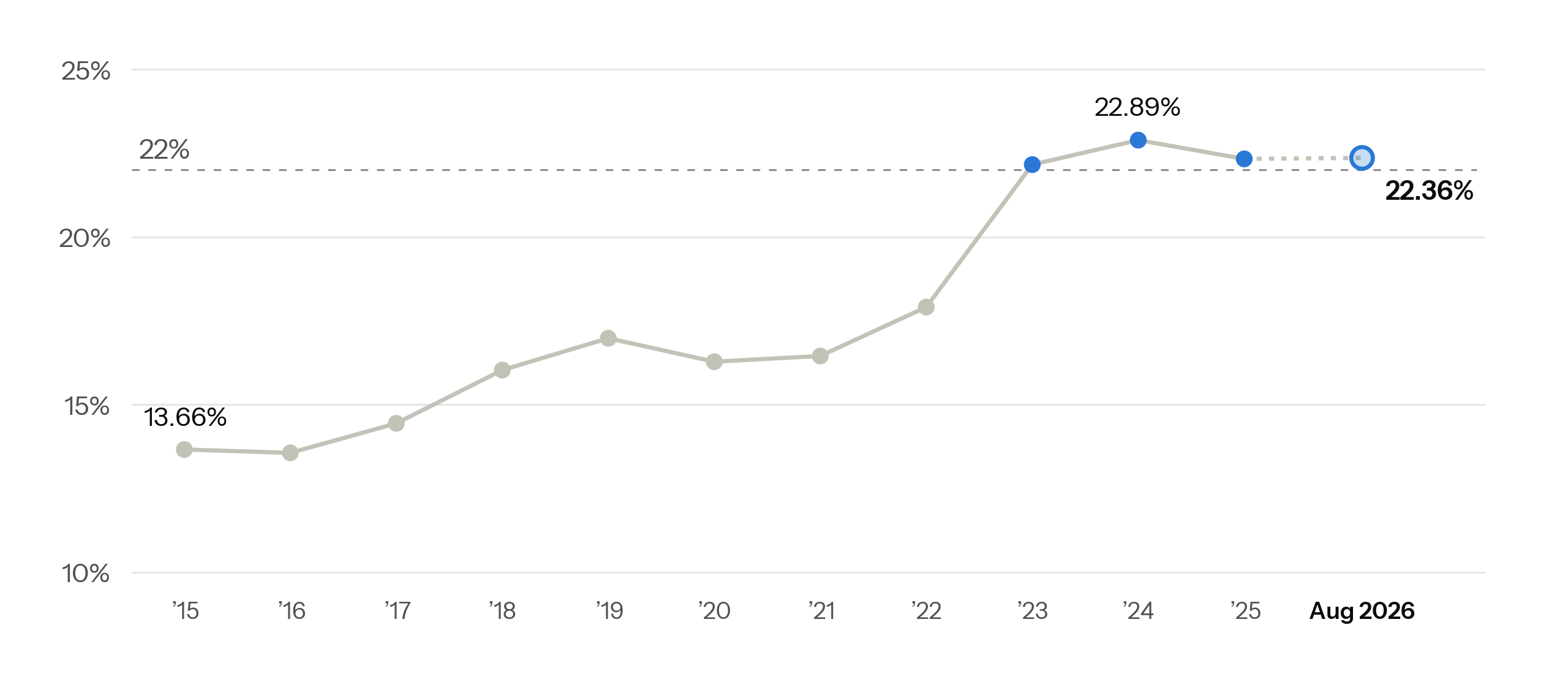
Source: Federal Reserve G.19 Consumer Credit releases 3,7,8. Annual averages 2015 to 2025; August 2026 is preliminary. Commercial bank rates, not seasonally adjusted. Axis starts at 10%. Quarterly readings vary around the annual averages.
The jump came in 2022 and 2023. Annual averages were above 22% in 2023, 2024 and 2025, though quarterly readings vary: the first quarter of 2026 was 21.52%, and the second was 22.15% 3. At 22.36%, carrying $1,000 for a year costs about $224 in simple interest, or nearer $250 with monthly compounding. The Consumer Financial Protection Bureau (CFPB) reported that cardholders were assessed $160 billion in interest in 2024, up from $105 billion in 2022 9. It also found the share of cardholders making only the minimum payment at its highest since at least 2015.
The burden is uneven. In the Fed's 2025 survey, 44.7% of families carried a card balance after their last payment 2. Their median balance was $3,100 and the mean was $8,000, so some households carry much larger balances than the typical one. The New York Fed's annualized flow of card balances into serious delinquency (90 or more days late) was 6.97% in the second quarter, against 6.93% a year earlier 4. The New York Fed described transition rates as mostly unchanged.
What else is competing with retirement contributions?
Everyday spending is rising fast. Bureau of Labor Statistics (BLS) data released October 29, 2026, show average spending per consumer unit, the BLS's household-style measure, of $81,905 in 2025, up 4.3% from 2024 10. Housing rose 5.8% to $27,790 and food rose 4.6%. Average pre-tax income grew faster, by 6.4%, though averages hide households whose costs outran pay.
Spending on personal insurance and pensions, the BLS category that includes retirement contributions and Social Security taxes, rose 3.9% to $10,175 10. BLS did not find that change statistically significant.
Prices are still climbing. The consumer price index rose 3.7% in the 12 months to September 2026, with electricity up 4.4% and shelter up 3.2% 11. Schroders found 69% of participants believe rising healthcare, utility, insurance and housing costs have put retirement out of reach for their generation 1.
That pressure shows up in contributions. In the survey, 55% said competing expenses keep them from saving 10% of pay 1. Some 27% had cut contributions, and 70% said they did so in the past two years. That matters because 74% called their workplace plan their most important retirement asset.
Borrowing from retirement plans is also notable in the survey. Some 27% had taken a plan loan. The most common reasons were paying down credit-card or other debt (36%), covering emergencies (31%) and keeping up with living costs (27%) 1. A year earlier, Schroders reported that 17% had taken a plan loan 5. The two samples differ, so the change is indicative only.
Recordkeeper data show hardship withdrawals rising too. Vanguard's How America Saves 2026, covering plans it administers, found that 6% of participants in plans offering them took a hardship withdrawal in 2025, up from 2% in 2021 12. The median withdrawal was $1,900, and 13% of participants in plans offering loans had a loan outstanding.
Hardship money does not go back in. Under Internal Revenue Service (IRS) rules, a hardship distribution cannot be repaid to the plan. It is subject to income tax, except for Roth contributions, and it may face a 10% additional tax 13.
What does the trade-off look like in dollars?
A simple example shows how interest and contributions compete for the same dollars. It uses an $8,000 card balance, close to the Fed's 2025 mean for families with a balance 2, and the 22.36% rate on interest-paying accounts in August 2026 3. The household has $400 a month for the card and retirement combined and adds no new charges.
The first month alone shows the drag. Interest on $8,000 at that rate is about $149, so a $200 payment reduces the balance by only $51. A $400 payment cuts it by $251, and the gap compounds every month after.
Splitting $400 a month costs more interest but keeps savings going from month 1
Illustrative: $8,000 card balance at a 22.36% APR; $400 a month for the card and retirement combined
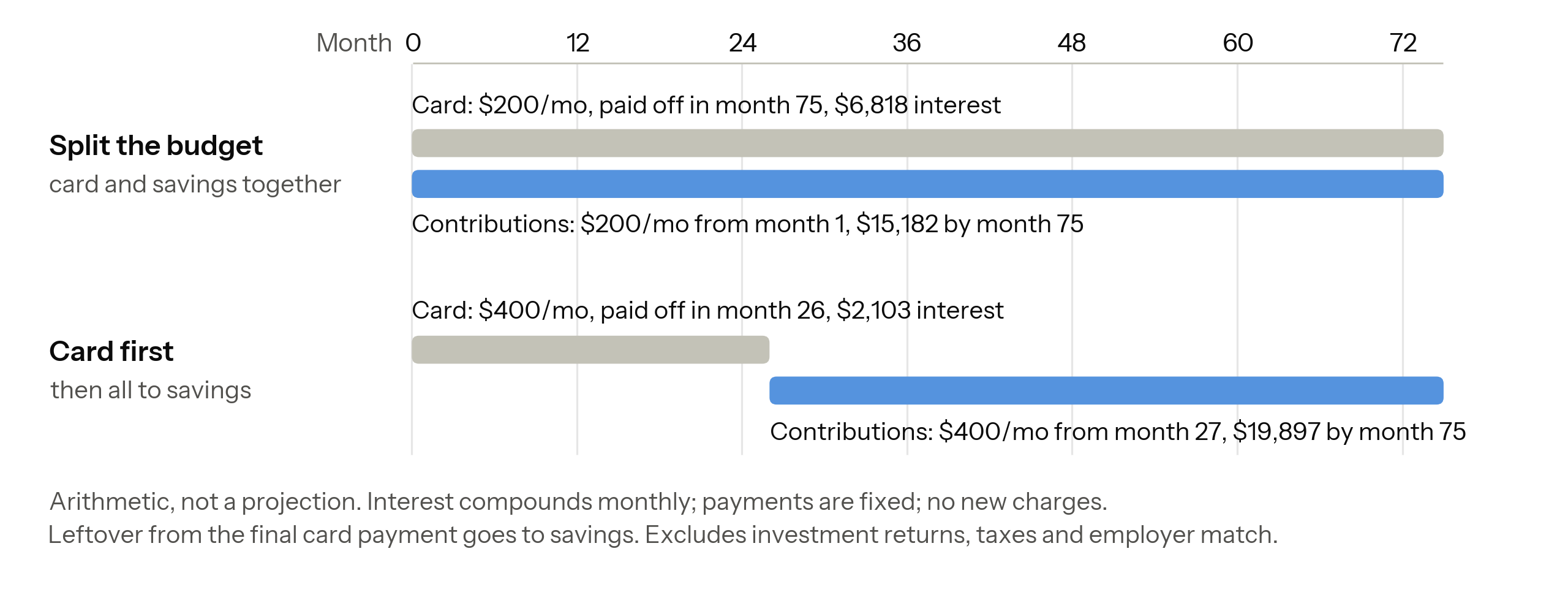
The arithmetic is an identity: every dollar of interest avoided is a dollar left for contributions over the same 75 months, here $4,715. What the arithmetic leaves out is timing. Paying the card first means no regular contributions until month 27, more than two years in, and with them any employer match tied to those contributions.
The example also assumes no investment return. Any growth on contributions would make earlier dollars worth more, while the card's rate is a known cost. Tax treatment, which varies by account type, is left out too.
Official investor guidance names both sides. The Financial Industry Regulatory Authority (FINRA), the broker-dealer regulator, says employees who contribute less than their employer will match “might be passing up free money” 14. In separate guidance, it lists paying down high-interest debt such as credit-card bills among uses for spare cash 15. Match terms, rates and emergency savings differ by household, which is why the example sets no order.
Illustrative worked example, not a projection or recommendation. Balance near the Fed SCF 2025 mean card balance 2; rate is the Fed G.19 August 2026 APR on accounts assessed interest 3. Wealthion arithmetic.
So is debt really what’s holding retirement savings back?
For a sizable group of households, the evidence points that way. But the counterargument deserves weight: most families did not carry a card balance after their last payment 2, and measured retirement savings rose between 2022 and 2025. In Vanguard's plans, the median account balance was $44,115 in 2025, and the average employee deferral rate was an estimated 7.6%, the same as in 2024 12.
In plans with automatic enrollment, contributions continue unless a worker opts out, which keeps savings flowing when budgets tighten. Rising averages and financial strain can both be true at once, since averages do not show how the strain is distributed.
The squeeze shows up in the Fed's debt-burden measures. The median share of income that indebted families spent on debt payments rose from 13.4% in 2022 to 15.4% in 2025 2. The fraction of families with debt payments above 40% of income rose from 6.5% to 8.6%.
Card balances for the typical family that carries one are modest: the Fed's median is $3,100, against a mean of $8,000. Those figures sit alongside the $106,000 retirement median, but they describe different groups of families, so they should not be read as one household's balance sheet.
The sources cited here do not link one household's card debt to its contribution rate over time. The Schroders figures are self-reported, Vanguard covers only its own plans, and the Fed's survey runs every three years. Each source describes a different group, so the evidence shows these pressures side by side, not that one causes the other.
The answer to the headline, then: debt is one real obstacle among several. High card rates, rising living costs and plan withdrawals all show up in the data, and the median retirement balance of $106,000 sits far below the $1.2 million target savers name.
Frequently asked questions
Where does the $1.2 million retirement figure come from? It is the amount workplace plan participants said they need to retire comfortably in the Schroders 2026 US Retirement Survey, fielded March 20 to April 15, 2026 1. Other surveys put the figure higher, such as Northwestern Mutual's $1.46 million 6.
How much do credit cards charge in interest right now? The Fed's G.19 release put the average bank card rate at 22.36% on accounts assessed interest and 21.19% across all accounts in August 2026, both preliminary 3. Individual card rates vary widely around those averages.
How is a 401(k) hardship withdrawal different from a plan loan? A plan loan is borrowed against the account and paid back under the plan's terms. A hardship distribution cannot be repaid to the plan, is subject to income tax unless it consists of Roth contributions, and may face a 10% additional tax, according to the IRS 13.
Is there evidence that savers are contributing less? The evidence is mixed. In Vanguard's plans, the average deferral rate was an estimated 7.6% in 2025, the same as in 2024 12, even as 27% of participants in the Schroders survey reported cutting contributions 1. Neither source covers all US workers.
Sources
1 To Retire Comfortably, Plan Participants Say They Need $1.2 Million. Schroders (survey publisher), July 15, 2026; $1.2 million target, savings expectations, card debt exceeding savings, contribution cuts, plan loans, worry, methodology. 2 Changes in U.S. Family Finances from 2022 to 2025. Federal Reserve Board, Survey of Consumer Finances, October 2026; retirement account ownership and balances, card balances, debt payment-to-income ratios. 3 Consumer Credit G.19, current release. Federal Reserve Board, October 7, 2026; card APRs 2021 to August 2026. 4 Household Debt and Credit Report, Q2 2026 (press release). Federal Reserve Bank of New York, August 11, 2026; card balances, total household debt, serious delinquency flow. 5 Retirement Plan Participants Think They'll Need $1.3 Million. Schroders (survey publisher), July 15, 2025; 2025 target of $1.28 million, 17% plan loans. 6 Americans Believe They Will Need $1.46 Million to Retire Comfortably. Northwestern Mutual (survey publisher), April 1, 2026; $1.46 million magic number, 2025 comparison, sample. 7 Consumer Credit G.19 (PDF). Federal Reserve Board, March 6, 2020; card APRs 2015 to 2019. 8 Consumer Credit G.19. Federal Reserve Board, May 6, 2022; card APR for 2020. 9 Credit CARD Act report notice, Federal Register Vol. 91, No. 4. Consumer Financial Protection Bureau, January 7, 2026; $160 billion interest assessed in 2024, minimum-payment share. 10 Consumer Expenditures in 2025. Bureau of Labor Statistics, October 29, 2026; spending per consumer unit, income, housing, food, personal insurance and pensions. 11 Consumer Price Index, September 2026. Bureau of Labor Statistics, October 14, 2026; 12-month CPI, electricity and shelter changes. 12 How America Saves 2026. Vanguard (industry research on Vanguard-recordkept plans), June 2026; hardship withdrawals, loans, deferral rates, balances. 13 Retirement topics: Hardship distributions. Internal Revenue Service, reviewed February 26, 2026; repayment and tax treatment of hardship distributions. 14 The Beginner's Guide to 401(k)s. FINRA, updated February 27, 2025; employer match guidance. 15 6 Smart Ways to Use Your Tax Refund. FINRA, March 18, 2025; guidance on paying down high-interest debt.
Wealthion is a dba of Greylock Peak Investments, a registered investment adviser. This article is general information only. It is not investment advice or an offer or solicitation, and it is not tailored to your circumstances. Guests’ views are their own and may not reflect those of Wealthion. Wealthion has not verified guest statements, including any performance figures. Investing involves risk, including loss of principal, and past performance does not guarantee future results. Wealthion refers readers to other registered investment advisers and shares in the fees they receive from referred clients, which creates a conflict of interest. Please see our Form ADV Part 2A and consult your own financial advisor before investing.
What Serious Investors Are Watching
Dive into expert interviews, market analysis, and long-form content built to help serious investors think long-term.

The Transformer Shortage: What It Means for the AI Buildout
A generator step-up transformer ordered in early 2026 could take more than three years to...

How Debt Is Getting in the Way of Retirement Savings
Savers say they need $1.2 million to retire comfortably. About half expect to arrive with...

Macro Bites – Chile Cuts Copper Production Forecasts as Mine Output Slumps
Indirect diplomatic talks between the U.S. and Iran brokered by Qatar concluded in Doha on...
Enjoyed This? Get More Insights
Expert insights and curated opportunities, delivered to your inbox.
Ready to Position for What's Coming?
Whether you're still learning or ready to act, your next step starts here.
- Independent
- Macro-Informed
- Real Asset Focused


The Wealthion Network
By subscribing, you agree to receive Wealthion emails. Unsubscribe anytime.
The Wealthion Network
By subscribing, you agree to receive Wealthion emails. Unsubscribe anytime.
Network Discussion
Sign in to share your thoughts and connect with other readers.
Join the Wealthion Network to Comment