

The Transformer Shortage: What It Means for the AI Buildout
A generator step-up transformer ordered in early 2026 could take more than three years to arrive, while US data center capacity is projected to rise from about 24 gigawatts (GW) to 110 GW by 2030. Here is where the shortage bites, how far waits and prices have moved, and who is adding capacity.
The numbers at a glance
Why are transformers holding up the artificial intelligence (AI) buildout?
Wood Mackenzie analyst Ben Boucher told Reuters that lead times for generator step-up (GSU) transformers passed 160 weeks in the first quarter of 2026, up from an average of 143 weeks in 2024 1. Reuters reported that high-voltage transformers took about a year to arrive in 2020 and 2021.
The demand behind that wait is large. Wood Mackenzie, an energy research firm, projects US data center capacity rising from about 24 gigawatts (GW) to 110 GW between 2026 and 2030 2. It expects the data center electrical equipment market to grow from $20 billion in 2025 to $65 billion by 2030 2.
“Equipment availability is becoming the biggest concern for developers as they value time to market so highly,” Boucher said 1.
Where do transformers sit between the grid and a server?
Electricity changes voltage several times before it reaches a chip. Transformers change voltage at grid and distribution stages, while server power supplies also use electronic conversion stages 5. High voltage moves power efficiently over long lines, while servers run on low voltage. The largest and slowest-to-build units sit at the top of that chain.
The biggest transformers sit on the grid side, where waits are longest
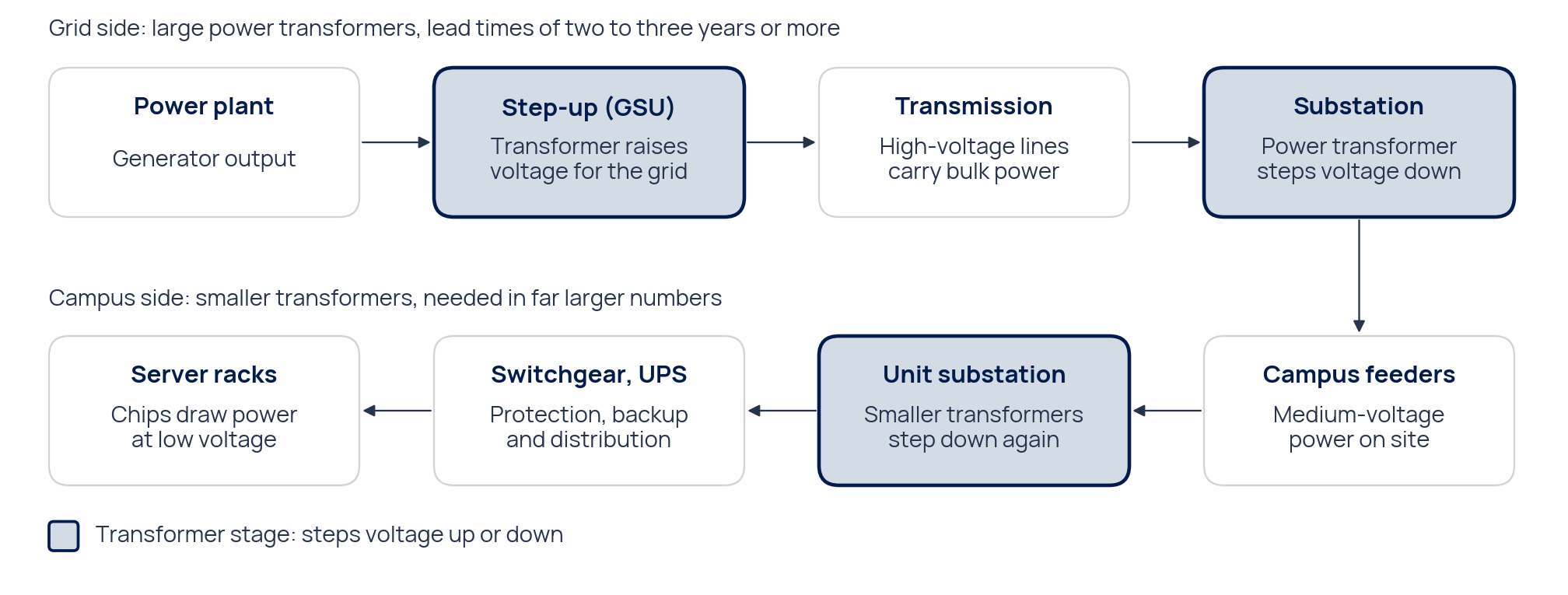
Simplified power chain from generator to server rack, with the transformer stages highlighted. Lead-time comment based on Wood Mackenzie data 1, 6. UPS means uninterruptible power supply.
The National Infrastructure Advisory Council (NIAC), which advises the White House, describes large power transformers as units rated 100 megavolt-amperes (MVA) or more, with low-side voltage above 34.5 kilovolts (kV) 7. Power plants need step-up units, and substations need step-down units. A campus that connects at transmission voltage needs the same class of substation transformer a utility buys, so it joins the same queue.
Inside the fence, the numbers multiply. Wood Mackenzie expects hyperscale data centers to need 9,395 padmount transformers in 2030, up from 1,573 in 2025 2. The big units still set the schedule. A Department of Energy (DOE) presentation put production at about 1.3 units per large-transformer design and the largest units at about 400 tons 8.
How far have delivery times and prices moved?
Lead times for the biggest units more than doubled in three years. NIAC's June 2024 report, citing Wood Mackenzie, said average transformer lead times rose from around 50 weeks in 2021 to 120 weeks in 2024 7.
Wood Mackenzie's 2025 survey showed a brief easing. Power transformers averaged 128 weeks in the second quarter of 2025, down from 138.4 in the first, while GSUs eased to 143.4 weeks from 147.7 6. Then came the reported 160-plus weeks for GSUs in early 2026 1. These figures come from different surveys and averages, so they show direction better than exact levels.
Prices followed. The federal producer price index for transformer manufacturing shows the jump came mainly in 2021 and 2022, then resumed in 2025 and 2026.
Transformer producer prices are up 86% since January 2020
Producer price index (PPI), electric power and specialty transformer manufacturing, index June 1981 = 100. Readings each January and July, plus the latest month.
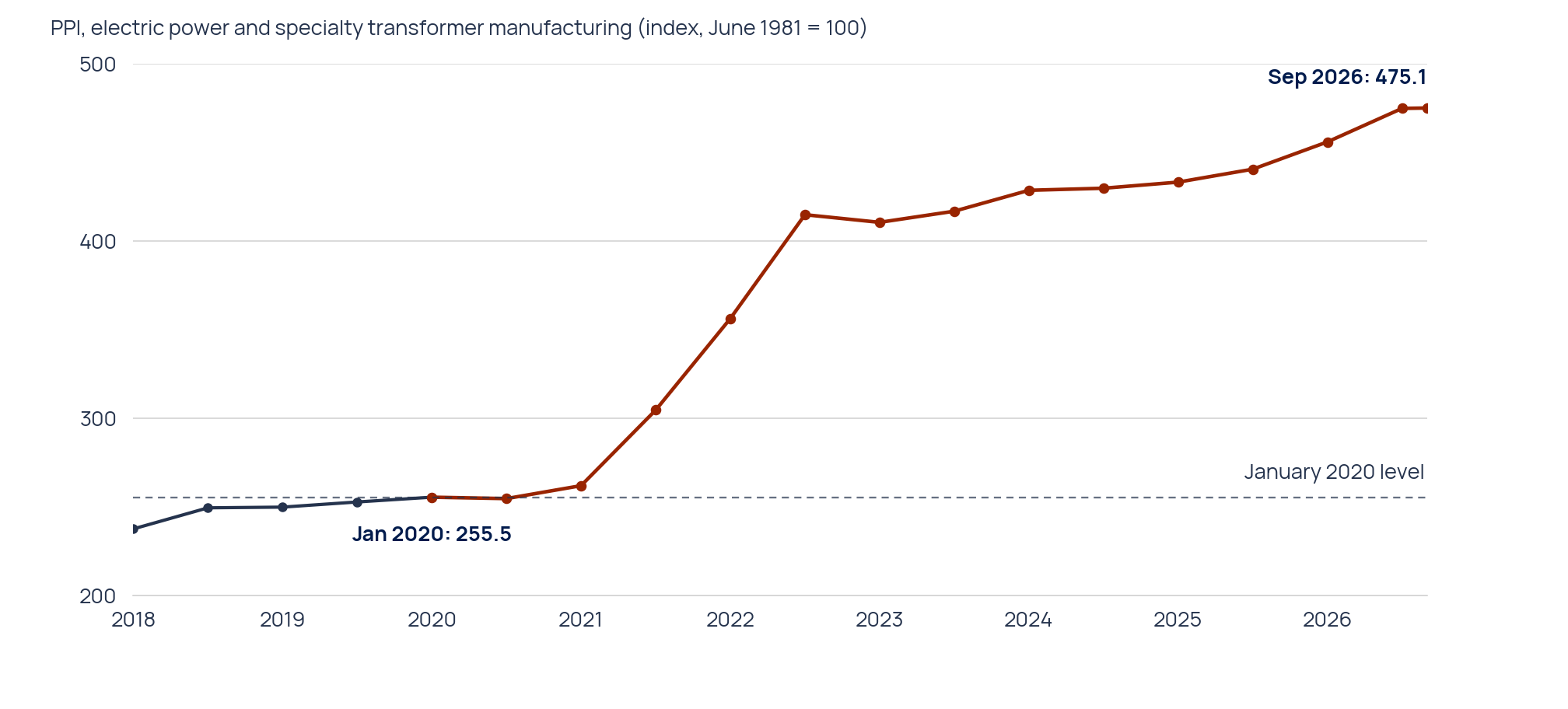
Source: Bureau of Labor Statistics PPI series PCU335311335311, via Federal Reserve Economic Data (FRED), maintained by the Federal Reserve Bank of St. Louis 3. Not seasonally adjusted; data through September 2026, released October 15, 2026.
The index stood at 475.1 in September 2026, against 255.5 in January 2020 3. It rose 7.8% in the 12 months to September 2026 3. It tracks prices received by US producers, so it misses imports, which Wood Mackenzie estimated would supply about 80% of US power transformers in 2025 9. Wood Mackenzie's own unit-cost data show increases since 2019 of 45% for GSUs, 77% for power transformers and 78% to 95% for distribution transformers, depending on specification 10.
The pressure also reaches orders already placed. Boucher said manufacturers return to customers with year-old purchase orders to impose 20% price increases to maintain delivery schedules 2. Other gear is tight too: high-voltage circuit breaker lead times reached 125 weeks in the second half of 2025, up from 77 weeks in 2023 1.
Why can't factories simply build more?
Large transformers are closer to custom machines than mass-produced goods. NIAC said many utilities order unique specifications, which makes mass production impractical and limits automation 7. The DOE presentation counted more than 80,000 distribution transformer configurations 8. NIAC also reported that manufacturers name a lack of workers as one of the largest obstacles to expanding capacity 7.
Electrical steel is another constraint. Wood Mackenzie reported in August 2025 that the US relied on a single domestic supplier of grain-oriented electrical steel, which is used in transformer cores 10.
History makes the industry cautious. Makers that expanded during the 2004 to 2007 housing boom were hit hard by the 2008 financial crisis and remain wary of adding capacity, NIAC said 7. A new line is a multi-year commitment, made before anyone knows how long the data center wave will last.
Trade policy adds friction in a market that relies on imports. NIAC estimated that domestic factories meet only about 20% of US large power transformer needs 7. An executive order signed on August 26, 2026, lets the Secretary of Energy bar certain acquisitions, imports, transfers or installations of foreign-produced bulk-power equipment, once a covered foreign entity link and an unacceptable national security risk are found. The restrictions cover transactions started after that date 11.
Wood Mackenzie said the order could affect a market of more than $22 billion in imports since 2025. It estimates a 2026 shortage of 15% for power transformers and 8% for substations 12. DOE has 120 days from the order to publish implementing rules, “as needed,” so the practical scope is still being set 11.
Washington is also pushing on supply. On April 20, 2026, the President determined that grid infrastructure equipment, including transformers and electrical core steel, is essential to national defense. The determination found US production capacity “dangerously limited” and waived certain procedural requirements of Section 303 of the Defense Production Act to expand domestic capability 13. Neither step adds factory output overnight.
Who is adding capacity, and how are suppliers and buyers adjusting?
Factory money is flowing, but much of it lands around 2027. Wood Mackenzie counted about $7 billion of new transmission and distribution manufacturing projects in 2023 and 2024, with at least 50 new plants or expansions announced by 25 manufacturers 14. About half is meant to serve the US market, and most projects are expected to finish between 2025 and 2027, though some larger ones may not be ready until the end of the decade 14. Recent US transformer projects include:
| Company | Site | Investment | Product | Timing |
|---|---|---|---|---|
| Hitachi Energy 15 | South Boston, Virginia | $457 million | Large power transformers | Broke ground June 29, 2026 |
| HD Hyundai Power Transformers USA 16 | Montgomery, Alabama | $200 million | Large power transformers | Scheduled to open mid-2027 |
| Siemens Energy 17, 18 | Charlotte, North Carolina | $150 million (2024) | Large power transformers | 24 units a year at first, rising to 57 at full capacity |
| Eaton 19 | Jonesville, South Carolina | $340 million | Three-phase transformers | Production from 2027 |
Hitachi Energy says the Virginia plant will add about 825 jobs to a campus of roughly 850 and is part of more than $1 billion of US grid equipment manufacturing investment 15. It did not give a production start date. HD Hyundai's $200 million expansion brings its total Montgomery investment to $277 million 16. In February 2026, North Carolina announced a $421 million Siemens Energy expansion across the state that includes the Charlotte transformer plant 20. The Eaton figure dates from February 2025 and is included for its 2027 timing.
For suppliers, the shortage shows up as long backlogs and wider margins. GE Vernova's Electrification segment ended September 2026 with a $42.2 billion equipment backlog, up $15.7 billion, or 60%, in a year. About $5 billion of it came from Prolec GE, the transformer maker whose remaining 50% GE Vernova bought 4. The segment's earnings before interest, taxes, depreciation and amortization (EBITDA) margin rose 4 percentage points to 19.1%, helped by “favorable price” at Power Transmission. Prolec GE accounts for $1 billion of GE Vernova's capital spending commitment for 2026 to 2028.
Siemens Energy's Grid Technologies booked €5.4 billion of orders in April to June 2026, up 27.6% on a comparable basis, for a book-to-bill ratio of 1.48 21. The release credited growth in the transformer business, including data center projects, and the segment margin before special items rose to 19.9% from 15.9%. Both segments also sell switchgear and other equipment, so neither figure is transformer-only.
Buyers are ordering earlier and paying sooner. Roseville Electric Utility, whose chief executive officer (CEO) Dan Beans spoke to Reuters, used to buy equipment about a year ahead. It now plans on a three-year timeline and, because large substation transformers face waits of more than three years, buys for projects about five years out 1. About three-fourths of its bids now come from foreign sources such as China and South Korea. A Wärtsilä Energy Storage executive said some developers pay upfront or offer better payment terms to secure earlier production slots 1.
Scale matters in that scramble. Long-term supply agreements help, but “they don't solve everything, particularly for smaller utilities that don't have the scale,” said Louis Finkel of the National Rural Electric Cooperative Association 1. Regulators are also addressing who bears the risk from big new loads. Pennsylvania's May 13, 2026 model tariff framework sets out guidance for customers above 50 megawatts (MW) individually, or 100 MW in aggregate, and calls for deposits and collateral in case projects are delayed, abandoned or fall short of projected demand 22. It serves as guidance for future utility tariff filings.
Could the shortage ease faster than expected?
There is a credible case that it could. Lead times dipped in the first half of 2025 6, and Wood Mackenzie's estimated power transformer shortfall fell from 30% for 2025 to 15% for 2026 9, 12. Those estimates come from separate releases, so the comparison is indicative rather than like-for-like. Wood Mackenzie also reported in October 2024 that the price of grain-oriented electrical steel, a key transformer input, had fallen 60% to 70% 14.
Demand could also come in below the headlines. Wood Mackenzie's moderated scenario puts US data centers at about 95 GW by 2030, below its 110 GW projection 2. In its April 2026 pipeline, Wood Mackenzie reported approximately 600 GW of projects still seeking power capacity, compared with 183 GW that had signed construction or electricity supply agreements with utilities 2. NIAC noted that makers who expanded before 2008 were hurt when demand fell 7.
The evidence through October 2026 still points to tight supply. GSU lead times rose again in early 2026 1, transformer producer prices kept climbing into September 3, and the new import rules could add to the squeeze 12. In August 2025, Boucher said rising demand, aging infrastructure and supply chain weaknesses had created constraints that “will persist well into the 2030s” 9.
So what does the shortage mean for the AI buildout? The record shows it bites hardest at the grid connection, where step-up and substation units take two to three years or more. Several announced US plants target 2027, so equipment slots are likely to shape project schedules until then. Suppliers are carrying larger backlogs at better margins, while buyers pay for certainty with earlier orders, upfront money and repriced contracts.
Frequently asked questions
What is a generator step-up transformer? It is the transformer at a power plant that raises a generator's output voltage so power can travel on the transmission grid. These units have some of the longest waits, above 160 weeks in early 2026 according to Wood Mackenzie data reported by Reuters 1.
Why do data centers need so many transformers? Power must step down from transmission voltage to the low voltage servers use. Transformers handle the grid and distribution stages, while server power supplies also use electronic conversion stages 5. Wood Mackenzie projects hyperscale demand for padmount transformers alone to rise about sixfold from 2025 to 2030 2.
Are transformer prices still rising? The Bureau of Labor Statistics producer price index for transformer manufacturing rose 7.8% in the year to September 2026 and stood 86% above its January 2020 level 3. It covers US producers only, not imported units.
When will new US factories add output? Several announced plants target 2027, including HD Hyundai's Alabama expansion and Eaton's South Carolina site 16, 19. Hitachi Energy broke ground in Virginia in June 2026 without a public production date 15.
Sources
1 US power companies scramble to secure equipment as surging data center demand strains supplies. Reuters, syndicated by Kitco, July 9, 2026; attributed interviews covering GSU lead times, circuit breakers, Roseville, the National Rural Electric Cooperative Association and Wärtsilä. 2 Data center demand drives US electrical equipment market to $65B, reshaping industry dynamics. Wood Mackenzie, April 28, 2026; capacity and equipment forecasts, padmount counts, moderated scenario, 20% price increases on year-old orders. 3 Producer Price Index by Industry: Electric Power and Specialty Transformer Manufacturing (PCU335311335311). US Bureau of Labor Statistics via Federal Reserve Economic Data (FRED), maintained by the Federal Reserve Bank of St. Louis; through September 2026, updated October 15, 2026; index of 475.1 in September 2026 and 255.5 in January 2020 as charted. 4 GE Vernova Third Quarter 2026 results (Form 8-K, exhibit 99.1). GE Vernova via the US Securities and Exchange Commission’s Electronic Data Gathering, Analysis, and Retrieval (EDGAR) system, October 28, 2026; Electrification equipment backlog, Prolec GE, margin, pricing and capital spending. 5 Electromagnetic Transient Modeling of Large Data Centers for Grid-Level Studies, Alpha Release, PNNL-38817. Pacific Northwest National Laboratory, prepared for the US Department of Energy, December 2025; grid, distribution and server power-conversion stages. 6 Making the connection: Meeting the electric T&D supply chain challenge (executive summary). Wood Mackenzie with American Clean Power, September 2025; transmission and distribution (T&D) equipment study, first- and second-quarter 2025 power transformer and GSU lead times. 7 Addressing the Critical Shortage of Power Transformers to Ensure Reliability of the U.S. Grid. National Infrastructure Advisory Council, June 2024 final report; transformer definitions, lead times, design specifications, labor, industry cyclicality and domestic supply. 8 Innovation for the Transformer Supply Chain. DOE Office of Electricity presentation by Andre Pereira, hosted by regional grid operator PJM Interconnection, April 20, 2026 (slide 5); units per design, unit weight and distribution configurations. 9 Power transformers and distribution transformers will face supply deficits of 30% and 10% in 2025. Wood Mackenzie, August 14, 2025; power-transformer shortfall estimate, estimated 2025 import share and constraints into the 2030s. 10 Transformer troubles: manufacturing and policy constraints hit US transformer supply. Wood Mackenzie, August 13, 2025; unit-cost increases since 2019, manufacturing constraints and the single domestic supplier of grain-oriented electrical steel. 11 Declaring a National Emergency to Secure the United States Bulk-Power System. US Department of Energy and White House, August 26, 2026; DOE authority, transactions after the order date, 120-day rulemaking window. 12 US executive order banning Chinese bulk-power equipment set to worsen critical transformer shortage. Wood Mackenzie, August 31, 2026; more than $22 billion in imports since 2025, 2026 shortage estimates. 13 Presidential Determination Pursuant to Section 303 of the Defense Production Act of 1950, as Amended, on Grid Infrastructure Equipment and Supply Chain Capacity. The White House, April 20, 2026; equipment covered and stated finding. 14 Making the connection: the electric T&D supply chain challenge. Wood Mackenzie, October 28, 2024; $7 billion of manufacturing projects, 50 facilities, 25 manufacturers, timing, electrical steel price decline. 15 Hitachi Energy breaks ground on the nation's largest facility for the production of large power transformers in South Boston, Virginia. Hitachi Energy, June 29, 2026; $457 million, about 825 jobs, more than $1 billion US program. 16 News release, March 6, 2026. HD Hyundai Power Transformers USA via Montgomery Regional Chamber of Commerce; $200 million expansion, $277 million total Montgomery investment, mid-2027 opening. 17 Siemens Energy addresses the shortage of U.S. power transformers and invests in new factory. Siemens Energy, February 14, 2024; $150 million Charlotte investment. 18 Power transformers, born in the USA. Siemens Energy, February 15, 2024; Charlotte investment and planned manufacturing capacity of 24 large power transformers initially, increasing to 57 annually at full capacity. 19 Eaton invests in new South Carolina transformer manufacturing site. Eaton via Business Wire, February 12, 2025; $340 million, three-phase transformers, production from 2027. 20 Siemens Energy Expands Operations in Charlotte, Creating More Jobs. City of Charlotte, February 3, 2026; $421 million North Carolina expansion including the large power transformer facility. 21 Earnings Release Q3 FY 2026. Siemens Energy, August 5, 2026; third-quarter fiscal year (FY) 2026 Grid Technologies orders, book-to-bill, margin and transformer growth. 22 Interconnection and Tariffs for Large Load Customers, Final Order, Docket M-2025-3054271. Pennsylvania Public Utility Commission, adopted April 30, 2026 and publicly released May 13, 2026; model tariff guidance, load thresholds and financial protections.
Wealthion is a dba of Greylock Peak Investments, a registered investment adviser. This article is general information only. It is not investment advice or an offer or solicitation, and it is not tailored to your circumstances. Guests’ views are their own and may not reflect those of Wealthion. Wealthion has not verified guest statements, including any performance figures. Investing involves risk, including loss of principal, and past performance does not guarantee future results. Wealthion refers readers to other registered investment advisers and shares in the fees they receive from referred clients, which creates a conflict of interest. Please see our Form ADV Part 2A and consult your own financial advisor before investing.
What Serious Investors Are Watching
Dive into expert interviews, market analysis, and long-form content built to help serious investors think long-term.
Natural Gas and Data Centers: The Near-Term Power Trade
How gas producers, pipeline operators, turbine makers and power generators are paid, and when data-center demand reaches each business's revenue.
The Transformer Shortage: What It Means for the AI Buildout
A generator step-up transformer ordered in early 2026 could take more than three years to...

How Debt Is Getting in the Way of Retirement Savings
Savers say they need $1.2 million to retire comfortably. About half expect to arrive with...
Enjoyed This? Get More Insights
Expert insights and curated opportunities, delivered to your inbox.
Ready to Position for What's Coming?
Whether you're still learning or ready to act, your next step starts here.
- Independent
- Macro-Informed
- Real Asset Focused


The Wealthion Network
By subscribing, you agree to receive Wealthion emails. Unsubscribe anytime.
The Wealthion Network
By subscribing, you agree to receive Wealthion emails. Unsubscribe anytime.
Network Discussion
Sign in to share your thoughts and connect with other readers.
Join the Wealthion Network to Comment