

Natural Gas and Data Centers: The Near-Term Power Trade
GE Vernova's gas turbine backlog and reservations reached 122 gigawatts (GW) at the end of September, up from 62 GW a year earlier. Kinder Morgan's project backlog stands at $14.4 billion. Here is how each link in the gas-to-power chain gets paid, and when data-center demand reaches its revenue.
The numbers at a glance
| 122 GW GE Vernova gas equipment backlog plus slot reservations at the end of the third quarter of 2026 GE Vernova, Q3 2026 results 1 |
$14.4 billion Kinder Morgan project backlog; more than 75% supports power generation and local distribution company demand Kinder Morgan, Q3 2026 results 2 |
| 11.75 billion Kilowatt-hours of US electricity use a day expected in 2026, up from 11.49 billion in 2025 US Energy Information Administration (EIA), Short-Term Energy Outlook, October 2026 3 |
$325 Capacity price per megawatt-day for 2028/2029 cleared in the PJM Interconnection (PJM) auction at its approved cap, with supply 6,831 megawatts (MW) short of the requirement PJM, July 14, 2026 4 |
Why is natural gas first in line to power data centers?
On October 28, 2026, GE Vernova reported that its gas power equipment backlog and slot reservations had reached 122 gigawatts (GW), up from 116 GW three months earlier 1. A week earlier, Kinder Morgan said more than 75% of its $14.4 billion project backlog supported power generation and local distribution company demand 2. Both companies sit on the chain that turns data-center electricity demand into natural gas demand. These backlog totals do not isolate data-center business.
Gas is first in line for practical reasons. A gas plant can run around the clock, and gas is already the largest source of US power, at about 40% of generation in 2025, according to the EIA 5. Gas plants can also be built beside a data center, as several projects below show. In its 2025 report on artificial intelligence (AI), the International Energy Agency (IEA) identified gas as the largest source of US data-center electricity and projected that it would also provide the largest increase in supply through 2030 in its Base Case 6.
This article follows that demand down the chain. It looks at how gas producers, pipeline operators, turbine makers and power generators are paid, and when data-center load reaches each one's revenue, based on company filings and contracts.
How much power do data centers need, and how much comes from gas?
Lawrence Berkeley National Laboratory (LBNL) estimated that US data centers used 176 terawatt-hours (TWh) in 2023, about 4.4% of US electricity 7. Its 2024 report projected 325 to 580 TWh by 2028, or 6.7% to 12% of the total 7. The range is wide because the lab modeled scenarios rather than a single forecast, and its data predate the past year's build-out.
The EIA's October 2026 Short-Term Energy Outlook (STEO) puts US electricity use at 11.75 billion kilowatt-hours a day in 2026 and 11.9 billion in 2027, up from 11.49 billion in 2025 3. It expects demand from the commercial sector, “which includes data centers,” to rise steadily through 2027 3. In its January 2026 outlook, the EIA put gas at about 40% of generation in 2025, easing to 39% in 2027 5.
Those national estimates do not identify the fuel mix at each individual data center. Most data centers draw from the grid, so their gas use depends on the regional mix where they connect. Some data centers are served by behind-the-meter gas plants built on site.
Gas supply is growing quickly, too. The EIA forecasts dry gas production rising from 107.6 billion cubic feet a day (Bcf/d) in 2025 to 116.1 Bcf/d in 2027, while US consumption rises from 91.9 to 93.8 Bcf/d 3. Exports of liquefied natural gas (LNG), forecast to climb from 15.1 to 18.6 Bcf/d, account for about 53% of the increase in production minus the increase in domestic consumption: 3.5 Bcf/d out of 6.6 Bcf/d 3. In that outlook, production growth offsets rising LNG exports and keeps inventories above their rolling five-year average in most forecast months 3.
Who sits on the value chain, and how does each link get paid?
Four businesses stand between a gas well and a server rack. Each is paid under a different kind of contract, which decides how directly data-center demand reaches its revenue.
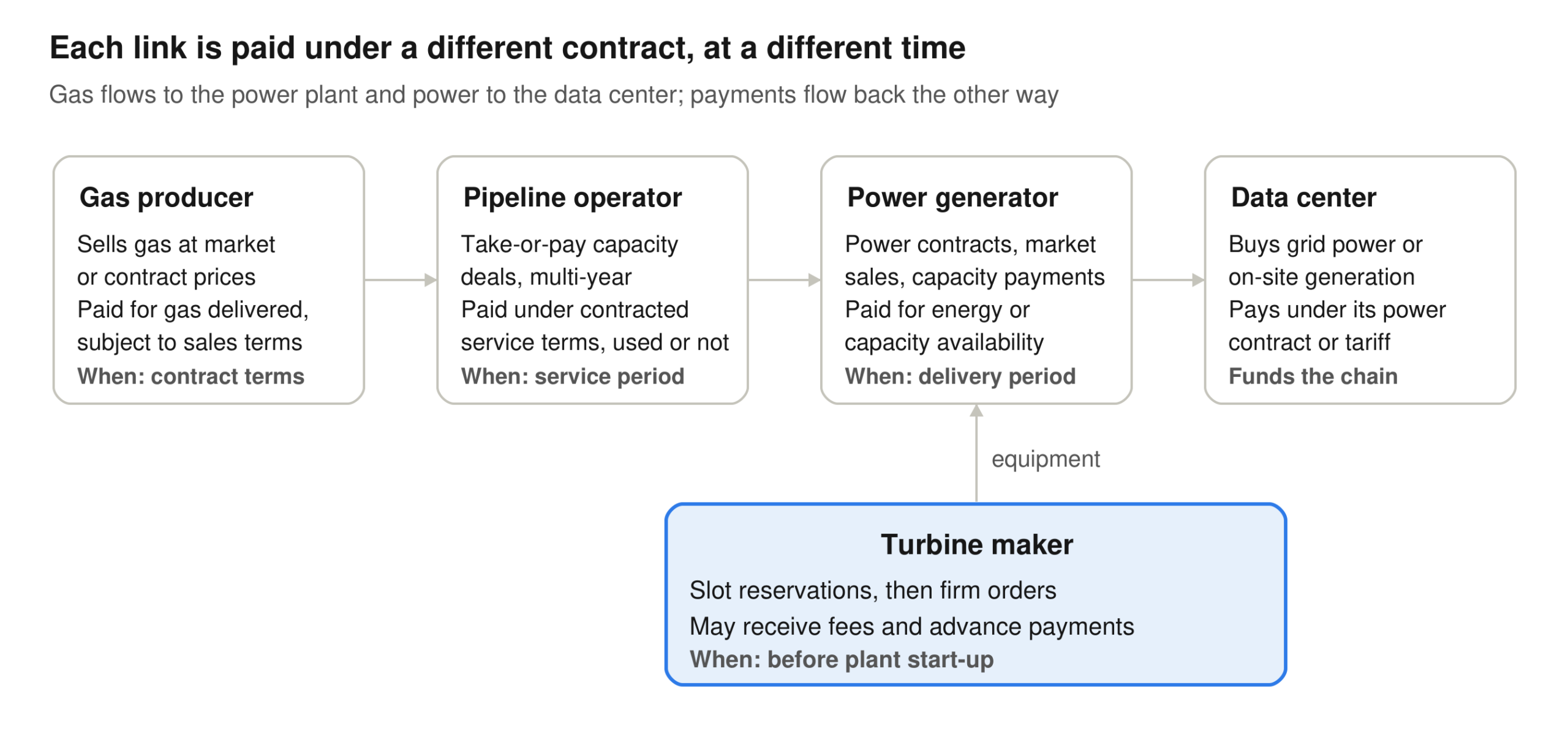
Turbine makers can receive reservation fees and advance payments before a plant starts operating. Pipeline capacity charges generally begin when contracted service starts, while generators and producers earn revenue as their contracted services or deliveries are provided 2, 10, 12.
Producers sell gas at market or contract prices, so revenue is volume times price. More gas burned by power plants can support producers' sales volumes, but revenue and profit also depend on prices, costs, sales contracts and hedges. EQT reported an average sales price for gas and liquids of $2.60 per thousand cubic feet equivalent (Mcfe) in the third quarter of 2026 before hedges, or $2.72 including settled hedges, and cited “downward pressure on natural gas prices during the quarter” 8.
Pipeline operators mostly sell capacity, not gas. Energy Transfer disclosed a 20-year agreement to provide Entergy Louisiana an initial 250,000 million British thermal units (MMBtu) a day of firm transport from December 2028, plus agreements to supply gas to three Oracle data centers 9. Kinder Morgan's Creekside Lateral rests on “take-or-pay agreements with data center and industrial customers,” meaning shippers pay for reserved space whether or not they use it 2.
Turbine makers build the machines that turn gas into power. Customers often sign slot reservation agreements to hold a place in the factory queue, then convert them into firm orders. Siemens Energy said its cash flow “benefited from customer advance payments, including reservation fees” 10.
Power generators own the plants and earn from power purchase agreements (PPAs), wholesale sales and, in some regions, capacity payments. Williams' Socrates project, announced in 2025 as a $1.6 billion gas project serving AI demand in Ohio 11, is backed by a 10-year, primarily fixed-price power purchase agreement 13. Its two sites have an expected combined capacity of 556 MW 13. Here a pipeline company acts as the generator, a sign that the links can blur.
When does data-center demand reach each link's revenue?
Turbine makers can receive reservation fees and advance payments years before a plant runs. Pipelines sign contracts before construction and generally earn capacity charges from the contracted service start date, while generators and producers earn revenue as their contracted services or deliveries are provided 2, 10, 12.
The chart below tracks that first stage through GE Vernova's quarterly releases 14, 15, 16. In the latest quarter, the company signed 11 GW of new gas equipment contracts, converted 13 GW of reservations into orders and shipped 5 GW 1. At that shipping pace, its 64 GW firm backlog equals about three years of deliveries, a simple ratio that ignores planned factory expansions. Siemens Energy reported a Gas Services backlog of about €73 billion for April to June 2026, citing “large orders related to data centers” in the US 10.
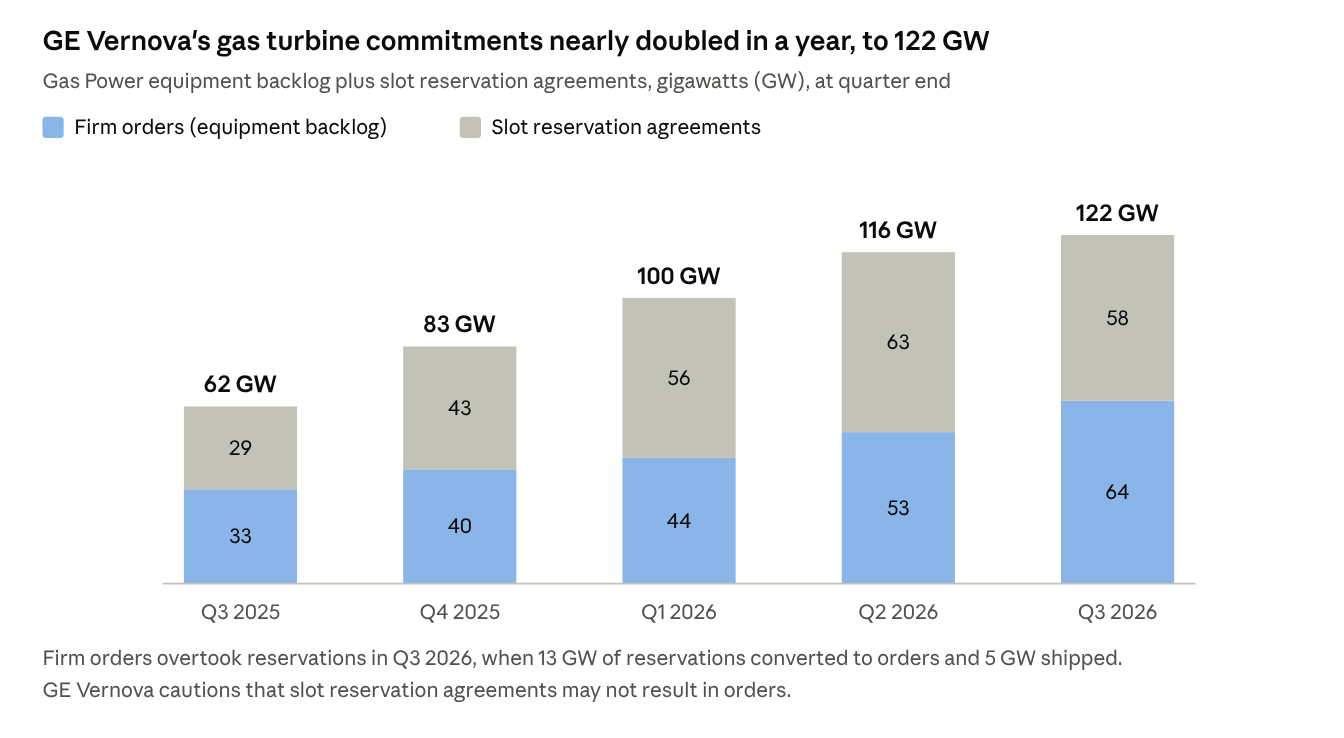
Orders, cash receipts and revenue follow different schedules. GE Vernova recognizes revenue on customized equipment over time as manufacturing or integration progresses, while billing and cash collection follow contractual terms 17. GE Vernova's Power segment booked $21.8 billion of orders in the third quarter and $6.1 billion of revenue, up 25% from a year earlier 1. The company named “higher price” among the reasons its margins expanded 1. The two quarterly totals do not measure conversion of the same set of orders.
Revenue from a new pipeline can follow years later. Kinder Morgan's Permian Link, which “will serve new power generation for an A-rated hyperscaler” (a very large cloud-computing company), is expected in service in the third quarter of 2030 2. Until then, the project remains in the expansion backlog rather than generating transportation revenue.
Generators can secure future capacity-payment commitments before delivery, but PJM pays those credits during the delivery year, rather than when the auction clears 12. PJM's auction for the 2028/2029 delivery year cleared at its $325 per MW-day cap and fell 6,831 MW short of the reliability requirement 4. PJM said large data-center loads continued to be added to the forecast behind that requirement 4.
Producers' exposure depends on gas sales volumes and realized prices, including the effects of sales contracts and hedges. Gas burn at power plants moves with weather, prices and competing sources of power.
Location matters as well. EQT reported an average differential, including settled basis swaps, of $0.64 per thousand cubic feet below its benchmark price in the third quarter, and its results came despite “widening basis during the quarter,” meaning a wider gap between local and benchmark prices 8. New demand near the wellhead, such as a data center in Appalachia, bears on that local price as well as on the national benchmark.
What limits how fast gas can serve data centers?
The filings point to three bottlenecks: equipment, pipes and grid connections. Each one stretches the time between a data-center announcement and a gas molecule burned.
Equipment comes first. GE Vernova's annual report warns that slot reservation agreements may not result in orders 17. Reservations indicate potential demand, but they are not firm orders, and factory output caps how fast backlog becomes plants.
Pipes take years to permit and build. Energy Transfer's Desert Southwest expansion, a roughly 520-mile line designed for up to 2.3 Bcf/d of capacity, targets service by the fourth quarter of 2029 9, 18. Smaller projects can move faster: Williams' Atlas project, up to 164 million cubic feet a day of pipeline capacity for a large investment-grade data-center customer in the Northeast, was expected in service by the end of 2026. The project converts backup generation at existing data centers from diesel to gas; reserved capacity does not imply continuous gas consumption 19.
Capital is following these faster projects. Williams finalized a joint venture with Blackstone that adds $5.34 billion of committed capital for near-term power projects, with Socrates' second phase on track for completion in the fourth quarter of 2026 20.
Grid rules are the third limit. In June 2026, the Federal Energy Regulatory Commission (FERC) preliminarily found that PJM's tariff appears unjust and unreasonable because it does not clearly address how large loads will be studied for transmission service 21. It ordered PJM to address study rules, cost recovery, flexible loads and co-located load, and to report on generation adequacy 21. Until those rules are settled, the cost and speed of a grid connection, and so the case for on-site gas, remain uncertain.
Contracts shape exposure to prices and volumes. Take-or-pay pipeline deals put volume risk on the shipper once contracted capacity is available, and primarily fixed-price PPAs can stabilize a generator's contracted revenue, subject to their fuel-cost and delivery terms 2, 13. Producers and merchant generators can retain more price and volume exposure, depending on their contracts and hedges.
What could keep gas from capturing this demand?
The obvious counterargument is that demand forecasts may run ahead of reality. PJM's January 2026 forecast cut its summer peak outlook for 2027 through 2029 by 2.3% to 2.6% from a year earlier, tying the cut partly to “improved vetting of requested adjustments for data centers and large loads” 22. LBNL's own 2028 range spans 255 TWh between its low and high cases 7.
Supply growth is a second check, mainly on producers. The EIA expects Henry Hub to average $3.48 per MMBtu in 2026, a figure lifted by a winter-storm spike in January, and $3.16 in 2027; the third quarter of 2026 averaged $2.87 3. In that outlook, production increases offset rising LNG exports and keep inventories above their rolling five-year average in most forecast months, limiting upward pressure on prices 3.
Third, gas competes with other sources. In the EIA's January 2026 outlook, gas's share of generation slips from 40% in 2025 to 39% in 2027 even as total demand grows, so other sources take part of the new load 5. More efficient chips and cooling could also reduce electricity use for a given amount of computing 6, and reservations can lapse, as GE Vernova's own filing states 17.
Is gas a major near-term power source for data centers? The IEA's Base Case supports that view for the US through 2030 6. But the demand does not reach every link at once.
Turbine makers can receive reservation fees and advance payments before a plant starts. Pipelines generally earn capacity charges from the contracted service start date. Generators earn energy revenue during delivery and capacity payments during the applicable delivery period; producers earn revenue under their gas sales contracts 2, 10, 12.
Frequently asked questions
Do data centers buy natural gas directly? Mostly not. Most draw power from the grid, but some data centers are served by on-site gas plants. Williams' Socrates South facility in Ohio entered service in late July 2026 13.
What is a slot reservation agreement? It holds a place in a turbine maker's production queue and may later become a firm order. GE Vernova's annual report says such agreements may not result in orders 17.
What does take-or-pay mean for a pipeline? The shipper pays for reserved capacity whether or not it moves gas, so revenue depends on the contract rather than daily volumes. Kinder Morgan describes most of its backlog as “stable, primarily take-or-pay cash flows” 2.
Why does the PJM capacity auction matter for generators? It sets a price in advance for capacity availability during a future delivery year. Payments are made during that delivery year 12. The 2028/2029 auction, with results announced in July 2026, cleared at its $325 per MW-day cap 4.
Sources
1 GE Vernova Reports Strong Third Quarter 2026 Financial Performance (Form 8-K, Ex. 99.1). GE Vernova via Securities and Exchange Commission (SEC) EDGAR, October 28, 2026; Gas Power backlog and reservations of 122 GW, Q3 contract signings, conversions and shipments, 64 GW firm backlog, Power orders and revenue, pricing comment. 2 Kinder Morgan Reports Record Third Quarter 2026 Financial Results (Form 8-K, Ex. 99.1). Kinder Morgan via SEC EDGAR, October 21, 2026; $14.4 billion backlog with more than 75% supporting power generation and local distribution company demand, take-or-pay terms, Creekside Lateral and Permian Link timing. 3 Short-Term Energy Outlook, October 2026. US Energy Information Administration, October 6, 2026; electricity use 2025 to 2027, commercial-sector demand, dry gas production, consumption, LNG exports, Henry Hub prices. 4 PJM Capacity Auction Procures 138,318 MW of Generation Resources. PJM Interconnection, July 14, 2026; 2028/2029 clearing price at the $325/MW-day cap, 6,831 MW shortfall, data-center loads in the forecast. 5 Solar power generation drives electricity generation growth over the next two years. US Energy Information Administration, January 16, 2026; natural gas share of US generation, 40% in 2025 and 39% in 2027. 6 Energy and AI, Energy supply for AI. International Energy Agency, 2025; Regional outlook for US data-center electricity supply through 2030 in the Base Case, and efficiency sensitivity cases. 7 Berkeley Lab Report Evaluates Increase in Electricity Demand from Data Centers. Lawrence Berkeley National Laboratory, January 15, 2025 (report released December 2024); 176 TWh and 4.4% in 2023, 325 to 580 TWh and 6.7% to 12% by 2028. 8 EQT Reports Third Quarter 2026 Results (Form 8-K, Ex. 99.1). EQT via SEC EDGAR, October 27, 2026; gas-and-liquids average sales price $2.60/Mcfe, average realized price $2.72/Mcfe, $(0.64)/Mcf differential including settled basis swaps, price and basis comments. 9 September 2026 Investor Presentation. Energy Transfer, September 29, 2026, pp. 8, 10 and 12; Entergy Louisiana 20-year firm transport, Oracle data-center supply agreements, Desert Southwest scope and timing. 10 Earnings Release Q3 FY 2026, April 1 to June 30, 2026. Siemens Energy, August 5, 2026; Gas Services backlog of about €73 billion, US data-center orders, reservation fees in advance payments. 11 Williams Announces Strong First-Quarter 2025 Results. Williams, May 5, 2025; Socrates as a $1.6 billion project backed by a long-term, fixed-price PPA. 12 PJM Manual 18: PJM Capacity Market. PJM Interconnection, section 9.3.1, Calculation of Auction Credits; auction credits calculated daily and billed weekly during the delivery year. 13 The Williams Companies Form 10-Q for the quarter ended June 30, 2026. Williams via SEC EDGAR, filed August 3, 2026, Management's Discussion and Analysis, Power Innovation-Socrates; expected combined capacity of 556 MW, 10-year primarily fixed-price PPA, and Socrates South placed in service in late July 2026. 14 GE Vernova Fourth Quarter and Full Year 2025 Results (Form 8-K, Ex. 99.1). GE Vernova via SEC EDGAR, January 28, 2026; Gas Power backlog and reservations of 62 GW (Q3 2025) and 83 GW (Q4 2025), with splits. 15 GE Vernova First Quarter 2026 Results (Form 8-K, Ex. 99.1). GE Vernova via SEC EDGAR, April 22, 2026; 100 GW at Q1 2026, with splits. 16 GE Vernova Second Quarter 2026 Results (Form 8-K, Ex. 99.1). GE Vernova via SEC EDGAR, July 22, 2026; 116 GW at Q2 2026, with splits. 17 GE Vernova Form 10-K for fiscal year 2025. GE Vernova via SEC EDGAR, filed 2026; risk factors on slot reservation agreements and Note 2 on equipment revenue recognition, milestone billings and progress collections. 18 Energy Transfer Reports Fourth Quarter and Full-Year 2025 Results. Energy Transfer, February 17, 2026; Desert Southwest capacity of up to 2.3 Bcf/d. 19 Q1 Earnings Recap: Data centers accelerate new growth paths for Williams. Williams newsroom, May 5, 2026; Atlas project capacity, timing and conversion of existing data-center backup generation from diesel to natural gas. 20 Williams Delivers Strong Second-Quarter 2026 Results. Williams, August 3, 2026; $5.34 billion Blackstone joint venture capital commitment, Socrates phase two timing. 21 Order Instituting Proceeding Under Section 206 of the Federal Power Act, PJM Interconnection, Docket EL26-67-000. Federal Energy Regulatory Commission, June 18, 2026; preliminary finding on PJM's large-load tariff and required filings. 22 PJM's Updated 20-Year Forecast Continues To See Significant Long-Term Load Growth. PJM Interconnection, January 14, 2026; 2027 to 2029 summer peak reductions and data-center vetting.
Wealthion is a dba of Greylock Peak Investments, a registered investment adviser. This article is general information only. It is not investment advice or an offer or solicitation, and it is not tailored to your circumstances. Guests’ views are their own and may not reflect those of Wealthion. Wealthion has not verified guest statements, including any performance figures. Investing involves risk, including loss of principal, and past performance does not guarantee future results. Wealthion refers readers to other registered investment advisers and shares in the fees they receive from referred clients, which creates a conflict of interest. Please see our Form ADV Part 2A and consult your own financial advisor before investing.
What Serious Investors Are Watching
Dive into expert interviews, market analysis, and long-form content built to help serious investors think long-term.

Natural Gas and Data Centers: The Near-Term Power Trade
How gas producers, pipeline operators, turbine makers and power generators are paid, and when data-center demand reaches each business's revenue.
The Transformer Shortage: What It Means for the AI Buildout
A generator step-up transformer ordered in early 2026 could take more than three years to...

How Debt Is Getting in the Way of Retirement Savings
Savers say they need $1.2 million to retire comfortably. About half expect to arrive with...
Enjoyed This? Get More Insights
Expert insights and curated opportunities, delivered to your inbox.
Ready to Position for What's Coming?
Whether you're still learning or ready to act, your next step starts here.
- Independent
- Macro-Informed
- Real Asset Focused


The Wealthion Network
By subscribing, you agree to receive Wealthion emails. Unsubscribe anytime.
The Wealthion Network
By subscribing, you agree to receive Wealthion emails. Unsubscribe anytime.
Network Discussion
Sign in to share your thoughts and connect with other readers.
Join the Wealthion Network to Comment