

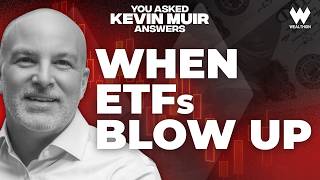
How Do Leveraged ETFs Work? Kevin Muir Explains
Key Takeaways
Leveraged ETFs deliver the daily return, not the total return. Muir stresses this is the single most misunderstood point: a 2x ETF gives twice the daily move, so "it's not the total return, it's the daily return," and over time the two can diverge sharply.
The daily reset quietly erodes value. To keep constant leverage, the fund buys as the asset rises and sells as it falls, a form of negative gamma that, in choppy markets, can leave holders down even when the underlying stock is up.
They can be wiped out fast. A 2x ETF is effectively insolvent if its underlying drops 50% in a day, and a 3x ETF needs only a 33% fall; Muir cites a recent Lucid ETF that was wound down even though the stock closed the day far off its intraday low.
Muir thinks they are a target. As the leveraged-ETF universe grows, he suspects aggressive funds may "hunt" a stock already near a wipeout level, calling it "a huge target on the back of the market."
They can amplify the whole market. Muir argues these products fueled the semiconductor rally and will worsen the decline, acting as "negative gamma that are exaggerating moves all over the place."
Key Moments
00:38 - How 2x and 3x leveraged ETFs actually work Why the daily return, not the total return, is the key.
01:41 - The hidden risk of daily ETF resets How rebalancing quietly costs holders money.
03:15 - How a leveraged ETF can get wiped out The Lucid example and the insolvency threshold.
04:29 - Why 3x ETFs create even bigger risks Why a 33% drop is enough to wipe one out.
05:00 - Could hedge funds "hunt" leveraged ETFs? The predictable rebalancing that makes them a target.
05:25 - When ETF hedging starts moving the market The tail-wags-the-dog dynamic.
06:02 - Gamma, options and the market's hidden plumbing How dealer hedging dampens or amplifies volatility.
07:18 - How leveraged ETFs amplify tech and semiconductor moves The role Muir says they played in the chip rally.
How Do Leveraged ETFs Work? Kevin Muir on the Trap That Could Amplify a Selloff
Leveraged ETFs promise two or three times the return of an index or stock, but veteran trader Kevin Muir, author of The Macro Tourist, told Wealthion in August 2026 that most investors misunderstand what they are actually buying, and that the products have grown large enough to amplify the market itself. What follows is his explanation of how they work and the risks he sees; it is risk education, not investment advice.
What are leveraged ETFs and how do they work?
Muir's essential point is a distinction in one word: daily. A leveraged ETF is designed to deliver two or three times the daily return of an underlying asset, not its total return over weeks or months. He gives a common example: an investor buys a 2x SpaceX-linked ETF, the stock rises 10% over three months, and they expect to be up 20%, only to find the ETF is actually down. The reason, he says, is that "it's not the total return, it's the daily return," and the fund resets its leverage every single day to stay at "twice the daily return."
Why do leveraged ETFs lose value over time?
Because the daily reset forces the fund to trade in a way that bleeds value in choppy markets. To keep leverage constant, Muir explains, the ETF must buy more of the asset as it rises and sell more as it falls, the opposite of buy-low-sell-high, which he describes as "in essence negative gamma." In a market that moves up and down a lot without going anywhere, that hedging quietly costs holders money, so the return ends up well short of what they expected. Crucially, he notes this is not a ripoff: the fund did exactly what it promised, deliver twice the daily return, which is simply not the same as twice the total return.
Can a leveraged ETF get wiped out?
Yes, and quickly. Muir explains that a 2x ETF becomes effectively insolvent if its underlying falls 50% in a single day, at which point "the ETF will be gone," so providers wind it down as it nears that level. He points to a recent real case: a 2x Lucid ETF that was wound down after a news report knocked the stock down about 50% intraday, even though Lucid rallied to close only about 16% lower that day, so holders were still stopped out. The danger is greater for 3x ETFs, he adds, which need only a 33% drop to be wiped out.
Could hedge funds "hunt" leveraged ETFs?
Muir suspects so, and sees it as a growing risk. Because the rebalancing is mechanical and predictable, he argues that in a down market an aggressive hedge fund could target a stock already sitting near a wipeout threshold, say a 3x ETF's underlying down 28%, since "it doesn't take much" to push it the rest of the way. As the universe of these products grows, he says, they become "a huge target on the back of the market." He has made related points about how market structure has shifted in why the smart money is selling AI stocks.
How do leveraged ETFs move the whole market?
Through their hedging flows, which Muir calls a "tail that wags the dog." He draws an analogy to large options positions, citing the well-known "JP Morgan option whale": when dealers on the other side of a big position are long gamma, they sell rallies and buy dips, which dampens volatility, but when they are short gamma, they sell dips and buy rallies, which amplifies it, a dynamic he says showed up around a volatile market low earlier in the year. Leveraged ETFs work the same way, buying as the market rises and selling as it falls, so their flows exaggerate moves in both directions. For more on hidden market plumbing, see Michael Green on the bond market hiding a banking crisis.
How did leveraged ETFs fuel the semiconductor rally?
Muir points to the chip sector as a live example. He notes that the bullish 3x semiconductor ETF grew to around $35 billion, which at triple leverage represents roughly $100 billion of exposure, and argues that this forced buying "caused the rally to be larger than it needed to be" and will make any decline worse too. His overall worry is that leveraged ETFs are "in essence a negative gamma that are exaggerating moves all over the place," a structural risk sitting underneath an already-stretched tech market. That connects to concerns about the AI spending boom cracking and Muir's own view that markets have already changed forever. As always on Wealthion, this is Muir's attributed analysis, not advice.
What Investors Should Watch
- Daily versus total return: the distinction Muir says trips up most leveraged-ETF buyers.
- Wipeout thresholds: a 50% one-day drop for 2x funds and 33% for 3x funds.
- The size of leveraged semiconductor ETFs: the roughly $35 billion (about $100 billion of exposure) he flags.
- Gamma and dealer hedging: whether positioning is dampening or amplifying volatility.
- Choppy, range-bound markets: the conditions in which the daily reset erodes value fastest.
FAQ
How do leveraged ETFs work? Kevin Muir explains that leveraged ETFs deliver two or three times the daily return of an underlying asset, not its total return, and reset their leverage every day. That daily rebalancing means their performance over weeks or months can differ sharply from a simple multiple of the asset's move.
Why do leveraged ETFs lose money over time? Because the daily reset forces them to buy as the asset rises and sell as it falls, a negative-gamma effect that erodes value in choppy markets. Muir stresses this is not a flaw or a scam; the fund delivers twice the daily return as promised, which is not twice the total return.
Can a leveraged ETF go to zero? Effectively, yes. Muir says a 2x ETF is insolvent if its underlying drops 50% in a day, and a 3x ETF needs only a 33% fall, at which point providers wind it down. He cites a recent Lucid ETF wound down after a sharp intraday drop.
Could hedge funds target leveraged ETFs? Muir suspects aggressive funds may "hunt" a stock already near a wipeout level, since the rebalancing is predictable. As these products grow, he calls them a large target within the market.
Which expert and interview does this article reference? This article draws on Wealthion's interview with trader Kevin Muir, author of The Macro Tourist: "The Leveraged ETF Trap That Could Wreck Tech Stocks."
Full Transcript (cleaned)
Speakers: Maggie Lake (Wealthion host) and Kevin Muir (author, The Macro Tourist). ASR errors corrected (fund names, terms) and filler removed; meaning preserved. One dated political reference was generalized.
Kevin Muir (cold open): If we get a situation where all of a sudden a stock goes down 50% in a day, you're actually going to be insolvent; the ETF will be gone. I suspect sharks hunt for these things. These leveraged ETFs are, in essence, a negative gamma that are exaggerating moves all over the place.
Maggie Lake: I share some of your pieces, and I think, wait, this is really important, you're looking at little indicators everywhere that have you worried. So let's talk about another one: leveraged ETFs.
Kevin Muir: For those who don't know, leveraged ETFs are funds that let an investor get two or three times the daily return, and I'll stress the daily return. It's really important to understand it's not the total return, it's the daily return of an underlying asset. One problem people run into is they'll buy, say, a 2x SpaceX ETF; the stock moves around and three months later it's up 10%, and they think that because they own the 2x version they'll be up 20%. Then they look and it's actually down, and they wonder how that can be. Remember, it's twice the daily return. Because the ETF has to reset every day, it's forced to do hedging. Think about it: if you bought $100,000 of SpaceX by putting up $50,000 and margining it two-for-one, and SpaceX then doubled, you'd actually have less leverage relative to your equity, you'd be playing with the house's money. Conversely, if SpaceX fell, your broker would call you for more money. The way the ETF gets around that is by resetting the leverage every day so it's always two times. So as the stock goes up, they buy more, and as it goes down, they sell more. It's in essence negative gamma. So the first worry is understanding that if the stock goes up and down a lot, that hedging can cost you, and your return isn't what you think. People say it's a ripoff, but they don't understand it did exactly what it said, provide two times the daily return.
Kevin Muir: The second problem is that if the stock suddenly falls 50% in a day, a 2x daily ETF is insolvent; the ETF will be gone. So as it approaches that point, they wind it down. We saw it this week with Lucid. Lucid had a 2x ETF, small, only a few million dollars, since nobody really trades Lucid anymore; there was a time everyone loved EVs, but not now. A news report caused the stock to fall about 50%, and they immediately wound down the ETF. The trouble is, on the day, Lucid rallied back and closed only down 16%, but as a 2x ETF holder you got stopped out because it had fallen 50% intraday. You might say, how many stocks fall 50%? But for a 3x ETF, it only has to fall 33%. And as this universe grows, in a down market I suspect sharks hunt for these things. If there's bad news and you're an aggressive hedge fund looking at a big 3x ETF whose stock is down 28%, it doesn't take much to push it further. So it's a huge target on the back of the market.
Kevin Muir: The other thing is that as these leveraged ETFs grow, the hedging is increasingly a tail that wags the dog. We've seen this in options. The famous example is the so-called JP Morgan option whale that everyone loves to talk about.
Maggie Lake: Yes, there are news flashes about it.
Kevin Muir: Exactly, and the reason is that the hedging from the market makers on the other side becomes a self-fulfilling prophecy. If we rally into calls that dealers are long, they're long gamma, which means they sell as the stock rallies and buy as it falls, and that dampens volatility, so a large position can actually make volatility around that strike smaller. The JP Morgan whale, on the other hand, buys a put, really a put spread. When we fall to the point where the market makers are short gamma, they make it more volatile, selling as it falls and buying as it rises, and that's what we saw during a volatile period earlier in the year, which turned out to be the low, coinciding with dealers being the most short gamma. But bring it back to leveraged ETFs: as I said, as the market rallies they buy more, and as it falls they sell more. That's one reason the semiconductor rally seemed to go on and on: it was fueled by these leveraged ETFs. The bullish 3x semiconductor ETF was around $35 billion, and being 3x, that's roughly $100 billion of exposure, so it made the rally larger than it needed to be and will make the decline larger too. So one of my worries is that these leveraged ETFs are, in essence, a negative gamma that are exaggerating moves all over the place.
Maggie Lake: Kevin, it's so fun to catch up, and I appreciate you talking not just about opportunities but about the risks, because someone will pay attention and be really thankful they did.
Kevin Muir: Thank you, Maggie. I always enjoy chatting with you.
What Serious Investors Are Watching
Dive into expert interviews, market analysis, and long-form content built to help serious investors think long-term.

Is NVIDIA a Good Investment? David Woo
Key Takeaways Woo says the AI trade rests on a winner-take-all bet and fear. He...
How Do Leveraged ETFs Work? Kevin Muir Explains
Key Takeaways Leveraged ETFs deliver the daily return, not the total return. Muir stresses this...

How to Invest in Commodities: Jonathan Wellum
Key Takeaways Commodities are highly cyclical, so discipline comes first. Wellum warns they "go up...
Enjoyed This? Get More Insights
Expert insights and curated opportunities, delivered to your inbox.
Ready to Position for What's Coming?
Whether you're still learning or ready to act, your next step starts here.
- Independent
- Macro-Informed
- Real Asset Focused


The Wealthion Network
Stay ahead of the curve. Subscribe to Wealthion’s newsletter and get timely videos, articles, and alerts featuring insights from the world’s leading experts in investing and wealth-building.
Network Discussion
Sign in to share your thoughts and connect with other readers.
Join the Wealthion Network to Comment