

Uranium Demand Could Double by 2040. Can Mines Keep Up?
A higher uranium price can make a mine worth building. Bringing it into production takes much longer.
Developers need to establish a resource, secure approvals, finance construction and get the operation running. A September 2026 Nuclear Energy Agency report puts typical uranium mining project development at 15 to 20 years. Construction is only part of that process.1
Meanwhile, the nuclear industry is planning for more fuel. The World Nuclear Association (WNA) estimates reactor requirements at about 68,920 metric tons of uranium in 2025. Its reference scenario puts them above 150,000 metric tons in 2040, more than twice as much. Existing mines also face resource depletion in the mid-2030s, the WNA warns. These are scenario estimates, not guarantees about reactor completions or mine output.2
The pressure falls on the years between today's supply and that possible future demand. Utilities need dependable deliveries; miners need enough confidence in future sales to commit capital. Contracts help connect the two.
Utilities buy years ahead, but their cover runs down
Most uranium trade takes place through contracts lasting 3 to 15 years, according to the WNA.3 In the United States (US), 87% of uranium delivered to reactor owners and operators in 2025 came under long-term contracts, according to the Energy Information Administration (EIA). Its definition includes contracts with a delivery more than a year after signing. Pound figures below measure uranium concentrate, or triuranium octoxide (U₃O₈), equivalents.4
Those agreements provide cover for the nearer years. Further out, more purchasing remains to be arranged. At the end of 2025, utilities reported about 23.1 million pounds of unfilled market requirements for 2031, against maximum contracted deliveries of 10.1 million pounds. The unfilled share was about 69% of that year's maximum anticipated market requirements.4
That measure needs care. EIA's unfilled requirements exclude needs covered by inventory usage as well as existing contracts. The chart shows future purchasing requirements, rather than every pound reactors will use. Maximum contracted deliveries also include optional quantities.4,5
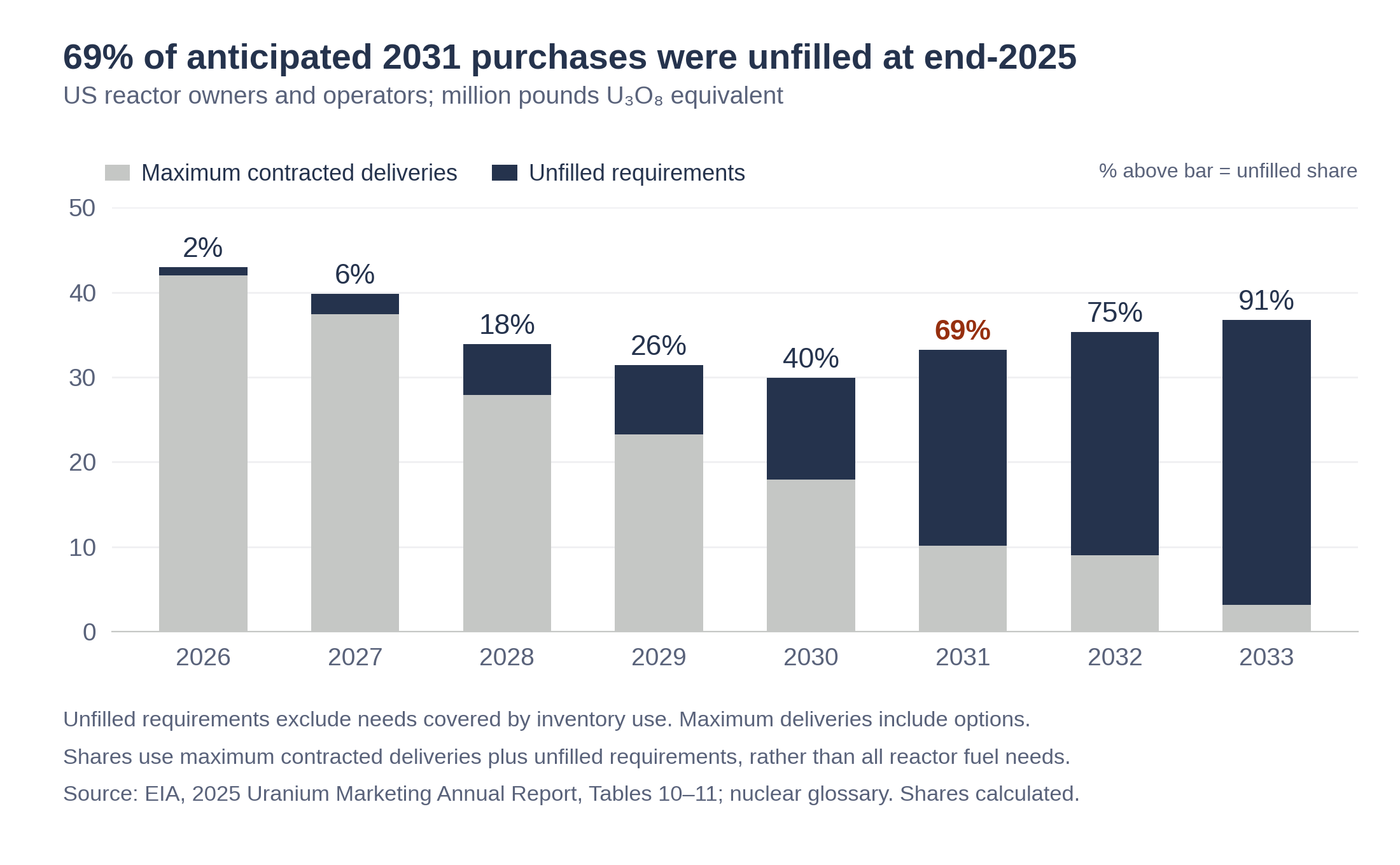
Sources: EIA data and definitions; shares calculated.4,5
Prices move on a different schedule again. Uranium producer Cameco's long-term industry indicator rose from $89 in January to $98 at October 2026 month-end, in US dollars per pound. It averages quotations from pricing services UxC and TradeTech.6 Yet uranium delivered under US long-term contracts in 2025 averaged $55.91 per pound.4
Older agreements still influence what buyers pay. Some prices escalate from an agreed base; others follow market indicators near delivery. A higher quotation therefore does not immediately reset every utility's fuel bill or every producer's revenue.7
A restart saves work, but it still takes time
An existing mine may already have a processing plant, access roads and valid approvals. Reusing them can shorten a restart, although the permits and work required depend on the site.
Paladin's Langer Heinrich mine in Namibia shows how much work can remain. In April 2023, the company put its restart at about 40% complete.8 In July 2026, it reported the ramp-up completed and full-mine production of 4.82 million pounds for the year ended June 30. First production and a fully ramped-up operation are different milestones.9
A new mine has more ground to cover. NexGen's Rook I project in Saskatchewan received provincial environmental approval in November 2023. Its federal construction license was announced in March 2026, and licensed construction began on June 8. NexGen's stated construction schedule is four years.10,11
That build follows years of development: the project's Arrow deposit was discovered in 2014.11 And the construction license does not authorize operations. Canada's nuclear regulator requires a separate future licensing hearing and decision before the facility can operate.12
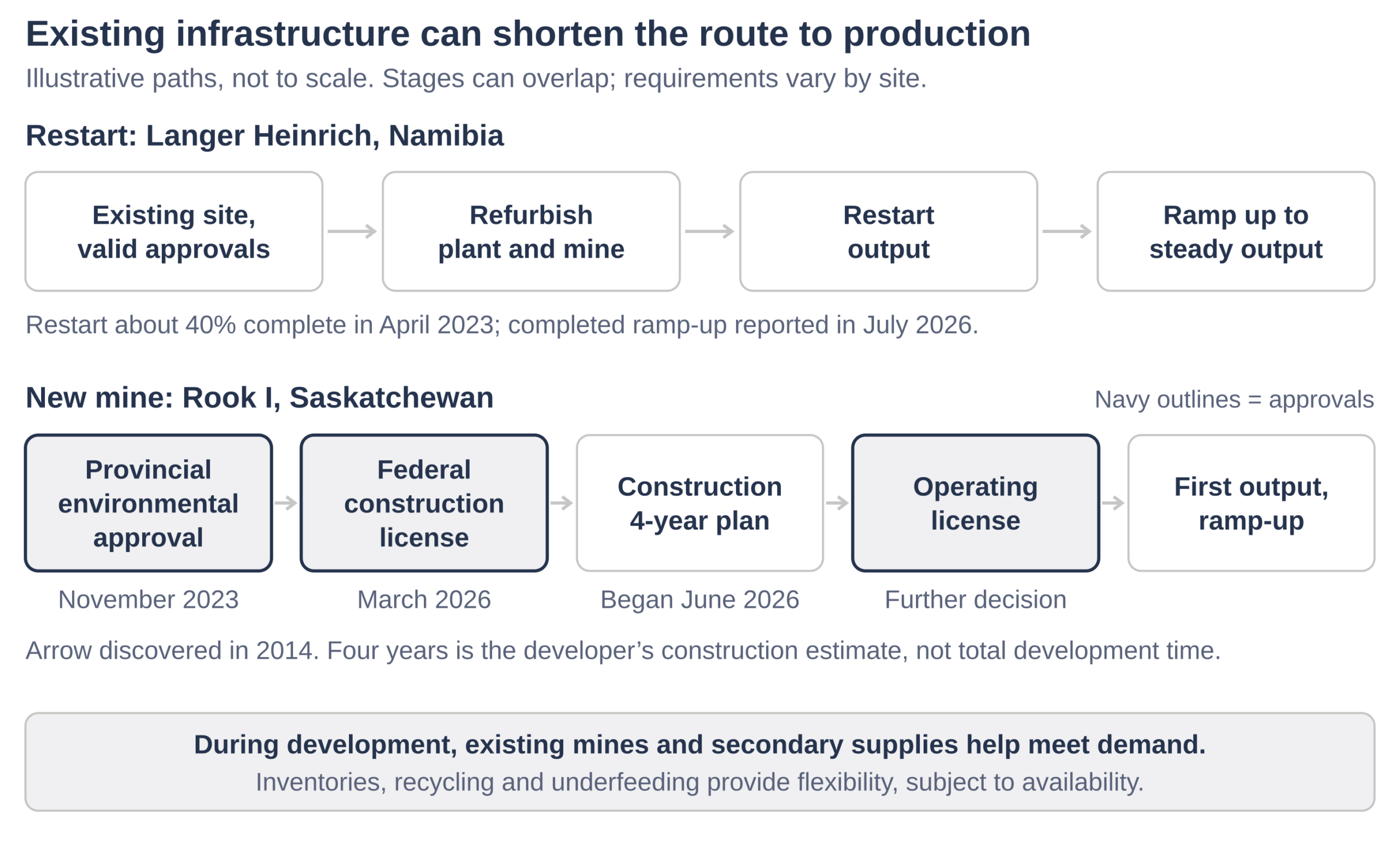
Sources: Paladin, NexGen, Canadian Nuclear Safety Commission and WNA.8,9,10,11,12,13
The distinction matters for supply forecasts. A project can have environmental approval and a construction program without having uranium available for a utility's next delivery.
Stockpiles help cover the intervening years
Reactors do not depend entirely on uranium mined that year. Secondary supply includes existing inventories, recycled material and uranium converted from former weapons stocks.13
US reactor owners and operators held 118 million pounds at the end of 2025. Those holdings included uranium at different processing stages, at domestic and foreign facilities. They were not all finished fuel ready to load.4 Aggregate inventory cannot show how long each utility can postpone its next purchase.
Enrichment raises the concentration of uranium-235, which sustains the reaction in most reactors. With spare capacity, enrichers can do more processing work to obtain the same enriched output from less natural uranium. Known as underfeeding, this can free surplus uranium for sale. When processing capacity is constrained, that flexibility is reduced.3,13,5
These sources can soften the impact of a delayed mine. Their availability and accessibility determine how much time they buy.
A stronger uranium market can still be difficult for a producer
A miner's delivery obligations do not disappear when its own production falls short. It may use inventory, buy uranium from others or borrow material to meet a contract. Those alternatives can carry costs.7
Cameco reported commitments averaging more than 28 million pounds annually for 2026 through 2030. Its 2026 third-quarter report also described a longer planned maintenance shutdown at the Key Lake mill, extending into the fourth quarter, with risks around restarting equipment.7
Those obligations explain why uranium prices and mining profits can diverge. A producer with a fixed-price sale, for example, can face a higher bill for replacement uranium when the market rises. Contract terms, operating costs and reliable production affect how much of a stronger uranium market reaches earnings.7
What could ease the pressure?
Supply is already responding. Kazakhstan's national producer, Kazatomprom, reported a preliminary 10% year-over-year production increase in the first nine months of 2026 on a full-operation basis, including joint-venture partners' shares.14 Restarts and expansions can add uranium while entirely new mines are still being developed.
The resource base is substantial, too. The Nuclear Energy Agency's September 2026 summary of its uranium resources report, the Red Book, identifies more than 8.1 million metric tons of uranium recoverable at costs below US$260 per kilogram of uranium, measured as of January 1, 2025. It considers those resources sufficient for even its highest projected demand through 2050, while stressing the investment needed to turn them into production.1,13
Demand can arrive later as well. The WNA's 2040 scenarios range from just over 107,000 to more than 204,000 metric tons of annual requirements, depending on how nuclear plans develop.2 Cameco, citing UxC, reported about 42 million pounds of term contracting in the first nine months of 2026, slightly below 45 million a year earlier. Forecast growth has not translated into higher contracting volumes in that comparison.7
The supply risk therefore depends on how the schedules meet. Pressure could build if reactor requirements grow before additional mine output arrives and the available buffers shrink. Successful restarts, expansions or slower reactor construction could ease it. More nuclear power creates a need for fuel; delivering that fuel remains a separate task.
Frequently asked questions
What is the difference between spot and term uranium prices?
Spot transactions generally cover delivery within a year. Term contracts arrange later deliveries, often over several years. Published indicators are references, while individual contracts have their own pricing terms.7
Does an unfilled requirement mean a reactor will run out of fuel?
No. It identifies purchasing that remains uncovered in a dated survey. Later contracts and additional available supplies can change that position before delivery is due.4,5
Can mine restarts solve the supply problem?
They can add output sooner by reusing existing infrastructure. They still depend on site conditions, approvals and a successful ramp-up, and they do not establish whether total future supply will meet demand.
We are not making any recommendations.
Sources & Disclosure
1 Adequate uranium resources available, but sustained investment essential to support global nuclear capacity growth. Nuclear Energy Agency, September 14, 2026; official publisher summary of Uranium 2026: Resources, Production and Demand, including development lead times and resources recoverable below US$260 per kilogram of uranium. 2 World Nuclear Fuel Report 2025: Investment in nuclear fuel cycle needed as demand for nuclear power grows. World Nuclear Association, September 5, 2025; 2025 reactor requirements, 2040 scenarios and existing-mine depletion. 3 Uranium Markets. World Nuclear Association, updated October 23, 2026; contract duration and the relationship between enrichment effort and uranium input. 4 2025 Uranium Marketing Annual Report. Energy Information Administration, July 29, 2026, reissued August 13, 2026; Tables 7, 10, 11 and 22, long-term purchases and prices, future contracted and unfilled requirements, and inventory ownership and scope. Chart percentages calculated from Tables 10 and 11. 5 Nuclear glossary, Unfilled requirements and uranium terms. Energy Information Administration; definition of unfilled requirements and uranium concentrate. 6 Uranium Price. Cameco, month-end series through October 30, 2026; industry-average indicators calculated from UxC and TradeTech quotations, in US dollars per pound of uranium concentrate. 7 Management's discussion and analysis for the quarter ended September 30, 2026. Cameco, information through October 29, 2026, released October 30; contract-pricing mechanisms, term-contracting volumes, delivery commitments, alternative supply arrangements and Key Lake maintenance. 8 Quarterly Activities Report for the period ending 31 March 2023, April 20, 2023; and Annual Report 2023, August 25, 2023. Paladin Energy; Langer Heinrich restart progress, refurbishment and permits and licenses remaining in good standing. 9 Quarterly Report for the period ending 30 June 2026. Paladin Energy, July 22, 2026; completed ramp-up and 4.82 million pounds of full-mine production for the year ended June 30, 2026. 10 NexGen Receives Final Federal Approval for the Rook I Uranium Project. NexGen Energy, March 5, 2026; November 2023 provincial approval and developer's four-year construction schedule. 11 Management's Discussion and Analysis for the three and nine months ended September 30, 2026. NexGen Energy, November 9, 2026; Arrow discovery in 2014, licensed construction starting June 8, 2026, and subsequent site progress. 12 Commission issues a licence to NexGen Energy Ltd. authorizing site preparation and construction of its Rook I Project. Canadian Nuclear Safety Commission, March 5, 2026; announcement and scope of authorization, with operations subject to a separate future hearing and decision. 13 Supply of Uranium. World Nuclear Association, updated September 29, 2026; inventories, recycling, converted military uranium and underfeeding at enrichment plants. 14 Kazatomprom 3Q26 Operations and Trading Update. Kazatomprom, November 3, 2026; preliminary nine-month production growth on a 100% basis, including joint-venture partners' shares.
Wealthion is a dba of Greylock Peak Investments, a registered investment adviser. This article is general information only. It is not investment advice or an offer or solicitation, and it is not tailored to your circumstances. Guests’ views are their own and may not reflect those of Wealthion. Wealthion has not verified guest statements, including any performance figures. Investing involves risk, including loss of principal, and past performance does not guarantee future results. Wealthion refers readers to other registered investment advisers and shares in the fees they receive from referred clients, which creates a conflict of interest. Please see our Form ADV Part 2A and consult your own financial advisor before investing.
What Serious Investors Are Watching
Dive into expert interviews, market analysis, and long-form content built to help serious investors think long-term.
Gold IRAs Explained: What the Rules Allow and What They Cost
An annual account fee is easy to spot. The extra amount built into a gold...
Uranium Spot vs Term Prices: Why the Headline Price Isn’t What Most Utilities Pay
Uranium headlines quoted $91.55 a pound at the end of October 2026. Reactor owners in...
REITs Explained: How Real Estate Investment Trusts Work
A REIT lets you own a share of real estate income without owning a building....
Enjoyed This? Get More Insights
Expert insights and curated opportunities, delivered to your inbox.
Ready to Position for What's Coming?
Whether you're still learning or ready to act, your next step starts here.
- Independent
- Macro-Informed
- Real Asset Focused

The Wealthion Network
By subscribing, you agree to receive Wealthion emails. Unsubscribe anytime.
The Wealthion Network
By subscribing, you agree to receive Wealthion emails. Unsubscribe anytime.
Network Discussion
Join the Wealthion Network to Comment