

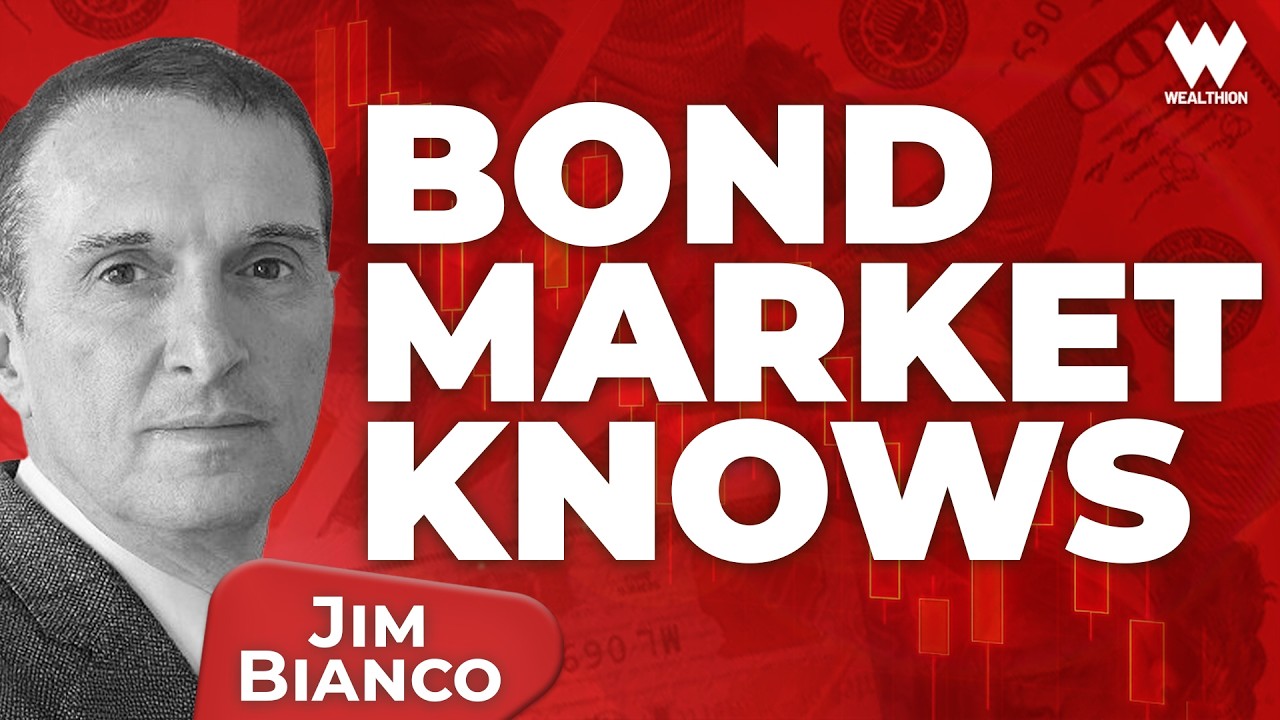
Will the Fed Raise Interest Rates? Jim Bianco
Key Takeaways
The Fed has structurally changed — the chair is now one vote of twelve. Bianco argues the chair used to be "90% of the Fed" and now carries about one-twelfth of the decision. In his words, "It's not the maestro Fed anymore."
Trump's attacks produced a more independent Fed, not a less independent one. Bianco's counterintuitive read: constant political pressure pushed governors to assert their own judgment and vote as they see fit, turning the committee into something closer to a divided Supreme Court than a chair-led bloc.
Bianco's contrarian call is to hike, not cut. With inflation running above the 2% target for years, he argues rates are too low relative to inflation and the Fed is overstimulating — so it should be raising rates, not preparing to ease.
Rising bond yields are, in his framing, a vote of no confidence in the Fed's inflation resolve. Bianco's line: "If the Fed isn't panicking, maybe bond investors should." He argues a hike would actually cap yields, not push them higher.
Forward guidance is ending — and Bianco thinks that's healthy. He sees the old "the Fed told us so it's a promise" model as a driver of over-speculation, and says reading the Fed now means counting votes across policymakers, not parsing the chair's every word.
Key Moments
01:17 - Why the Fed has changed forever Bianco's core thesis: the chair is now one of twelve, not the whole show.
03:10 - The end of the "Maestro" Fed Why the Greenspan-era model of unanimous votes and pre-written statements is over.
04:42 - Trump, Kevin Warsh and Fed independence The counterintuitive claim that political pressure made the Fed more independent.
06:13 - Why Wall Street keeps getting the Fed wrong "Wall Street doesn't get it" - and what markets have to relearn.
10:45 - Should the Fed raise rates now? Bianco's contrarian case for hiking rather than holding or cutting.
11:51 - Why bond yields keep rising The Fed-credibility read on elevated 10- and 30-year yields.
14:30 - Why inflation isn't going away Core inflation above target and what it means for policy.
16:00 - What to watch from the Fed meeting The new Fed-watching: count the votes, not the chair's syllables.
Will the Fed Raise Interest Rates? Why Jim Bianco Says the Fed Has Changed Forever
The Federal Reserve sets short-term interest rates to balance inflation and employment - but according to strategist Jim Bianco, the more important story is that the Fed no longer works the way markets assume. Speaking with Wealthion in late July 2026, Bianco argued that the Fed should be raising rates rather than cutting, that rising bond yields reflect doubt about the Fed's inflation resolve, and that under Chair Kevin Warsh the central bank has become a genuinely divided committee - a change he says Wall Street has yet to price in.
Will the Fed raise interest rates?
Bianco's own view is that it should - even if it won't at any single meeting. Ahead of the late-July 2026 FOMC meeting he expected the Fed to hold, but he stressed the vote itself would be unusually divided, with several dissents possible and prediction markets pricing roughly a 40% chance of a hike. His personal call went further: he argued the Fed should raise rates then, and again in September. That puts him firmly on the hawkish side of what, as of mid-2026, is a live hike-versus-hold debate rather than a debate about cuts.
Why does Jim Bianco think the Fed should hike?
Because, in his analysis, rates are simply too low relative to inflation. Bianco pointed to core PCE - the Fed's preferred gauge - running around 3.3%, with headline CPI near 3.5% and inflation above the 2% target for what he counted as 64 straight months. A policy rate near 3.5%, he argued, is below the neutral level for an economy with sticky inflation, which means the Fed is overstimulating and risks getting "even more inflation." He paired that with a labor market he sees as resilient, citing jobless claims at what he called a 57-year low - evidence, in his view, that the economy can handle higher rates. It's a read that lines up with other guests who argue the U.S. economy keeps defying expectations.
Why do bond yields keep rising?
Bianco's answer is blunt: because the Fed isn't taking its inflation-fighting credibility seriously enough. He noted the 10-year Treasury yield around 4.62% and the 30-year above 5.10%, and drew a contrast with 2022, when inflation hit 9% yet the 10-year peaked near 4.23% - precisely, he argued, because the Fed was hiking 75 basis points a meeting and visibly fighting. His framing is that a credible, aggressive Fed reassures bond investors, while a passive one unsettles them: "If the Fed isn't panicking, maybe bond investors should." The counterintuitive conclusion is that a rate hike would help cap yields, not push them higher - "you want to put the peak in yields, have the Fed panic a little bit and raise rates." For a different lens on what's moving the long end, see Michael Green on how the bond market is hiding a banking crisis.
How has the Fed changed under Kevin Warsh?
It has stopped being a one-man show. Bianco's central claim is structural: "the chairman is one 12th of the Fed. He used to be 90% of the Fed." The Greenspan-era "maestro" model - where the chair wrote the statement the night before and the committee voted unanimously - is, in his words, gone: "It's not the maestro Fed anymore." He argues Trump's sustained attacks pushed governors to assert their independence and vote their own read of the economy, making Warsh's job one of persuasion rather than command; the chair, Bianco notes, could now be outvoted. He cited Wall Street Journal reporting of a sharp exchange between Governor Chris Waller and Warsh at a June FOMC dinner as the "opening salvo" of a more contentious, Supreme-Court-style Fed. For the backdrop on the man at the center of it, see Wealthion's coverage of a Fed now led by Kevin Warsh.
Why does Bianco say Wall Street keeps getting the Fed wrong?
Because, he argues, markets are still using the old playbook. "Wall Street doesn't get it," Bianco said - investors keep expecting the chair to decide, telegraph the move, and see the committee fall in line. That model, he contends, no longer holds, which is why a Fed that offers less certainty will feel more volatile at first. His expectation is that once markets learn the new rules of the road, the volatility calms and the Fed actually gains credibility.
Is forward guidance really going away - and is that good?
Bianco says yes on both counts, and he's in favor of it. He argues forward guidance was consistently misread as a promise, giving traders "a license to overspeculate" - he pointed to Silicon Valley Bank's failure to hedge interest-rate risk as an example of the damage that assumption can do. Removing that crutch, in his view, is healthy discipline even if it raises near-term uncertainty. Not everyone reads current conditions the same way; bond strategist George Goncalves has argued that stealth tightening is already hitting markets, a useful counterweight to Bianco's "the Fed is still too loose" stance.
Is the economy heading into recession?
Not on Bianco's read. He described a $30 trillion economy that "will have problems every single day" and acknowledged it is K-shaped, but argued the aggregate picture is solid - sticky inflation alongside a labor market near multi-decade strength. That combination is exactly why he thinks the current policy rate is too low, and why the recession that markets keep bracing for isn't showing up in the data he watches.
How should investors read the Fed now as per Bianco?
Bianco's framework: stop parsing the chair and start counting votes. With policymakers asserting independence, he argues the signal now comes from the dispersion of views - track where individual presidents and governors land in their speeches and ask, in his phrase, "Which column has seven?", since seven is a majority. He also flagged Warsh's repeated use of the phrase "family fight" as a tell for how divided the board really is. As always on Wealthion, this is one strategist's method for reading policy, not a recommendation to trade any particular outcome.
FAQ
Will the Fed raise interest rates? Jim Bianco argues it should. As of late July 2026 he expected the Fed to hold at its meeting but with an unusually divided vote, and he made the case for hikes then and in September - a hawkish position within a live hike-versus-hold debate.
Why does Jim Bianco think the Fed should hike? Because he sees rates as too low relative to inflation. He cited core PCE around 3.3%, headline CPI near 3.5%, and inflation above the 2% target for 64 months, arguing the Fed is overstimulating an economy that a near-57-year low in jobless claims suggests can handle higher rates.
Why are bond yields rising? In Bianco's framing, because the Fed isn't showing enough inflation-fighting urgency. He contrasts today's elevated 10- and 30-year yields with 2022, when aggressive hikes kept the 10-year capped even as inflation hit 9%, and argues a credible hike would help cap yields rather than lift them.
Has the Fed become less independent under Trump? Bianco argues the opposite. He says political pressure pushed governors to vote their own judgment, making the chair one vote of twelve and the committee more independent and more divided than it has been in decades.
Is Fed forward guidance ending? Bianco expects it to, and he supports the change. He argues guidance was misread as a promise and fueled over-speculation, and that reading the Fed now means counting votes across policymakers rather than relying on the chair to telegraph moves.
Which expert and interview does this article reference? This article draws on Wealthion's interview with strategist Jim Bianco, president of Bianco Research: "Jim Bianco: The Fed Has Changed Forever."
What Serious Investors Are Watching
Dive into expert interviews, market analysis, and long-form content built to help serious investors think long-term.
Is the AI Bubble Bursting? Why Barry Knapp Cut Tech
Key Takeaways The economy is K-shaped by the design of Fed policy. Knapp traces the...
Will the Fed Raise Interest Rates? Jim Bianco
Key Takeaways The Fed has structurally changed — the chair is now one vote of...
Is the 60/40 Portfolio Dead? What Six Experts Said on Wealthion in 2026
The 60/40 portfolio, 60 percent stocks and 40 percent bonds, was the default answer to...
Enjoyed This? Get More Insights
Expert insights and curated opportunities, delivered to your inbox.
Ready to Position for What's Coming?
Whether you're still learning or ready to act, your next step starts here.
- Independent
- Macro-Informed
- Real Asset Focused


The Wealthion Network
Stay ahead of the curve. Subscribe to Wealthion’s newsletter and get timely videos, articles, and alerts featuring insights from the world’s leading experts in investing and wealth-building.
Network Discussion
Sign in to share your thoughts and connect with other readers.
Join the Wealthion Network to Comment