

Will the Fed Raise Rates in December? What Steve Hanke, Kevin Muir and Keith McCullough Say
The Federal Reserve raised interest rates in September and held them steady in October.1,2 The October minutes show almost every participant thought more increases would likely be appropriate if their own forecasts hold.3 The next decision comes on December 8–9.4
A pause is not a pivot. The Fed has not signaled that its inflation fight is over, so the question is how much more restraint is needed. Officials can act in December, or wait for clearer proof that September's increase is working.
Three recent Wealthion interviews with Maggie Lake show how guests see the choice. Economist Steve Hanke expects more rate increases. Kevin Muir expects the Fed to tighten into an oil shock and weaken the economy. Keith McCullough expects tightening to arrive just as growth slows.8,9,10 Their worries are about what a hike would do, not about whether one is coming.
Key takeaways
- Official signals point toward more tightening if the outlook holds, although December's vote is not settled.
- Warsh has kept the 2% inflation goal firm while leaving room to assess new evidence.
- Waller has favored a quarter-point December hike and raised the chance of a half-point move. That is his position, not a committee commitment.
- The guests see more tightening as a risk, but they differ on its timing, size and eventual effect on growth and bonds.
Will the Fed raise interest rates in December?
Another hike has support, although December's vote is not settled. The Federal Open Market Committee, chaired by Kevin Warsh, held its target range at 3.75%–4.00% in October. The range applies to the federal funds rate, the rate banks pay to borrow from one another overnight. Lisa Cook and Beth Hammack voted no. They wanted another quarter-point increase.2
The minutes show wider support for more increases than the two dissents suggest. Almost all participants thought more hikes would likely be appropriate under their own outlooks. Some participants do not vote at every meeting, so this signals the policy direction rather than a count of December votes.3
What is Warsh signaling about the next move?
At his October 28 press conference, Warsh described the pause as a chance to assess earlier action and gather more information. Financial conditions had tightened since September, he said, but he was not ready to call them tight.11
Earlier action may be starting to work, while more tightening may still be needed. Warsh said there were "no firm conclusions" about the right policy setting. He also rejected the idea that the Fed was accepting a softer inflation target. The goal remained 2%.11
He also said he would not prejudge the next meeting or give guidance on future policy in normal times.11 He kept the goal firm and the next step open. The pause did not mean rates had peaked.
Why does inflation keep another hike in play?
The Fed uses the personal consumption expenditures price index, or PCE, to measure its 2% annual inflation goal. The index tracks prices across consumer spending. The core measure leaves out food and energy to show broader price pressure.5 In September, PCE inflation was 3.6% over a year, and core inflation was 3.1%. The 2% goal applies to the overall measure.6
The chart shows the unfinished work. Inflation fell sharply from its 2022 peak, but the overall rate rose again in 2026. Core inflation also stayed above 2%.
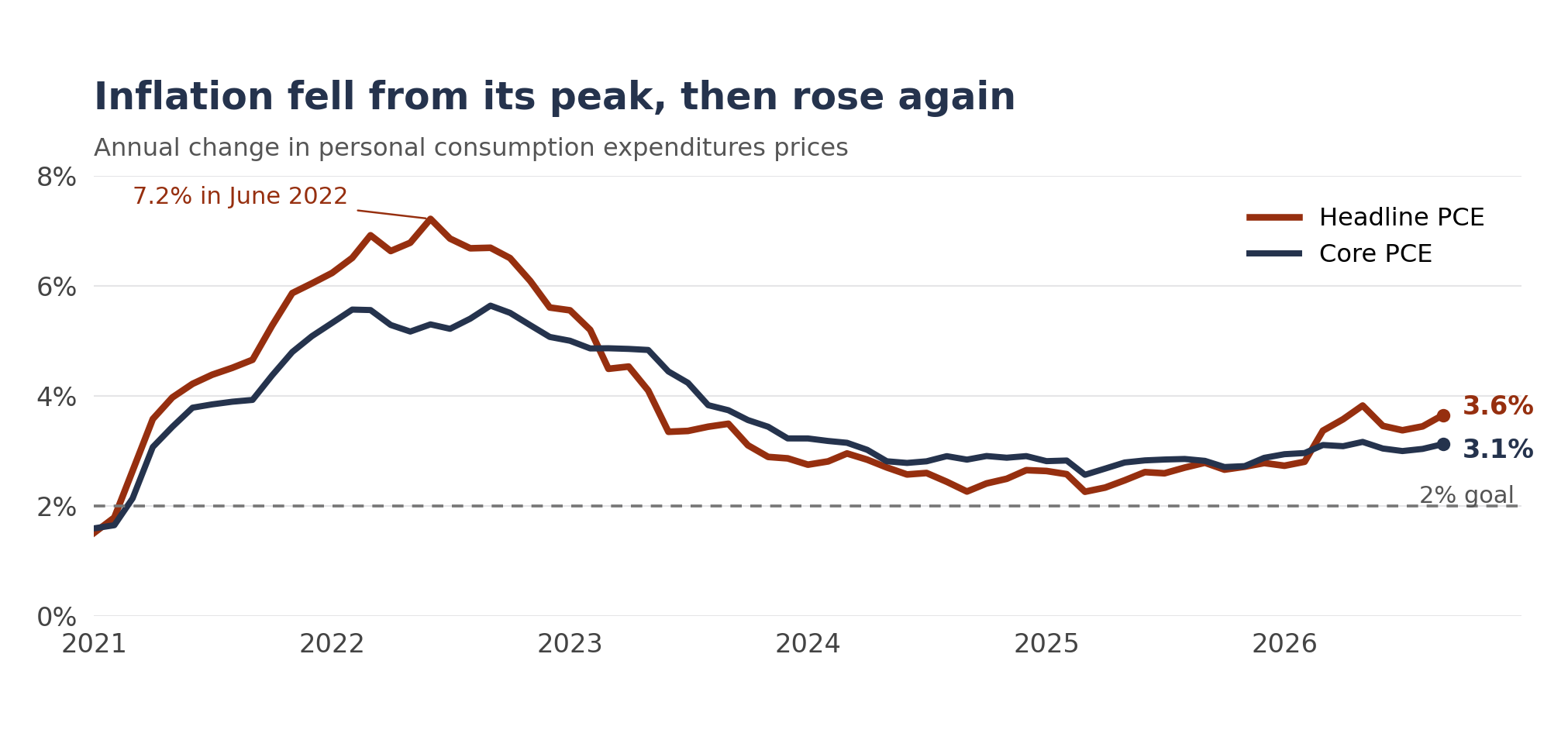
Monthly observations, January 2021–September 2026. Annual changes calculated from Bureau of Economic Analysis price indexes. Core excludes food and energy. The 2% goal applies to headline PCE. Source: Bureau of Economic Analysis via the Federal Reserve Bank of St. Louis; Wealthion calculations.12
More recent figures have not settled that concern. The Consumer Price Index rose 0.4% in October, seasonally adjusted, and 0.3% excluding food and energy.13 There is no annual October comparison because October 2025 data are missing.14
Cook said on November 20 that she doubted September's single quarter-point increase would be enough. She warned that waiting could let businesses and workers build higher inflation into prices and pay. That would require larger increases later.15
Hanke reaches a similar conclusion about policy pressure. The economist told Lake on November 11 that "the inflation genie is out of the bottle." He expects higher short-term rates and sees little room for easier policy.8 That is his outlook for policy direction, not a specific December vote forecast.
Could the Fed raise rates by half a point?
Governor Christopher Waller has been direct about the size of the move. Before the November 10 consumer price report, he backed a quarter-point December hike under his outlook. A monthly core reading around 0.3% or higher, he said, would justify considering a half-point move.16
The report met that condition. It did not settle the committee's choice. A quarter-point increase would take the target range to 4.00%–4.25%. A half-point move would take it to 4.25%–4.50%.
Muir acknowledged the larger move on November 18 but thought it unlikely: "They're probably not going to do it," he said of the half-point possibility.9
What could persuade the Fed to wait?
The October employment report showed steady hiring alongside signs of strain. Payrolls rose by 165,000, which lifted the revised August–October average to 137,000 a month. Unemployment was 4.1%. But 339,000 more people worked part time for economic reasons, even though they wanted full-time work.7
The Middle East oil shock adds another complication. Vice Chair Philip Jefferson said on November 19 that higher energy prices can raise inflation while weakening demand. More money spent on fuel leaves less for other purchases.17 Higher rates can restrain spending further while earlier increases are still taking effect.18
Muir expects inflation to weaken as the economy slows, even though he expects higher inflation over the long run. He worries that the Fed will tighten into the oil shock and cause a recession. He calls the danger a "classic Fed error."9
McCullough, founder and chief executive of Hedgeye Risk Management, also sees a timing problem. On November 6, he expected inflation to keep accelerating in the near term before growth and inflation slow in 2027. That could leave the Fed raising rates just as the next slowdown approaches. His market warning does not require a recession.10
Their forecasts help explain the case for caution, but they do not show that today's inflation problem has passed. Recent Fed research found that oil prices have had a stronger effect on core inflation since the pandemic across five major economies. The later sample is short and the findings depend on the model, so they are not an official forecast.19
What could change before the December decision?
The release calendar sets the next tests. Officials will see some November jobs data before they decide, but not November's Consumer Price Index.
| Scheduled date | Release or event | Why it matters |
|---|---|---|
| November 25 | October PCE inflation | Updates the Fed's targeted price measure.6 |
| December 1 | October job openings and labor turnover | Adds evidence on vacancies, hiring and worker departures.20 |
| December 4 | November employment report | Shows payroll growth and unemployment.20 |
| December 9 | Fed decision and projections | Reveals the policy choice and officials' updated outlooks.4 |
| December 10 | November Consumer Price Index | Arrives after the decision.20 |
Sticky inflation and steady hiring would strengthen the case for another increase. Clear cooling in both prices and employment would give officials more reason to wait. Higher inflation alongside weaker hiring would make the choice harder, because the two sides of the Fed's mandate would pull against each other. None of these creates an automatic trigger.
December's interest-rate dots will also show where each official thinks policy should go, given their own outlook. They are not promises about future votes.21
What would another hike mean for investors?
Markets can adjust before a vote. October's minutes already noted higher mortgage rates since September. They also noted a wider gap between what some riskier companies pay to borrow and what safer borrowers pay.3 Longer-term bond yields also reflect expected inflation, future policy and the extra pay investors want for lending over time.18 For more, see The Fed Just Raised Rates. What Changes for Investors and Will the Fed Raise Interest Rates? Jim Bianco.
When comparable yields rise, an existing fixed-rate bond's price generally falls. When yields fall, its price generally rises. Bonds that mature later usually move more, all else being equal.22
Muir described buying two-year bonds and positions that benefit from lower future rates. McCullough has also moved toward Treasury bonds because he expects a slowdown.9,10 Hanke instead expects lasting pressure on longer-term yields. The maturities and forecasts differ, so a hike is not uniformly good or bad for bonds.8
Higher short-term rates can feed into Treasury bills and savings products, although account rates vary and may adjust slowly. More interest does not guarantee more purchasing power after inflation and taxes.18,23
A fixed-rate mortgage does not reset because the Fed raises rates. An adjustable-rate mortgage can change when its contract allows.24 On a hypothetical $100,000 loan, a quarter-point rate increase adds $250 in annual simple interest, with the balance unchanged for a year and no fees.25
For stocks, higher borrowing costs can weigh on profits. Falling rates caused by a severe slowdown could also come with weaker earnings.18 That is why the reason for the Fed's next move matters along with the move itself.
The signals favor more tightening if the outlook holds, with December the next test. Incoming reports could change that judgment. The guests add a second question: if another hike comes, will it bring inflation down without pushing growth too far? Both the vote and what follows matter for investors.
Sources & Disclosure
1 Federal Reserve Board, Federal Open Market Committee statement, September 16, 2026. 2 Federal Reserve Board, Federal Open Market Committee statement, October 28, 2026. 3 Federal Reserve Board, Minutes of the Federal Open Market Committee, October 27–28, 2026, released November 18; Participants’ Views and Committee Policy Actions. 4 Federal Reserve Board, FOMC meeting calendars and December 2026 events calendar. 5 Federal Reserve Board, inflation FAQs, Why Does the Federal Reserve Aim for Inflation of 2 Percent over the Longer Run? and What Is Inflation?, accessed November 24, 2026. 6 Bureau of Economic Analysis, Personal Income and Outlays, September 2026, October 29, 2026. 7 Bureau of Labor Statistics, The Employment Situation, October 2026, November 6, 2026; revisions and Tables A-8 and B-1. Three-month average: Wealthion calculation. 8 Wealthion, Steve Hanke interview with Maggie Lake, November 11, 2026. 9 Wealthion, Kevin Muir interview with Maggie Lake, November 18, 2026 (no companion article page yet). 10 Wealthion, Keith McCullough interview with Maggie Lake, November 6, 2026. 11 Federal Reserve Board, Transcript of Chairman Warsh’s Press Conference, October 28, 2026, pages 1–7 and 14. 12 Bureau of Economic Analysis, PCEPI and PCEPILFE price indexes, via Federal Reserve Bank of St. Louis, October 29, 2026 vintage; annual changes calculated by Wealthion. 13 Bureau of Labor Statistics, Consumer Price Index, October 2026, November 10, 2026; Table A. 14 Bureau of Labor Statistics, October 2026 12-Month Percent Changes, November 10, 2026. 15 Lisa D. Cook, The US Economy in Global Context, November 20, 2026. 16 Christopher J. Waller, The Economic Outlook and Some Thoughts on Labor Market Dynamism, November 10, 2026. 17 Philip N. Jefferson, Monetary Policy amid Frequent and Complex Shocks, November 19, 2026. 18 Federal Reserve Board, Monetary Policy: What Are Its Goals? How Does It Work?, accessed November 24, 2026. 19 Andrea De Michelis and coauthors, The Effect of Oil Prices on Core Inflation: Recent Evidence from the Advanced Economies, FEDS Notes, November 9, 2026. 20 Bureau of Labor Statistics, Schedule of Selected Releases for December 2026. 21 Federal Reserve Board, Summary of Economic Projections, September 16, 2026; Figure 2 notes. 22 Securities and Exchange Commission, Investor Bulletin: Interest Rate Risk, June 2013, pages 1–4. 23 Federal Reserve Bank of New York, Deposit Betas: Up, Up, and Away?, April 11, 2023; Securities and Exchange Commission, Investor.gov, Real Return, accessed November 24, 2026. 24 Consumer Financial Protection Bureau, fixed-rate versus adjustable-rate mortgage and index-and-margin explainers, accessed November 24, 2026. 25 Wealthion hypothetical simple-interest calculation; $100,000 × 0.0025 = $250 annually.
Wealthion is a dba of Greylock Peak Investments, a registered investment adviser. This article is general information only. It is not investment advice or an offer or solicitation, and it is not tailored to your circumstances. Guests’ views are their own and may not reflect those of Wealthion. Wealthion has not verified guest statements, including any performance figures. Investing involves risk, including loss of principal, and past performance does not guarantee future results. Wealthion refers readers to other registered investment advisers and shares in the fees they receive from referred clients, which creates a conflict of interest. Please see our Form ADV Part 2A and consult your own financial advisor before investing.
What Serious Investors Are Watching
Dive into expert interviews, market analysis, and long-form content built to help serious investors think long-term.
Will the Fed Raise Rates in December? What Steve Hanke, Kevin Muir and Keith McCullough Say
The Fed’s latest signals point toward further tightening. December’s decision turns on whether to act now, how large a hike might be and what the next reports show.
Gold as Portfolio Insurance: Trey Reik on Time vs. Price
Trey Reik separates gold's long-term portfolio role from the difficulty of timing its bottom. His conversation with Maggie Lake also examines Fed expectations, silver demand, mining shares and digital vulnerabilities.
Is the Bull Market Over? Kevin Muir on the AI Bubble
Kevin Muir believes the long bull market may have ended, while allowing for a near-term rally. He explains the risks in AI earnings and hedge fund positioning, alongside his views on cash, bonds, gold and oil.
Enjoyed This? Get More Insights
Expert insights and curated opportunities, delivered to your inbox.
Ready to Position for What's Coming?
Whether you're still learning or ready to act, your next step starts here.
- Independent
- Macro-Informed
- Real Asset Focused


The Wealthion Network
By subscribing, you agree to receive Wealthion emails. Unsubscribe anytime.
The Wealthion Network
By subscribing, you agree to receive Wealthion emails. Unsubscribe anytime.
Network Discussion
Join the Wealthion Network to Comment